Format Coursework turnaround data and Students expectation of
- Slides: 1
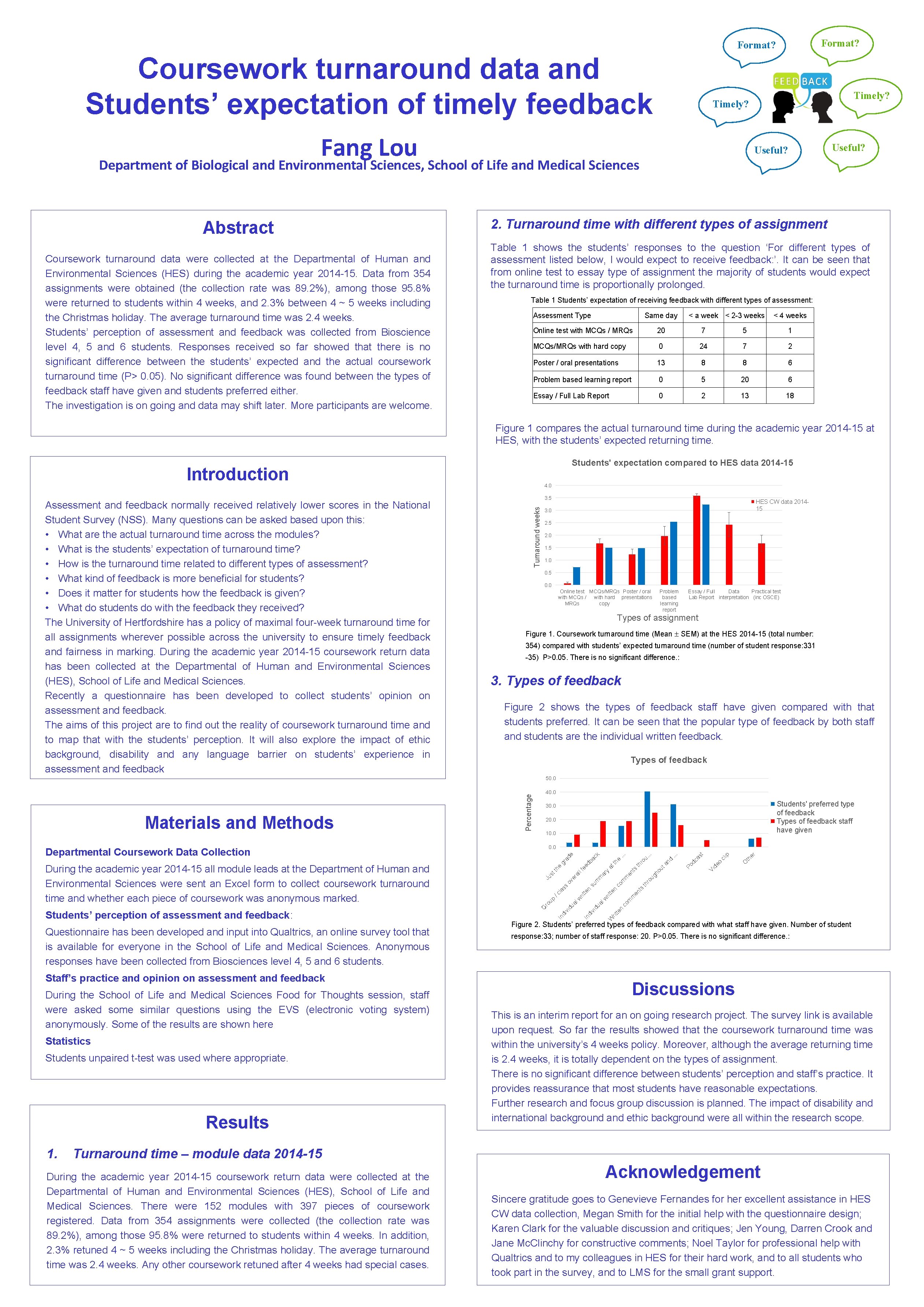
Format? Coursework turnaround data and Students’ expectation of timely feedback Timely? Fang Lou Useful? Department of Biological and Environmental Sciences, School of Life and Medical Sciences Abstract Coursework turnaround data were collected at the Departmental of Human and Environmental Sciences (HES) during the academic year 2014 -15. Data from 354 assignments were obtained (the collection rate was 89. 2%), among those 95. 8% were returned to students within 4 weeks, and 2. 3% between 4 ~ 5 weeks including the Christmas holiday. The average turnaround time was 2. 4 weeks. Students’ perception of assessment and feedback was collected from Bioscience level 4, 5 and 6 students. Responses received so far showed that there is no significant difference between the students’ expected and the actual coursework turnaround time (P> 0. 05). No significant difference was found between the types of feedback staff have given and students preferred either. The investigation is on going and data may shift later. More participants are welcome. 2. Turnaround time with different types of assignment Table 1 shows the students’ responses to the question ‘For different types of assessment listed below, I would expect to receive feedback: ’. It can be seen that from online test to essay type of assignment the majority of students would expect the turnaround time is proportionally prolonged. Table 1 Students’ expectation of receiving feedback with different types of assessment: Assessment Type Same day < a week < 2 -3 weeks < 4 weeks Online test with MCQs / MRQs 20 7 5 1 MCQs/MRQs with hard copy 0 24 7 2 Poster / oral presentations 13 8 8 6 Problem based learning report 0 5 20 6 Essay / Full Lab Report 0 2 13 18 Figure 1 compares the actual turnaround time during the academic year 2014 -15 at HES, with the students’ expected returning time. Students' expectation compared to HES data 2014 -15 Introduction 3. 5 Turnaround weeks Assessment and feedback normally received relatively lower scores in the National Student Survey (NSS). Many questions can be asked based upon this: • What are the actual turnaround time across the modules? • What is the students’ expectation of turnaround time? • How is the turnaround time related to different types of assessment? • What kind of feedback is more beneficial for students? • Does it matter for students how the feedback is given? • What do students do with the feedback they received? The University of Hertfordshire has a policy of maximal four-week turnaround time for all assignments wherever possible across the university to ensure timely feedback and fairness in marking. During the academic year 2014 -15 coursework return data has been collected at the Departmental of Human and Environmental Sciences (HES), School of Life and Medical Sciences. Recently a questionnaire has been developed to collect students’ opinion on assessment and feedback. The aims of this project are to find out the reality of coursework turnaround time and to map that with the students’ perception. It will also explore the impact of ethic background, disability and any language barrier on students’ experience in assessment and feedback 4. 0 HES CW data 201415 3. 0 2. 5 2. 0 1. 5 1. 0 0. 5 0. 0 Online test MCQs/MRQs Poster / oral with MCQs / with hard presentations MRQs copy Problem based learning report Essay / Full Data Practical test Lab Report interpretation (inc OSCE) Types of assignment Figure 1. Coursework turnaround time (Mean SEM) at the HES 2014 -15 (total number: 354) compared with students’ expected turnaround time (number of student response: 331 -35) P>0. 05. There is no significant difference. : 3. Types of feedback Figure 2 shows the types of feedback staff have given compared with that students preferred. It can be seen that the popular type of feedback by both staff and students are the individual written feedback. Types of feedback 50. 0 Percentage 20. 0 10. 0 Questionnaire has been developed and input into Qualtrics, an online survey tool that is available for everyone in the School of Life and Medical Sciences. Anonymous responses have been collected from Biosciences level 4, 5 and 6 students. Staff’s practice and opinion on assessment and feedback During the School of Life and Medical Sciences Food for Thoughts session, staff were asked some similar questions using the EVS (electronic voting system) anonymously. Some of the results are shown here Statistics Students unpaired t-test was used where appropriate. Results 1. er O cl o Vi de th ip t ug Po dc as . . . d an ut ho ts en m ro m ts th co en te n m m rit w co al en du W rit t vi di In ro u th th at y m ar m su te n rit w al du di e ac db lf ee al er ov ss la /c In . . . k e ad gr th e st Ju up ro G Students’ perception of assessment and feedback: . . . 0. 0 Departmental Coursework Data Collection During the academic year 2014 -15 all module leads at the Department of Human and Environmental Sciences were sent an Excel form to collect coursework turnaround time and whether each piece of coursework was anonymous marked. Students' preferred type of feedback Types of feedback staff have given 30. 0 vi Materials and Methods 40. 0 Figure 2. Students’ preferred types of feedback compared with what staff have given. Number of student response: 33; number of staff response: 20. P>0. 05. There is no significant difference. : Discussions This is an interim report for an on going research project. The survey link is available upon request. So far the results showed that the coursework turnaround time was within the university’s 4 weeks policy. Moreover, although the average returning time is 2. 4 weeks, it is totally dependent on the types of assignment. There is no significant difference between students’ perception and staff’s practice. It provides reassurance that most students have reasonable expectations. Further research and focus group discussion is planned. The impact of disability and international background and ethic background were all within the research scope. Turnaround time – module data 2014 -15 During the academic year 2014 -15 coursework return data were collected at the Departmental of Human and Environmental Sciences (HES), School of Life and Medical Sciences. There were 152 modules with 397 pieces of coursework registered. Data from 354 assignments were collected (the collection rate was 89. 2%), among those 95. 8% were returned to students within 4 weeks. In addition, 2. 3% retuned 4 ~ 5 weeks including the Christmas holiday. The average turnaround time was 2. 4 weeks. Any other coursework retuned after 4 weeks had special cases. Acknowledgement Sincere gratitude goes to Genevieve Fernandes for her excellent assistance in HES CW data collection, Megan Smith for the initial help with the questionnaire design; Karen Clark for the valuable discussion and critiques; Jen Young, Darren Crook and Jane Mc. Clinchy for constructive comments; Noel Taylor for professional help with Qualtrics and to my colleagues in HES for their hard work, and to all students who took part in the survey, and to LMS for the small grant support.