
Formalization Policies Strategies and Plans Impact of the
- Slides: 3
Formalization Policies, Strategies and Plans: Impact of the COVID-19 Pandemic HIGH LEVEL MEETING ON EMPLOYMENT Thursday, 20 May 2021
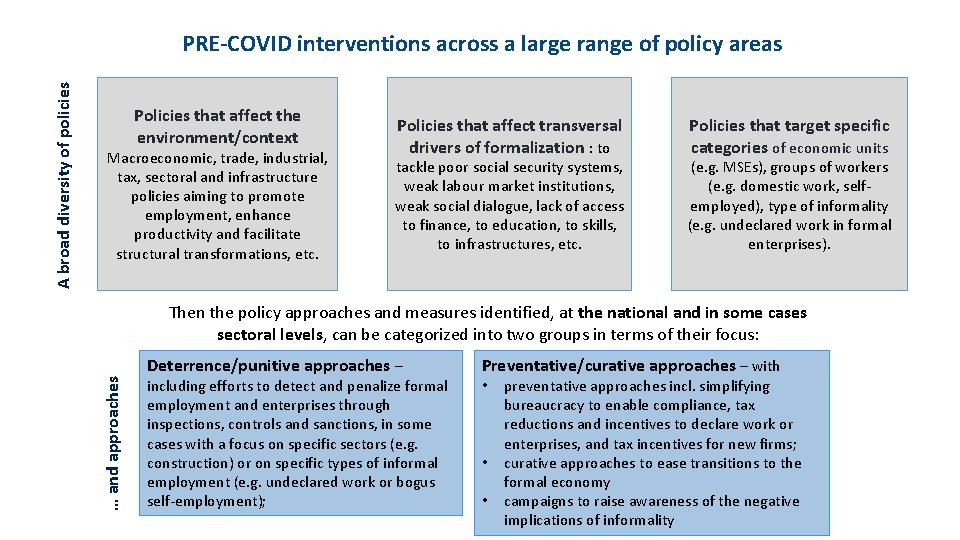
Policies that affect the environment/context Macroeconomic, trade, industrial, tax, sectoral and infrastructure policies aiming to promote employment, enhance productivity and facilitate structural transformations, etc. Policies that affect transversal drivers of formalization : to tackle poor social security systems, weak labour market institutions, weak social dialogue, lack of access to finance, to education, to skills, to infrastructures, etc. Policies that target specific categories of economic units (e. g. MSEs), groups of workers (e. g. domestic work, selfemployed), type of informality (e. g. undeclared work in formal enterprises). Then the policy approaches and measures identified, at the national and in some cases sectoral levels, can be categorized into two groups in terms of their focus: … and approaches A broad diversity of policies PRE-COVID interventions across a large range of policy areas Deterrence/punitive approaches – including efforts to detect and penalize formal employment and enterprises through inspections, controls and sanctions, in some cases with a focus on specific sectors (e. g. construction) or on specific types of informal employment (e. g. undeclared work or bogus self-employment); Preventative/curative approaches – with • • • preventative approaches incl. simplifying bureaucracy to enable compliance, tax reductions and incentives to declare work or enterprises, and tax incentives for new firms; curative approaches to ease transitions to the formal economy campaigns to raise awareness of the negative implications of informality
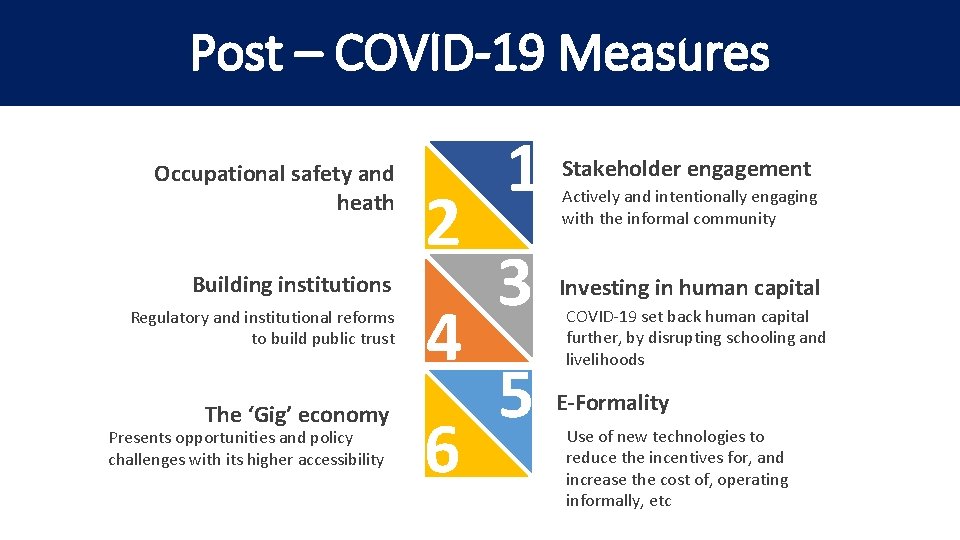
Post – COVID-19 Measures Occupational safety and heath Building institutions Regulatory and institutional reforms to build public trust The ‘Gig’ economy Presents opportunities and policy challenges with its higher accessibility 2 4 6 1 Stakeholder engagement Actively and intentionally engaging with the informal community 3 Investing in human capital 5 E-Formality COVID-19 set back human capital further, by disrupting schooling and livelihoods Use of new technologies to reduce the incentives for, and increase the cost of, operating informally, etc