
Formal Writing Rules How to Avoid the Most
- Slides: 11
Formal Writing Rules
How to Avoid the Most Common Writing Mistakes … • Avoid one sentence paragraphs. Also avoid page long paragraphs! • Avoid sentence fragments. Make sure sentences have a complete subject and a complete predicate! • Avoid run on sentences. Use a comma before a conjunction separating sentences, OR you may use a semicolon to separate related sentences and NOT use a comma and conjunction.
How to Avoid the Most Common Writing Mistakes … • DO NOT START YOUR PAPER WITH … • “I’m going to tell you about …” • “I’m going to write about …” • “My paper is about …” • THE READER KNOWS YOU ARE WRITING; THAT PERSON IS READING YOUR PAPER. THEY KNOW YOU ARE TELLING THEM ABOUT SOMETHING … NO NEED TO BE REDUNDANT!
No Matter What You’ve Been Told … • Do not start introductions with a question. Use a quote, a general statement or a startling fact. • End the first paragraph of your essay with a THESIS. • A THESIS is ONE statement detailing the points you are going to cover in your essay.
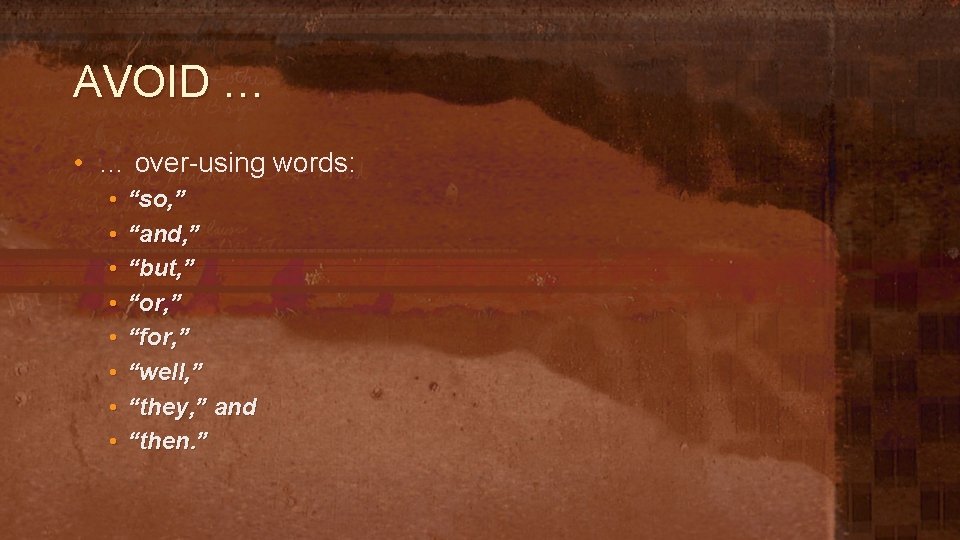
AVOID … • … over-using words: • • “so, ” “and, ” “but, ” “or, ” “for, ” “well, ” “they, ” and “then. ”
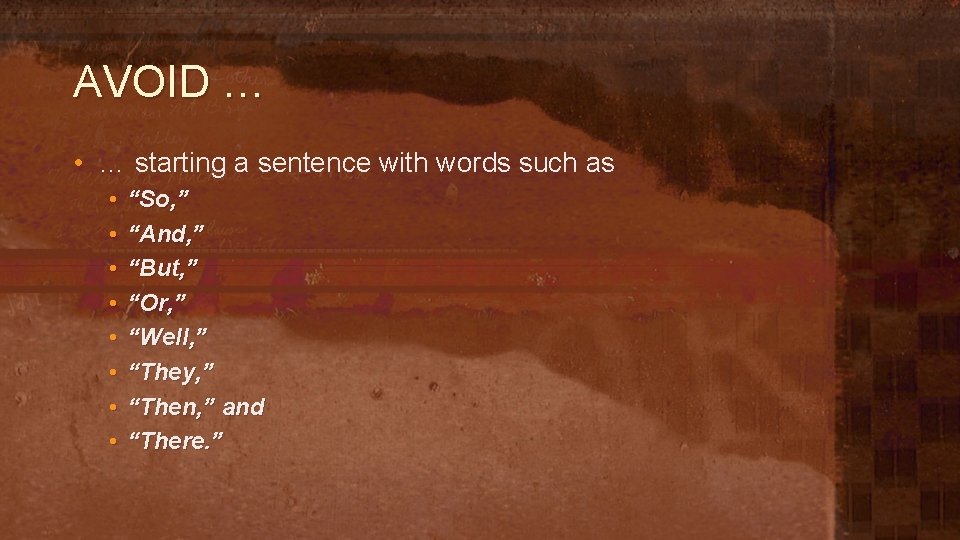
AVOID … • … starting a sentence with words such as • • “So, ” “And, ” “But, ” “Or, ” “Well, ” “They, ” “Then, ” and “There. ”
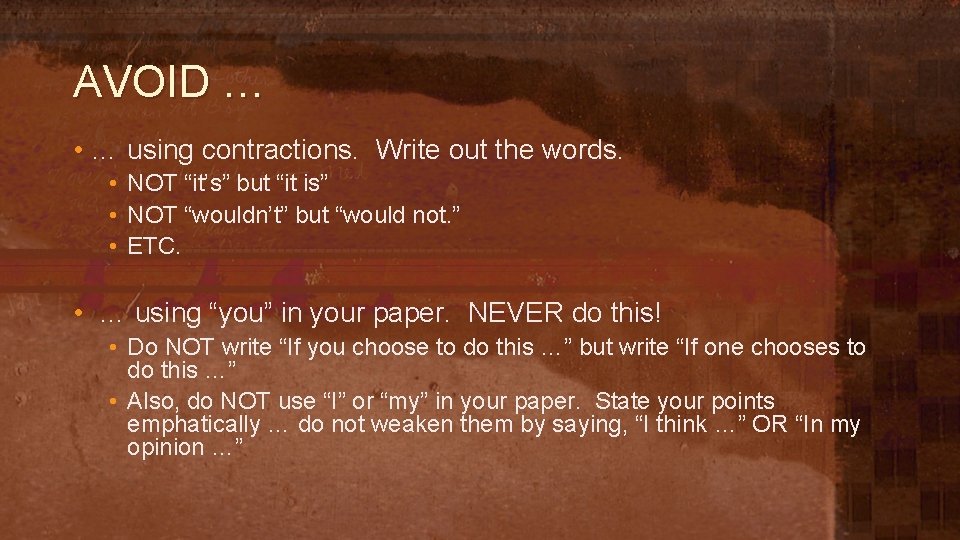
AVOID … • … using contractions. Write out the words. • NOT “it’s” but “it is” • NOT “wouldn’t” but “would not. ” • ETC. • … using “you” in your paper. NEVER do this! • Do NOT write “If you choose to do this …” but write “If one chooses to do this …” • Also, do NOT use “I” or “my” in your paper. State your points emphatically … do not weaken them by saying, “I think …” OR “In my opinion …”
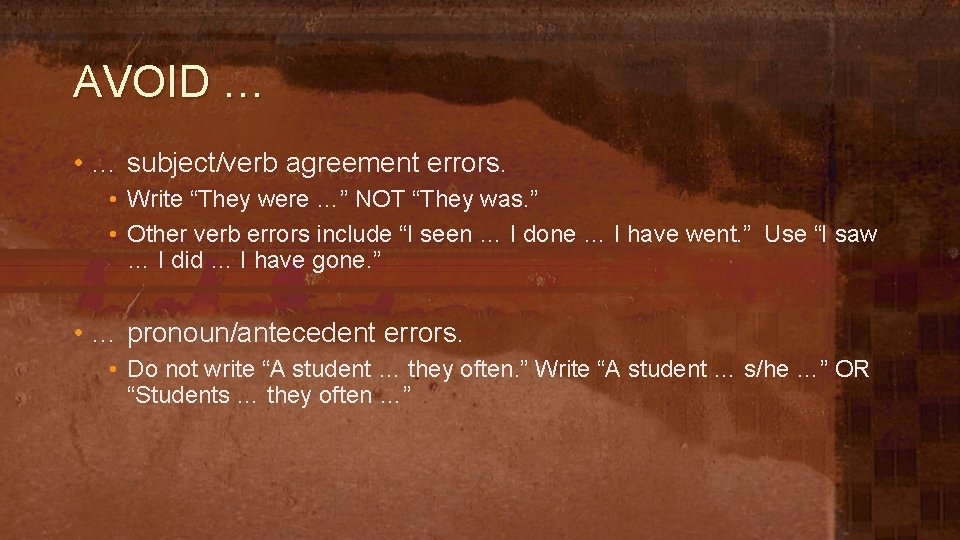
AVOID … • … subject/verb agreement errors. • Write “They were …” NOT “They was. ” • Other verb errors include “I seen … I done … I have went. ” Use “I saw … I did … I have gone. ” • … pronoun/antecedent errors. • Do not write “A student … they often. ” Write “A student … s/he …” OR “Students … they often …”
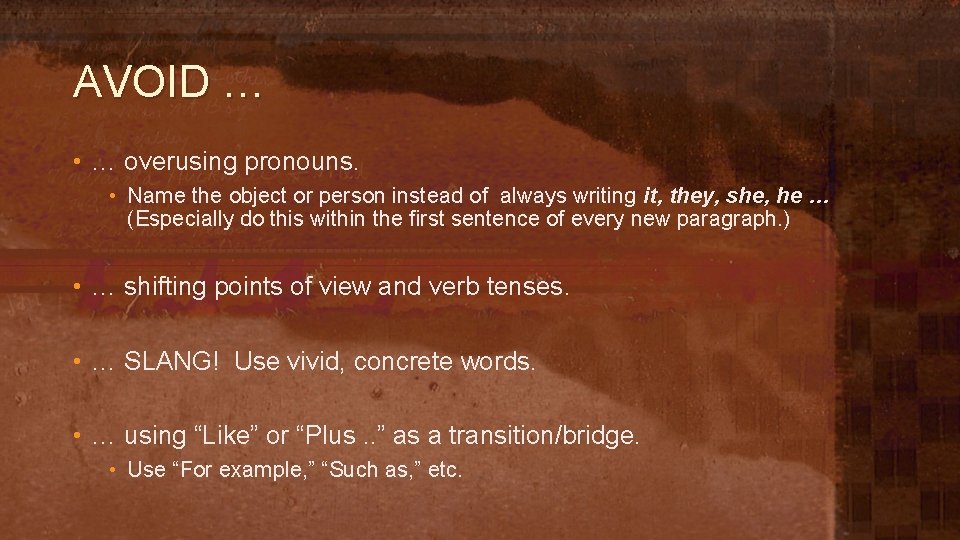
AVOID … • … overusing pronouns. • Name the object or person instead of always writing it, they, she, he … (Especially do this within the first sentence of every new paragraph. ) • … shifting points of view and verb tenses. • … SLANG! Use vivid, concrete words. • … using “Like” or “Plus. . ” as a transition/bridge. • Use “For example, ” “Such as, ” etc.
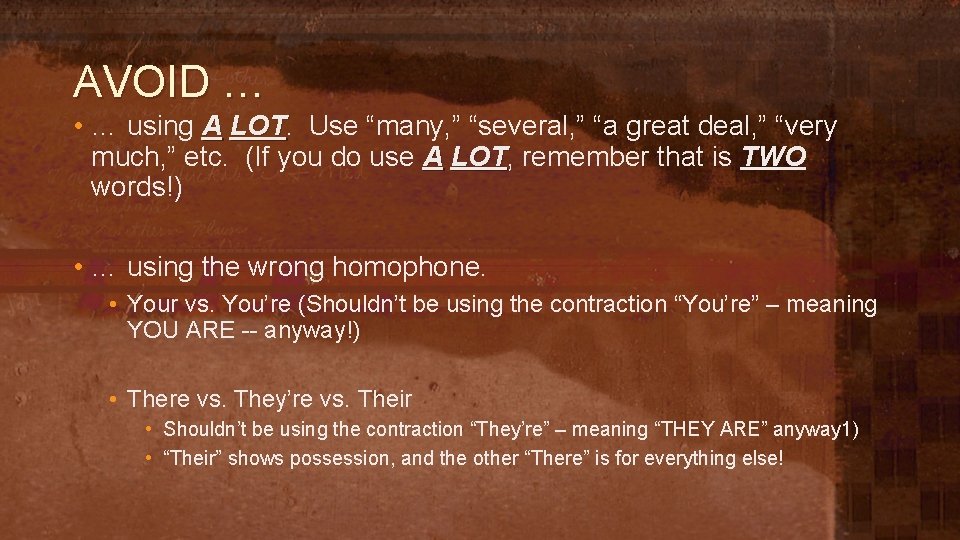
AVOID … • … using A LOT Use “many, ” “several, ” “a great deal, ” “very much, ” etc. (If you do use A LOT, LOT remember that is TWO words!) • … using the wrong homophone. • Your vs. You’re (Shouldn’t be using the contraction “You’re” – meaning YOU ARE -- anyway!) • There vs. They’re vs. Their • Shouldn’t be using the contraction “They’re” – meaning “THEY ARE” anyway 1) • “Their” shows possession, and the other “There” is for everything else!
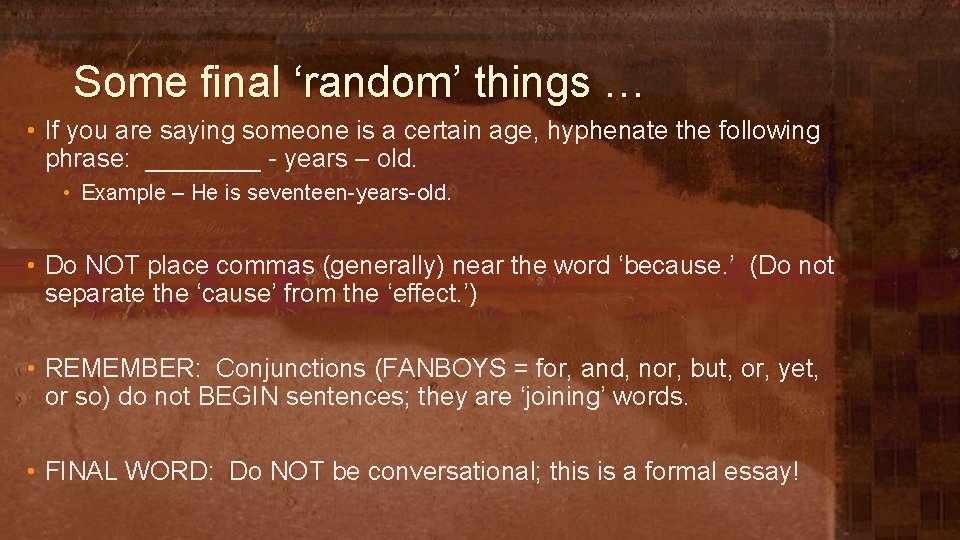
Some final ‘random’ things … • If you are saying someone is a certain age, hyphenate the following phrase: ____ - years – old. • Example – He is seventeen-years-old. • Do NOT place commas (generally) near the word ‘because. ’ (Do not separate the ‘cause’ from the ‘effect. ’) • REMEMBER: Conjunctions (FANBOYS = for, and, nor, but, or, yet, or so) do not BEGIN sentences; they are ‘joining’ words. • FINAL WORD: Do NOT be conversational; this is a formal essay!