
Formal vs Informal Writing Adapted from The Language
- Slides: 9
Formal vs Informal Writing… (Adapted from The Language Network) Free template from www. brainybetty. com
You may not realize it, but you speak and write differently depending on the situation. Knowing when to use formal and informal language can make you a more confident and successful writer. 1/2/2022 Free template from www. brainybetty. com 2
Formal Language • is serious and polite • often uses sophisticated words and longer sentences • is grammatically correct 1/2/2022 Free template from www. brainybetty. com 3
Informal Language • Is more like conversation • Uses simpler words, shorter sentences, and more contractions • May contain slang or idioms 1/2/2022 Free template from www. brainybetty. com 4
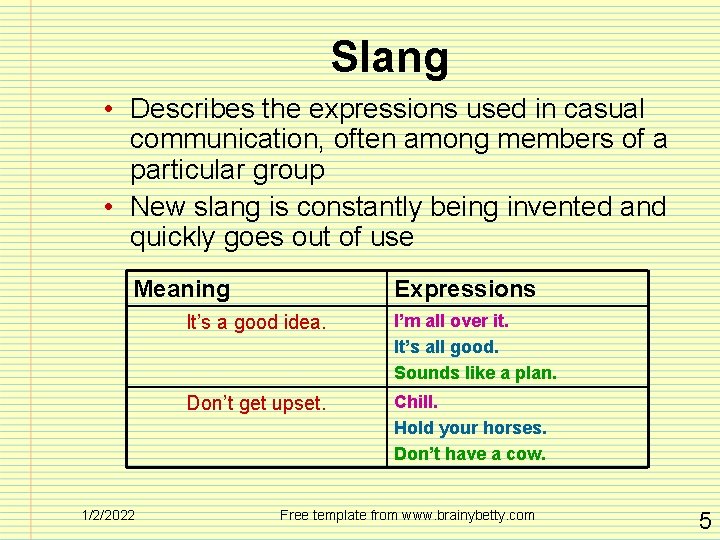
Slang • Describes the expressions used in casual communication, often among members of a particular group • New slang is constantly being invented and quickly goes out of use Meaning 1/2/2022 Expressions It’s a good idea. I’m all over it. It’s all good. Sounds like a plan. Don’t get upset. Chill. Hold your horses. Don’t have a cow. Free template from www. brainybetty. com 5
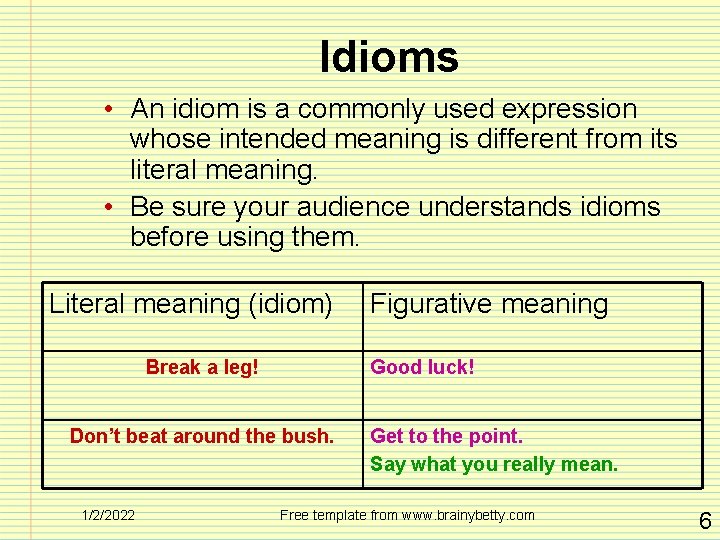
Idioms • An idiom is a commonly used expression whose intended meaning is different from its literal meaning. • Be sure your audience understands idioms before using them. Literal meaning (idiom) Break a leg! Good luck! Don’t beat around the bush. 1/2/2022 Figurative meaning Get to the point. Say what you really mean. Free template from www. brainybetty. com 6
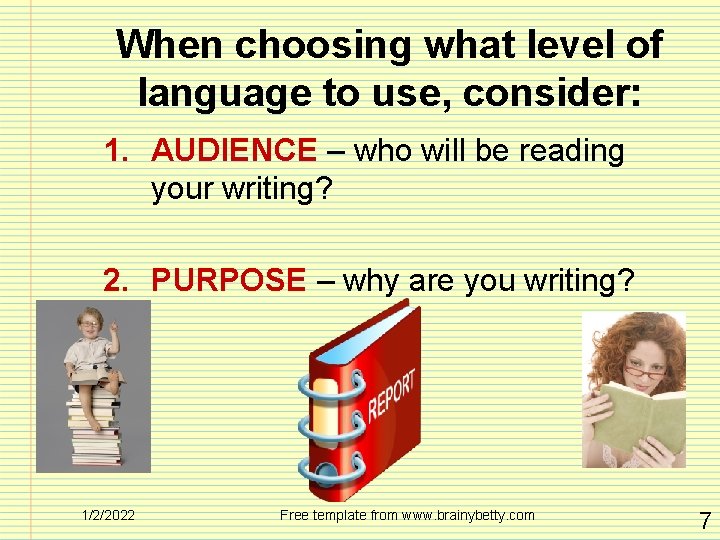
When choosing what level of language to use, consider: 1. AUDIENCE – who will be reading your writing? 2. PURPOSE – why are you writing? 1/2/2022 Free template from www. brainybetty. com 7
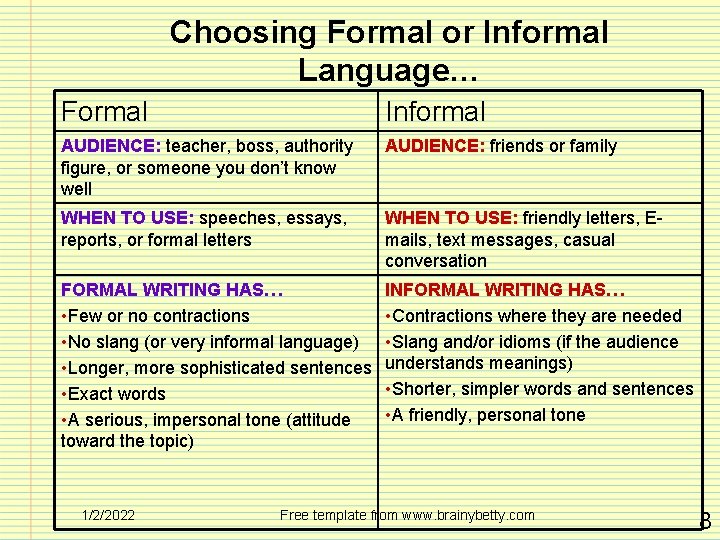
Choosing Formal or Informal Language… Formal Informal AUDIENCE: teacher, boss, authority figure, or someone you don’t know well AUDIENCE: friends or family WHEN TO USE: speeches, essays, reports, or formal letters WHEN TO USE: friendly letters, Emails, text messages, casual conversation FORMAL WRITING HAS… • Few or no contractions • No slang (or very informal language) • Longer, more sophisticated sentences • Exact words • A serious, impersonal tone (attitude toward the topic) INFORMAL WRITING HAS… • Contractions where they are needed • Slang and/or idioms (if the audience understands meanings) • Shorter, simpler words and sentences • A friendly, personal tone 1/2/2022 Free template from www. brainybetty. com 8
Read the article and answer the questions Having a sense of not just topic, but also of audience and purpose, will help you to become a better writer in EVERY situation! 1/2/2022 Free template from www. brainybetty. com 9