
Formal versus Informal Advisees Inside the Brain of
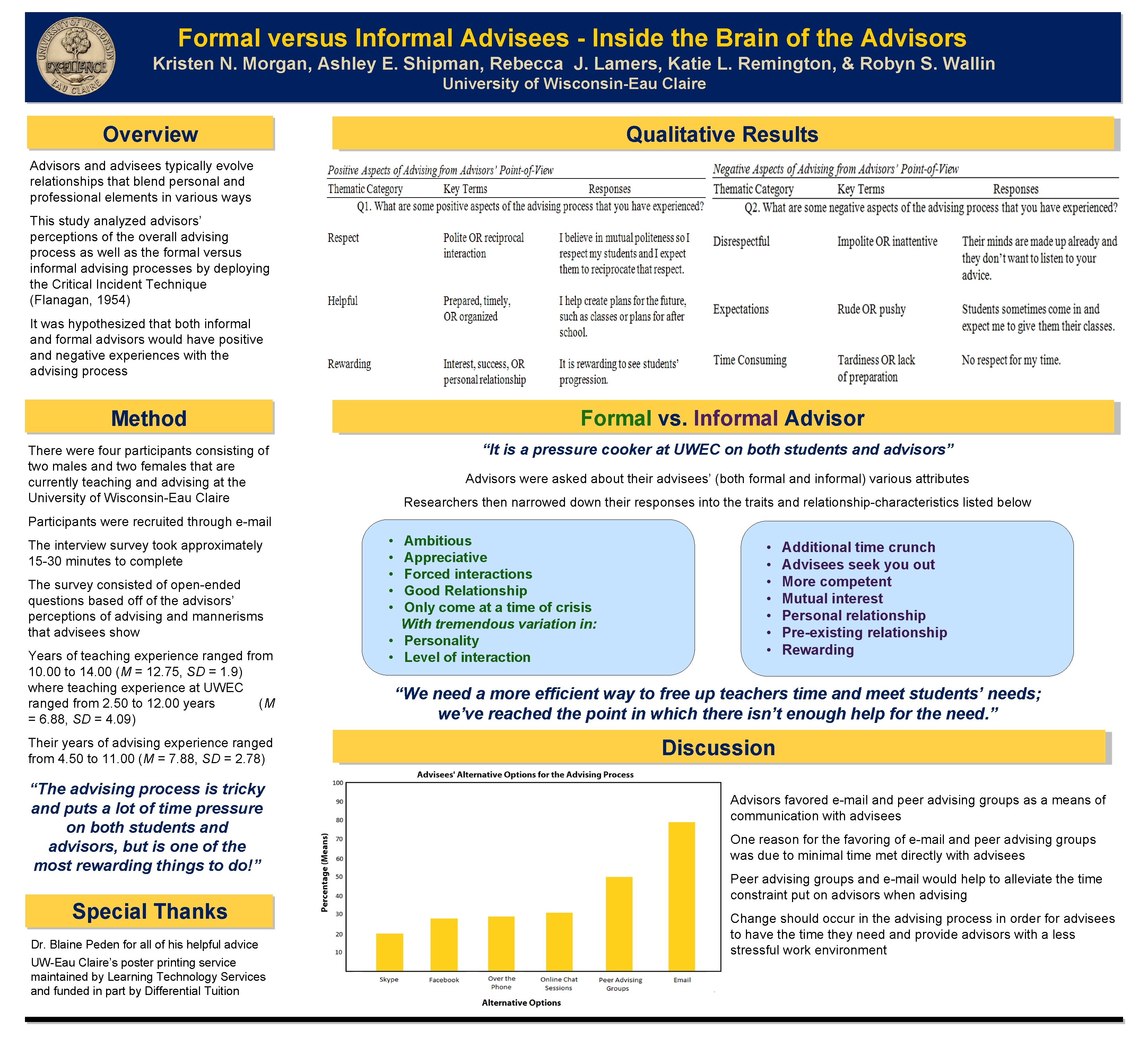
Formal versus Informal Advisees - Inside the Brain of the Advisors Kristen N. Morgan, Ashley E. Shipman, Rebecca J. Lamers, Katie L. Remington, & Robyn S. Wallin University of Wisconsin-Eau Claire Overview Qualitative Results Advisors and advisees typically evolve relationships that blend personal and professional elements in various ways This study analyzed advisors’ perceptions of the overall advising process as well as the formal versus informal advising processes by deploying the Critical Incident Technique (Flanagan, 1954) It was hypothesized that both informal and formal advisors would have positive and negative experiences with the advising process Formal vs. Informal Advisor Method “It is a pressure cooker at UWEC on both students and advisors” There were four participants consisting of two males and two females that are currently teaching and advising at the University of Wisconsin-Eau Claire Advisors were asked about their advisees’ (both formal and informal) various attributes Researchers then narrowed down their responses into the traits and relationship-characteristics listed below Participants were recruited through e-mail The interview survey took approximately 15 -30 minutes to complete The survey consisted of open-ended questions based off of the advisors’ perceptions of advising and mannerisms that advisees show Years of teaching experience ranged from 10. 00 to 14. 00 (M = 12. 75, SD = 1. 9) where teaching experience at UWEC ranged from 2. 50 to 12. 00 years (M = 6. 88, SD = 4. 09) Their years of advising experience ranged from 4. 50 to 11. 00 (M = 7. 88, SD = 2. 78) “The advising process is tricky and puts a lot of time pressure on both students and advisors, but is one of the most rewarding things to do!” Special Thanks Dr. Blaine Peden for all of his helpful advice UW-Eau Claire’s poster printing service maintained by Learning Technology Services and funded in part by Differential Tuition • • • Ambitious Appreciative Forced interactions Good Relationship Only come at a time of crisis With tremendous variation in: • Personality • Level of interaction • • Additional time crunch Advisees seek you out More competent Mutual interest Personal relationship Pre-existing relationship Rewarding “We need a more efficient way to free up teachers time and meet students’ needs; we’ve reached the point in which there isn’t enough help for the need. ” Discussion Advisors favored e-mail and peer advising groups as a means of communication with advisees One reason for the favoring of e-mail and peer advising groups was due to minimal time met directly with advisees Peer advising groups and e-mail would help to alleviate the time constraint put on advisors when advising Change should occur in the advising process in order for advisees to have the time they need and provide advisors with a less stressful work environment
- Slides: 1