
Formal Observation Administrator schedules and conducts one Formal
Formal Observation Administrator schedules and conducts one Formal Observation (50 Minutes). Administrator uses the Formative Classroom Analysis form to provide feedback on many of the elements. 9/10/2008 CLASS Keys 1
Post-Observation Feedback Written post-observation feedback should be provided to the teacher for all formal (and informal observations) within five working days of the observation. All feedback should be related to the teacher’s performance on the twenty-six elements of the CLASS Keys and the GTDR. Post-Observation Conferences are required for the formal observation. 9/10/2008 CLASS Keys 2
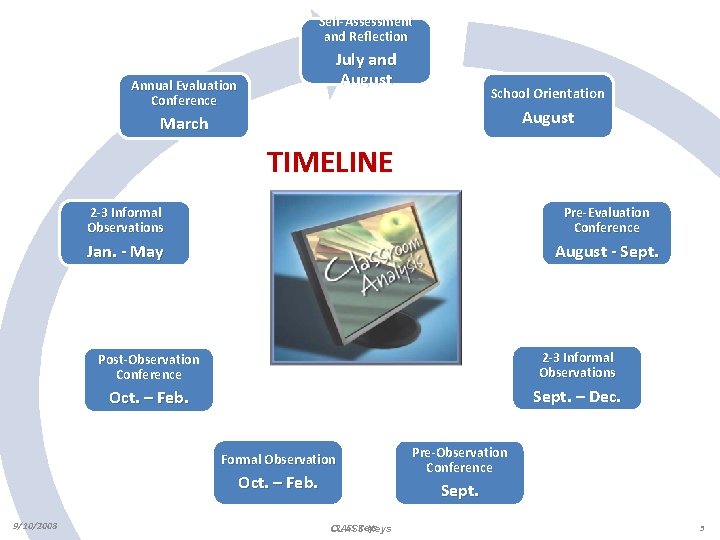
Self-Assessment and Reflection July and August Annual Evaluation Conference School Orientation August March TIMELINE 2 -3 Informal Observations Pre-Evaluation Conference Jan. - May August - Sept. Post-Observation Conference 2 -3 Informal Observations Oct. – Feb. Sept. – Dec. Formal Observation Oct. – Feb. 9/10/2008 Pre-Observation Conference Sept. CLASS Keys 3
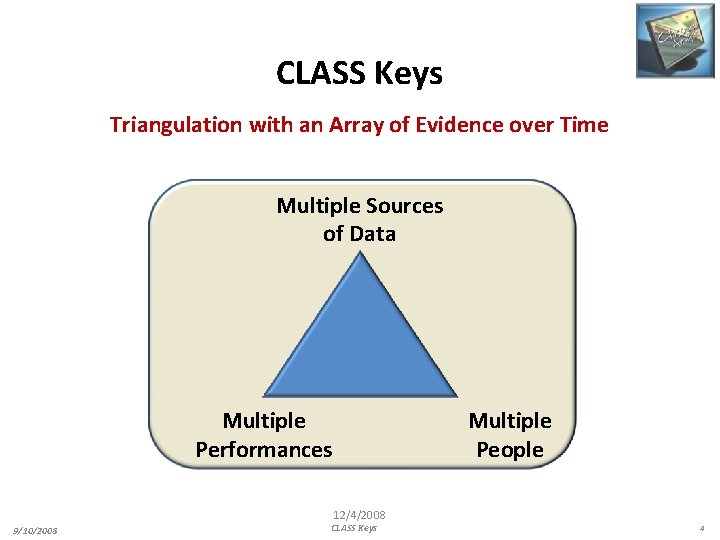
CLASS Keys Triangulation with an Array of Evidence over Time Multiple Sources of Data Multiple Performances Multiple People 12/4/2008 9/10/2008 CLASS Keys 4
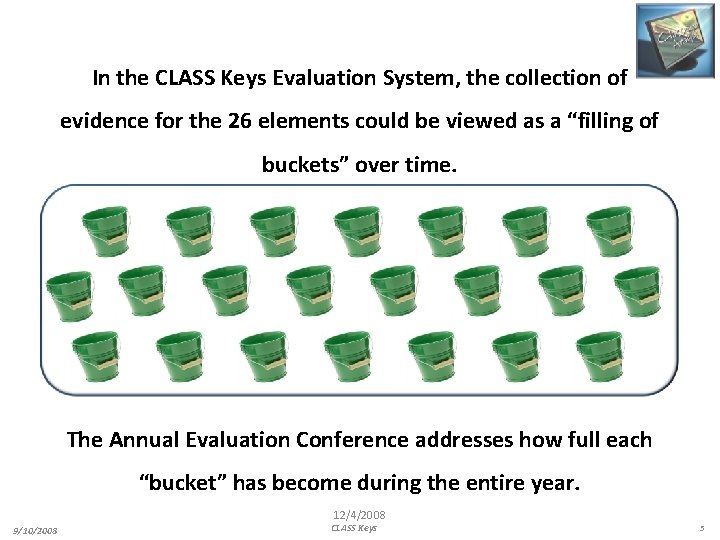
In the CLASS Keys Evaluation System, the collection of evidence for the 26 elements could be viewed as a “filling of buckets” over time. The Annual Evaluation Conference addresses how full each “bucket” has become during the entire year. 12/4/2008 9/10/2008 CLASS Keys 5
The Annual Evaluation The evaluation of performance occurs at the ELEMENT level. Elements scores are aggregated to form STRANDS rating. To be Satisfactory, ALL STRANDS must be “Emerging” or higher. 9/10/2008 12/4/2008 CLASS Keys 6
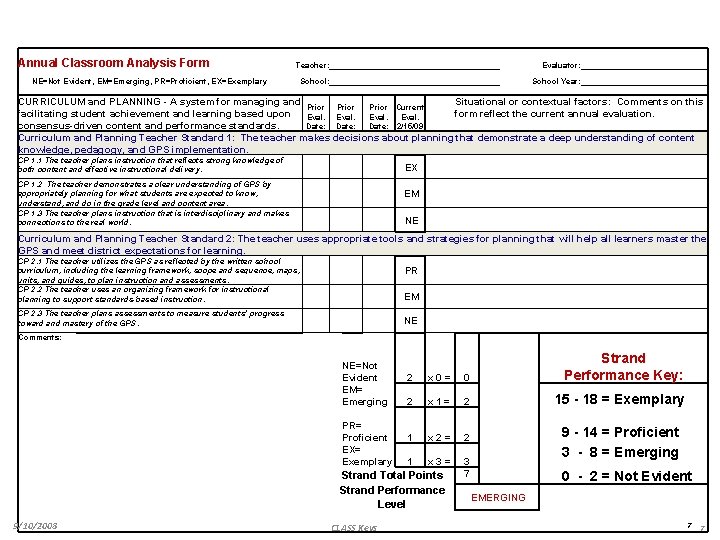
Annual Classroom Analysis Form Teacher: Evaluator: School Year: NE=Not Evident, EM=Emerging, PR=Proficient, EX=Exemplary CURRICULUM and PLANNING - A system for managing and Situational or contextual factors: Comments on this Prior Current facilitating student achievement and learning based upon form reflect the current annual evaluation. Eval. consensus-driven content and performance standards. Date: 2/15/09 Curriculum and Planning Teacher Standard 1: The teacher makes decisions about planning that demonstrate a deep understanding of content knowledge, pedagogy, and GPS implementation. CP 1. 1 The teacher plans instruction that reflects strong knowledge of both content and effective instructional delivery. EX CP 1. 2 The teacher demonstrates a clear understanding of GPS by appropriately planning for what students are expected to know, understand, and do in the grade level and content area. CP 1. 3 The teacher plans instruction that is interdisciplinary and makes connections to the real world. EM NE Curriculum and Planning Teacher Standard 2: The teacher uses appropriate tools and strategies for planning that will help all learners master the GPS and meet district expectations for learning. CP 2. 1 The teacher utilizes the GPS as reflected by the written school curriculum, including the learning framework, scope and sequence, maps, units, and guides, to plan instruction and assessments. CP 2. 2 The teacher uses an organizing framework for instructional planning to support standards-based instruction. EM CP 2. 3 The teacher plans assessments to measure students’ progress toward and mastery of the GPS. NE PR Comments: NE=Not Evident EM= Emerging PR= Proficient EX= Exemplary 2 x 0= 0 Strand Performance Key: 2 x 1= 2 15 - 18 = Exemplary 1 x 2= 2 1 x 3= 3 7 9 - 14 = Proficient 3 - 8 = Emerging Strand Total Points Strand Performance Level 9/10/2008 CLASS Keys 0 - 2 = Not Evident EMERGING 7 7
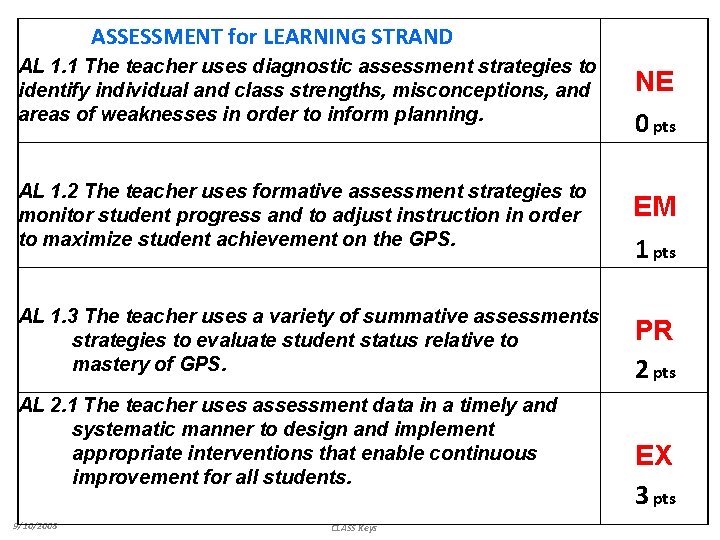
ASSESSMENT for LEARNING STRAND AL 1. 1 The teacher uses diagnostic assessment strategies to identify individual and class strengths, misconceptions, and areas of weaknesses in order to inform planning. AL 1. 2 The teacher uses formative assessment strategies to monitor student progress and to adjust instruction in order to maximize student achievement on the GPS. AL 1. 3 The teacher uses a variety of summative assessments strategies to evaluate student status relative to mastery of GPS. AL 2. 1 The teacher uses assessment data in a timely and systematic manner to design and implement appropriate interventions that enable continuous improvement for all students. 9/10/2008 CLASS Keys NE 0 pts EM 1 pts PR 2 pts EX 3 pts
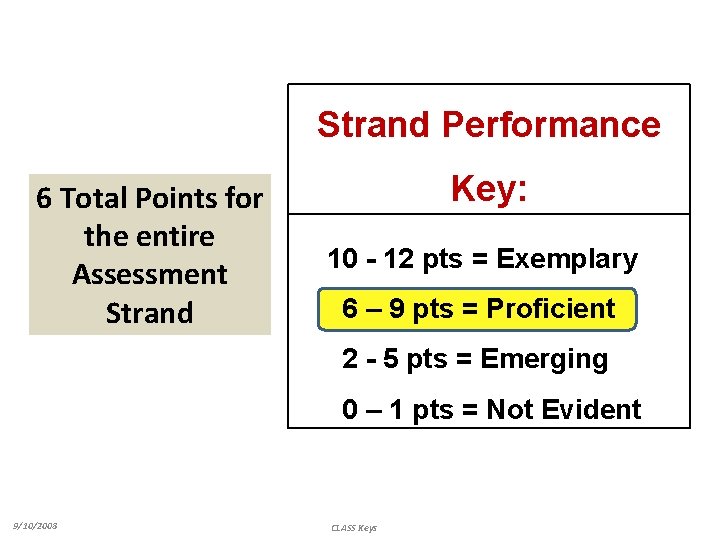
Strand Performance 6 Total Points for the entire Assessment Strand Key: 10 - 12 pts = Exemplary 6 – 9 pts = Proficient 2 - 5 pts = Emerging 0 – 1 pts = Not Evident 9/10/2008 CLASS Keys
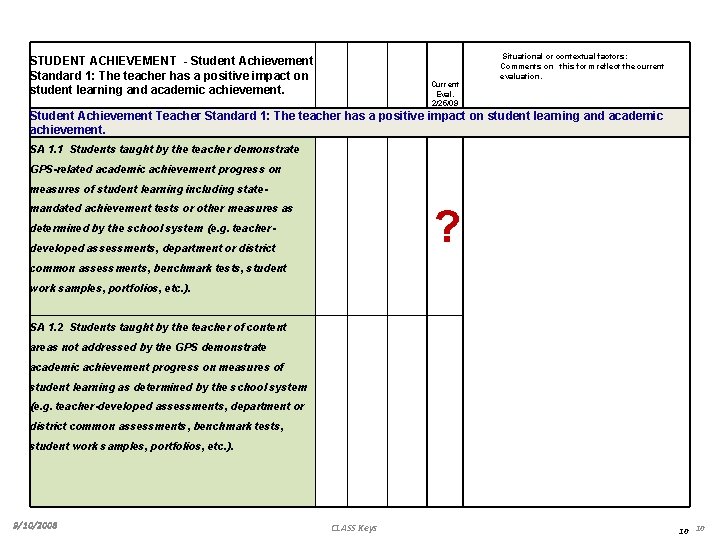
STUDENT ACHIEVEMENT - Student Achievement Standard 1: The teacher has a positive impact on student learning and academic achievement. Prior Current Eval. Prior Eval. Date: 2/25/09 Situational or contextual factors: Comments on this form reflect the current evaluation. Student Achievement Teacher Standard 1: The teacher has a positive impact on student learning and academic achievement. SA 1. 1 Students taught by the teacher demonstrate GPS-related academic achievement progress on measures of student learning including statemandated achievement tests or other measures as ? determined by the school system (e. g. teacherdeveloped assessments, department or district common assessments, benchmark tests, student work samples, portfolios, etc. ). SA 1. 2 Students taught by the teacher of content areas not addressed by the GPS demonstrate academic achievement progress on measures of student learning as determined by the school system (e. g. teacher-developed assessments, department or district common assessments, benchmark tests, student work samples, portfolios, etc. ). 9/10/2008 CLASS Keys 10 10
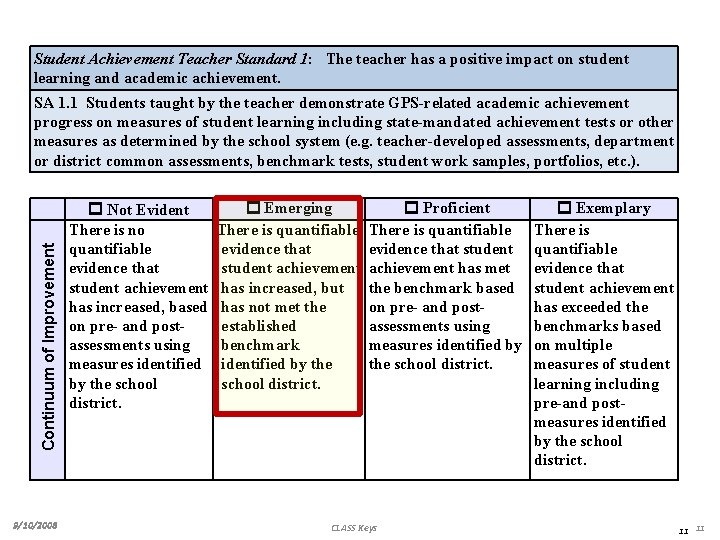
Student Achievement Teacher Standard 1: The teacher has a positive impact on student learning and academic achievement. Continuum of Improvement SA 1. 1 Students taught by the teacher demonstrate GPS-related academic achievement progress on measures of student learning including state-mandated achievement tests or other measures as determined by the school system (e. g. teacher-developed assessments, department or district common assessments, benchmark tests, student work samples, portfolios, etc. ). 9/10/2008 Not Evident There is no quantifiable evidence that student achievement has increased, based on pre- and postassessments using measures identified by the school district. Emerging There is quantifiable evidence that student achievement has increased, but has not met the established benchmark identified by the school district. Proficient There is quantifiable evidence that student achievement has met the benchmark based on pre- and postassessments using measures identified by the school district. CLASS Keys Exemplary There is quantifiable evidence that student achievement has exceeded the benchmarks based on multiple measures of student learning including pre-and postmeasures identified by the school district. 11 11
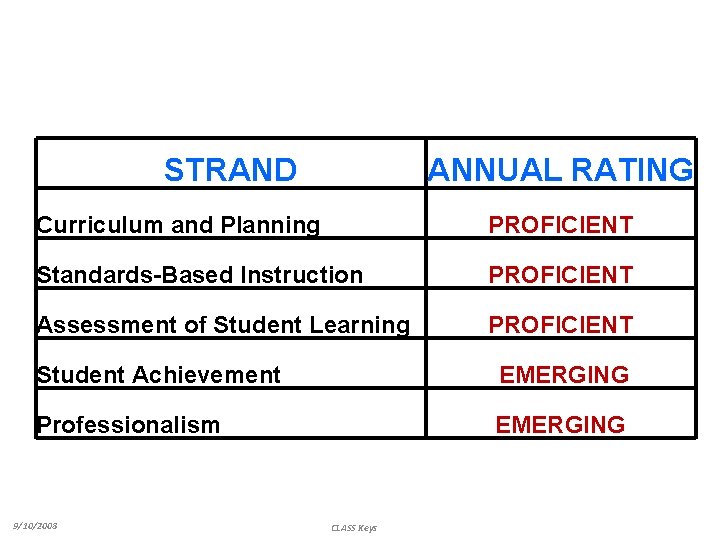
STRAND ANNUAL RATING Curriculum and Planning PROFICIENT Standards-Based Instruction PROFICIENT Assessment of Student Learning PROFICIENT Student Achievement EMERGING Professionalism EMERGING 9/10/2008 CLASS Keys
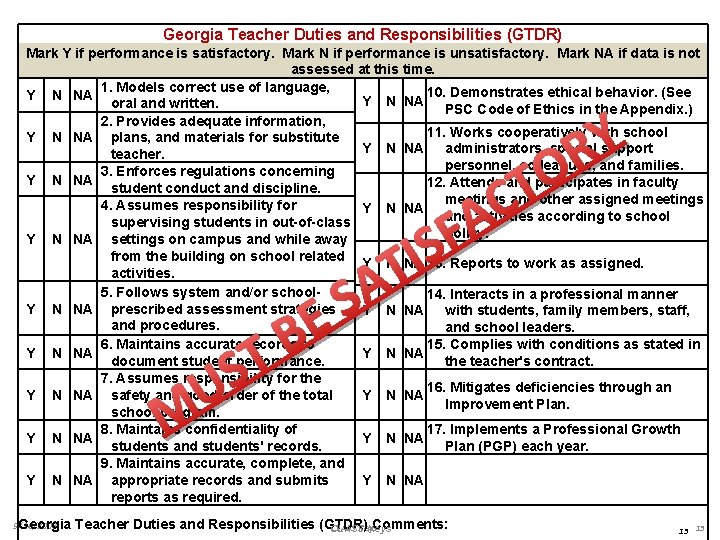
Georgia Teacher Duties and Responsibilities (GTDR) Mark Y if performance is satisfactory. Mark N if performance is unsatisfactory. Mark NA if data is not assessed at this time. 1. Models correct use of language, 10. Demonstrates ethical behavior. (See Y N NA oral and written. PSC Code of Ethics in the Appendix. ) 2. Provides adequate information, 11. Works cooperatively with school Y N NA plans, and materials for substitute Y N NA administrators, special support teacher. personnel, colleagues, and families. 3. Enforces regulations concerning Y N NA 12. Attends and participates in faculty student conduct and discipline. meetings and other assigned meetings 4. Assumes responsibility for Y N NA and activities according to school supervising students in out-of-class policy. Y N NA settings on campus and while away from the building on school related Y N NA 13. Reports to work as assigned. activities. 5. Follows system and/or school 14. Interacts in a professional manner Y N NA prescribed assessment strategies Y N NA with students, family members, staff, and procedures. and school leaders. 6. Maintains accurate records to 15. Complies with conditions as stated in Y N NA document student performance. the teacher's contract. 7. Assumes responsibility for the 16. Mitigates deficiencies through an Y N NA safety and good order of the total Y N NA Improvement Plan. school program. 8. Maintains confidentiality of 17. Implements a Professional Growth Y N NA students and students' records. Plan (PGP) each year. 9. Maintains accurate, complete, and Y N NA appropriate records and submits Y N NA reports as required. O T C A F S I T S U M Georgia 9/10/2008 Y R A S E B T Teacher Duties and Responsibilities (GTDR) Comments: CLASS Keys 13 13
CLASS Keys will leverage other changes. ü Greater understanding of standards-based practices ü More feedback for teachers ü Greater focus on instruction by administrators ü Better direction for professional learning ü Better direction for school improvement ü Better teacher-administrator relationships ü Frequent common assessments 9/10/2008 CLASS Keys 14
Is our school ready for the CLASS Keys? üA common understanding of key concepts (such as differentiation and formative assessment) is shared by our leaders and instructional staff. üOur school has adopted/developed an assessment infrastructure that can be used for periodic monitoring of student achievement and teacher accountability. üA culture of high expectations and collegiality exists in which adults collaborate and model continuous learning. 9/10/2008 CLASS Keys 15
Am I ready for the CLASS Keys? üI have an understanding of the School Keys. ü I understand effective instructional practices. ü I have experience using rubrics. ü I have experience observing and assessing staff. ü I have experience giving feedback to teachers. ü I have effective conferencing skills. CLASS Keys 16
How some are preparing for the CLASS Keys üReviewing/Studying the elements to come to a common understanding of what they look like in practice. üUsing the elements as “LOOK-FORs” during walkthroughs. üUsing the elements for peer observations. üDeveloping common assessments. 9/10/2008 CLASS Keys 17
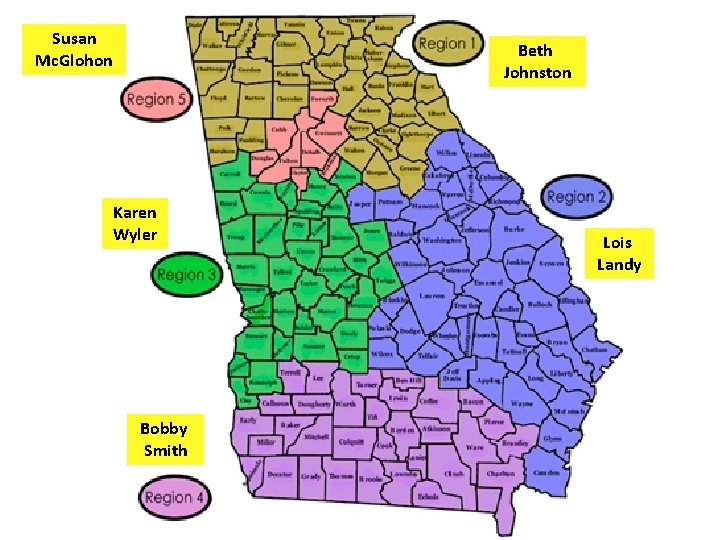
Susan Mc. Glohon Beth Johnston Karen Wyler Bobby Smith Lois Landy
Contact Information Region 1 Beth Johnston sajohnst@doe. k 12. ga. us Region 2 Lois Landy llandy@doe. k 12. ga. us Veta New Director Teacher Quality vnew@doe. k 12. ga. us Diane Bradford, Ed. D. Deputy Superintendent Education Support and Improvement dbradfor@doe. k 12. ga. us 9/10/2008 Region 3 Karen Wyler kwyler@doe. k 12. ga. us Region 4 Bobby Smith bosmith@doe. k 12. ga. us Region 5 Susan Mc. Glohon smcgloho@doe. k 12. ga. us CLASS Keys 19
- Slides: 19