
Formal Elements of Art Tone Drawing Techniques How
- Slides: 8
Formal Elements of Art Tone: Drawing Techniques
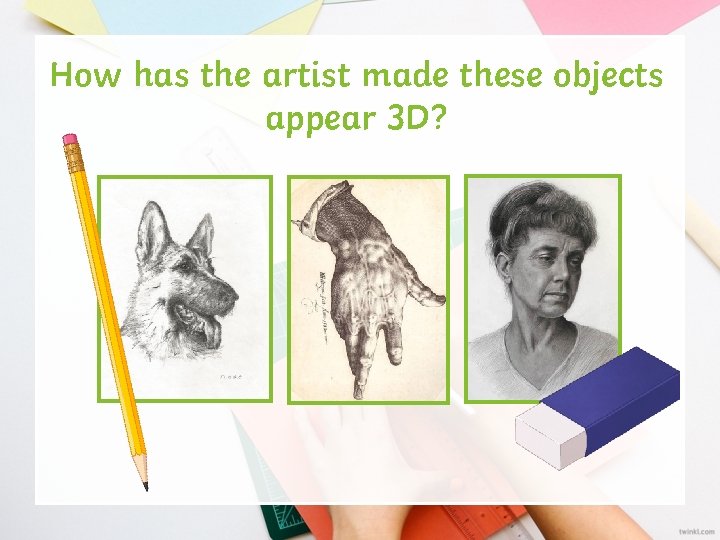
How has the artist made these objects appear 3 D?
Learning Objective • To develop your drawing technique when creating tone. Success Criteria • To create light, medium and dark tones with pencil. • To experiment with cross-hatching, blending and stippling. • To apply these techniques to make an object appear 3 D.
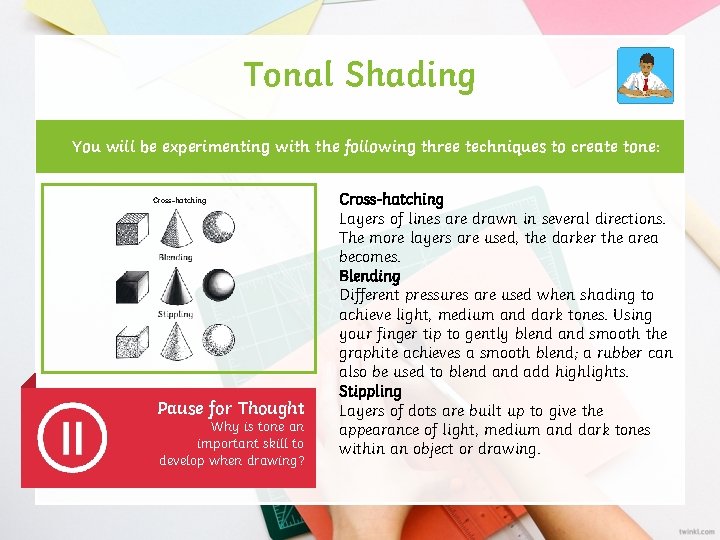
Tonal Shading You will be experimenting with the following three techniques to create tone: Cross-hatching Pause for Thought Why is tone an important skill to develop when drawing? Cross-hatching Layers of lines are drawn in several directions. The more layers are used, the darker the area becomes. Blending Different pressures are used when shading to achieve light, medium and dark tones. Using your finger tip to gently blend and smooth the graphite achieves a smooth blend; a rubber can also be used to blend add highlights. Stippling Layers of dots are built up to give the appearance of light, medium and dark tones within an object or drawing.
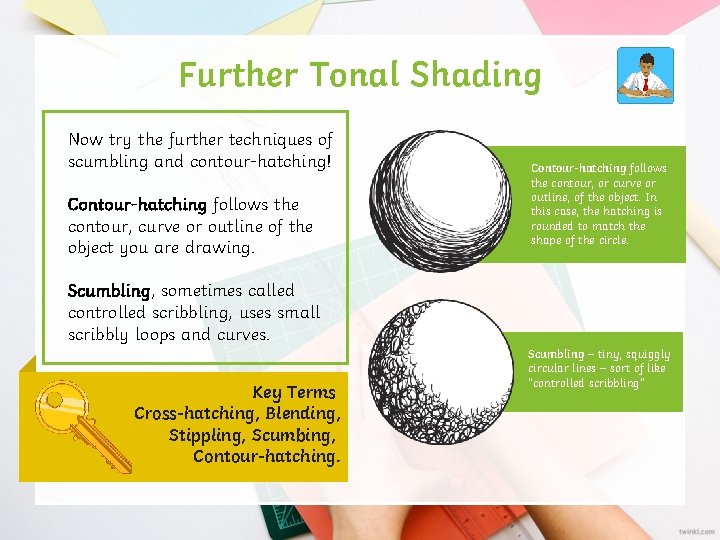
Further Tonal Shading Now try the further techniques of scumbling and contour-hatching! Contour-hatching follows the contour, curve or outline of the object you are drawing. Contour-hatching follows the contour, or curve or outline, of the object. In this case, the hatching is rounded to match the shape of the circle. Scumbling, sometimes called controlled scribbling, uses small scribbly loops and curves. Key Terms Cross-hatching, Blending, Stippling, Scumbing, Contour-hatching. Scumbling – tiny, squiggly circular lines – sort of like “controlled scribbling”
Learning Objective • To develop your drawing technique when creating tone. Success Criteria • To create light, medium and dark tones with pencil. • To experiment with cross-hatching, blending and stippling. • To apply these techniques to make an object appear 3 D.
What Have We Learnt Today? Swap your tonal shading activity sheet with your partner for a peer-assessment task. Thinking about the success criteria below, give your partner two positive comments about their work and one thing they could improve upon. • To create light, medium and dark tones with pencil. • To experiment with cross-hatching, blending and stippling. • To apply these techniques to make an object appear 3 D.