
Formal Description of a Problem In AI we
Formal Description of a Problem • In AI, we will formally define a problem as – a space of all possible configurations where each configuration is called a state • thus, we use the term state space – an initial state – one or more goal states – a set of rules/operators which move the problem from one state to the next • In some cases, we may enumerate all possible states (see monkey & banana problem on the next slide) – but usually, such an enumeration will be overwhelmingly large so we only generate a portion of the state space, the portion we are currently examining

The Monkey & Bananas Problem • A monkey is in a cage and bananas are suspended from the ceiling, the monkey wants to eat a banana but cannot reach them – in the room are a chair and a stick – if the monkey stands on the chair and waves the stick, he can knock a banana down to eat it – what are the actions the monkey should take? Initial state: monkey on ground with empty hand bananas suspended Goal state: monkey eating Actions: climb chair/get off grab X wave X eat X
Missionaries and Cannibals • 3 missionaries and 3 cannibals are on one side of the river with a boat that can take exactly 2 people across the river – how can we move the 3 missionaries and 3 cannibals across the river – with the constraint that the cannibals never outnumber the missionaries on either side of the river (lest the cannibals start eating the missionaries!)? ? • We can represent a state as a 6 -item tuple: – (a, b, c, d, e, f) • a/b = number of missionaries/cannibals on left shore • c/d = number of missionaries/cannibals in boat • e/f = number of missionaries/cannibals on right shore • where a + b + c + d + e + f = 6 • and a >= b unless a = 0, c >= d unless c = 0, and e >= f unless e = 0 • Legal operations (moves) are – – – 0, 1, 2 missionaries get into boat (c + d must be <= 2) 0, 1, 2 missionaries get out of boat 0, 1, 2 cannibals get into boat (c + d must be <= 2) 0, 1, 2 missionaries get out of boat sails from left shore to right shore (c + d must be >= 1) boat sails from right shore to left shore (c + d must be >= 1)

8 Puzzle The 8 puzzle search space consists of 8! states (40320)
Search • Given a problem expressed as a state space (whether explicitly or implicitly) – with operators/actions, an initial state and a goal state, how do we find the sequence of operators needed to solve the problem? – this requires search • Formally, we define a search space as [N, A, S, GD] – N = set of nodes or states of a graph – A = set of arcs (edges) between nodes that correspond to the steps in the problem (the legal actions or operators) – S = a nonempty subset of N that represents start states – GD = a nonempty subset of N that represents goal states • Our problem becomes one of traversing the graph from a node in S to a node in GD – we can use any of the numerous graph traversal techniques for this but in general, they divide into two categories: • brute force – unguided search • heuristic – guided search
Consequences of Search • As shown a few slides back, the 8 -puzzle has over 40000 different states – what about the 15 puzzle? • A brute force search means try all possible states blindly until you find the solution – if a problem has a state space that consists of n moves where each move has m possible choices, then there are 2 m*n states – two forms of brute force search are: depth first search, breath first search • A guided search examines a state and uses some heuristic (usually a function) to determine how good that state is (how close you might be to a solution) to help determine what state to move to – – hill climbing best-first search A/A* algorithm Minimax • While a good heuristic can reduce the complexity from 2 m*n to something tractable, there is no guarantee so any form of search is O(2 n) in the worst case
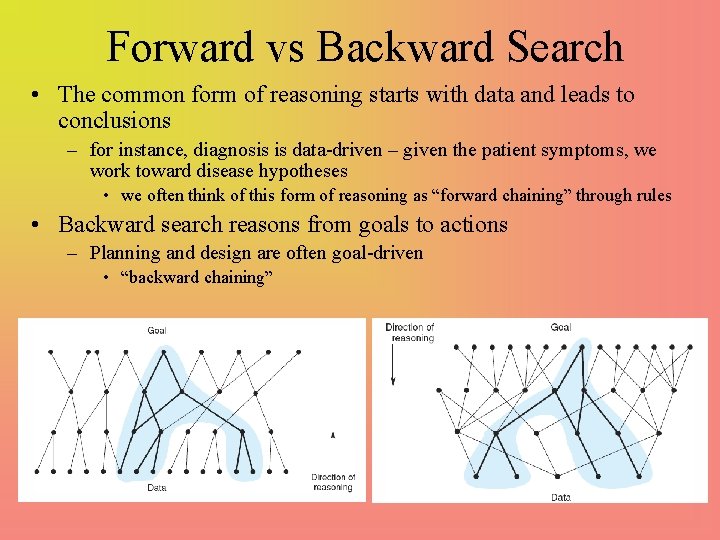
Forward vs Backward Search • The common form of reasoning starts with data and leads to conclusions – for instance, diagnosis is data-driven – given the patient symptoms, we work toward disease hypotheses • we often think of this form of reasoning as “forward chaining” through rules • Backward search reasons from goals to actions – Planning and design are often goal-driven • “backward chaining”
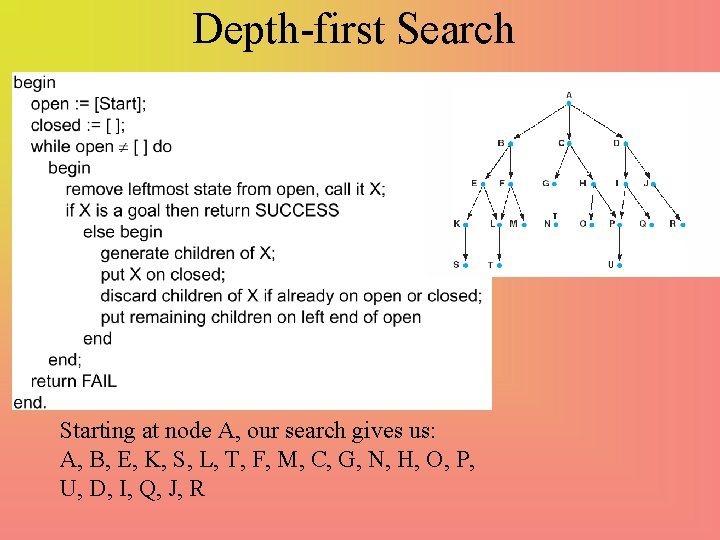
Depth-first Search Starting at node A, our search gives us: A, B, E, K, S, L, T, F, M, C, G, N, H, O, P, U, D, I, Q, J, R
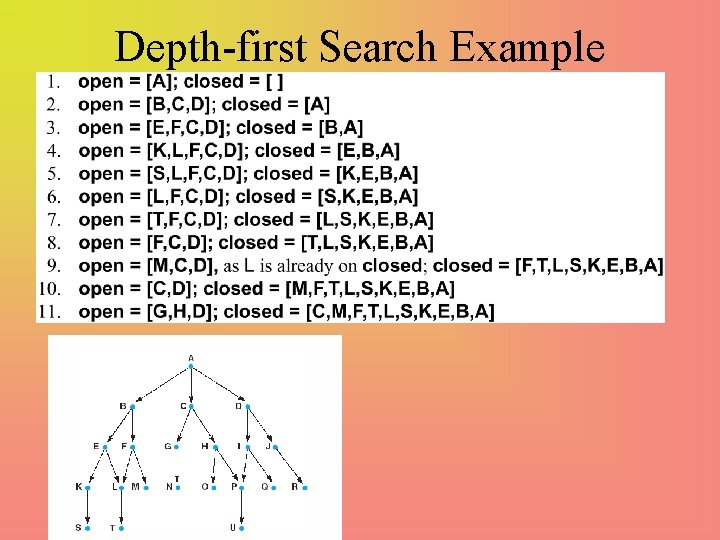
Depth-first Search Example

Traveling Salesman Problem
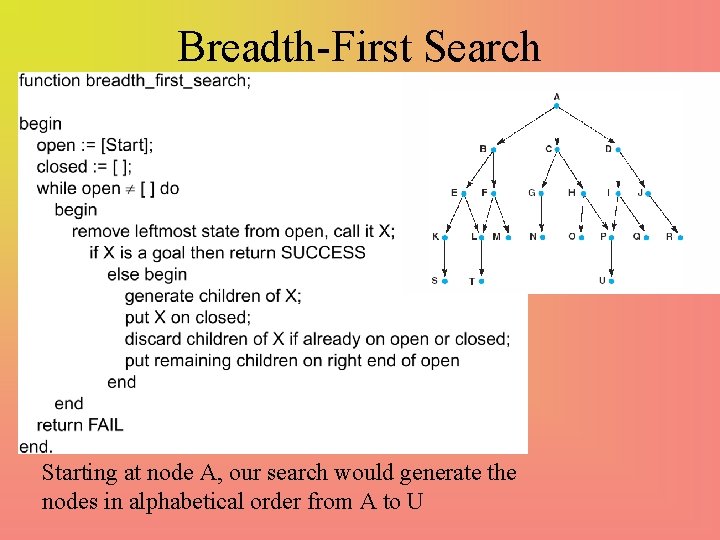
Breadth-First Search Starting at node A, our search would generate the nodes in alphabetical order from A to U

Breadth-First Search Example
- Slides: 12