
Formal Definition and Examples o A partially ordered
- Slides: 6
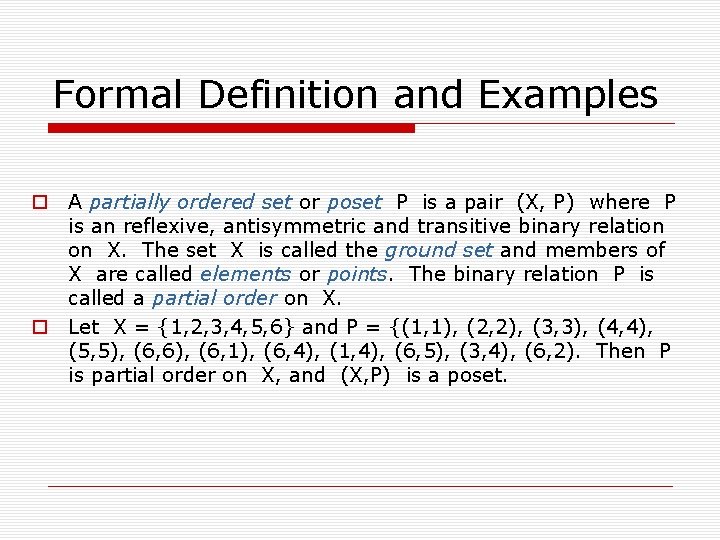
Formal Definition and Examples o A partially ordered set or poset P is a pair (X, P) where P is an reflexive, antisymmetric and transitive binary relation on X. The set X is called the ground set and members of X are called elements or points. The binary relation P is called a partial order on X. o Let X = {1, 2, 3, 4, 5, 6} and P = {(1, 1), (2, 2), (3, 3), (4, 4), (5, 5), (6, 6), (6, 1), (6, 4), (1, 4), (6, 5), (3, 4), (6, 2). Then P is partial order on X, and (X, P) is a poset.
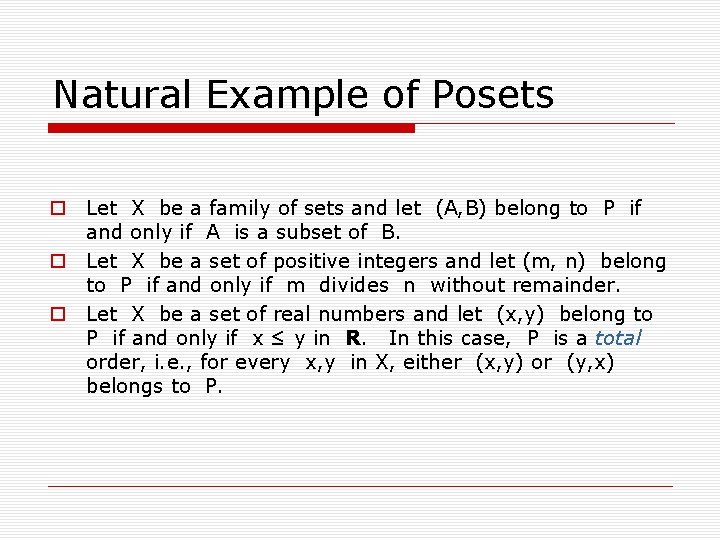
Natural Example of Posets o Let X be a family of sets and let (A, B) belong to P if and only if A is a subset of B. o Let X be a set of positive integers and let (m, n) belong to P if and only if m divides n without remainder. o Let X be a set of real numbers and let (x, y) belong to P if and only if x ≤ y in R. In this case, P is a total order, i. e. , for every x, y in X, either (x, y) or (y, x) belongs to P.
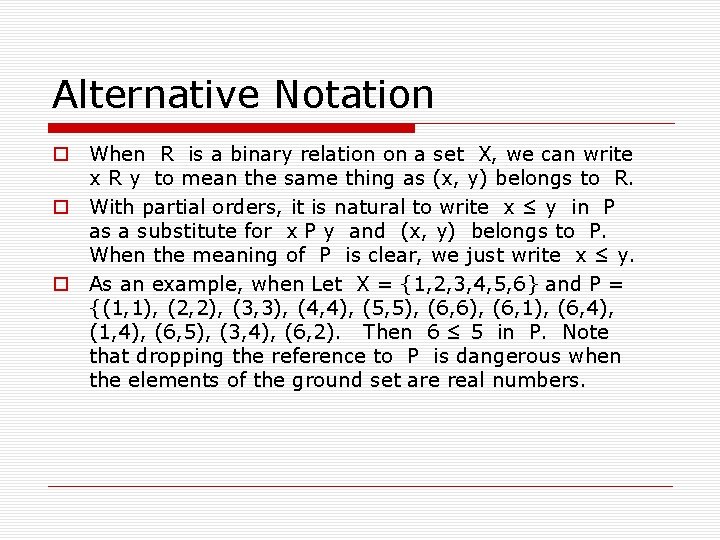
Alternative Notation o When R is a binary relation on a set X, we can write x R y to mean the same thing as (x, y) belongs to R. o With partial orders, it is natural to write x ≤ y in P as a substitute for x P y and (x, y) belongs to P. When the meaning of P is clear, we just write x ≤ y. o As an example, when Let X = {1, 2, 3, 4, 5, 6} and P = {(1, 1), (2, 2), (3, 3), (4, 4), (5, 5), (6, 6), (6, 1), (6, 4), (1, 4), (6, 5), (3, 4), (6, 2). Then 6 ≤ 5 in P. Note that dropping the reference to P is dangerous when the elements of the ground set are real numbers.
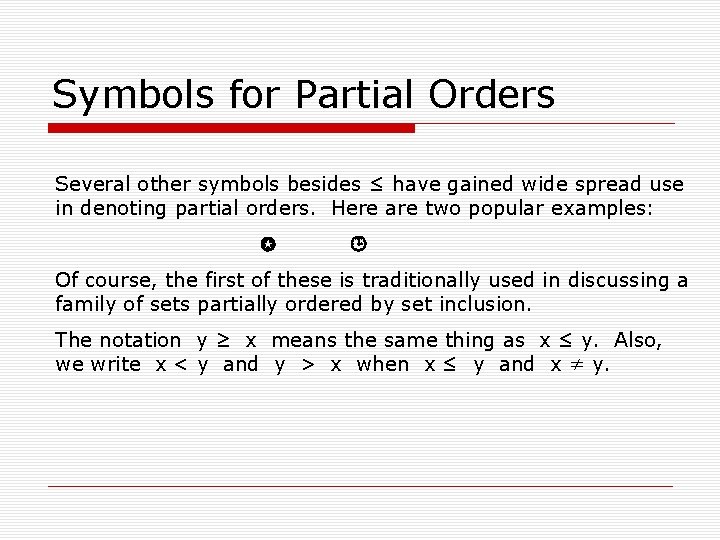
Symbols for Partial Orders Several other symbols besides ≤ have gained wide spread use in denoting partial orders. Here are two popular examples: µ ¹ Of course, the first of these is traditionally used in discussing a family of sets partially ordered by set inclusion. The notation y ≥ x means the same thing as x ≤ y. Also, we write x < y and y > x when x ≤ y and x ≠ y.
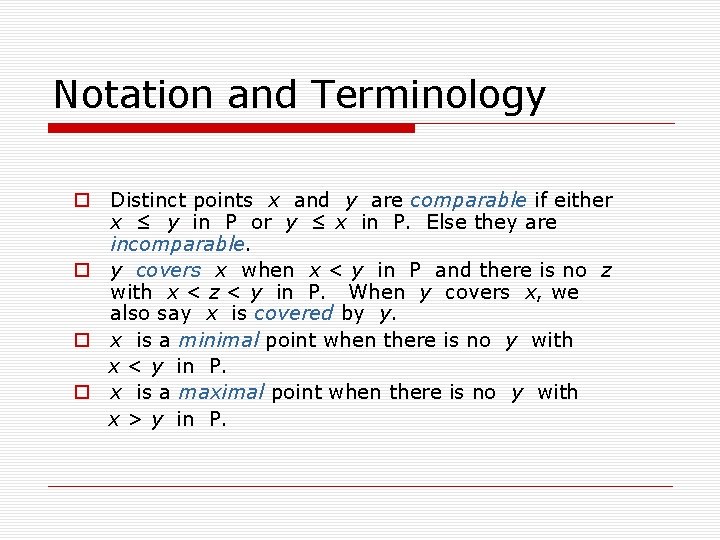
Notation and Terminology o Distinct points x and y are comparable if either x ≤ y in P or y ≤ x in P. Else they are incomparable. o y covers x when x < y in P and there is no z with x < z < y in P. When y covers x, we also say x is covered by y. o x is a minimal point when there is no y with x < y in P. o x is a maximal point when there is no y with x > y in P.
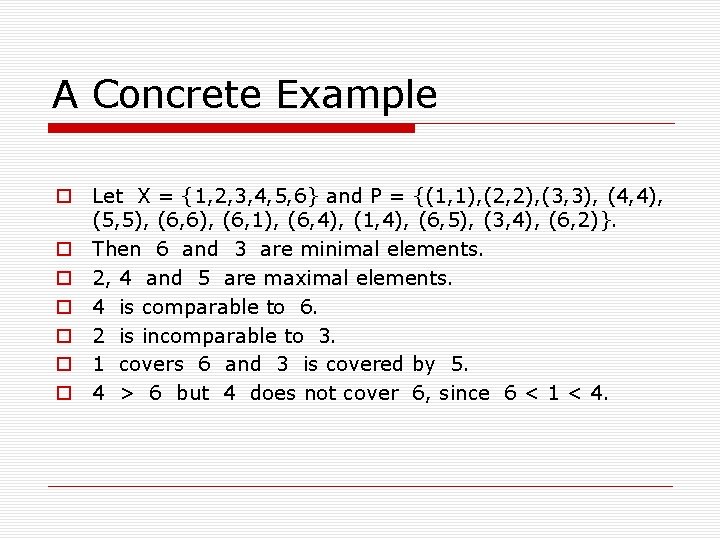
A Concrete Example o Let X = {1, 2, 3, 4, 5, 6} and P = {(1, 1), (2, 2), (3, 3), (4, 4), (5, 5), (6, 6), (6, 1), (6, 4), (1, 4), (6, 5), (3, 4), (6, 2)}. o Then 6 and 3 are minimal elements. o 2, 4 and 5 are maximal elements. o 4 is comparable to 6. o 2 is incomparable to 3. o 1 covers 6 and 3 is covered by 5. o 4 > 6 but 4 does not cover 6, since 6 < 1 < 4.