
formal charge the charge a bonded atom would
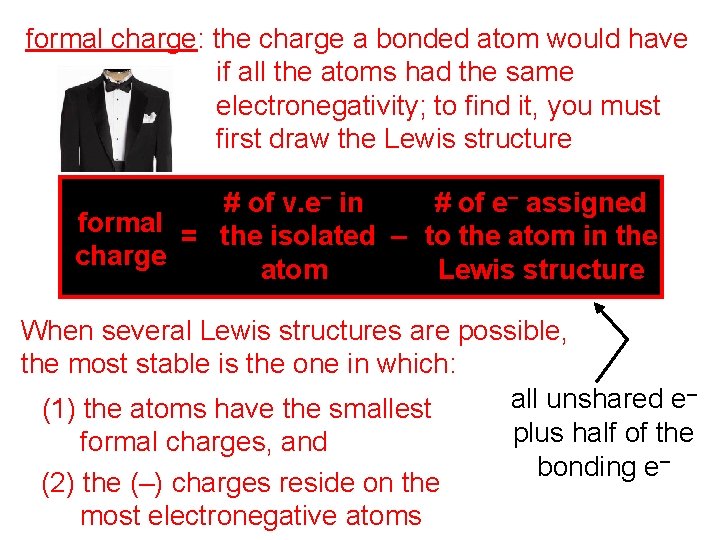
formal charge: the charge a bonded atom would have if all the atoms had the same electronegativity; to find it, you must first draw the Lewis structure # of v. e– in # of e– assigned formal = the isolated – to the atom in the charge atom Lewis structure When several Lewis structures are possible, the most stable is the one in which: – all unshared e (1) the atoms have the smallest plus half of the formal charges, and bonding e– (2) the (–) charges reside on the most electronegative atoms
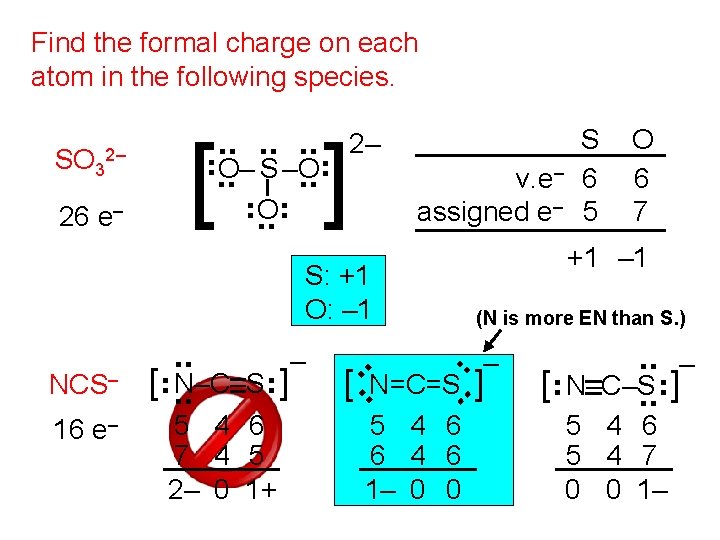
Find the formal charge on each atom in the following species. S v. e– 6 assigned e– 5 S: +1 O: – 1 16 e– 5 4 6 7 4 5 2– 0 1+ +1 – 1 (N is more EN than S. ) . . – [ N=C=S. . ] . . N–C–S . . [ . . NCS– – 5 4 6 6 4 6 1– 0 0 O 6 7 [ – N–C–S ] 5 4 6 5 4 7 0 0 1– . . 2– . . ] . . e– . . 26 [ . . . O– S –O. . . SO 3 2–
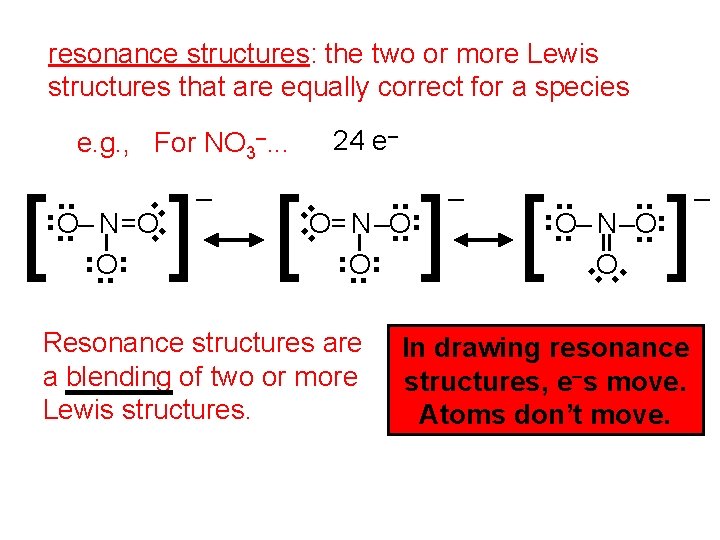
resonance structures: the two or more Lewis structures that are equally correct for a species 24 e– Resonance structures are a blending of two or more Lewis structures. ] [ . . O– N–O. . ] . . – O . . . . O= N–O. . . . – . . ] [ . . O– N=O. . . . e. g. , For NO 3–. . . In drawing resonance structures, e–s move. Atoms don’t move. –
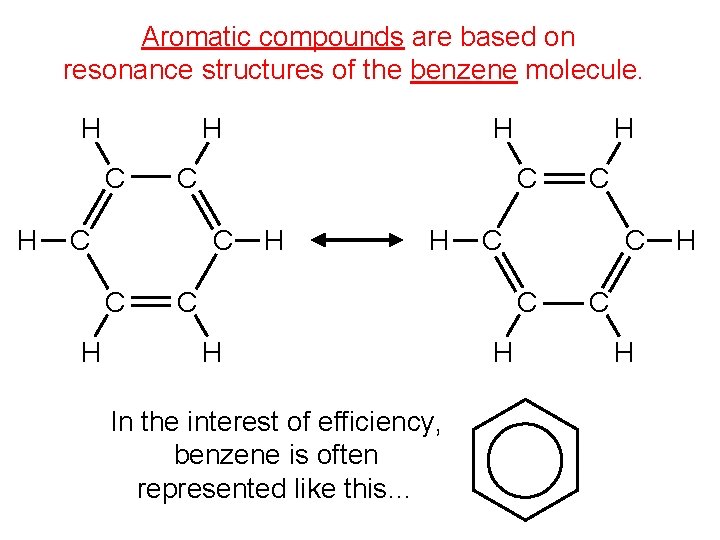
Aromatic compounds are based on resonance structures of the benzene molecule. H H C C C H H H C C H In the interest of efficiency, benzene is often represented like this… C H H
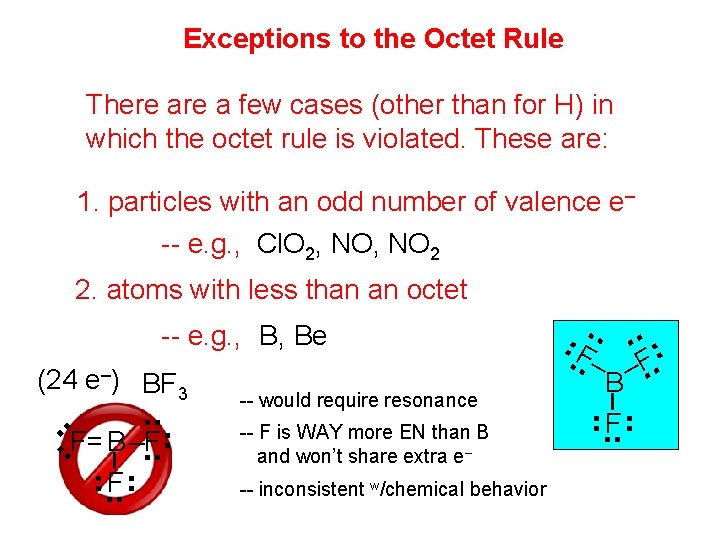
Exceptions to the Octet Rule There a few cases (other than for H) in which the octet rule is violated. These are: 1. particles with an odd number of valence e– -- e. g. , Cl. O 2, NO 2 (24 e–) BF 3 . . . F= B –F. . F . . . . F. – –F. . B -- would require resonance -- F is WAY more EN than B and won’t share extra e– -- inconsistent w/chemical behavior . . F . . -- e. g. , B, Be . . 2. atoms with less than an octet
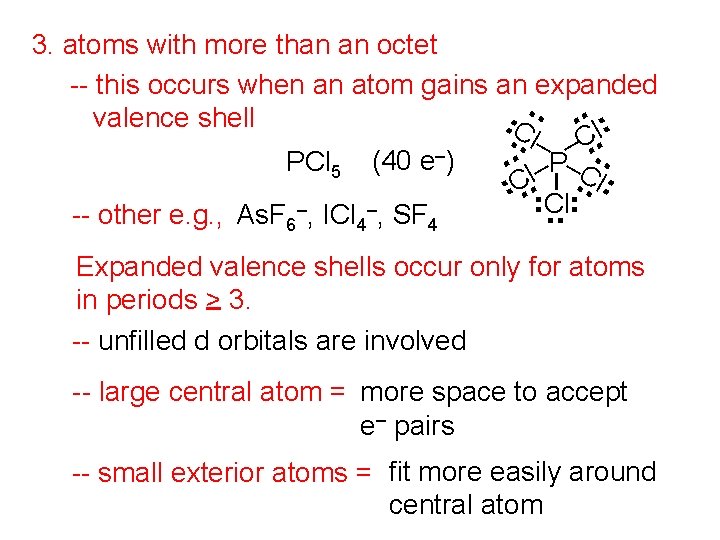
. . . 3. atoms with more than an octet -- this occurs when an atom gains an expanded. . valence shell C. l– C. l. . –. . PCl 5 (40 e ) – P C – l. C. . . l Cl. . -- other e. g. , As. F 6–, ICl 4–, SF 4 Expanded valence shells occur only for atoms in periods > 3. -- unfilled d orbitals are involved -- large central atom = more space to accept e– pairs -- small exterior atoms = fit more easily around central atom
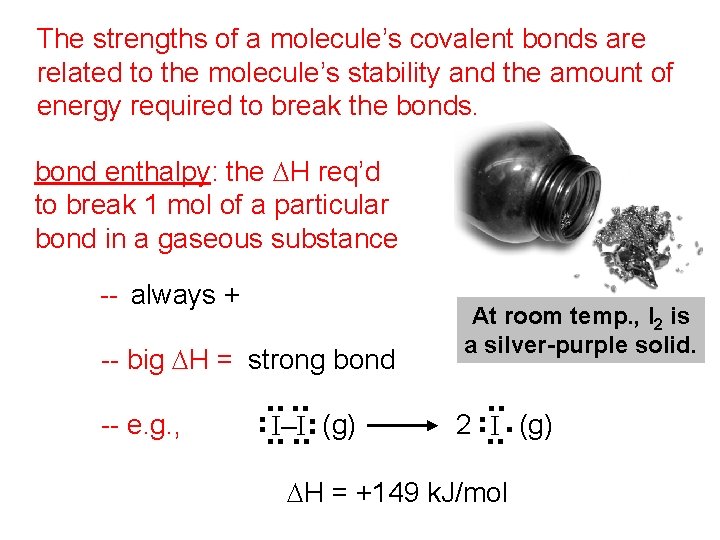
The strengths of a molecule’s covalent bonds are related to the molecule’s stability and the amount of energy required to break the bonds. bond enthalpy: the DH req’d to break 1 mol of a particular bond in a gaseous substance -- big DH = strong bond (g) . . -- e. g. , . . . I–I. . At room temp. , I 2 is a silver-purple solid. 2 . . I (g) . . . -- always + DH = +149 k. J/mol
- Slides: 7