
Formal Charge QUEST Organic Chemistry Mystery Molecule Consider
- Slides: 24
Formal Charge QUEST Organic Chemistry
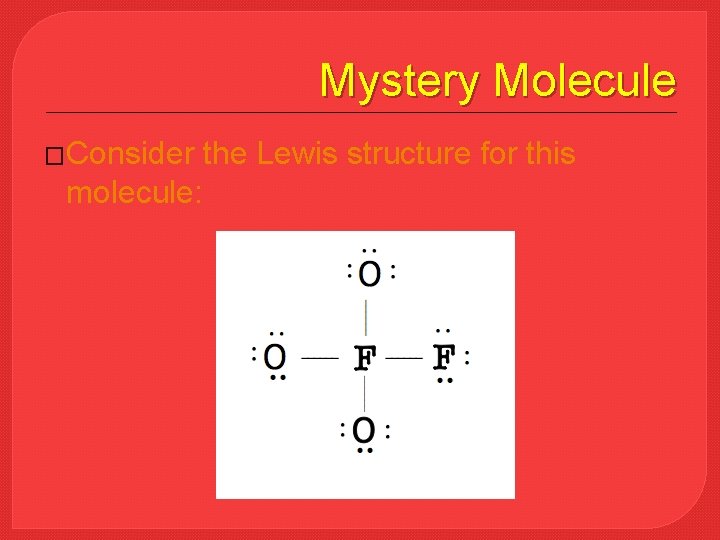
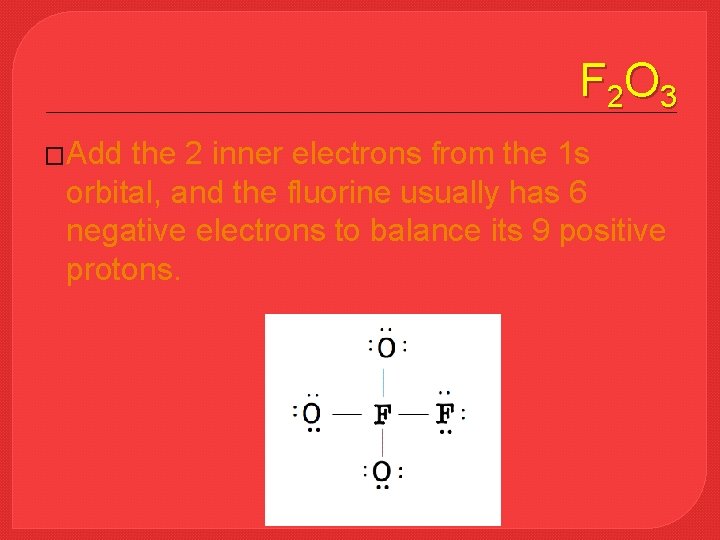
Mystery Molecule �Consider molecule: the Lewis structure for this
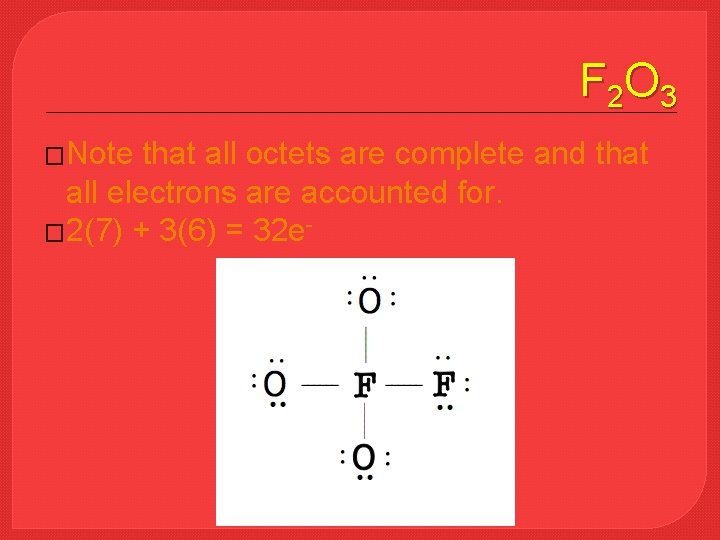
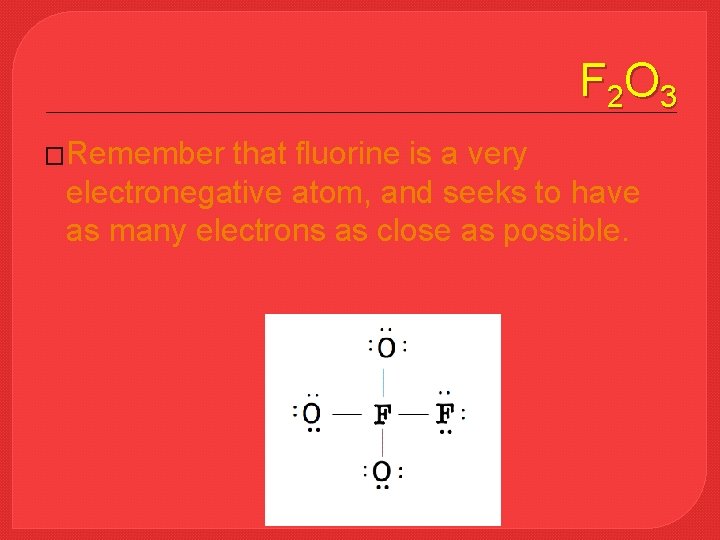
F 2 O 3 �Note that all octets are complete and that all electrons are accounted for. � 2(7) + 3(6) = 32 e-
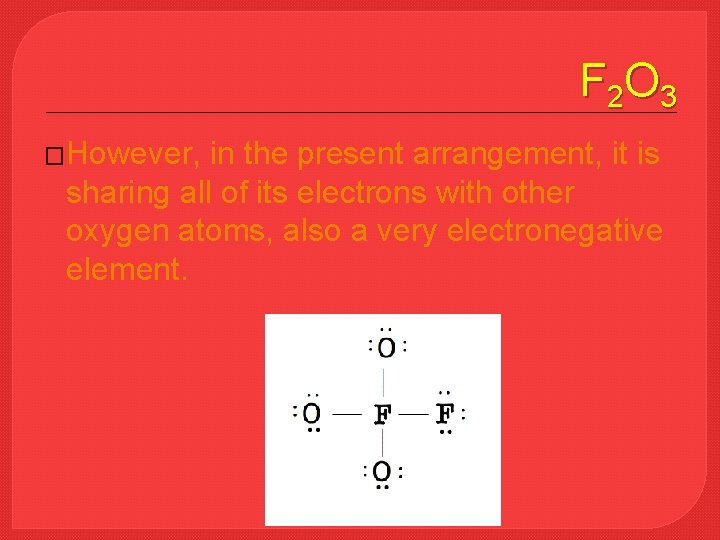
F 2 O 3 �However, this molecule does NOT occur in real life. �To explain why, let’s look at the central fluorine atom.
F 2 O 3 �Remember that fluorine is a very electronegative atom, and seeks to have as many electrons as close as possible.
F 2 O 3 �However, in the present arrangement, it is sharing all of its electrons with other oxygen atoms, also a very electronegative element.
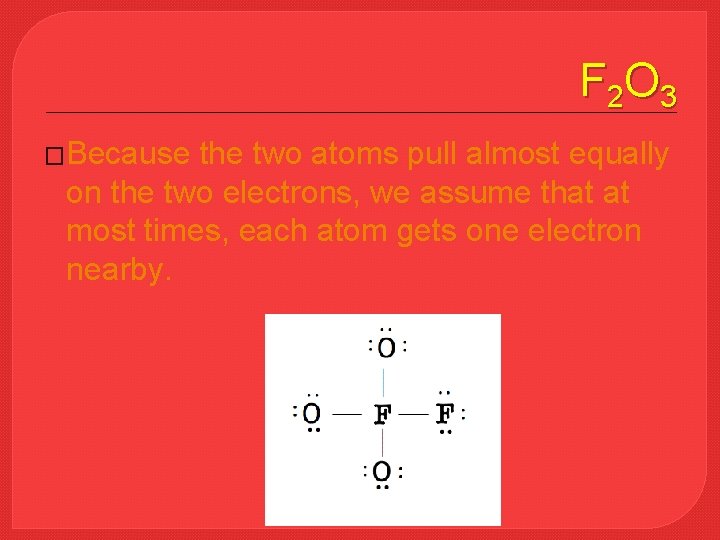
F 2 O 3 �Because the two atoms pull almost equally on the two electrons, we assume that at most times, each atom gets one electron nearby.
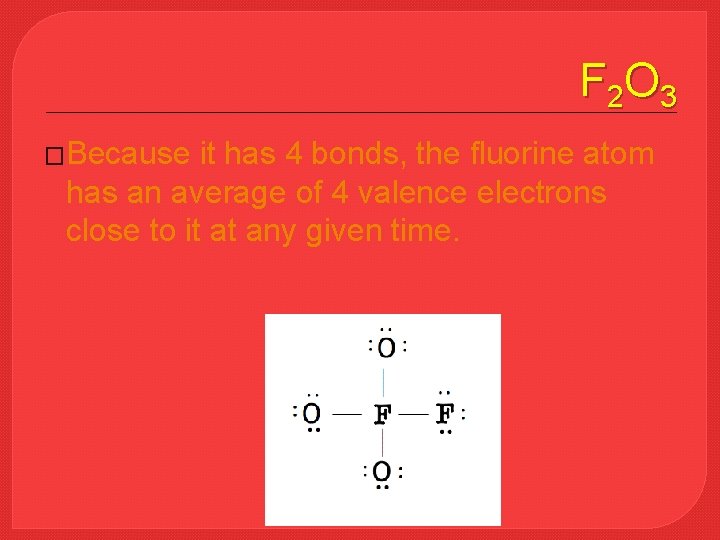
F 2 O 3 �Because it has 4 bonds, the fluorine atom has an average of 4 valence electrons close to it at any given time.
F 2 O 3 �Add the 2 inner electrons from the 1 s orbital, and the fluorine usually has 6 negative electrons to balance its 9 positive protons.
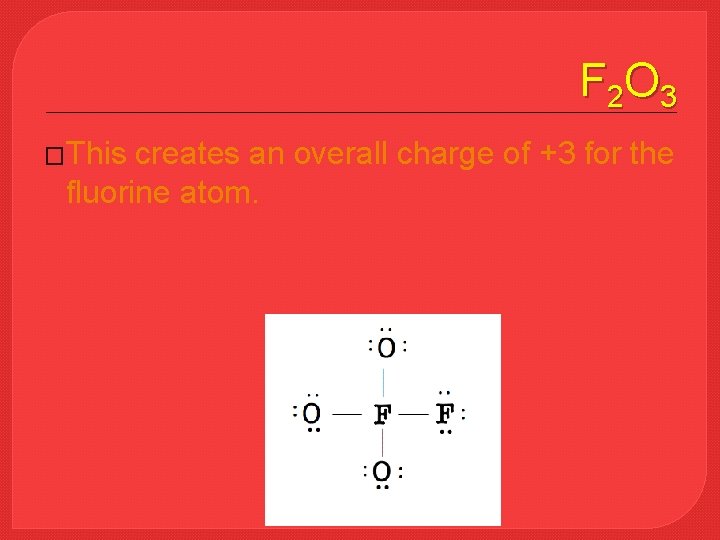
F 2 O 3 �This creates an overall charge of +3 for the fluorine atom.
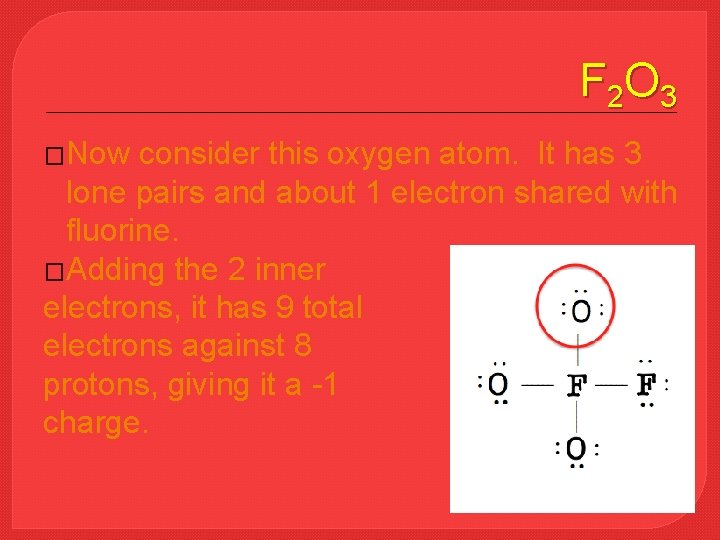
F 2 O 3 �Now consider this oxygen atom. It has 3 lone pairs and about 1 electron shared with fluorine. �Adding the 2 inner electrons, it has 9 total electrons against 8 protons, giving it a -1 charge.
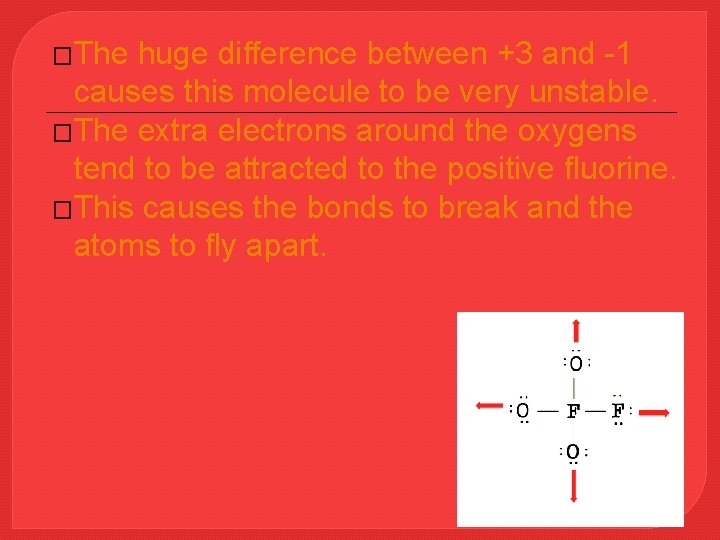
�The huge difference between +3 and -1 causes this molecule to be very unstable. �The extra electrons around the oxygens tend to be attracted to the positive fluorine. �This causes the bonds to break and the atoms to fly apart.
Formal Charge �The charges we assigned to atoms are called formal charges. �Each atom’s formal charge is calculated separately.
Calculating Formal Charges �Note how we counted ALL lone pair electrons as they can only be said to reside at that particular atom. �However, each bond counted as 1 electron because the 2 electrons are shared between 2 atoms. �(A double bond would count as 2 electrons. )
Calculating Formal Charges �Formal Charge = charge of protons + charge or electrons �Note how non-valence shell electrons are automatically cancelled out by protons.
Calculating Formal Charge �The number of protons that are not cancelled out by inner electrons is equal to the group number for IA to VIIIA elements. �Find the number of electrons by counting the number of electrons in a Lewis structure that are DIRECTLY around that atom.
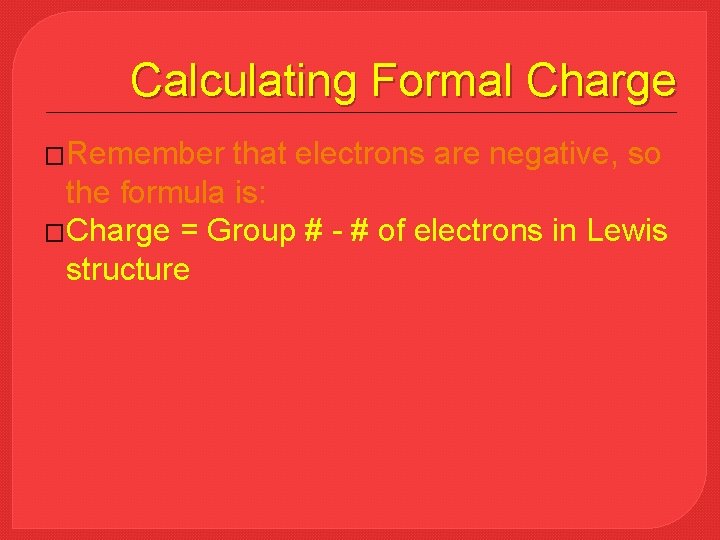
Calculating Formal Charge �Remember that electrons are negative, so the formula is: �Charge = Group # - # of electrons in Lewis structure
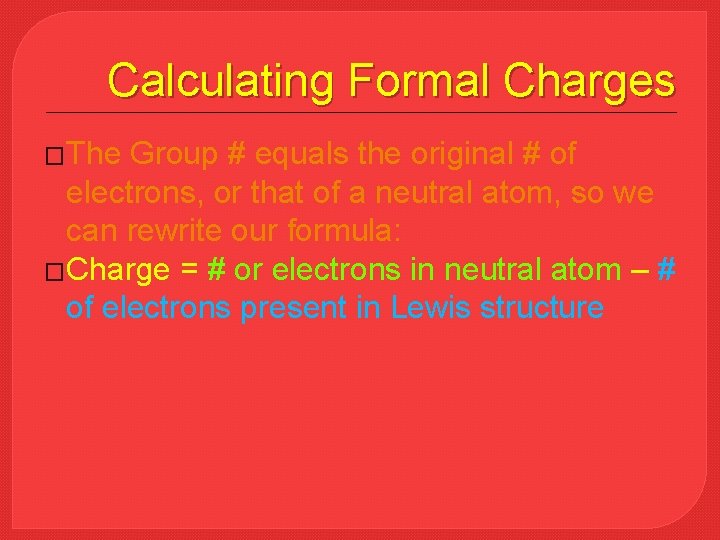
Calculating Formal Charges �The Group # equals the original # of electrons, or that of a neutral atom, so we can rewrite our formula: �Charge = # or electrons in neutral atom – # of electrons present in Lewis structure
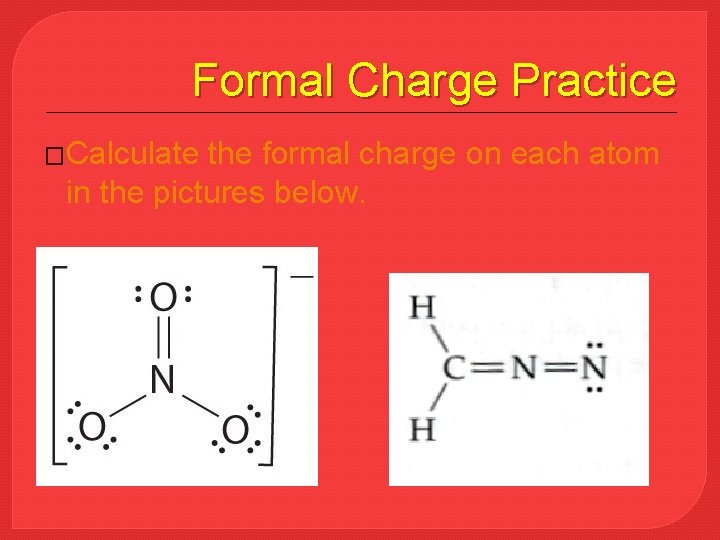
Formal Charge Practice �Calculate the formal charge on each atom in the pictures below.
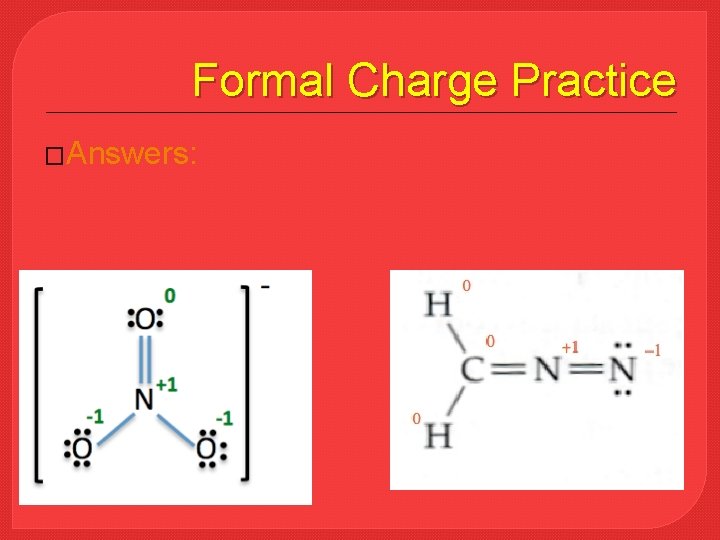
Formal Charge Practice �Answers:
Formal Charges �It helps to “assign” a number to each common atom in your head, so you automatically know that C usually has 4 electrons, N should have 5, S should have 6, Cl 7, and so on.
Formal Charges �A molecule is usually most stable when the formal charges are closest to zero. �If an atom must have a formal charge, try to assign the negative charges to the more elctronegative atoms and the positive charges to the less electronegative atoms.
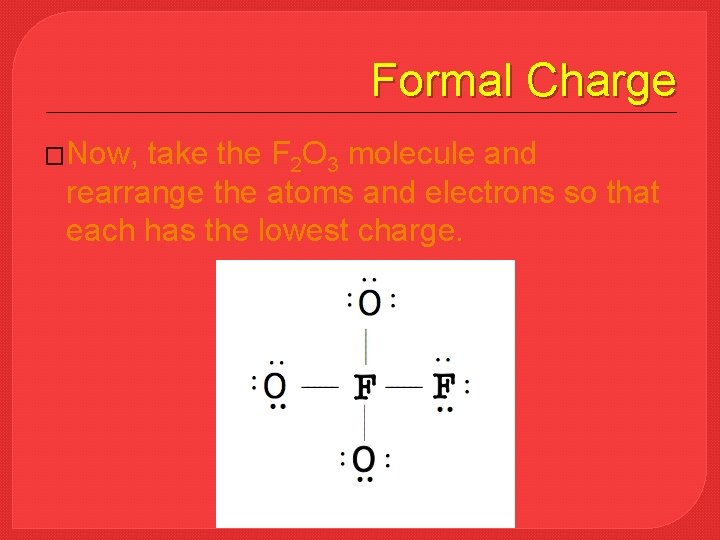
Formal Charge �Now, take the F 2 O 3 molecule and rearrange the atoms and electrons so that each has the lowest charge.
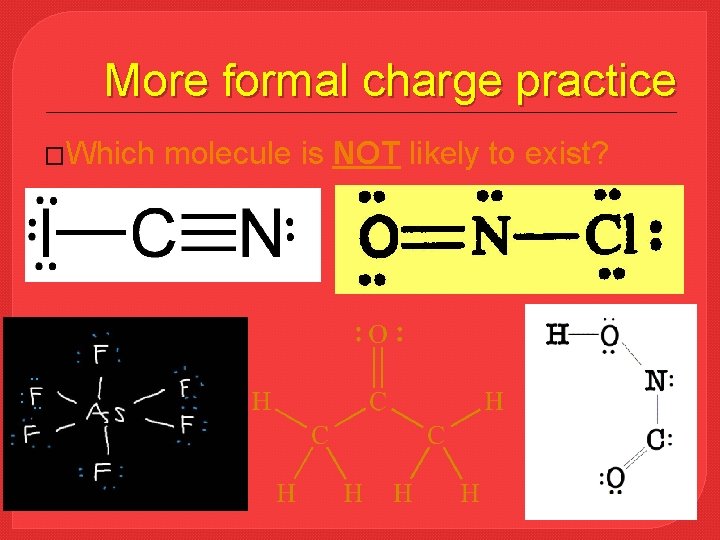
More formal charge practice �Which . . : . . molecule is NOT likely to exist?