
Formal and Informal Writing Considering Your Audience Informal
- Slides: 7
Formal and Informal Writing Considering Your Audience
Informal essays • Based more on personal opinion • Can use “I” – if addressing a personal topic • Narrative essays do not always have an introduction. • May be shorter • Still need to have proper spelling and grammar.
Formal Essays • Formal essays follow an established format 1. Introduction & Thesis 2. Topic Sentences 3. Supporting body paragraphs 4. Restated Thesis & Conclusion
Formal Essays • Do not abbreviate or use contractions (example: can’t, won’t, isn’t, could’ve, doesn’t) • Do not use I, Your, Our, Me, My, etc. These pronouns can be easily replaced with a more formal name or ‘the reader’” • Always have a works cited page also called a bibliography.
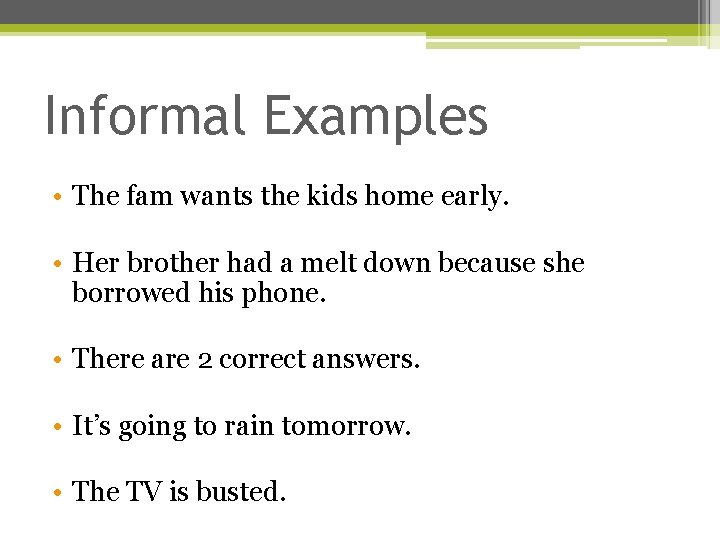
Informal Examples • The fam wants the kids home early. • Her brother had a melt down because she borrowed his phone. • There are 2 correct answers. • It’s going to rain tomorrow. • The TV is busted.
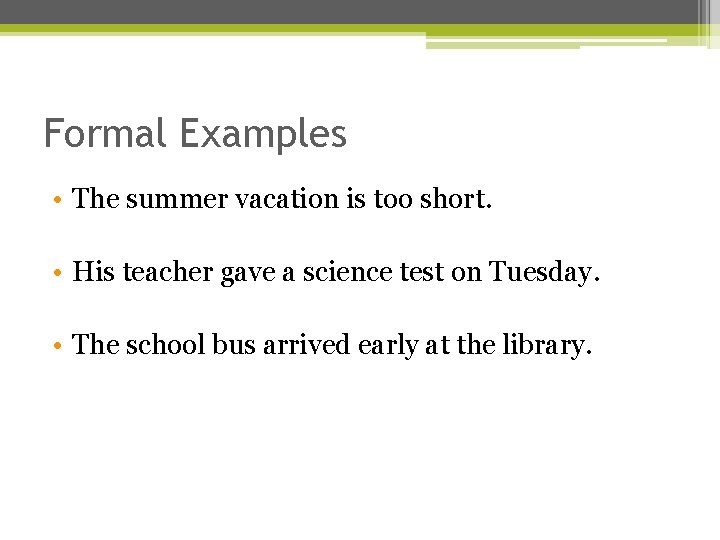
Formal Examples • The summer vacation is too short. • His teacher gave a science test on Tuesday. • The school bus arrived early at the library.
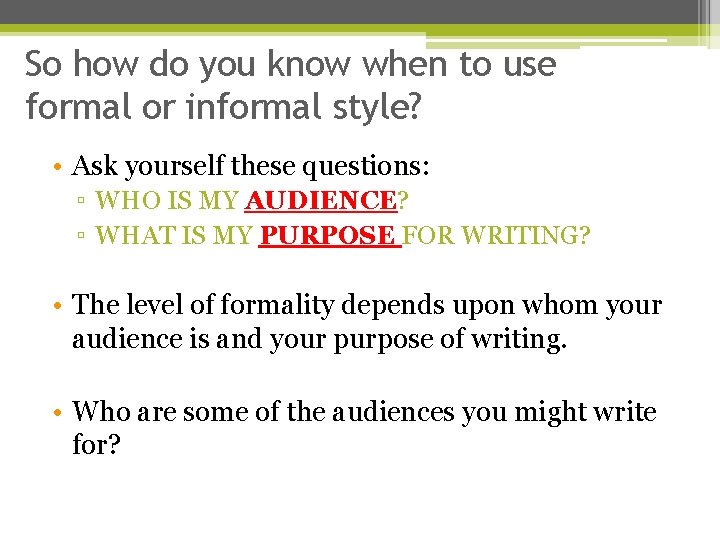
So how do you know when to use formal or informal style? • Ask yourself these questions: ▫ WHO IS MY AUDIENCE? ▫ WHAT IS MY PURPOSE FOR WRITING? • The level of formality depends upon whom your audience is and your purpose of writing. • Who are some of the audiences you might write for?