
FORMAL AND INFORMAL CHANGE TO THE CONSTITUTION FORMAL

- Slides: 6
FORMAL AND INFORMAL CHANGE TO THE CONSTITUTION
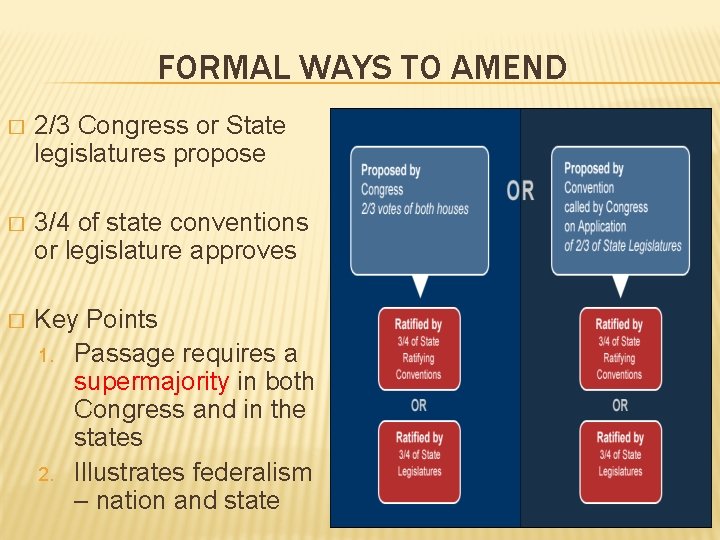
FORMAL WAYS TO AMEND � 2/3 Congress or State legislatures propose � 3/4 of state conventions or legislature approves � Key Points 1. Passage requires a supermajority in both Congress and in the states 2. Illustrates federalism – nation and state
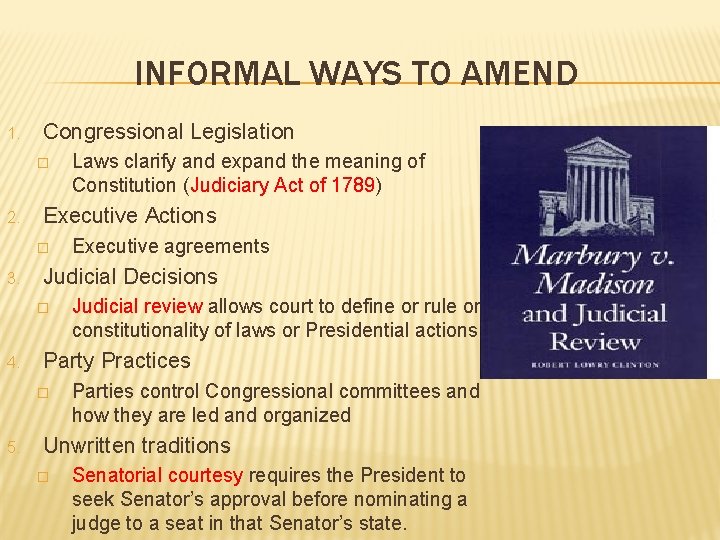
INFORMAL WAYS TO AMEND 1. Congressional Legislation � 2. Executive Actions � 3. Judicial review allows court to define or rule on constitutionality of laws or Presidential actions Party Practices � 5. Executive agreements Judicial Decisions � 4. Laws clarify and expand the meaning of Constitution (Judiciary Act of 1789) Parties control Congressional committees and how they are led and organized Unwritten traditions � Senatorial courtesy requires the President to seek Senator’s approval before nominating a judge to a seat in that Senator’s state.
CHANGING THE CONSTITUTION - FRQ Grading Scale 8 = A+ 7 = A 6 = B+ 5 = B 4 = C+ 3 = C 2=D 1 = F+ � The United States Constitution has endured for more than two centuries as the framework of our government. However, the meaning of our Constitution has been changed by both formal and informal methods. � Identify 2 formal methods for adding amendments to the Constitution. � Describe 2 informal methods that have been used to change the Constitution. Provide one specific example for each informal method you describe. � Explain why informal methods are used more often than the formal amendment process.
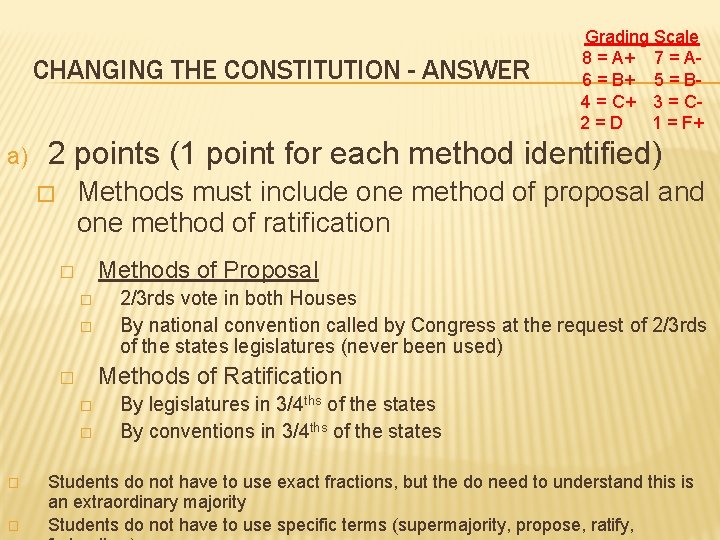
CHANGING THE CONSTITUTION - ANSWER a) 2 points (1 point for each method identified) Methods must include one method of proposal and one method of ratification � Methods of Proposal � � � 2/3 rds vote in both Houses By national convention called by Congress at the request of 2/3 rds of the states legislatures (never been used) Methods of Ratification � � Grading Scale 8 = A+ 7 = A 6 = B+ 5 = B 4 = C+ 3 = C 2=D 1 = F+ By legislatures in 3/4 ths of the states By conventions in 3/4 ths of the states Students do not have to use exact fractions, but the do need to understand this is an extraordinary majority Students do not have to use specific terms (supermajority, propose, ratify,
CHANGING THE CONSTITUTION ANSWER Grading Scale 8 = A+ 7 = A 6 = B+ 5 = B 4 = C+ 3 = C 2=D 1 = F+ a) b) 4 points � � 1 point for each description of informal methods; 1 point for each example Acceptable informal methods � � c) Courts (judicial review/interpretation/application) Elastic clause (legislation by Congress) Development of political customs The example chosen must be linked to the method described 2 points 1 point for basic explanation; 1 point for elaboration (2 points total) � � � Basic explanation (“its harder to amend formally) Second point requires further elaboration