
FORMAL AND INFORMAL ASSESSMENT Mary Stewart Anderson Teaching

- Slides: 26
FORMAL AND INFORMAL ASSESSMENT Mary Stewart Anderson Teaching Strategies Project EDSP 5319 – Dr. Charlotte Fontenot Summer 2015
Formal and Informal Assessment - Content § Key Terms § A Definition of Assessment § Formal Assessment § Examples of Formal Assessment § Informal Assessment § Examples of Informal Assessment § Formal vs. Informal Assessment § Implications for Special Education § My Takeaways Hopkins, B. UCF stands alone in its method of distributing. scantrons (2013). Retrieved from http: //knightnews. com/2013/12/ucf-stands-alone-in-theirmethod-of-distributing-scantrons/
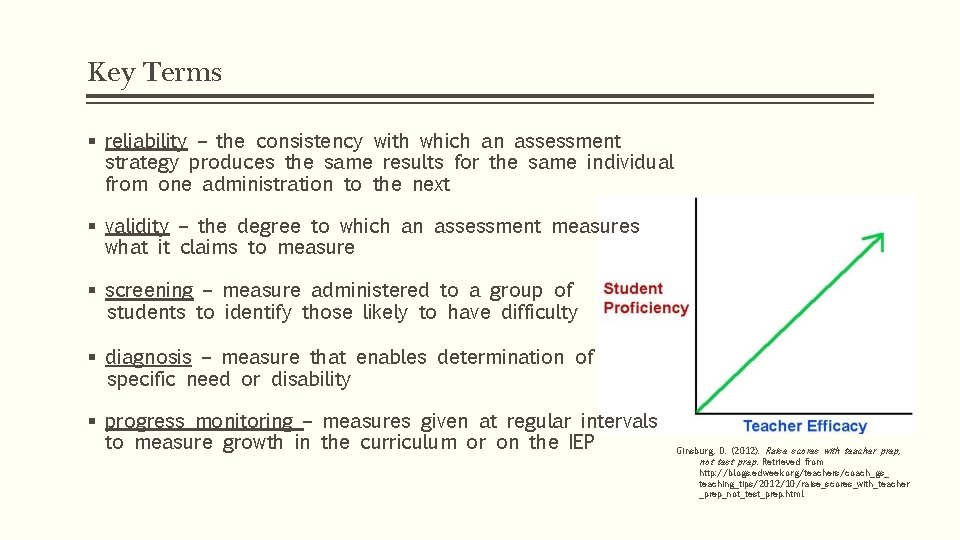
Key Terms § reliability – the consistency with which an assessment strategy produces the same results for the same individual from one administration to the next § validity – the degree to which an assessment measures what it claims to measure § screening – measure administered to a group of students to identify those likely to have difficulty § diagnosis – measure that enables determination of specific need or disability § progress monitoring – measures given at regular intervals to measure growth in the curriculum or on the IEP Ginsburg, D. (2012). Raise scores with teacher prep, not test prep. Retrieved from http: //blogs. edweek. org/teachers/coach_gs_ teaching_tips/2012/10/raise_scores_with_teacher _prep_not_test_prep. html
Key Terms cont’d. § norm-referenced– compare student to large groups of same age/grade peers (uses percentiles) § criterion-referenced – based on curriculum or taught objectives § curriculum-based measurement (CBM) – assessments that are centered around specific objectives taught by the teacher § evaluating student outcomes – measure administered to determine program effectiveness Patricio, R & Von Stamm, B. . (2012). Fun and games – changing the world of innovation assessments. Retrieved from http: //www. innovationmanagement. se /2014/11/03/fun-and-games-changing-theworld-of-innovation-assessments/
A Definition of Assessment § Collects data to determine the effectiveness of instruction § Used to inform instruction – planning and decision-making § Used to improve outcomes for students § 4 specific purposes: § § Lean Enterprise Institute. (2015). Pre-summit workshops. Retrieved from http: //www. lean. org/events/2012_lean_hc_pre_summit_workshops. cfm Screening Diagnosis Progress Monitoring Evaluating Student Outcomes § 2 main categories: Formal and Informal
Formal Assessment • Characteristics: • • Structured Controlled Attempt to plan for extraneous factors Specific protocol • Types: • • Norm-referenced Criterion-referenced • Purposes of Assessment: • • Screening Diagnosis* Progress Monitoring Evaluating Outcomes* Ridley, C. (2015). Assessing the assessment of church planters. Retrieved from http: //www. churchplanting. com/assessing-the-assessment-of-church-planters-do-we-measureup/? doing_wp_cron=1435580638. 1077320575714111328125#. VZE 4403 JDIU
Examples of Formal Assessments – Reading • Stanford Diagnostic Reading Test – 4 th Ed. • • Emerging literacy skills, phonetic analysis, vocabulary, scanning Used to identify strengths and weaknesses in specific reading skills Norm-referenced and criterion-referenced Grades K - 13 Keimer, Courtney. (2015). My fluency Progress Monitoring Graph. • DIBELS: Dynamis Indicators of Basic Early Literacy Skills • • Phonological awareness, alphabetic principle, oral reading fluency Screening and progress-monitoring measure for early literacy development Criterion-referenced Grades K - 6 Retrieved from https: //somedivine intervention. wordpress. com/2013/03/28/myfluency-progress-mon itoring-graph/ • Test of Phonological Awareness Skills • • Phonological awareness: sound comparison, phoneme blending, and phoneme segmentation Used to identify students with problems with phonological awareness Norm-referenced Grades K – 5
Examples of Formal Assessments – Math • Key. Math – 3: Diagnostic Assessment Blair. (2013). Math • • Chapter 6 Test Wednesday. Retrieved from http: //staff. camas. wednet. edu/blogs/ larablair/2013/12/ • • Basic concepts, operations, and applications Used to measure essential mathematical concepts Norm-referenced Grades K - 12 • DIBELS: Dynamis Indicators of Basic Early Literacy Skills • • Comprehensive Mathematical Abilities Test • • Calculations, mathematical reasoning, practical applications Real world problems and higher-level math ability Norm-referenced Grades 2 - 12 • • • Phonological awareness, alphabetic principle, oral reading fluency Screening and progress-monitoring measure for early literacy development Criterion-referenced Grades K - 6
Examples of Formal Assessments - Language • Bankson Language Test – 2 • • Measures receptive and expressive language in morphology, syntax, semantics, and pragmatics Used to identify students low in handwriting readiness compared to peers Screening and Diagnostic Age 3 – 6 years • Test for Auditory Comprehension of Language – 3 • • Assesses receptive language in morphology, syntax, and semantics Focus on auditory comprehension Specific components Age 3 – 9 years Look. For. Diagnosis. com. (2014). Look for diagnosis. Retrieved from http: //www. lookfordiagnosis. com/mesh_info. php? term=Language+Tests&lang=1
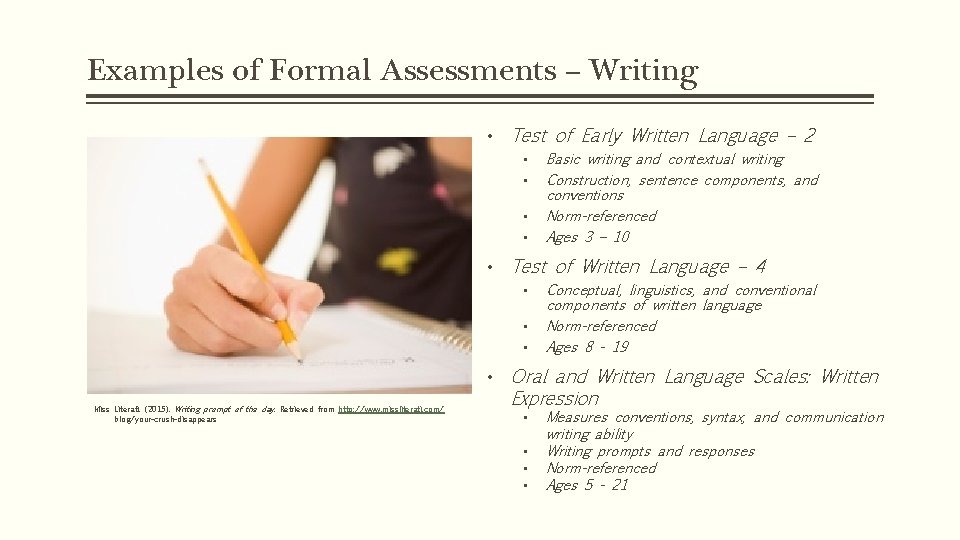
Examples of Formal Assessments – Writing • Test of Early Written Language – 2 • • Basic writing and contextual writing Construction, sentence components, and conventions Norm-referenced Ages 3 – 10 • Test of Written Language – 4 • • • Miss Literati. (2015). Writing prompt of the day. Retrieved from http: //www. missliterati. com/ blog/your-crush-disappears Conceptual, linguistics, and conventional components of written language Norm-referenced Ages 8 - 19 • Oral and Written Language Scales: Written Expression • • Measures conventions, syntax, and communication writing ability Writing prompts and responses Norm-referenced Ages 5 - 21
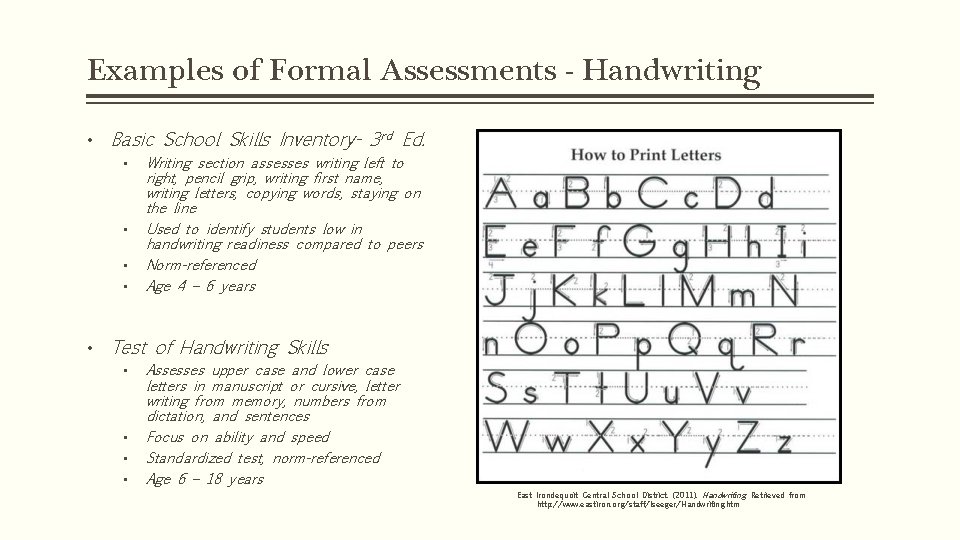
Examples of Formal Assessments - Handwriting • Basic School Skills Inventory- 3 rd Ed. • • Writing section assesses writing left to right, pencil grip, writing first name, writing letters, copying words, staying on the line Used to identify students low in handwriting readiness compared to peers Norm-referenced Age 4 – 6 years • Test of Handwriting Skills • • Assesses upper case and lower case letters in manuscript or cursive, letter writing from memory, numbers from dictation, and sentences Focus on ability and speed Standardized test, norm-referenced Age 6 – 18 years East Irondequoit Central School District. (2011). Handwriting. Retrieved from http: //www. eastiron. org/staff/lseeger/Handwriting. htm
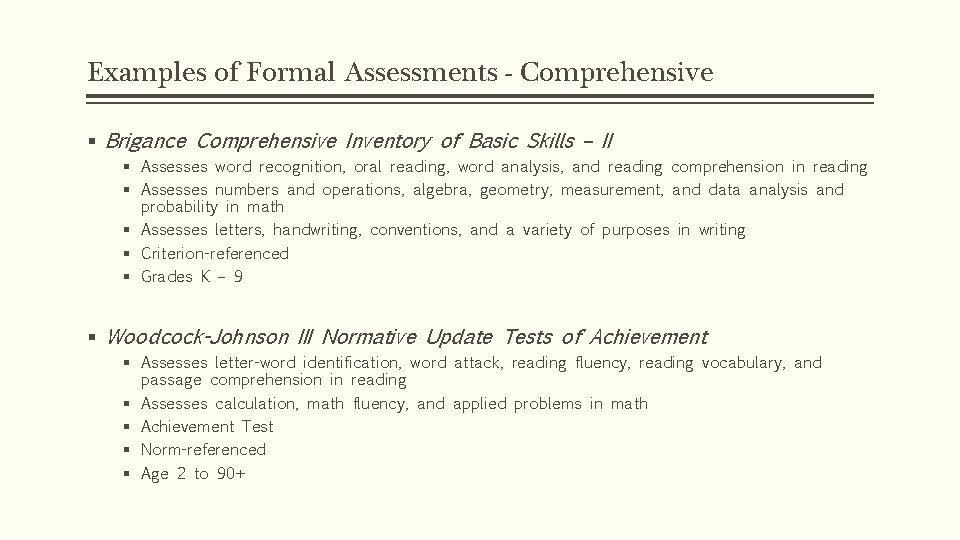
Examples of Formal Assessments - Comprehensive § Brigance Comprehensive Inventory of Basic Skills – II § Assesses word recognition, oral reading, word analysis, and reading comprehension in reading § Assesses numbers and operations, algebra, geometry, measurement, and data analysis and probability in math § Assesses letters, handwriting, conventions, and a variety of purposes in writing § Criterion-referenced § Grades K – 9 § Woodcock-Johnson III Normative Update Tests of Achievement § Assesses letter-word identification, word attack, reading fluency, reading vocabulary, and passage comprehension in reading § Assesses calculation, math fluency, and applied problems in math § Achievement Test § Norm-referenced § Age 2 to 90+
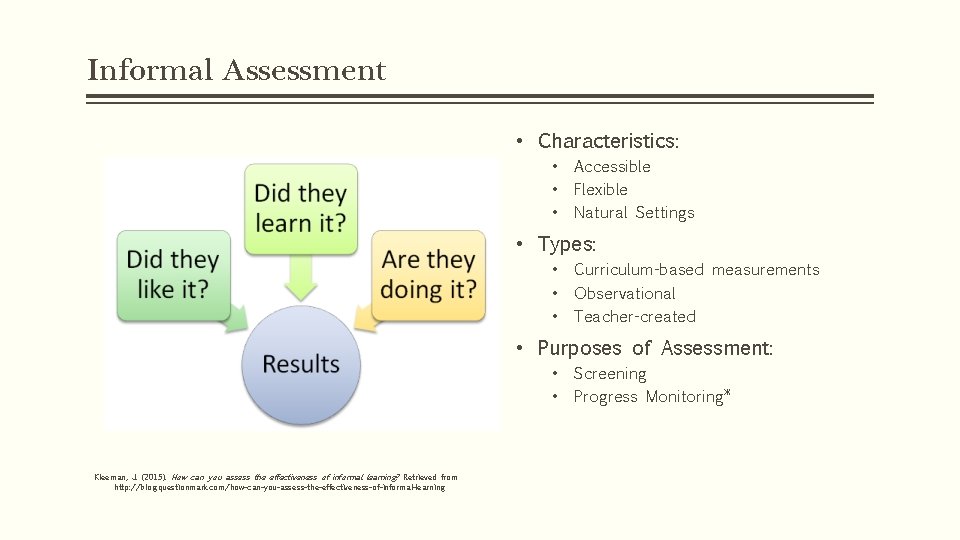
Informal Assessment • Characteristics: • • • Accessible Flexible Natural Settings • Types: • • • Curriculum-based measurements Observational Teacher-created • Purposes of Assessment: • • Kleeman, J. (2015). How can you assess the effectiveness of informal learning? Retrieved from http: //blog. questionmark. com/how-can-you-assess-the-effectiveness-of-informal-learning Screening Progress Monitoring*
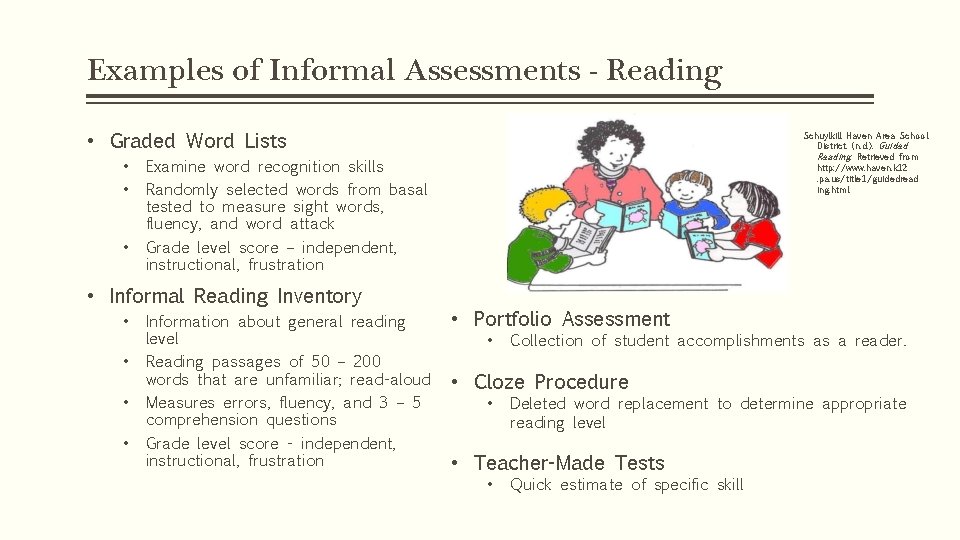
Examples of Informal Assessments - Reading • Graded Word Lists • • • Examine word recognition skills Randomly selected words from basal tested to measure sight words, fluency, and word attack Grade level score – independent, instructional, frustration • Informal Reading Inventory • • Schuylkill Haven Area School District. (n. d. ). Guided Reading. Retrieved from http: //www. haven. k 12. pa. us/title 1/guidedread ing. html Information about general reading level Reading passages of 50 – 200 words that are unfamiliar; read-aloud Measures errors, fluency, and 3 – 5 comprehension questions Grade level score - independent, instructional, frustration • Portfolio Assessment • Collection of student accomplishments as a reader. • Cloze Procedure • Deleted word replacement to determine appropriate reading level • Teacher-Made Tests • Quick estimate of specific skill
Examples of Informal Assessments – Math • Teacher-Constructed Tests • • 6 Red (n. d. ). I love math. Retrieved from http: //6 red shrewsbury. weebly. com /math. html Identify problems, level of understanding, and monitor progress Progresses through levels of understanding: • Concrete • Semiconcrete • Abstract levels • Diagnostic Math Interviews • • • Helps identify specific problems, error patterns, and problem-solving strategies Student expresses their thought process while solving math problems Direct and indirect questioning • Portfolio Assessment • • Collection of student accomplishments in math Open-ended
Examples of Informal Assessments – Language • Tests of Phonology Lansky, A. (2015). Language is a virus. • • Retrieved from http: //amylansky. com/wordpress/ Analyze production of phonemes Direct observation, spontaneous speech • Tests of Morphology • • Brown’s rank of morpheme acquisition Checklists, conversational speech • Tests of Syntax • • • Tests of Pragmatics • • Grammatical analysis Spontaneous speech • Tests of Semantics Analyzing sample of spontaneous speech Transcribe video tape of speech Classify pragmatic function by events before and after Frequency monitoring • • Can be difficult to devise (complex) Checklists on word association and categorization
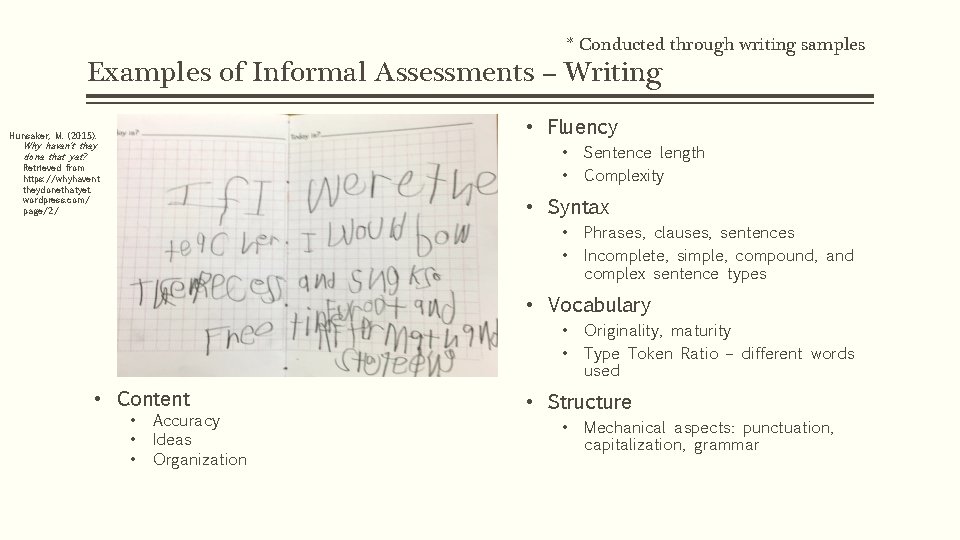
* Conducted through writing samples Examples of Informal Assessments – Writing • Fluency Hunsaker, M. (2015). Why haven’t they done that yet? • • Retrieved from https: //whyhavent theydonethatyet. wordpress. com/ page/2/ Sentence length Complexity • Syntax • • Phrases, clauses, sentences Incomplete, simple, compound, and complex sentence types • Vocabulary • • • Content • • • Accuracy Ideas Organization Originality, maturity Type Token Ratio – different words used • Structure • Mechanical aspects: punctuation, capitalization, grammar
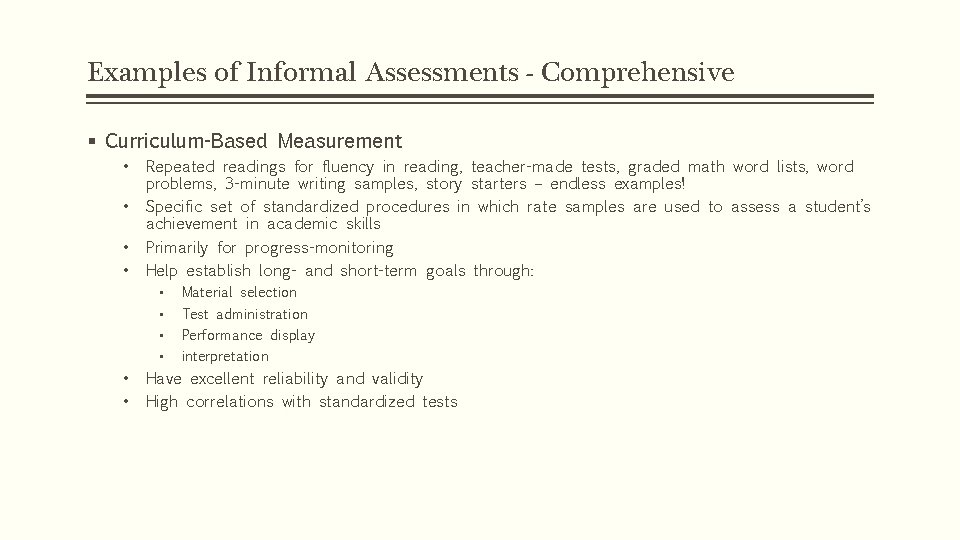
Examples of Informal Assessments - Comprehensive § Curriculum-Based Measurement • • Repeated readings for fluency in reading, teacher-made tests, graded math word lists, word problems, 3 -minute writing samples, story starters – endless examples! Specific set of standardized procedures in which rate samples are used to assess a student’s achievement in academic skills Primarily for progress-monitoring Help establish long- and short-term goals through: • • • Material selection Test administration Performance display interpretation Have excellent reliability and validity High correlations with standardized tests
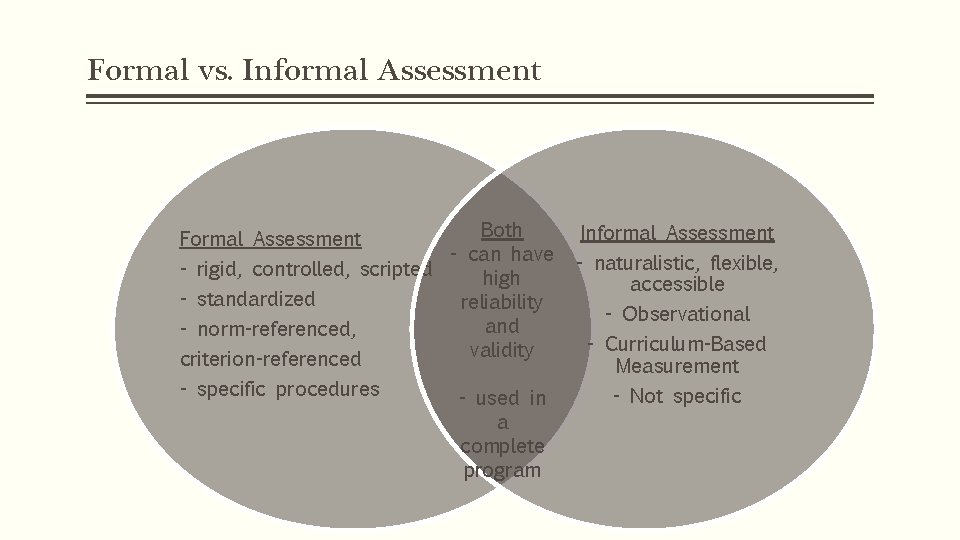
Formal vs. Informal Assessment Both Formal Assessment - can have - rigid, controlled, scripted high - standardized reliability and - norm-referenced, validity criterion-referenced - specific procedures - used in a complete program Informal Assessment - naturalistic, flexible, accessible - Observational - Curriculum-Based Measurement - Not specific
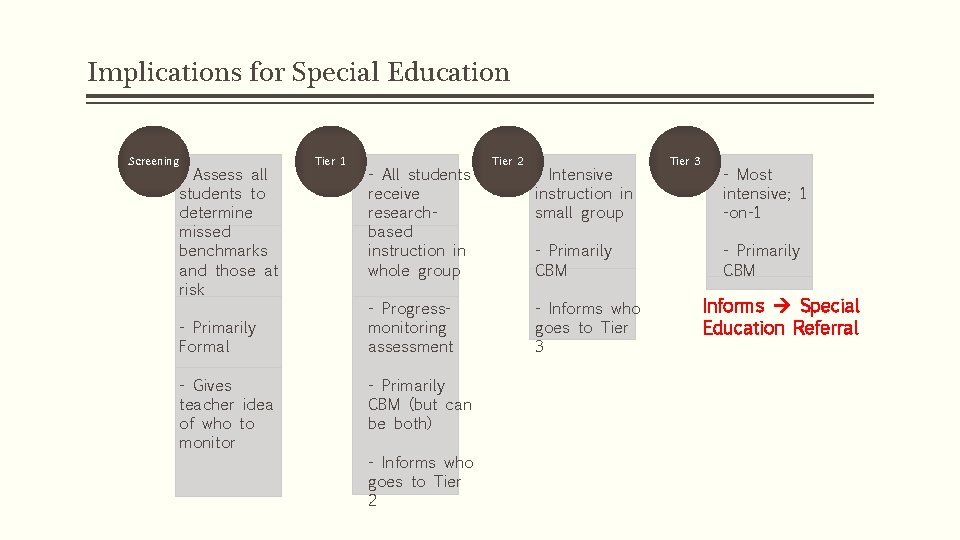
Implications for Special Education Screening - Assess all students to determine missed benchmarks and those at risk - Primarily Formal - Gives teacher idea of who to monitor Tier 1 - All students receive researchbased instruction in whole group - Progressmonitoring assessment - Primarily CBM (but can be both) - Informs who goes to Tier 2 - Intensive instruction in small group - Primarily CBM - Informs who goes to Tier 3 - Most intensive; 1 -on-1 - Primarily CBM Informs Special Education Referral
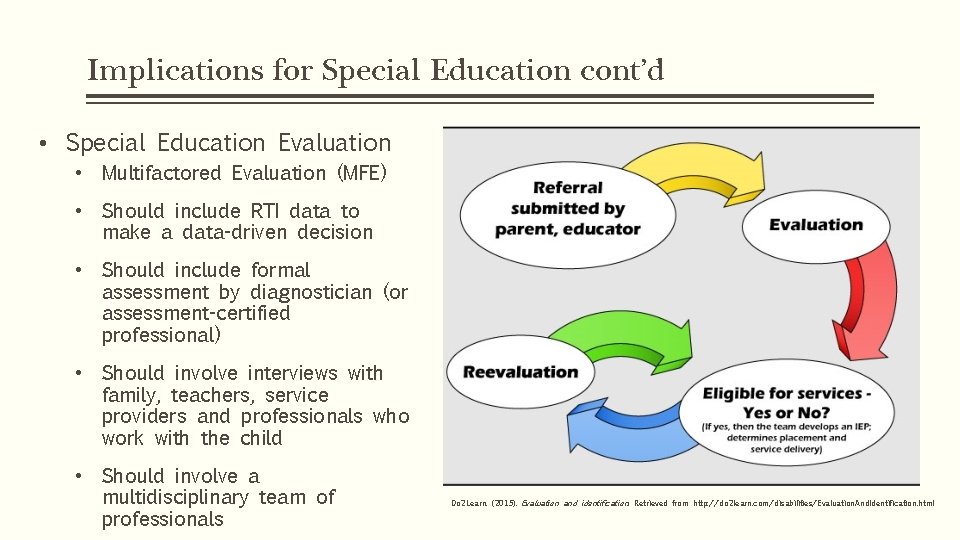
Implications for Special Education cont’d • Special Education Evaluation • Multifactored Evaluation (MFE) • Should include RTI data to make a data-driven decision • Should include formal assessment by diagnostician (or assessment-certified professional) • Should involve interviews with family, teachers, service providers and professionals who work with the child • Should involve a multidisciplinary team of professionals Do 2 Learn. (2015). Evaluation and identification. Retrieved from http: //do 2 learn. com/disabilities/Evaluation. And. Identification. html
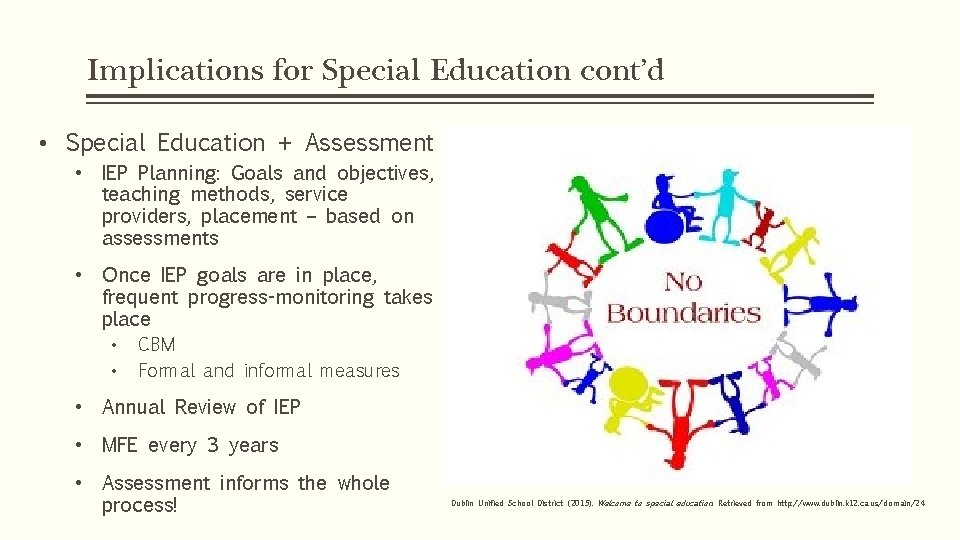
Implications for Special Education cont’d • Special Education + Assessment • IEP Planning: Goals and objectives, teaching methods, service providers, placement – based on assessments • Once IEP goals are in place, frequent progress-monitoring takes place • • CBM Formal and informal measures • Annual Review of IEP • MFE every 3 years • Assessment informs the whole process! Dublin Unified School District. (2015). Welcome to special education. Retrieved from http: //www. dublin. k 12. ca. us/domain/24
MY TAKEAWAYS • Formal and informal assessment are more similar than I originally thought • Assessment is crucial to general education and special education • We need BOTH forms of assessment to ensure that we see the “whole picture” • Neither form of assessment is superior
References Federation for Children with Special Needs. (2015). Assessment. Retrieved from http: //fcsn. org/pti/topics/transition/tools/assessment. pdf Heward, W. (2013). Exceptional children: An introduction to special education. Boston, MA: Pearson. Kagan, S. L. , Shepard, L. , & Wurtz, E. (Eds. ). (1998, February). Principles and Recommendations for Earlyy Childhood Assessments (United States of America, Education, Goal 1 Early Childhood Assessments Resource Group). Retrieved from http: //govinfo. library. unt. edu/negp/reports/prinrec. pdf
References cont’d LD Online. (2015). Assessments for young children. Retrieved from http: //www. ldonline. org/article/6040/ Mercer, C. D. , Mercer, A. R. , & Pullen, P. C. (2011). Teaching students with learning problems. Boston, MA: Pearson. Moersch, C. (2015). A-z informal assessment techniques. Retrieved from http: //mlpinc. net/reading/informal-assessment-strategies-a-z-for-the-math-classroom-b. Ho. html
References cont’d Salvia, J. , Ysseldyke, J. E. , & Bolt, S. (2013). Assessment: In special and inclusive education (12 th ed. ). Southern Early Childhood Association. (2000). Assessing development and learning in young children. Retrieved from http: //www. southernearlychildhood. org/upload/pdf/Assessing_Development. pdf