
Formal and Functional Explanations New Perspective on an
![Formalism vs functionalism l “a central task for linguists [is] characterising the formal relations](https://slidetodoc.com/presentation_image/18875e4c5c2baea347fe8f321bc892a3/image-3.jpg "Formalism vs functionalism l “a central task for linguists [is] characterising the formal relations")
![l Virtual diachronic and synchronic lack of: l *[V O] Aux (Biberauer et al.](https://slidetodoc.com/presentation_image/18875e4c5c2baea347fe8f321bc892a3/image-26.jpg "l Virtual diachronic and synchronic lack of: l *[V O] Aux (Biberauer et al.")
![Demonstratives l In [DP D [Num. P Num [n. P n [NP N ]]]],](https://slidetodoc.com/presentation_image/18875e4c5c2baea347fe8f321bc892a3/image-39.jpg "Demonstratives l In [DP D [Num. P Num [n. P n [NP N ]]]],")
![Definite and indefinite articles Definites: l a. [DP D[uφ]. . . [n. P Art[iφ]](https://slidetodoc.com/presentation_image/18875e4c5c2baea347fe8f321bc892a3/image-40.jpg "Definite and indefinite articles Definites: l a. [DP D[uφ]. . . [n. P Art[iφ]")
![Weak and strong quantifiers Weak quantifiers: l [DP D[uφ] [Num. P [Num some ]](https://slidetodoc.com/presentation_image/18875e4c5c2baea347fe8f321bc892a3/image-41.jpg "Weak and strong quantifiers Weak quantifiers: l [DP D[uφ] [Num. P [Num some ]")
- Slides: 46
Formal and Functional Explanations: New Perspective on an Old Debate Ian Roberts University of Cambridge igr 20@cam. ac. uk
Outline l Some general reflections l No-choice parameters l U 20 effects l Diachronic filters? l Why do we Agree? l Why we should agree
Formalism vs functionalism l “a central task for linguists [is] characterising the formal relations among grammatical elements independently of any semantic or pragmatic properties of those elements” l “the function of conveying meaning (in its broadest sense) has so affected grammatical form that it is senseless to compartmentalize it. ” (Newmeyer 1998: 7).
Extreme formalism l No connection between grammar and meaning l But of course most formal theories assume some kind of compositional mapping from syntax to semantics l Unclear if anyone really holds the logically most extreme view
Extreme functionalism l “Advocates of this approach believe that all of grammar can be derived from semantic and discourse factors” l “very few linguists of any theoretical stripe believe such an approach to be tenable” (Newmeyer 1998: 17 -8, emphasis original)
Mixed approaches l are what just about everyone really seems to adopt in practice l The differences among approaches have to do with the degree of explanatory burden carried by formal or functional notions, and so in part with the notion of explanation itself
A general view l The juxtaposition of formal and functional is misleading – commonalities and asymmetries across human languages are shaped by both formal constraints and functional pressures (cf. Newmeyer 2002, 2003, 2005, Anderson 2008, Haspelmath 2008, Nichols 2008, Kiparsky 2008)
Beyond explanatory adequacy? Three factors in language design l Chomsky (2005: 6) - there are ‘three factors’ affecting “the growth of language in the individual”: i. the genetic endowment (UG); ii. experience; iii. “principles not specific to the faculty of language”.
Third factors l Non-domain-specific cognitive capacities l Economy/optimisation strategies l Natural law l “Performance” factors v. All the above offer ways to introduce “functional” explanations into formal linguistics, in some cases in a novel way
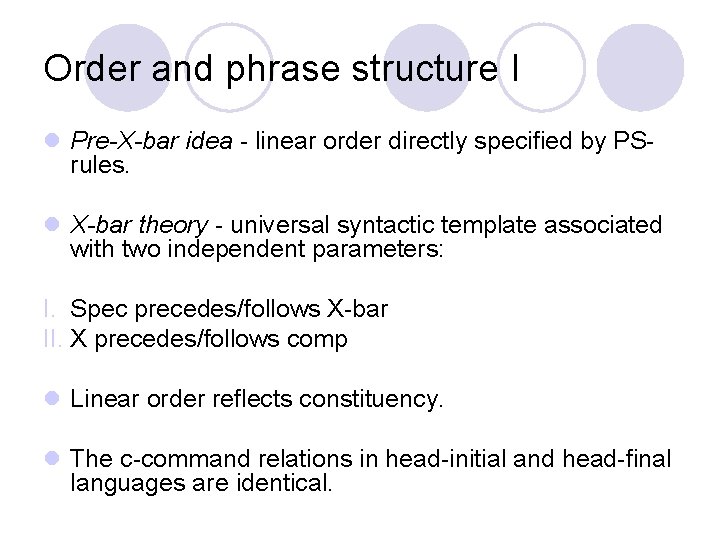
Order and phrase structure I l Pre-X-bar idea - linear order directly specified by PSrules. l X-bar theory - universal syntactic template associated with two independent parameters: I. Spec precedes/follows X-bar II. X precedes/follows comp l Linear order reflects constituency. l The c-command relations in head-initial and head-final languages are identical.
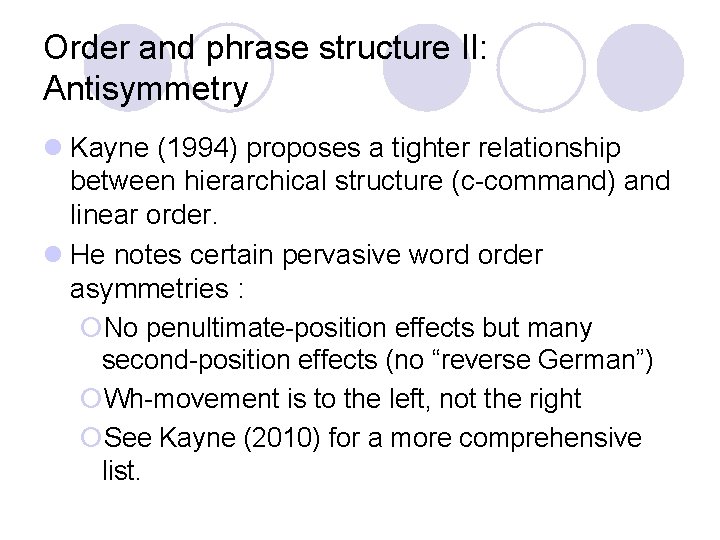
Order and phrase structure II: Antisymmetry l Kayne (1994) proposes a tighter relationship between hierarchical structure (c-command) and linear order. l He notes certain pervasive word order asymmetries : ¡No penultimate-position effects but many second-position effects (no “reverse German”) ¡Wh-movement is to the left, not the right ¡See Kayne (2010) for a more comprehensive list.
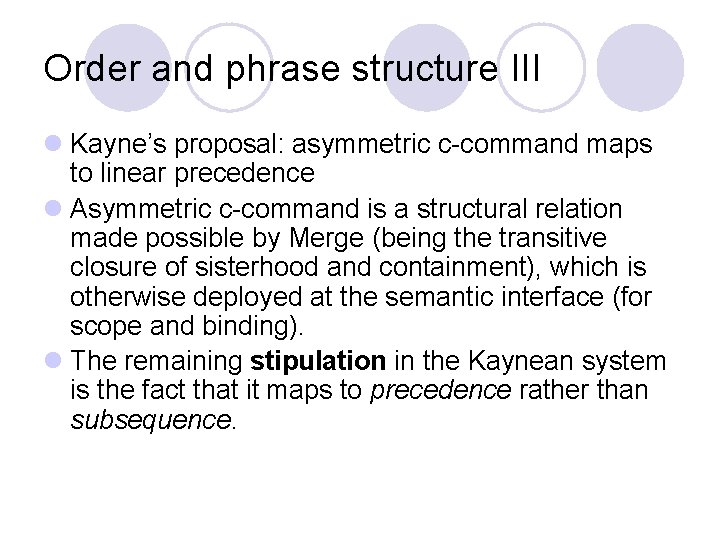
Order and phrase structure III l Kayne’s proposal: asymmetric c-command maps to linear precedence l Asymmetric c-command is a structural relation made possible by Merge (being the transitive closure of sisterhood and containment), which is otherwise deployed at the semantic interface (for scope and binding). l The remaining stipulation in the Kaynean system is the fact that it maps to precedence rather than subsequence.
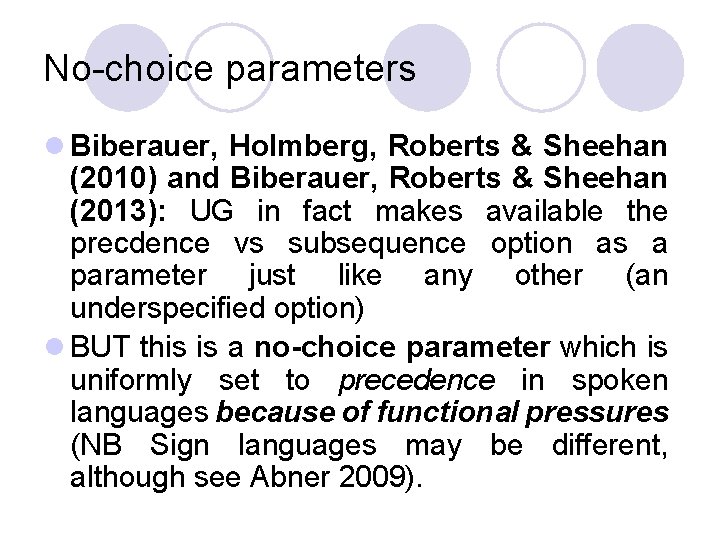
No-choice parameters l Biberauer, Holmberg, Roberts & Sheehan (2010) and Biberauer, Roberts & Sheehan (2013): UG in fact makes available the precdence vs subsequence option as a parameter just like any other (an underspecified option) l BUT this is a no-choice parameter which is uniformly set to precedence in spoken languages because of functional pressures (NB Sign languages may be different, although see Abner 2009).
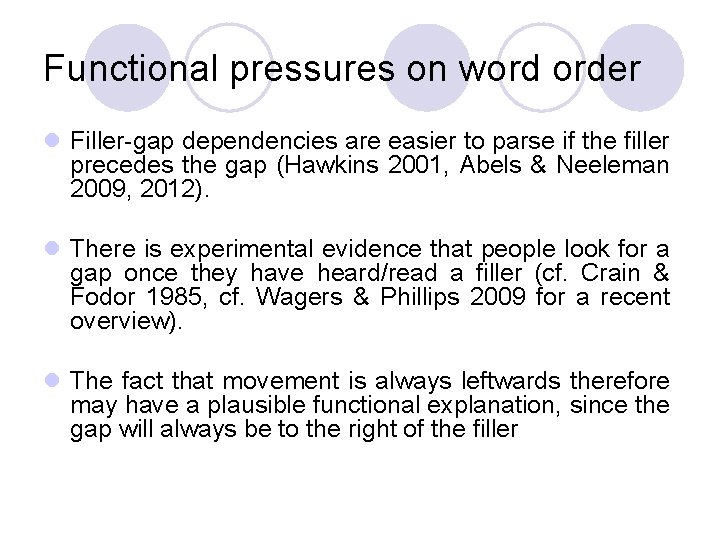
Functional pressures on word order l Filler-gap dependencies are easier to parse if the filler precedes the gap (Hawkins 2001, Abels & Neeleman 2009, 2012). l There is experimental evidence that people look for a gap once they have heard/read a filler (cf. Crain & Fodor 1985, cf. Wagers & Phillips 2009 for a recent overview). l The fact that movement is always leftwards therefore may have a plausible functional explanation, since the gap will always be to the right of the filler
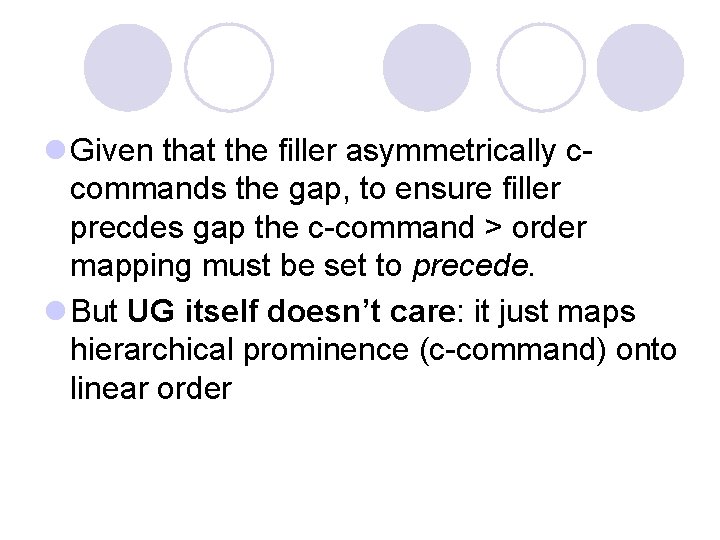
l Given that the filler asymmetrically ccommands the gap, to ensure filler precdes gap the c-command > order mapping must be set to precede. l But UG itself doesn’t care: it just maps hierarchical prominence (c-command) onto linear order
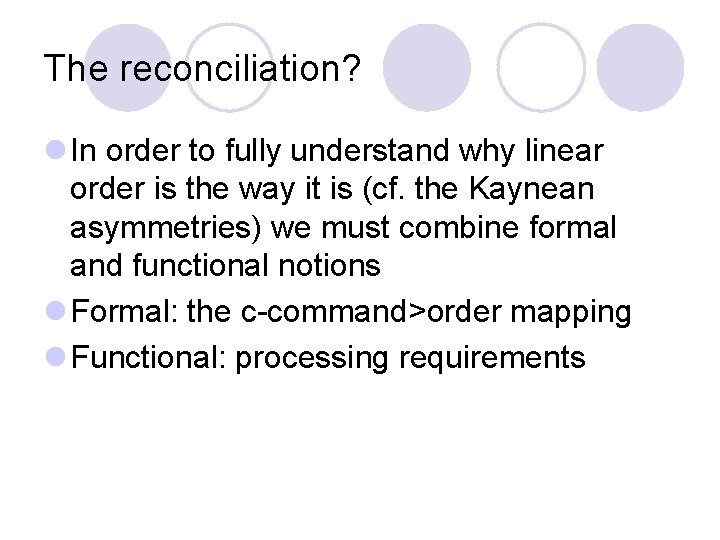
The reconciliation? l In order to fully understand why linear order is the way it is (cf. the Kaynean asymmetries) we must combine formal and functional notions l Formal: the c-command>order mapping l Functional: processing requirements
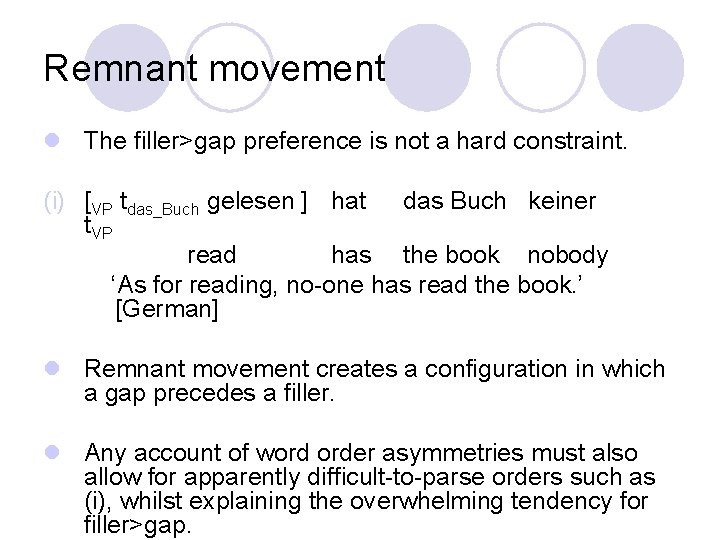
Remnant movement l The filler>gap preference is not a hard constraint. (i) [VP tdas_Buch gelesen ] hat das Buch keiner t. VP read has the book nobody ‘As for reading, no-one has read the book. ’ [German] l Remnant movement creates a configuration in which a gap precedes a filler. l Any account of word order asymmetries must also allow for apparently difficult-to-parse orders such as (i), whilst explaining the overwhelming tendency for filler>gap.
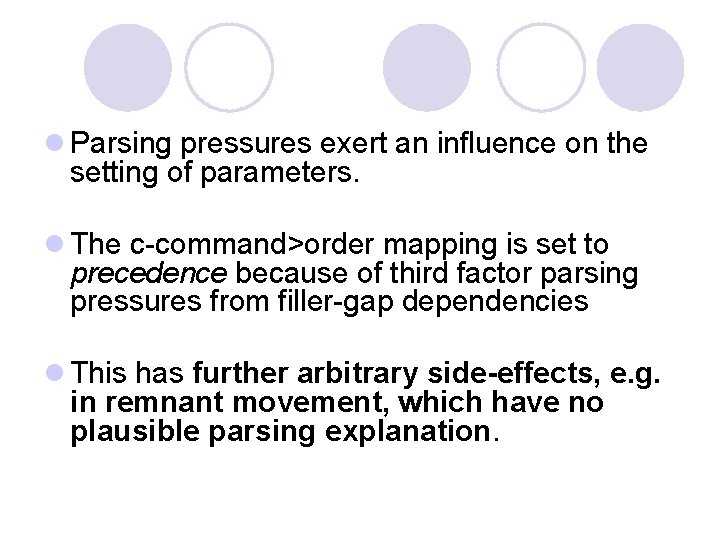
l Parsing pressures exert an influence on the setting of parameters. l The c-command>order mapping is set to precedence because of third factor parsing pressures from filler-gap dependencies l This has further arbitrary side-effects, e. g. in remnant movement, which have no plausible parsing explanation.
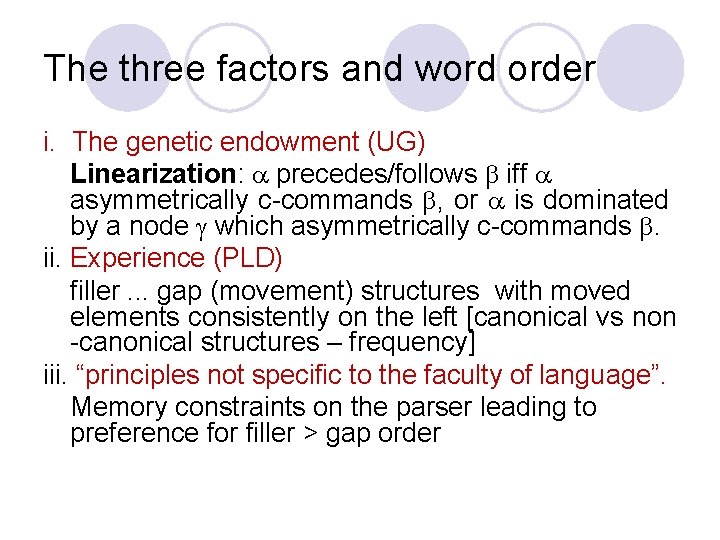
The three factors and word order i. The genetic endowment (UG) Linearization: a precedes/follows b iff a asymmetrically c-commands b, or a is dominated by a node g which asymmetrically c-commands b. ii. Experience (PLD) filler. . . gap (movement) structures with moved elements consistently on the left [canonical vs non -canonical structures – frequency] iii. “principles not specific to the faculty of language”. Memory constraints on the parser leading to preference for filler > gap order
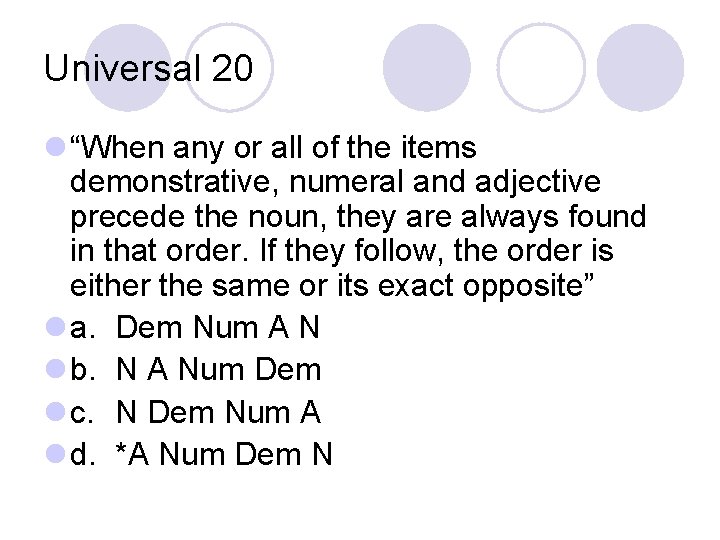
Universal 20 l “When any or all of the items demonstrative, numeral and adjective precede the noun, they are always found in that order. If they follow, the order is either the same or its exact opposite” l a. Dem Num A N l b. N A Num Dem l c. N Dem Num A l d. *A Num Dem N
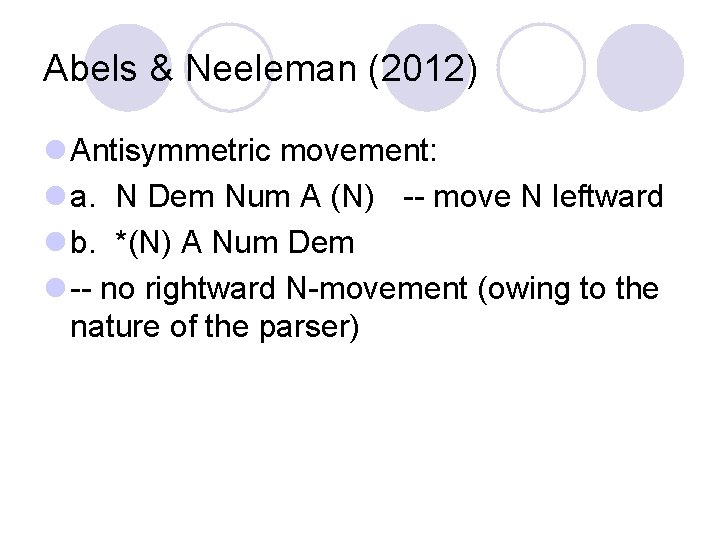
Abels & Neeleman (2012) l Antisymmetric movement: l a. N Dem Num A (N) -- move N leftward l b. *(N) A Num Dem l -- no rightward N-movement (owing to the nature of the parser)
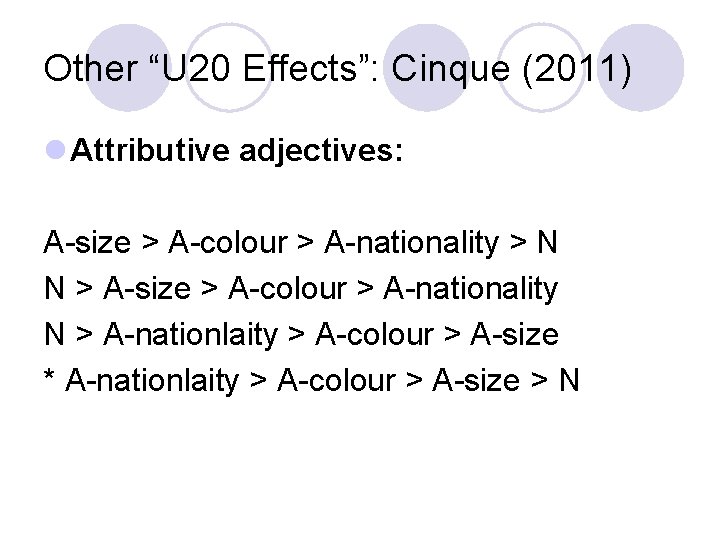
Other “U 20 Effects”: Cinque (2011) l Attributive adjectives: A-size > A-colour > A-nationality > N N > A-size > A-colour > A-nationality N > A-nationlaity > A-colour > A-size * A-nationlaity > A-colour > A-size > N
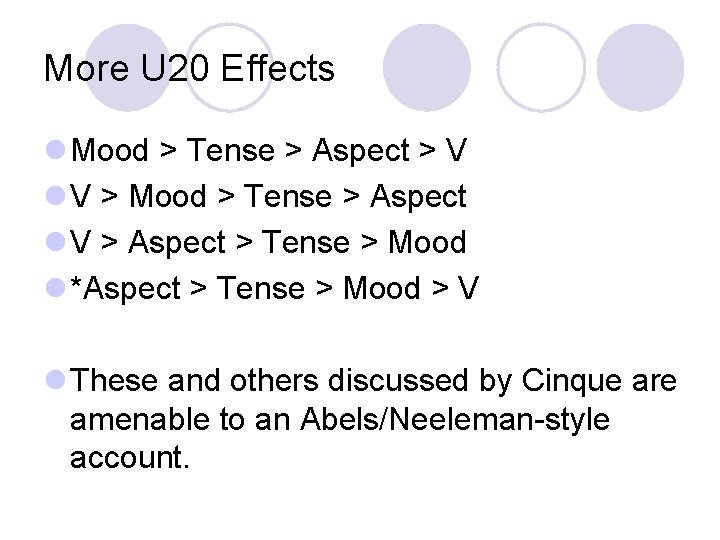
More U 20 Effects l Mood > Tense > Aspect > V l V > Mood > Tense > Aspect l V > Aspect > Tense > Mood l *Aspect > Tense > Mood > V l These and others discussed by Cinque are amenable to an Abels/Neeleman-style account.
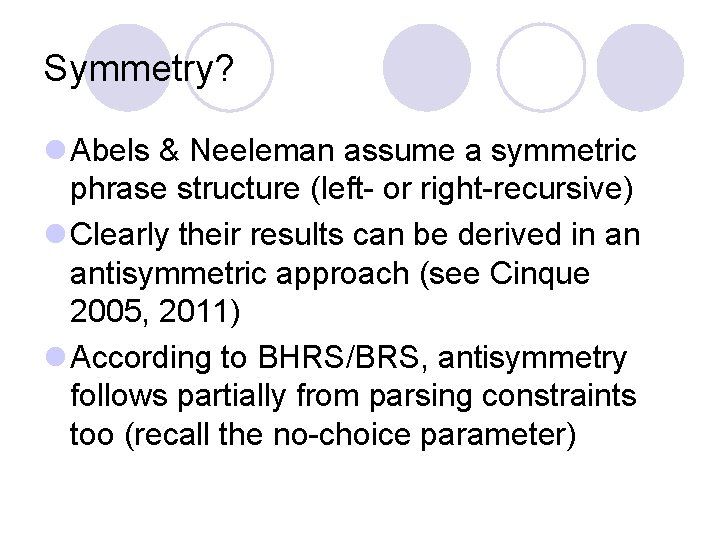
Symmetry? l Abels & Neeleman assume a symmetric phrase structure (left- or right-recursive) l Clearly their results can be derived in an antisymmetric approach (see Cinque 2005, 2011) l According to BHRS/BRS, antisymmetry follows partially from parsing constraints too (recall the no-choice parameter)
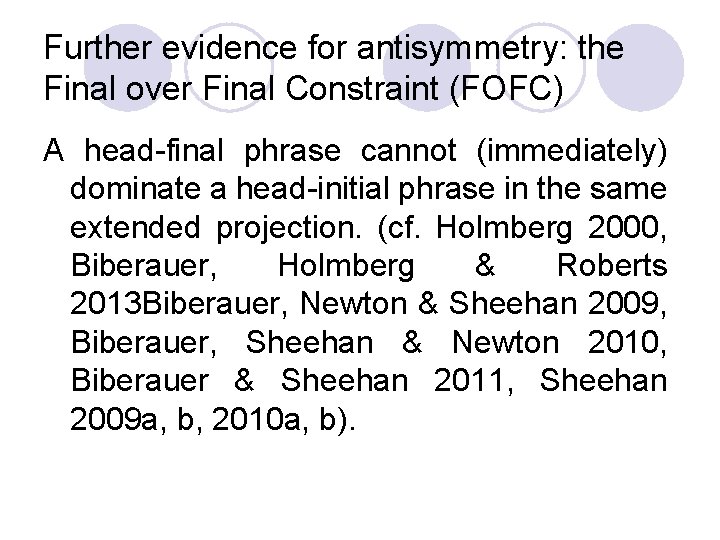
Further evidence for antisymmetry: the Final over Final Constraint (FOFC) A head-final phrase cannot (immediately) dominate a head-initial phrase in the same extended projection. (cf. Holmberg 2000, Biberauer, Holmberg & Roberts 2013 Biberauer, Newton & Sheehan 2009, Biberauer, Sheehan & Newton 2010, Biberauer & Sheehan 2011, Sheehan 2009 a, b, 2010 a, b).
l Virtual diachronic and synchronic lack of: l *[V O] Aux (Biberauer et al. 2007 et seq. ) l *[V O]. . . C (Hawkins 1994, Kayne 1994) l *[C TP] V(Dryer 2008, Biberauer & Sheehan 2011) l *[Q TP] C (Biberauer, Sheehan & Newton 2010) l *[Asp V] V (Julien 2002, 2007)
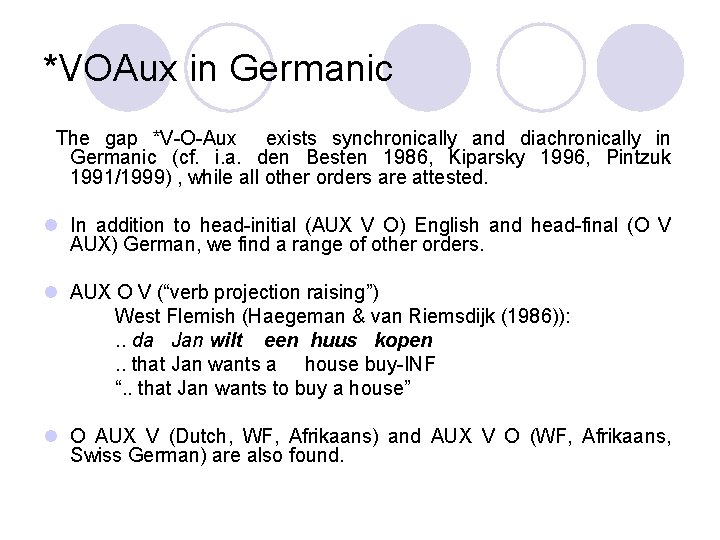
*VOAux in Germanic The gap *V-O-Aux exists synchronically and diachronically in Germanic (cf. i. a. den Besten 1986, Kiparsky 1996, Pintzuk 1991/1999) , while all other orders are attested. l In addition to head-initial (AUX V O) English and head-final (O V AUX) German, we find a range of other orders. l AUX O V (“verb projection raising”) West Flemish (Haegeman & van Riemsdijk (1986)): . . da Jan wilt een huus kopen. . that Jan wants a house buy-INF “. . that Jan wants to buy a house” l O AUX V (Dutch, WF, Afrikaans) and AUX V O (WF, Afrikaans, Swiss German) are also found.
FOFC and Antisymmetry l FOFC shows that head-final order is more constrained that head-initial order. l In the antisymmetric approach, head-final order is necessarily derived and so is expected to be more constrained. l FOFC can therefore be seen as a side-effect of antisymmetry (see in particular Biberauer, Holmberg & Roberts 2013 for more on this).
Cultural Evolution l Deacon (1997): biological evolution gives a “flexible mind” (logic, recursion, memory) l Languages have evolved as independent replicators (transmitted culturally) l “very simple learning algorithms can generate apparent linguistic universals due the ‘cultural evolutionary’ pressure for ease of learning” (Mac. Mahon & Mac. Mahon 2012: 263; see also Kirby 1999).
Cultural Evolution l Concept highly dubious: no clear unit of heredity (Dawkins’ 1986 meme? ) l Deacon’s account presupposes logic and recursion l Mac. M & Mac. M define neither “ease” nor “learning”; presupposes the mental capacities we’re supposed to be explaining l Moving towards relating historical language change to evolutionary change
Cultural evolution and diachrony l possibility of continuing cultural evolution after ex -Africa migration should predict vast regional differences – not found l Diachronic change does not obviously remove variants for good: cyclic changes/homoplasy (see Ringe, Warner & Taylor 2005) l E. g. null subjects in Latin (yes), Medieval Veneto (no), Modern Veneto (yes) (Poletto 1995)
Evolution and diachrony “Confusion about these matters could be overcome by replacing the metaphoric notions “evolution of language” and “language change” by their more exact counterparts: evolution of the organisms that use language, and change in the ways they do so. In these more accurate terms, emergence of the language faculty involved evolution, while historical change (which continues constantly) does not. ” (Berwick & Chomsky, 2011: 15 -6).
Time l Comparative reconstruction only reliable to about 8000 y. BP (roughly date of Afro-Asiatic) l Nichols (1998): current diversity must have begun ca 100, 000 y. BP l “Gap” of 40, 000 -90, 000 years – most of human existence l But no reason to think biological evolution affected language faculty in that time (lack of attested dramatic typological variation; lack of time for natural selection to have effects)
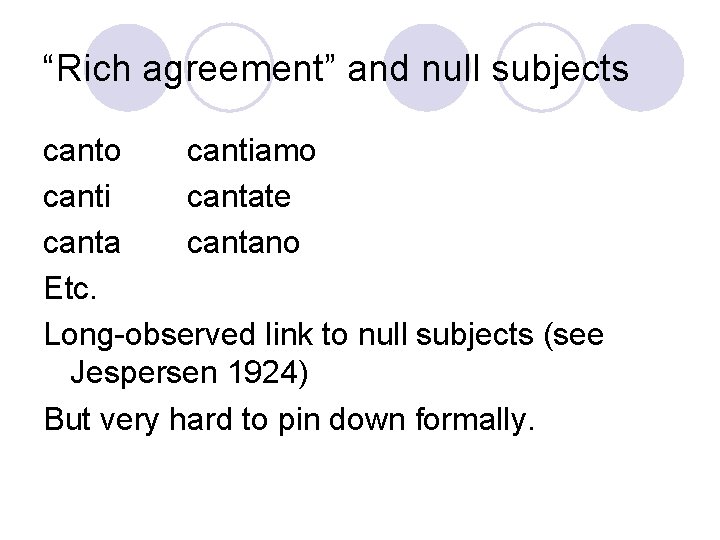
“Rich agreement” and null subjects canto cantiamo canti cantate cantano Etc. Long-observed link to null subjects (see Jespersen 1924) But very hard to pin down formally.
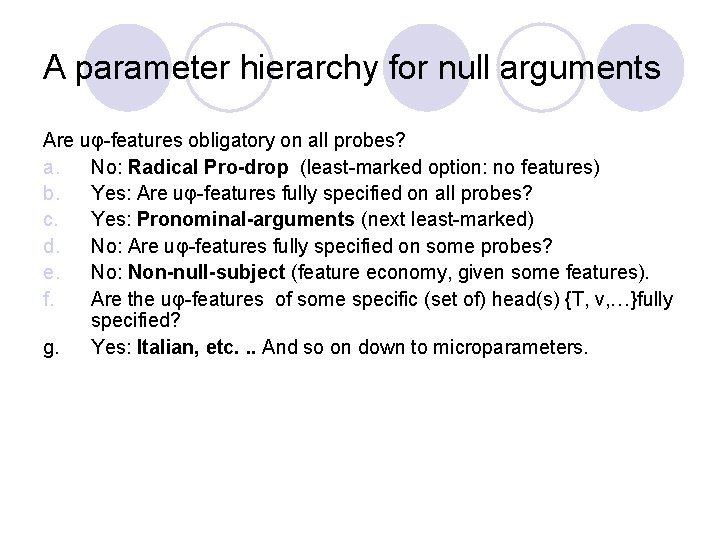
A parameter hierarchy for null arguments Are uφ-features obligatory on all probes? a. No: Radical Pro-drop (least-marked option: no features) b. Yes: Are uφ-features fully specified on all probes? c. Yes: Pronominal-arguments (next least-marked) d. No: Are uφ-features fully specified on some probes? e. No: Non-null-subject (feature economy, given some features). f. Are the uφ-features of some specific (set of) head(s) {T, v, …}fully specified? g. Yes: Italian, etc. . . And so on down to microparameters.
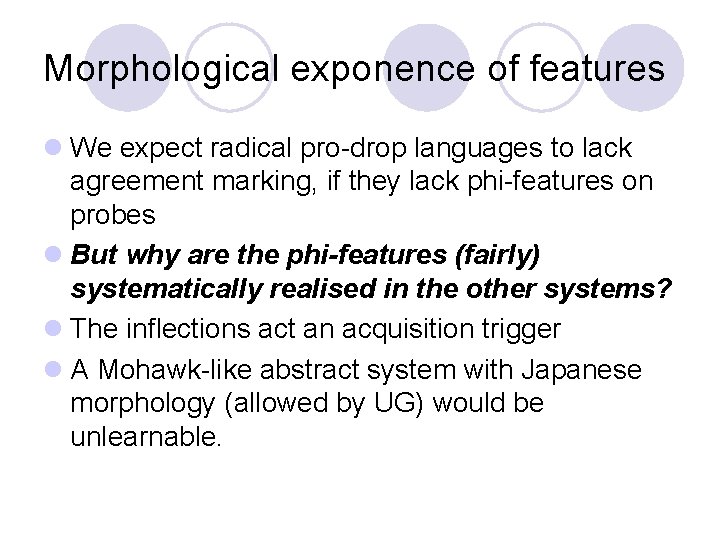
Morphological exponence of features l We expect radical pro-drop languages to lack agreement marking, if they lack phi-features on probes l But why are the phi-features (fairly) systematically realised in the other systems? l The inflections act an acquisition trigger l A Mohawk-like abstract system with Japanese morphology (allowed by UG) would be unlearnable.
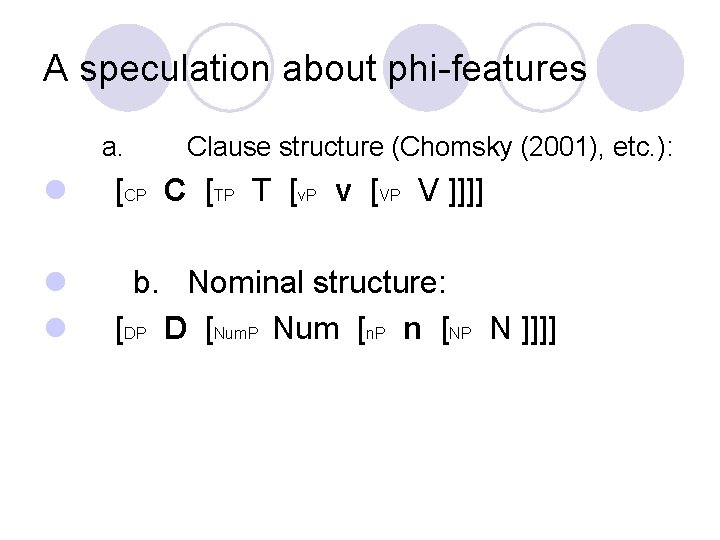
A speculation about phi-features a. Clause structure (Chomsky (2001), etc. ): l [CP C [TP T [v. P v [VP V ]]]] l l b. Nominal structure: [DP D [Num. P Num [n. P n [NP N ]]]]
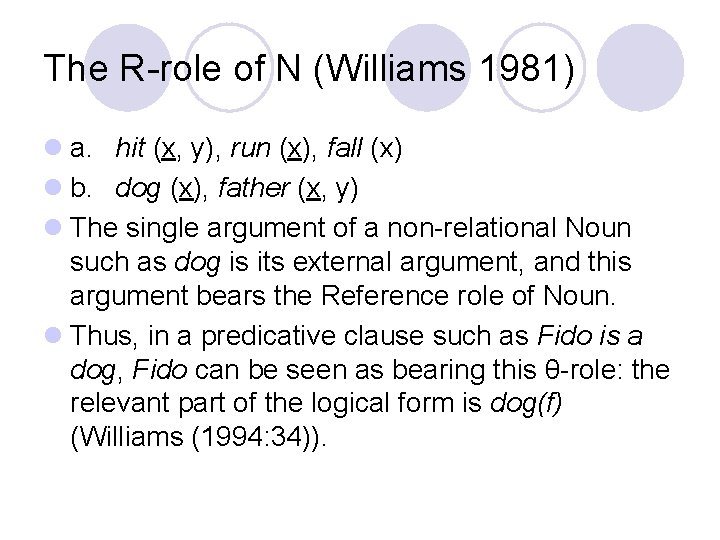
The R-role of N (Williams 1981) l a. hit (x, y), run (x), fall (x) l b. dog (x), father (x, y) l The single argument of a non-relational Noun such as dog is its external argument, and this argument bears the Reference role of Noun. l Thus, in a predicative clause such as Fido is a dog, Fido can be seen as bearing this θ-role: the relevant part of the logical form is dog(f) (Williams (1994: 34)).
Demonstratives l In [DP D [Num. P Num [n. P n [NP N ]]]], the R-role is assigned to Spec, n. P l Dem can occupy Spec, n. P as Dem is able to form a “logically proper name”. l In other words, Dem is able to directly establish the reference of NP without the intermediary of a propositional function, i. e. some form of quantification, what Russell (1905) called a “description”. l In many (but not all) languages, Dem raises to Spec. DP.
Definite and indefinite articles Definites: l a. [DP D[uφ]. . . [n. P Art[iφ] [ n [NP N. . ]]]] l b. [DP Art[iφ]+D[uφ]. . . [n. P (Art[iφ]) [ n [NP N. . ]]]] Indefinites: [DP D[uφ] [Num. P [Num a ] [n. P pro/x [ n [NP N. . ]]]]
Weak and strong quantifiers Weak quantifiers: l [DP D[uφ] [Num. P [Num some ] [n. P pro/x [ n [NP N. . Strong quantifiers: [DP every D[uφ] [Num. P Num [n. P (every) = pro/x [ n [NP N. . ]]]]
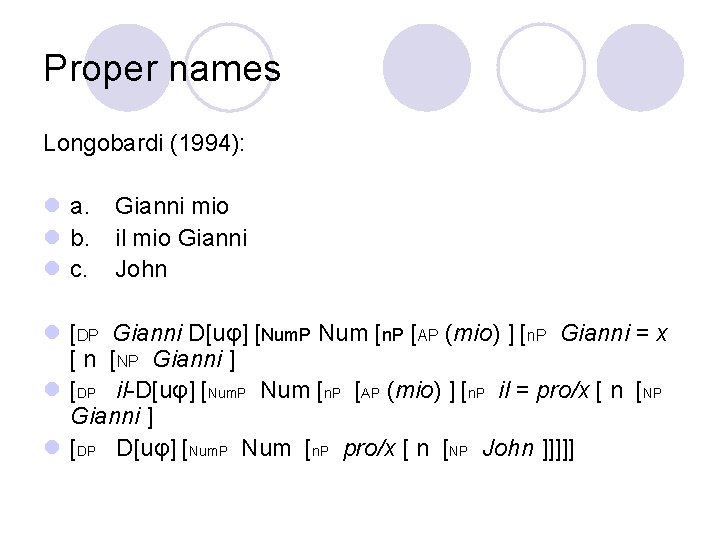
Proper names Longobardi (1994): l a. l b. l c. Gianni mio il mio Gianni John l [DP Gianni D[uφ] [Num. P Num [n. P [AP (mio) ] [n. P Gianni = x [ n [NP Gianni ] l [DP il-D[uφ] [Num. P Num [n. P [AP (mio) ] [n. P il = pro/x [ n [NP Gianni ] l [DP D[uφ] [Num. P Num [n. P pro/x [ n [NP John ]]]]]
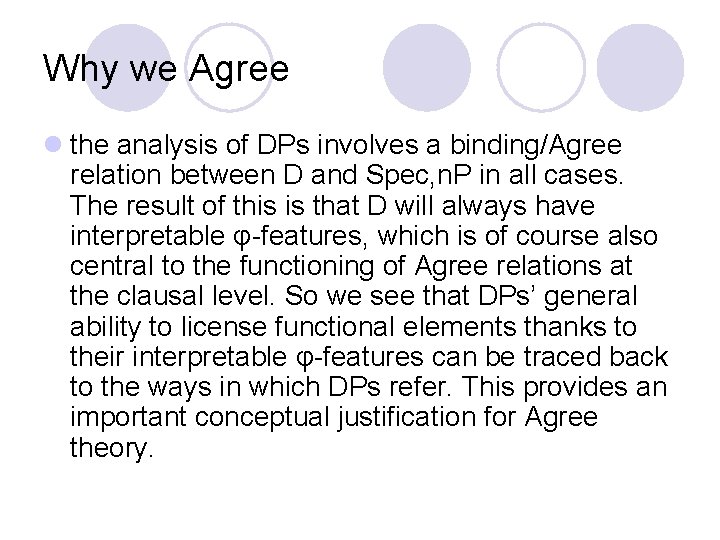
Why we Agree l the analysis of DPs involves a binding/Agree relation between D and Spec, n. P in all cases. The result of this is that D will always have interpretable φ-features, which is of course also central to the functioning of Agree relations at the clausal level. So we see that DPs’ general ability to license functional elements thanks to their interpretable φ-features can be traced back to the ways in which DPs refer. This provides an important conceptual justification for Agree theory.
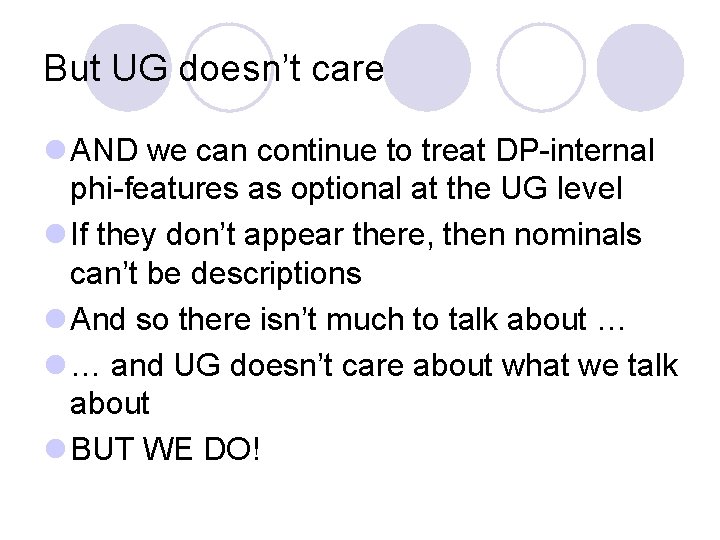
But UG doesn’t care l AND we can continue to treat DP-internal phi-features as optional at the UG level l If they don’t appear there, then nominals can’t be descriptions l And so there isn’t much to talk about … l … and UG doesn’t care about what we talk about l BUT WE DO!
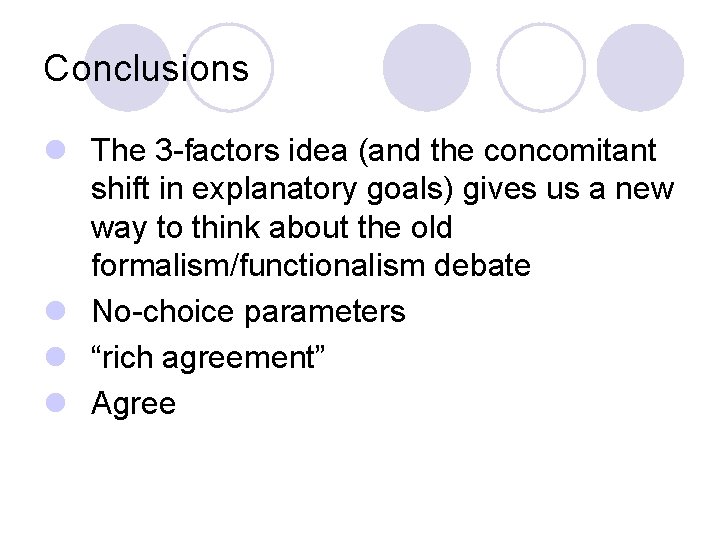
Conclusions l The 3 -factors idea (and the concomitant shift in explanatory goals) gives us a new way to think about the old formalism/functionalism debate l No-choice parameters l “rich agreement” l Agree
Why we must agree l Convergence and complimentarity among formerly radically opposed approaches can emerge quite unexpectedly l Our field is too small, and the outside world too harsh, for us to continue to be divided by bitter disagreements l Of course, total consensus is impossible (and boring), but we should recognise common ground where it appears, and work together.