
FORM MEANING Making the Gospel Language Meaningful Cultural
- Slides: 18
FORM & MEANING Making the Gospel Language Meaningful
Cultural Forms & Meanings Adapted from Darrel Whiteman Lectures Asbury Theological Seminary, 2001 n Meanings always expressed through cultural forms n Cultural forms are on surface, but meanings are beneath surface n No sacred forms, but many sacred meanings n Easily entangle evangelized in forms that have no equivalent meaning in host culture n If you want to get the meaning right, you must employ the proper contextual form
Cultural Forms & Meanings Adapted from Darrel Whiteman Lectures Asbury Theological Seminary, 2001 n Language as unique cultural form n Language forms designate a distinct reality n Sapir-Wharf Hypothesis n n n Worlds of different societies are distinct worlds, not just same with different labels One's view of reality is influenced, if not determined, by the language a person speaks Different languages direct us to different aspects of phenomena
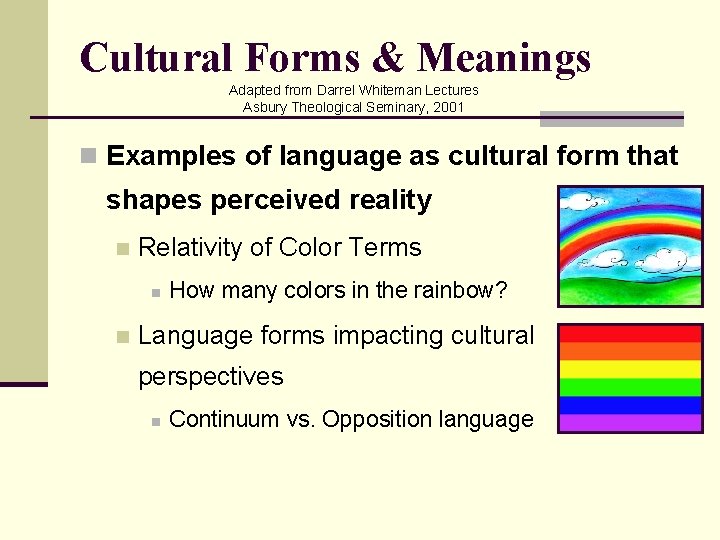
Cultural Forms & Meanings Adapted from Darrel Whiteman Lectures Asbury Theological Seminary, 2001 n Examples of language as cultural form that shapes perceived reality n Relativity of Color Terms n n How many colors in the rainbow? Language forms impacting cultural perspectives n Continuum vs. Opposition language
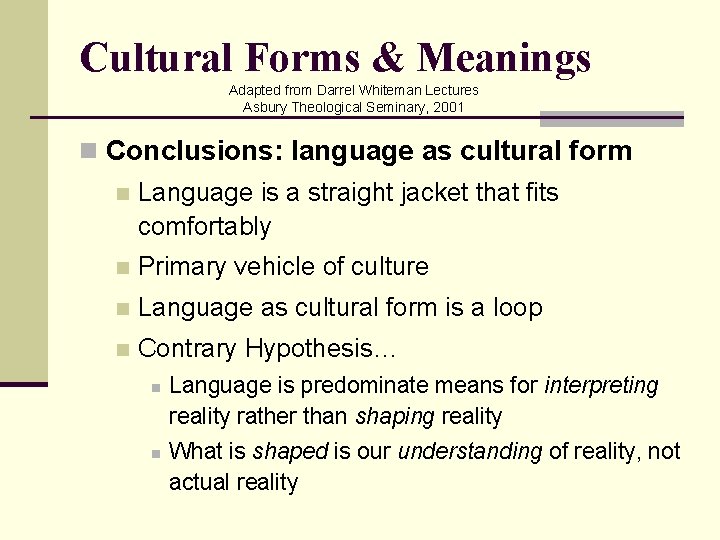
Cultural Forms & Meanings Adapted from Darrel Whiteman Lectures Asbury Theological Seminary, 2001 n Conclusions: language as cultural form n Language is a straight jacket that fits comfortably n Primary vehicle of culture n Language as cultural form is a loop n Contrary Hypothesis… n n Language is predominate means for interpreting reality rather than shaping reality What is shaped is our understanding of reality, not actual reality
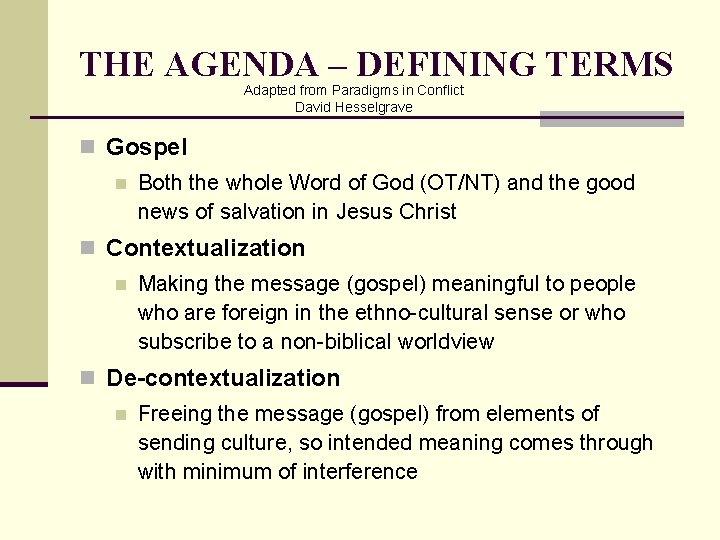
THE AGENDA – DEFINING TERMS Adapted from Paradigms in Conflict David Hesselgrave n Gospel n Both the whole Word of God (OT/NT) and the good news of salvation in Jesus Christ n Contextualization n Making the message (gospel) meaningful to people who are foreign in the ethno-cultural sense or who subscribe to a non-biblical worldview n De-contextualization n Freeing the message (gospel) from elements of sending culture, so intended meaning comes through with minimum of interference
THE AGENDA – DEFINING TERMS Adapted from Paradigms in Conflict David Hesselgrave n Verbal-Plenary Inspiration n Human authors were inspired by Holy Spirit in such a way that every word they wrote (all of OT/NT) expressed the precise thought that God intended to communicate
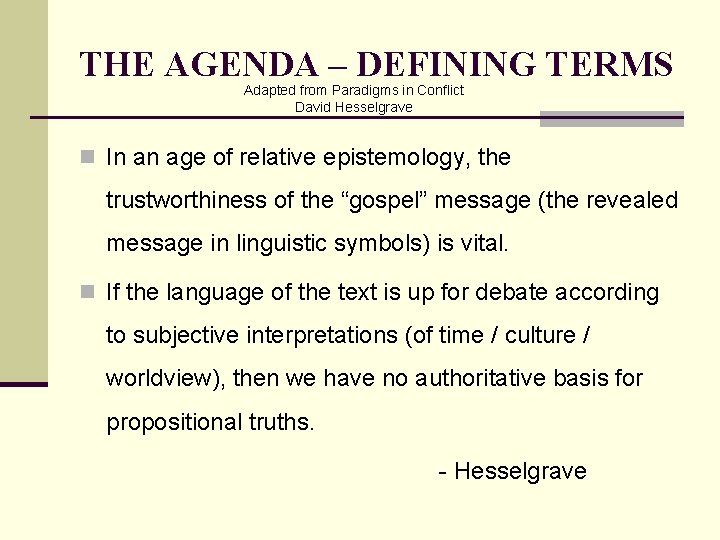
THE AGENDA – DEFINING TERMS Adapted from Paradigms in Conflict David Hesselgrave n In an age of relative epistemology, the trustworthiness of the “gospel” message (the revealed message in linguistic symbols) is vital. n If the language of the text is up for debate according to subjective interpretations (of time / culture / worldview), then we have no authoritative basis for propositional truths. - Hesselgrave
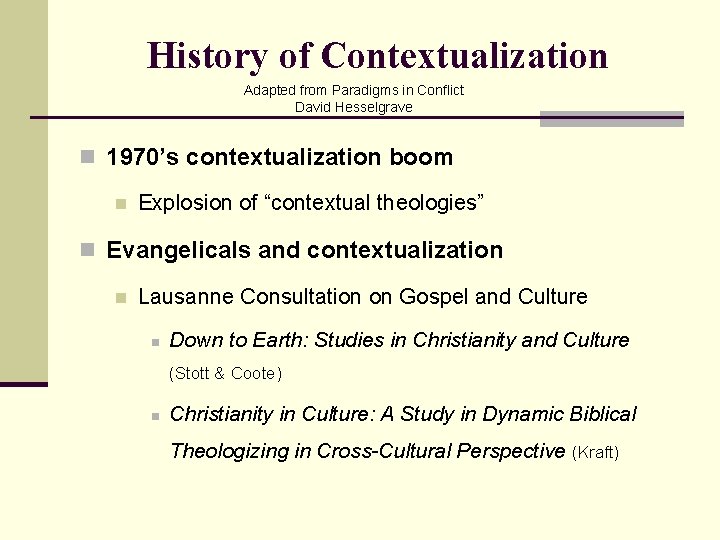
History of Contextualization Adapted from Paradigms in Conflict David Hesselgrave n 1970’s contextualization boom n Explosion of “contextual theologies” n Evangelicals and contextualization n Lausanne Consultation on Gospel and Culture n Down to Earth: Studies in Christianity and Culture (Stott & Coote) n Christianity in Culture: A Study in Dynamic Biblical Theologizing in Cross-Cultural Perspective (Kraft)
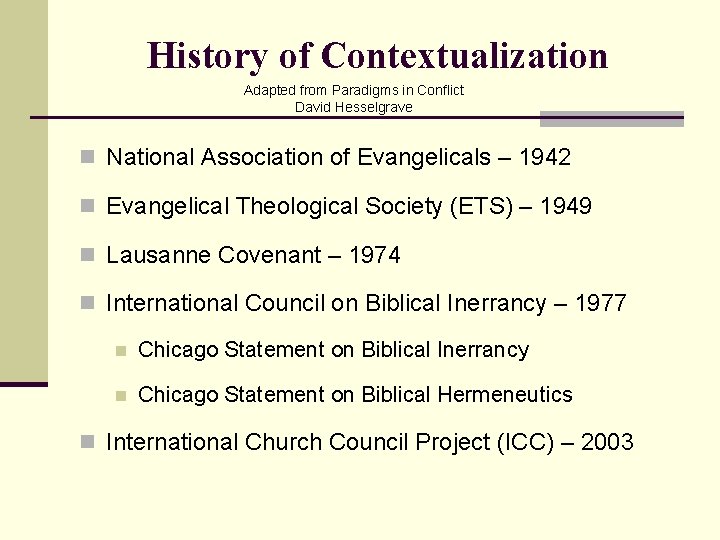
History of Contextualization Adapted from Paradigms in Conflict David Hesselgrave n National Association of Evangelicals – 1942 n Evangelical Theological Society (ETS) – 1949 n Lausanne Covenant – 1974 n International Council on Biblical Inerrancy – 1977 n Chicago Statement on Biblical Inerrancy n Chicago Statement on Biblical Hermeneutics n International Church Council Project (ICC) – 2003
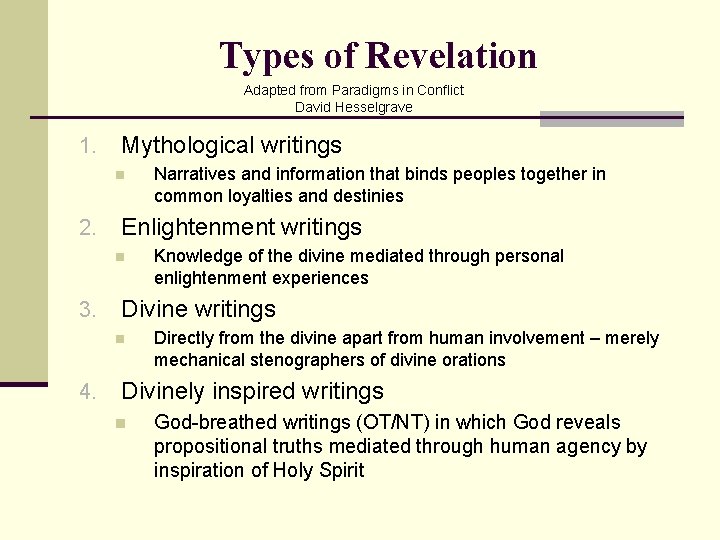
Types of Revelation Adapted from Paradigms in Conflict David Hesselgrave 1. Mythological writings n 2. Enlightenment writings n 3. Knowledge of the divine mediated through personal enlightenment experiences Divine writings n 4. Narratives and information that binds peoples together in common loyalties and destinies Directly from the divine apart from human involvement – merely mechanical stenographers of divine orations Divinely inspired writings n God-breathed writings (OT/NT) in which God reveals propositional truths mediated through human agency by inspiration of Holy Spirit
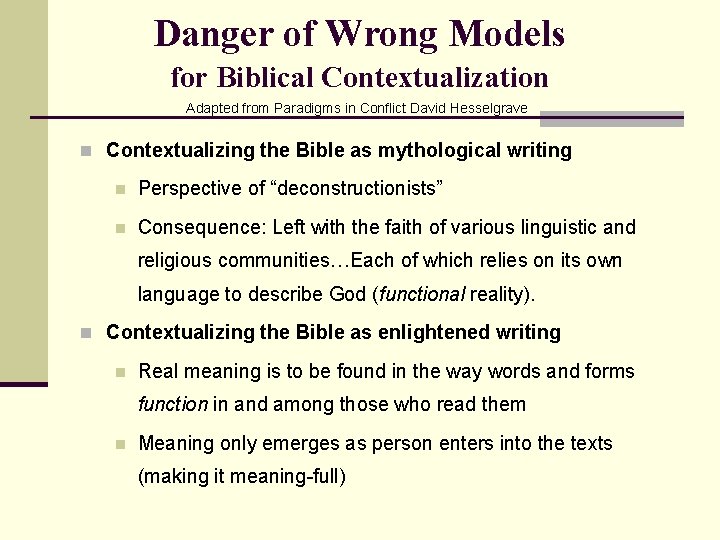
Danger of Wrong Models for Biblical Contextualization Adapted from Paradigms in Conflict David Hesselgrave n Contextualizing the Bible as mythological writing n Perspective of “deconstructionists” n Consequence: Left with the faith of various linguistic and religious communities…Each of which relies on its own language to describe God (functional reality). n Contextualizing the Bible as enlightened writing n Real meaning is to be found in the way words and forms function in and among those who read them n Meaning only emerges as person enters into the texts (making it meaning-full)
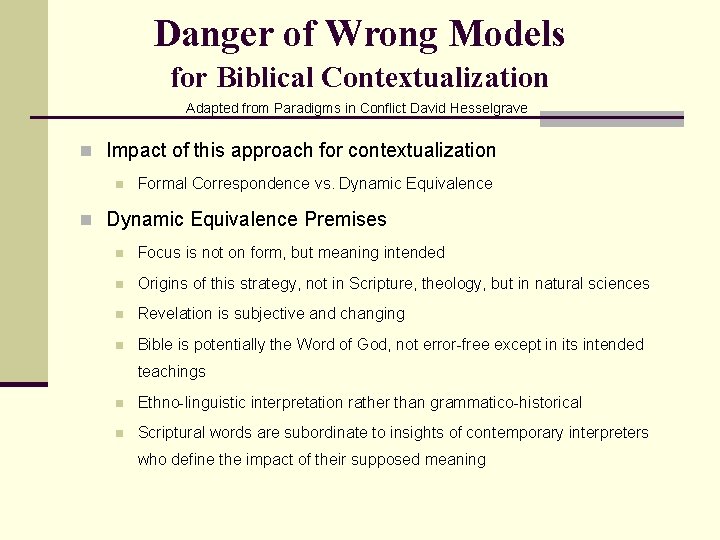
Danger of Wrong Models for Biblical Contextualization Adapted from Paradigms in Conflict David Hesselgrave n Impact of this approach for contextualization n Formal Correspondence vs. Dynamic Equivalence n Dynamic Equivalence Premises n Focus is not on form, but meaning intended n Origins of this strategy, not in Scripture, theology, but in natural sciences n Revelation is subjective and changing n Bible is potentially the Word of God, not error-free except in its intended teachings n Ethno-linguistic interpretation rather than grammatico-historical n Scriptural words are subordinate to insights of contemporary interpreters who define the impact of their supposed meaning
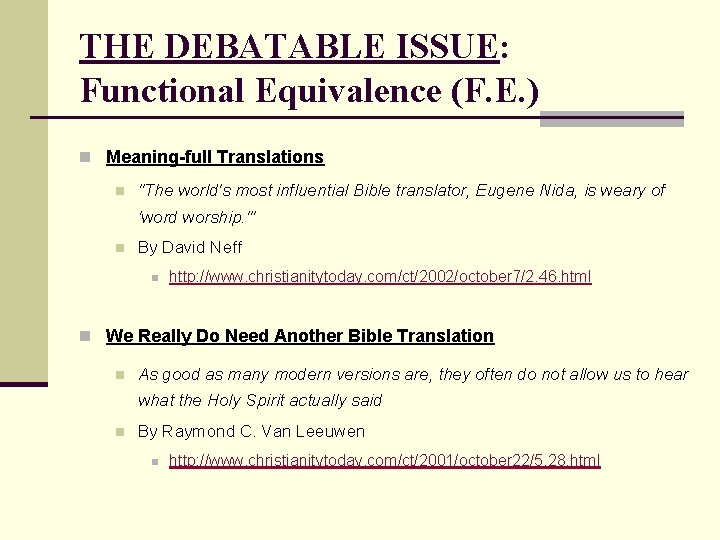
THE DEBATABLE ISSUE: Functional Equivalence (F. E. ) n Meaning-full Translations n "The world's most influential Bible translator, Eugene Nida, is weary of 'word worship. '" n By David Neff n http: //www. christianitytoday. com/ct/2002/october 7/2. 46. html n We Really Do Need Another Bible Translation n As good as many modern versions are, they often do not allow us to hear what the Holy Spirit actually said n By Raymond C. Van Leeuwen n http: //www. christianitytoday. com/ct/2001/october 22/5. 28. html
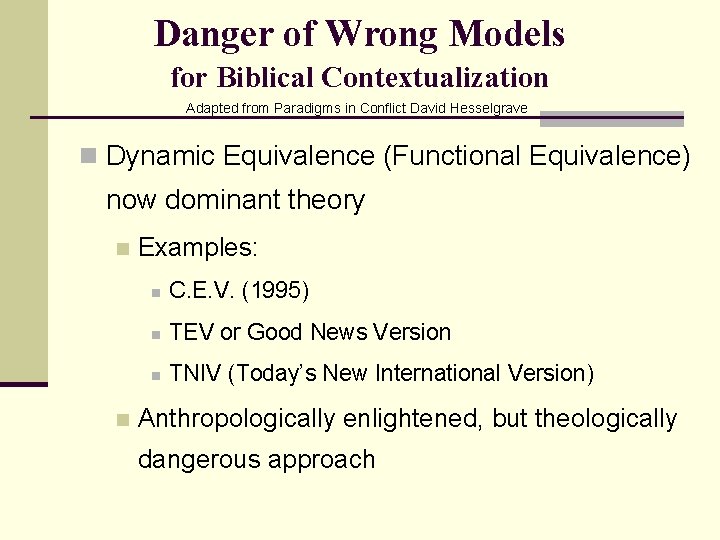
Danger of Wrong Models for Biblical Contextualization Adapted from Paradigms in Conflict David Hesselgrave n Dynamic Equivalence (Functional Equivalence) now dominant theory n n Examples: n C. E. V. (1995) n TEV or Good News Version n TNIV (Today’s New International Version) Anthropologically enlightened, but theologically dangerous approach
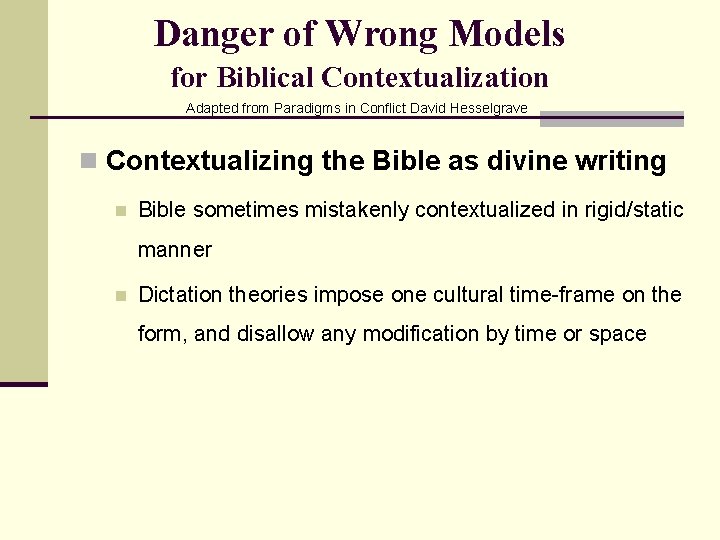
Danger of Wrong Models for Biblical Contextualization Adapted from Paradigms in Conflict David Hesselgrave n Contextualizing the Bible as divine writing n Bible sometimes mistakenly contextualized in rigid/static manner n Dictation theories impose one cultural time-frame on the form, and disallow any modification by time or space
Danger of Wrong Models for Biblical Contextualization Adapted from Paradigms in Conflict David Hesselgrave n Contextualizing Bible as Inspired Writings n Affirms reality of consistent (universal) propositional truth revealed in Scripture n Opposes postmodern “formalist criticisms”
Effective Evangelical Contextualization Adapted from Paradigms in Conflict David Hesselgrave n Meeting of minds for “critical contextualization n Discussion is needed regarding non-negotiable universals n Must begin with commitment to authoritative Word of God n Tools afforded by relevant sciences then engaged as helpful/necessary additions that enable us to understand Scripture and communicate it meaningfully across cultures