
FORM CRITICISM RESEARCH INTO LITERARY TYPES HERMAN GUNKEL

- Slides: 6
FORM CRITICISM “RESEARCH INTO LITERARY TYPES”
HERMAN GUNKEL • Hermann Gunkel is the father of Form criticism, and he called it “Research into Literary Types”. • It was Martin Dibelius who named it Form Criticism. Basic Assumption • All forms of human communication, in writing, follow well defined patterns, and most of the times human beings follow these patterns unconsciously, e. g. Letters, poems, news paper sections etc.
TASKS 1. Identifying the unit. 2. Naming the form used, e. g. letter, song etc. 3. Describing its setting in life, (Sitz-im-Leben) Psalm 137: 1 -6, (By the river of Babylon) 4. Identifying its purpose. • NB: It involves tracing a text through all levels from the most primitive oral saying up to the finished product. In the progress the material changed and was reshaped.
THE CATHOLIC CHURCH • These methods were suspected by Catholics. • Pope Pius X, in 1907 condemned them for being modernist and too critical. • In 1943, Pope Pius XII issued an encyclical, Divino Afflante Spiritu, which encouraged Catholic’s biblical scholars to examine the ancient sources and literary forms in order to deepen the understanding of the sacred texts.
Questions Form Critics Ask 1. Who is speaking in this passage? 2. Who is the audience? 3. What is being said? 4. Where is it said? 5. What is the purpose? 6. Who added the additions? 7. Who was the editor?
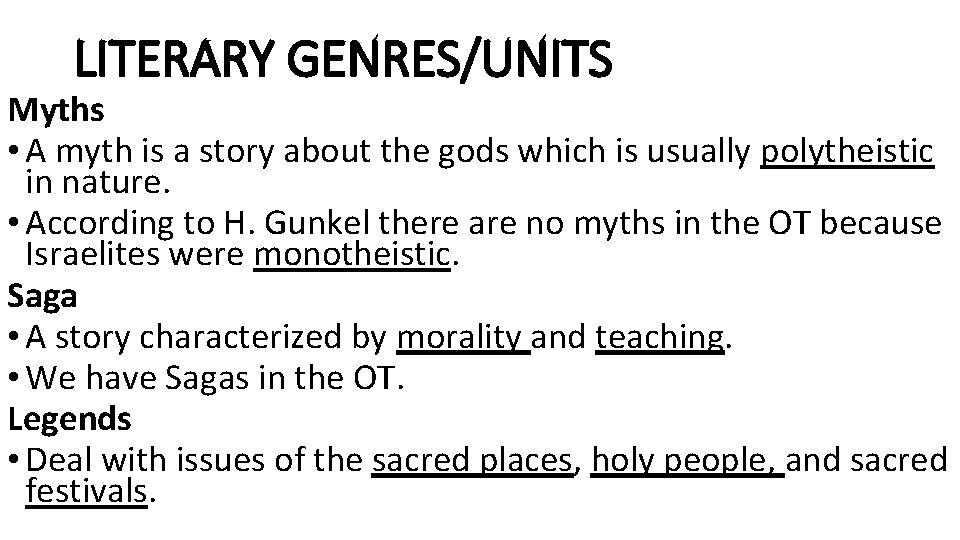
LITERARY GENRES/UNITS Myths • A myth is a story about the gods which is usually polytheistic in nature. • According to H. Gunkel there are no myths in the OT because Israelites were monotheistic. Saga • A story characterized by morality and teaching. • We have Sagas in the OT. Legends • Deal with issues of the sacred places, holy people, and sacred festivals.