
Forgiveness Pauls Letter to Philemon Philemon Background The
Forgiveness Paul’s Letter to Philemon
Philemon: Background • The Roman Empire, like most of the ancient world, was a slave-based society. • Slaves made up something like 25 -35% of the empire’s 60 million people. • The emperor alone might own thousands. • From the earliest days, a slave-owner could inflict any injury or punishment upon a slave that he wanted. • There was no crime for doing harm to a slave.
Philemon: Background • On the other hand, if a slave murdered his or her master, all the slaves in the household were to be killed. • When convicted of a serious crime, a slave might be crucified. • Around 73 BC there was a huge slave uprising led by a Thracian named Spartacus.
Philemon: Background • He soon led an army that repeatedly defeated the armies of Rome and controlled much of southern Italy. • Unfortunately, they were stuck on the end of the Italian peninsula and were never able to leave Italy to go to their homelands. • Finally, in 71 BC the Roman senate raised a huge army to contend with Spartacus.
Philemon: Background • This army won and took 6, 000 slaves prisoner. • They were crucified along the Appian Way – the main road leading into Rome. • Their bodies remained hanging in place for several months. • This was a warning to other slaves who might think about rebelling against their masters.
Philemon: Background • Fast-forward now to about 62 A. D. • Nothing has changed regarding the status of slaves in the Roman world. • In Colossae in the Eastern empire, a slave named Onesimus escaped from his master Philemon. • He ran away and eventually made it to Rome.
Philemon: Background • As it happened, Paul led Philemon the slaveowner to Christ while both were in Ephesus a few years before. • As it also happened, Onesimus the slave somehow encountered Paul, now a prisoner under house arrest, while in Rome. • Paul then had the privilege of leading the slave Onesimus to Christ.
Philemon: Background • Onesimus the slave remained in Rome for some time serving Paul the apostle/prisoner, who became his pastor, mentor and friend. • But Paul knew the story could not end there. • Onesimus was a fugitive with no legal status in Rome. • Additionally, Paul saw the need for reconciliation between Onesimus the slave and Philemon the slave-owner.

Philemon: Background • Onesimus needed to get up the courage to go back to Colossae and face Philemon so that the two might be reconciled • They were now both brothers in Christ. • Philemon needed to learn the beautiful and beneficial Christian art of forgiveness. • The only way to learn forgiveness is to forgive.

Philemon: Background • Paul writes to Philemon as the advocate of Onesimus. • He asks Philemon to receive him, forgive him and potentially even free him. • This is more than a recommendation. • Paul promises to pay Philemon anything Onesimus may owe.
Philemon: Examining the Text • 1 Paul, a prisoner of Christ Jesus • Paul considers his imprisonment in light of the sovereignty of God. • He does not blame the Romans or the Jews. • He credits his humble position to the Lordship of Jesus Christ. • Paul sees his imprisonment as a part of God’s plan for him at this time.
Philemon: Examining the Text • 2 Apphia is apparently Philemon’s wife. • Archippus is apparently Philemon’s son, but he also seems to be the pastor or leader of the church. – See Colossians 4: 17 • 4 -7 Paul uses a good deal of text telling Philemon how highly he thinks of him and the importance of his ministry to other believers.
Philemon: Examining the Text • If you do a good job hosting a home Bible study, then you have a similar reinforcement from Paul. – See what he says in v. 6. • Don’t ever minimize the importance of such a ministry of hospitality to the spiritual growth and benefit of the church.
Philemon: Examining the Text • 8 -16 This is where Paul explains to Philemon what happened to Onesimus. • In the Roman world, citizens like Paul (and perhaps Philemon) had the highest status. • Other free people came next, but did not enjoy the all the benefits of citizenship. • Slaves were subhuman.

Philemon: Examining the Text • But in the church, Philemon and Onesimus were both brothers in the Lord. • He was returning not simply as a slave, but as an equal member of the church. – See also Colossians 4: 7 -9 • Paul’s point in v. 16 is that Onesimus should be more valuable to Philemon than to Paul since he was once part of his own household.

Philemon: Examining the Text • 17 -22 Here Paul drives his request home. • He is asking Philemon for three things: – Receive him – Forgive him – Free him? 17 18 -19 21 - and look back at 12 -14
Historical Data on Slavery • Christianity is sometimes blamed for the problem of slavery in the ancient world, or more often in the USA. • Fact: the condition of slaves in the Roman Empire began to improve only after the spread of Christianity – especially after the conversion of Constantine.
Historical Data on Slavery • While the USA certainly could have done more to give freedom to slaves and could have done it more quickly, consider the following: – Slavery was never legal in Indiana, Ohio, Michigan, Illinois, Wisconsin, Minnesota, Maine, Iowa, Oregon, California and other states which entered the union as free states. – 1777 Vermont – 1783 Massachusetts and New Hampshire – 1863 Lincoln’s Emancipation Proclamation
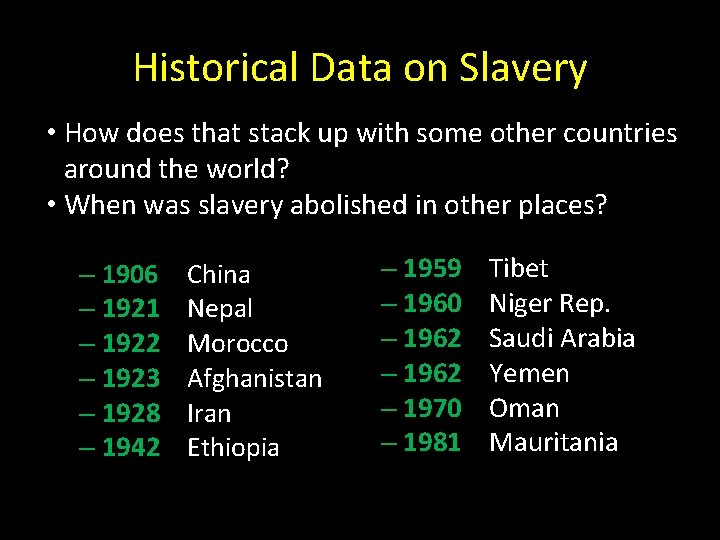
Historical Data on Slavery • How does that stack up with some other countries around the world? • When was slavery abolished in other places? – 1906 – 1921 – 1922 – 1923 – 1928 – 1942 China Nepal Morocco Afghanistan Iran Ethiopia – 1959 – 1960 – 1962 – 1970 – 1981 Tibet Niger Rep. Saudi Arabia Yemen Oman Mauritania
Historical Data on Slavery • That information does not excuse the sins of American slave traders or slave owners. • It is only intended to remind us that our country is not alone in its guilt. • The injustice caused by slavery is widespread just as sin is common to the entire human race. • And sadly, though illegal, slavery still exists today and is perhaps more evil than ever.
Philemon: Application From the perspective of Paul: • Paul was unjustly imprisoned, but not bitter over his circumstances. • He was willing to humbly submit to God in his time of difficulty. • This is not easy, but this kind of humble submission may be a necessary part of our Christian growth.

Philemon: Application From the perspective of Paul: • Paul was willing to stand behind Onesimus who was at a difficult point in his life. • Onesimus had proven himself to Paul. • Paul gave him more than a good reference, he was willing to back up his words by saying he would pay Philemon whatever Onesimus owed him.
Philemon: Application From the perspective of Paul: • Sometimes God puts people in our lives simply so that we can help them. • We may find ourselves in the position to be someone’s advocate as Paul was able to be for Onesimus. • Paul’s resources and abilities were severely limited, but he still did whatever he could.

Philemon: Application From the perspective of Onesimus: • The first thing Onesimus did was prove the reality of his conversion to Paul. • His name means “profitable” or “useful” and he made himself useful to Paul. • The best way to get good references behind you is to make yourself valuable to others. • People will (normally) appreciate your faithfulness.
Philemon: Application From the perspective of Onesimus: • “The Synagogue of the Freedmen” in Acts 6: 9 shows us that Jerusalem alone was home to many freed slaves. • There were legal means of being set free in the Roman world, but simply running away was not one of them. • Onesimus now needed to boldly face Philemon as a brother in the Lord.
Philemon: Application From the perspective of Onesimus: • Have you wronged someone who now needs you to openly admit what you have done? • If we are willing to do whatever it takes to make amends, this will go a long way toward reconciliation. • (But it might not be wise to confess all your secret sins. I really don’t want to know all the bad things you have ever thought about me!)
Philemon: Application From the perspective of Philemon: • Forgiveness is the biggest lesson in this letter. • Philemon had the legal right to literally do anything he wanted to get back at Onesimus without getting in the least bit of trouble. • But as a Christian brother Philemon was obligated to forgive. • What’s more the whole church was watching.
Philemon: Application From the perspective of Philemon: • If we are holding any grudges, harboring any bitterness, refusing to let go of some past hurt, then we are only stunting our own spiritual growth. • Refusing to forgive is like taking poison in the hope that it kills somebody else.
Philemon: Application From the perspective of Philemon: • Please take some time to examine your heart, consider your hurts and be willing to simply let them go. • Your integrity as a Christian depends on it. • Keep in mind that we owe Christ so much more than we can possibly ever repay. – See Matthew 18: 21 -35
- Slides: 29