
Forests in Poland Europe Characteristics and management The



- Slides: 13
Forests in Poland Europe. Characteristics and management
The history of Polish forests About 11 -10 thousands years before Christ the hole area of Poland was almost woodless. At the end of 8000 -7000 years before Christ in our country appeared first thermophilic trees just like elm tree and alder tree. In south part of country pine tree was dominant. The highest forest was located about 1050 meters about sea level. In this forest were trees like: pine, larch, birch, dwarf mountain pine and spruce. In boreal period (7000 -4000 years before Christ) woodiness of our country raised thanks for example pine expansion to the north. In Atlantic period (4000 -3000 years before Christ) the assemblages of birch and pine started disappearing from Poland. The forests of oak and alder took their places. From south and northeast spruce shifted increasingly. In sub boreal period (30001000 years before Christ) thermophilic species gave place to fir, beech in this area.
The history of forest management which resulted in changes of the forests cover in Poland isn’t the history of forests protection but its destruction and sometimes its restoration. The entire period can be divide into a few characteristic stages: 1)From V to XII century – here begins the period of intense destruction of forests associated with the expansion of arable grounds and pastures and with the formation of cities. 2)From XII to XV century - the dynamic development of the cities metallurgy and glass production caused a terrible devastation of forests. This period marks a significant soar in the industrial development. 3)From XV to XVIII century – it witness the great geographical discoveries associated with demand on high quality timber, especially the pine and oak ones as well as the further development of industry and rapid population growth have contributed to the depletion of forests. Polish wood from its forests in the northeastern part of the country contributes to construction of the power of the Dutch, English and Spanish fleets as well as to the development of industrial extraction and decoction of salt.
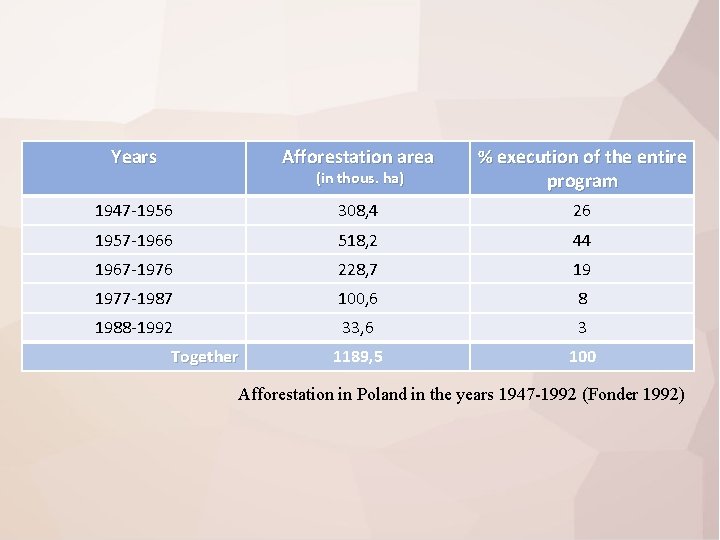
4)From XVIII to mid-nineteenth century - the first law requiring the renewal of cut down and burned forests, was introduced. Poland was the place where the first book of forestry in which the terms of use and forest management, as well its protection, was published. 5)Since the mid-nineteenth century until 1917 there was an uncontrolled development of industrialization and the population growth resulting in further deforestation of the country. 6)From 1917 to about 1960 – its the time when intensive afforestation works begin, especially in the first years after the ending World War I and World War II. Still, the productive function of forests is the fundamental imperative defining the principles of forest management. 7)1960 to 1992 – it is when revaluation and a change in the hierarchy of functions of forests occurs as a result of the changes observed in the environment and its effects on humans. The progressive pollution causes that the environment forming function of the forest is considered the most important. 8)From June 14, 1992 - the postwar period is followed by a rapid increase in the forest cover of Poland. In 1947, a plan of afforestation nearly 1 million hectares of land was accepted for implementation.
Years Afforestation area (in thous. ha) % execution of the entire program 1947 -1956 308, 4 26 1957 -1966 518, 2 44 1967 -1976 228, 7 19 1977 -1987 100, 6 8 1988 -1992 33, 6 3 1189, 5 100 Together Afforestation in Poland in the years 1947 -1992 (Fonder 1992)
The forest area in Poland amounts to 9088 thousand hectares which puts Poland in the seventh place in the European Union. Polish forest cover is 28. 5%. The lowest forest cover is characteristic for the province of Częstochowa, Mazowsze and Lublin, wild the largest ones are the provinces of Zielona Góra, Krosno and Katowice. A fallible, but commonly expressed view that in Poland there is a systematic decrease in the forest area. In Poland, there is a systematic increase in the area of forests in compliance with its national program to enlarge the forest cover, which is developed by the Forest Research Institute in Warsaw. Our country stands out from other EU countries implementing the program of increasing the forest cover based not only on the original scientific methodology tested and verified by the practice, but most of all aiming at the consistent realization of the fundamental objectives of forestry underlying of sustainable development. The main goal is to create conditions to achieve forests cover in Poland at the level of 30% in 2020 and ultimately up to 33% in 2050.
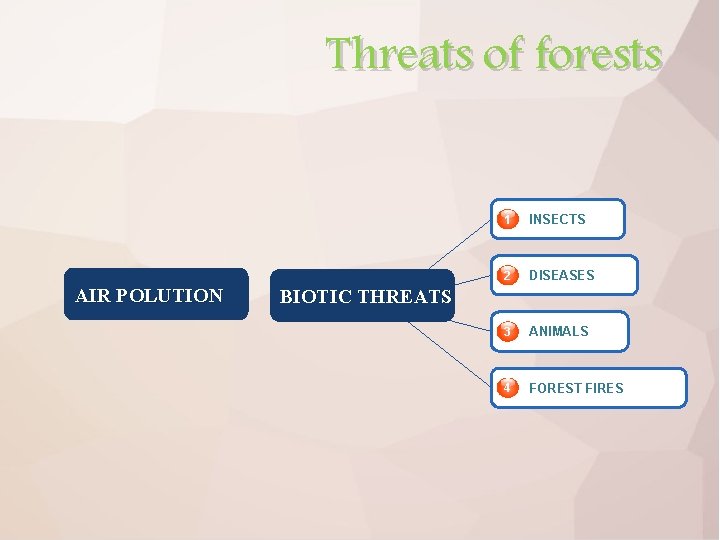
Threats of forests AIR POLUTION 1 INSECTS 2 DISEASES 3 ANIMALS 4 FOREST FIRES BIOTIC THREATS
AIR POLLUTION Emissions of sulfur dioxide, nitrogen oxides and ammonia is permanently controlled in Europe. The limitation of emissions of sulfur and nitrogen compounds mainly by industry has resulted in a significant change. The pollution level has significantly decreased, but it is still high especially in the western and central part Europe. The reduction of emissions of gaseous air pollutants in Poland in recent years has led to a decline in the level of concentration of SO 2 in forest areas. In the case of concentrations of NO 2 a minor increase has been noted compared to 2001. The northern Polish region is characterized by lower rates of NO 2 concentrations during the year compared with the rest of the country. Emissions of SO 2 and NO 2 in the atmosphere from Polish area in 1987 -2000 (source: Central Statistical Office of Poland according to the annual report of The State Forests National Forest Holding 2002)
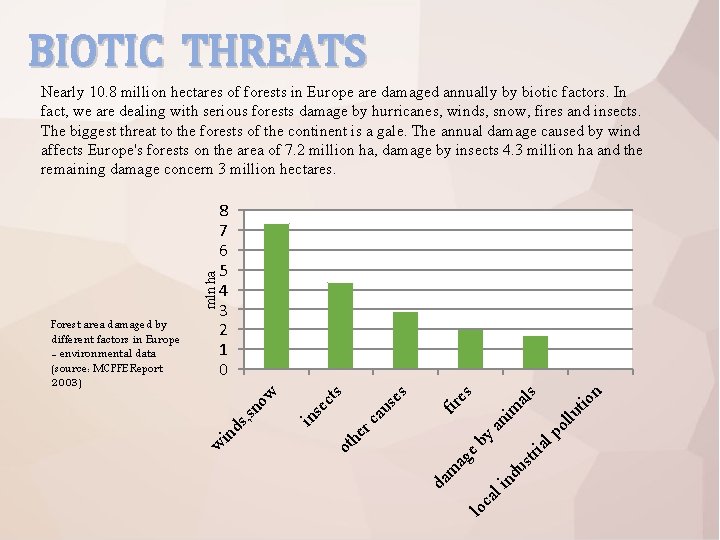
BIOTIC THREATS nd u str i al po llu tio al an im y li ca lo da m ag eb ot h n s es fir er ca us e s ec ts in s , sn in ds w Forest area damaged by different factors in Europe - environmental data (source: MCPFE Report 2003) 8 7 6 5 4 3 2 1 0 ow mln ha Nearly 10. 8 million hectares of forests in Europe are damaged annually by biotic factors. In fact, we are dealing with serious forests damage by hurricanes, winds, snow, fires and insects. The biggest threat to the forests of the continent is a gale. The annual damage caused by wind affects Europe's forests on the area of 7. 2 million ha, damage by insects 4. 3 million ha and the remaining damage concern 3 million hectares.
-INSECTS – The most intensive growth in the Polish case is noted by leaf-eating pests pine stands, and above all: nun moth, sawflies, lappet, looper and pine beauty. The risk low average high Danger zone of Polish forests by insect pests (including primary and secondary) (source: Forest Research Institute according to the annual report of The State Forests National Forest Holding 2003) Torticidae and Geometridae Pine sawflies Nun moth Pine-tree Lappet Phyllophaga Pamphiliidae Combating pest herbivorous in 2003 (source: Forest Research Institute according to the annual report of The State Forests National Forest Holding 2003)
-DISEASES- In 2002, the incidence of infectious diseases was reported on the surface of 679 ha of forest stands. Compared with 2001, this represents a decrease of almost 62 thousand hectares. -ANIMALS- In Poland, according to statistics 2 -6% of the forest area is damaged by the animals. High risk on the part of the animal forces makes it necessary to protect trees from the bitting process. Chemical and mechanical protection has been used on the forest area. -FOREST FIRES- The share of the forest area affected by fires in State Forests compared to the total burnt area in the country shows a downward trend. Seasonality characters of such occurrence of forest fires is closely connected with the nature of the weather, especially with the air temperature and the amount of precipitation. The main causes of fires were arsons (44%) and careless adults (23%). Loss of assimilation appartus of forests trees Loss of assimilation apparatus of forest trees (defoliation) and the density of the crown are also considered as an important component of the health of forests. It has been assumed that the defoliation of trees greater than 25% means that the tree is "damaged”. The increase of the degree of defoliation is another degree of damage defined as "medium damage", "badly damaged" and "dead". In Europe, we observe the progressive process of defoliation. Coniferous species have higher rates of damage of the assimilation apparatus than deciduous. In Europe, the level of defoliation is different for each species, the highest is registered for Scots pine and spruce and the smallest for Mediterranean pine. Dynamics of changes in defoliation of deciduous species shows a greater increase in their degree of defoliation (24. 4%) than coniferous species (21%). Unlike Europe, where there has been a high rate of damage to pine stands the greatest degree of defoliation in Poland among conifers was recorded for fir and the smallest for pine. Among deciduous species the highest degree of defoliation occurs in oak stands, and the lowest in beech.
Bibliography • Piotr Paschalis- Jakubowicz, „Polskie leśnictwo w Unii Europejskiej”, Warsaw 2004
Authors § Gabriela Ciesielska, 17 yeras old, second class, I Liceum Ogólnokształcące im. Ziemi Kujawskiej we Włocławku § Patrycja Gmurska, 18 years old, second class, I Liceum Ogólnokształcące im. Ziemi Kujawskiej we Włocławku § Marta Starczewska, 18 years old, second class, I Liceum Ogólnokształcące im. Ziemi Kujawskiej we Włocławku