
Forest Mushrooms Josh Shields Forestry Assistance Program FAP
- Slides: 26
Forest Mushrooms! Josh Shields, Forestry Assistance Program (FAP) at Manistee and Mason-Lake Conservation Districts; Kama Ross, FAP at Leelanau, Grand Traverse, and Benzie Conservation Districts September 7 th, 2017
Forestry Assistance Program (FAP) • We are grant-funded service foresters based at conservation districts • Josh Shields – FAP forester in Manistee, Mason, and western half of Lake Counties • Kama Ross – FAP forester in Leelanau, Grand Traverse, and Benzie Counties
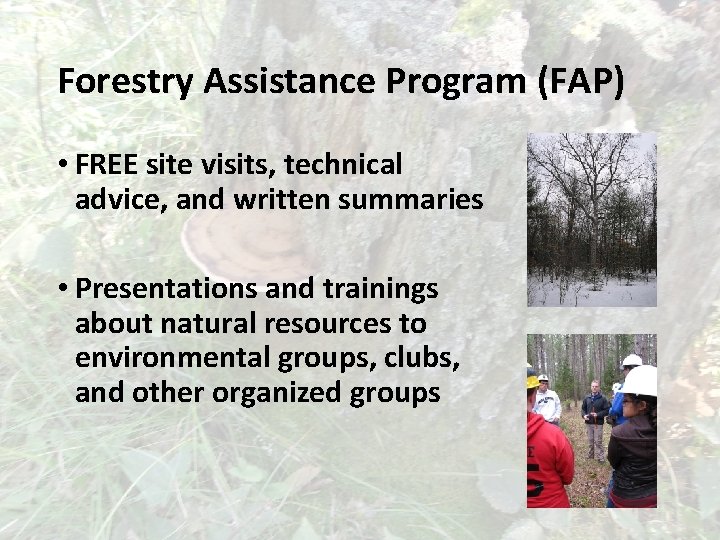
Forestry Assistance Program (FAP) • FREE site visits, technical advice, and written summaries • Presentations and trainings about natural resources to environmental groups, clubs, and other organized groups
Forestry Assistance Program (FAP) • Connect landowners with natural resource professionals and programs • Professionals include consulting foresters, industry foresters, tree planters, wildlife specialists, and partnering organizations • We DO NOT compete with these professionals
The Forestry Assistance Program (FAP) Connect landowners with valuable programs: ØAmerican Tree Farm System (ATFS) – certification program ØMichigan Agriculture Environmental Assurance Program (MAEAP), Forest, Wetlands, and Habitat A*Syst (FWH*A*Syst) tool – verification program ØQualified Forest Program (QFP) – tax incentive program ØCommercial Forest (CF) – tax incentive program ØNatural Resources Conservation Service (NRCS) Programs – cost share money available for conservation practices Ø forest management plan, forest stand improvement, tree/shrub establishment, brush management, the list goes on… ØForest Stewardship Plan – cost share money for management plans ØEyes on the Forest (EOTF) – reporting tree health and invasive spp.
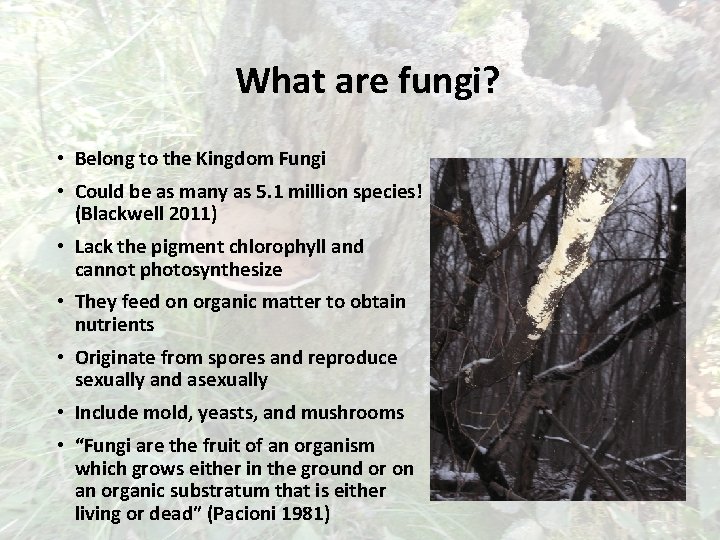
What are fungi? • Belong to the Kingdom Fungi • Could be as many as 5. 1 million species! (Blackwell 2011) • Lack the pigment chlorophyll and cannot photosynthesize • They feed on organic matter to obtain nutrients • Originate from spores and reproduce sexually and asexually • Include mold, yeasts, and mushrooms • “Fungi are the fruit of an organism which grows either in the ground or on an organic substratum that is either living or dead” (Pacioni 1981)
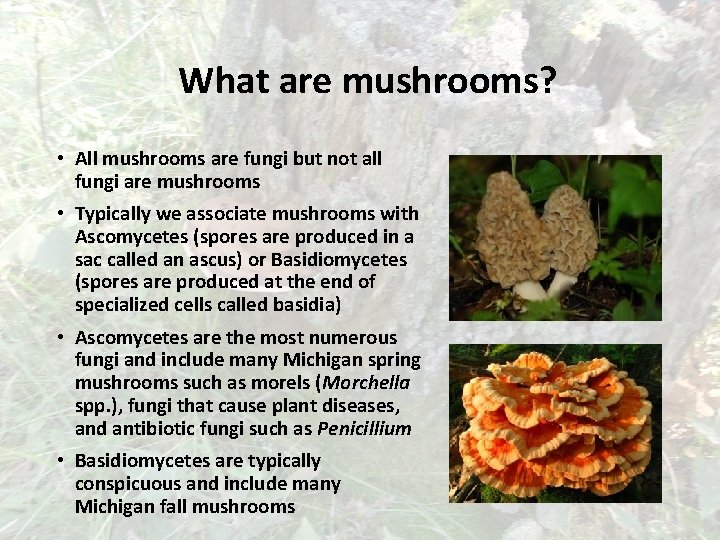
What are mushrooms? • All mushrooms are fungi but not all fungi are mushrooms • Typically we associate mushrooms with Ascomycetes (spores are produced in a sac called an ascus) or Basidiomycetes (spores are produced at the end of specialized cells called basidia) • Ascomycetes are the most numerous fungi and include many Michigan spring mushrooms such as morels (Morchella spp. ), fungi that cause plant diseases, and antibiotic fungi such as Penicillium • Basidiomycetes are typically conspicuous and include many Michigan fall mushrooms
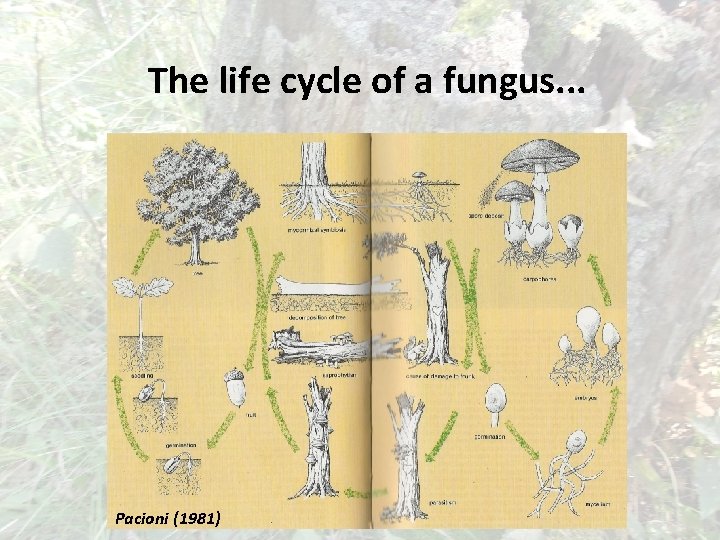
The life cycle of a fungus. . . Pacioni (1981)
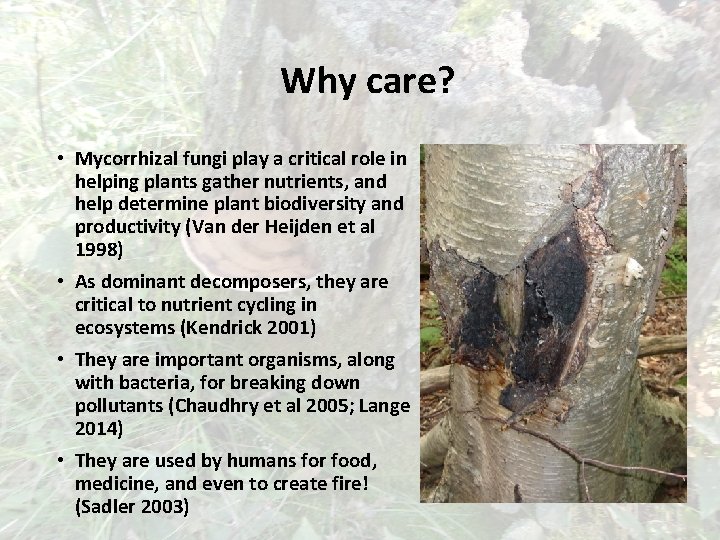
Why care? • Mycorrhizal fungi play a critical role in helping plants gather nutrients, and help determine plant biodiversity and productivity (Van der Heijden et al 1998) • As dominant decomposers, they are critical to nutrient cycling in ecosystems (Kendrick 2001) • They are important organisms, along with bacteria, for breaking down pollutants (Chaudhry et al 2005; Lange 2014) • They are used by humans for food, medicine, and even to create fire! (Sadler 2003)
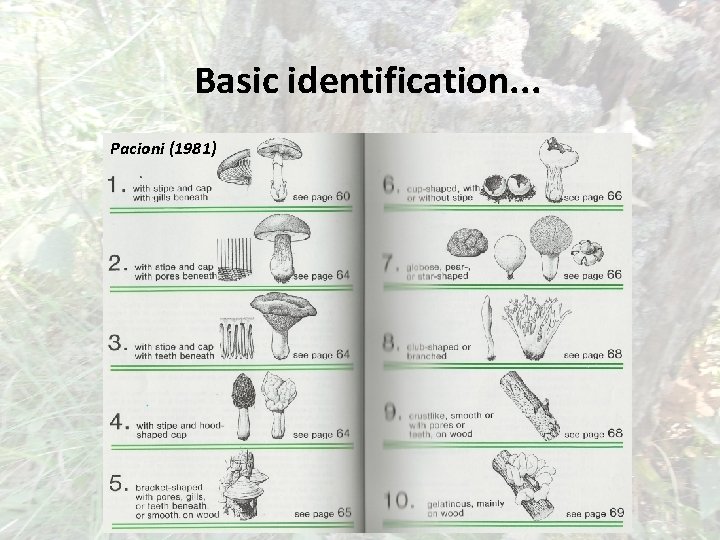
Basic identification. . . Pacioni (1981)
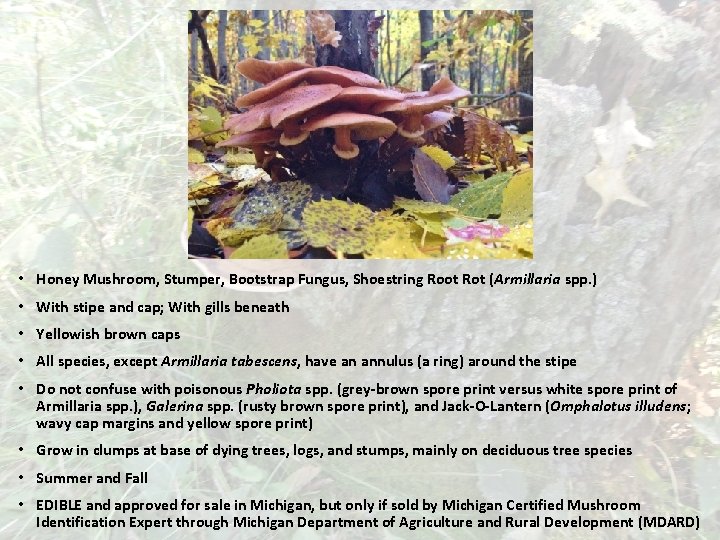
• Honey Mushroom, Stumper, Bootstrap Fungus, Shoestring Root Rot (Armillaria spp. ) • With stipe and cap; With gills beneath • Yellowish brown caps • All species, except Armillaria tabescens, have an annulus (a ring) around the stipe • Do not confuse with poisonous Pholiota spp. (grey-brown spore print versus white spore print of Armillaria spp. ), Galerina spp. (rusty brown spore print), and Jack-O-Lantern (Omphalotus illudens; wavy cap margins and yellow spore print) • Grow in clumps at base of dying trees, logs, and stumps, mainly on deciduous tree species • Summer and Fall • EDIBLE and approved for sale in Michigan, but only if sold by Michigan Certified Mushroom Identification Expert through Michigan Department of Agriculture and Rural Development (MDARD)
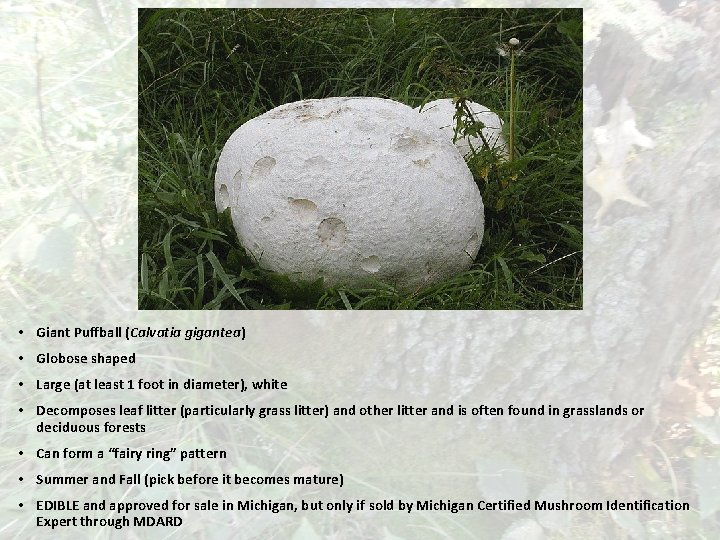
• Giant Puffball (Calvatia gigantea) • Globose shaped • Large (at least 1 foot in diameter), white • Decomposes leaf litter (particularly grass litter) and other litter and is often found in grasslands or deciduous forests • Can form a “fairy ring” pattern • Summer and Fall (pick before it becomes mature) • EDIBLE and approved for sale in Michigan, but only if sold by Michigan Certified Mushroom Identification Expert through MDARD
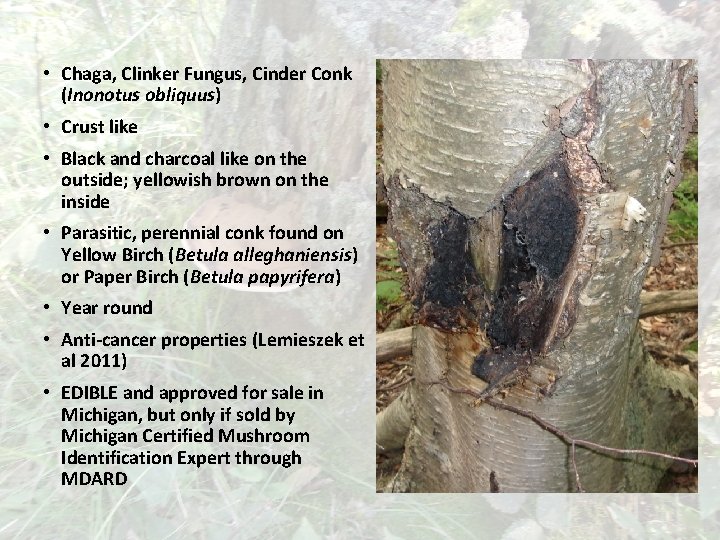
• Chaga, Clinker Fungus, Cinder Conk (Inonotus obliquus) • Crust like • Black and charcoal like on the outside; yellowish brown on the inside • Parasitic, perennial conk found on Yellow Birch (Betula alleghaniensis) or Paper Birch (Betula papyrifera) • Year round • Anti-cancer properties (Lemieszek et al 2011) • EDIBLE and approved for sale in Michigan, but only if sold by Michigan Certified Mushroom Identification Expert through MDARD
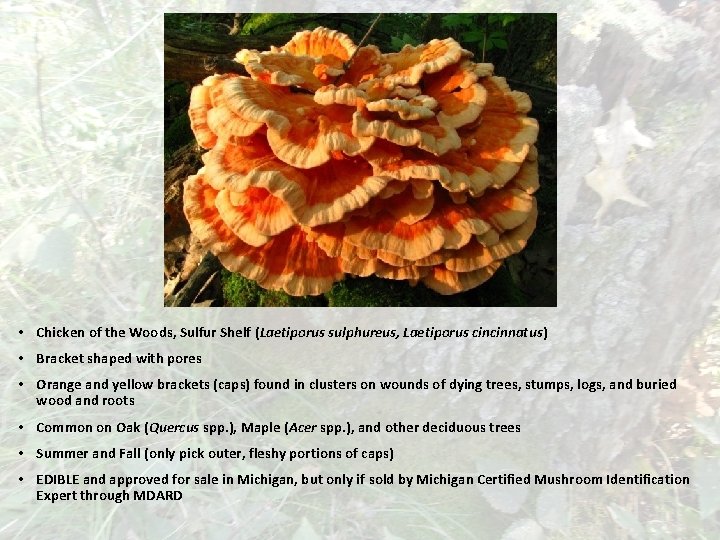
• Chicken of the Woods, Sulfur Shelf (Laetiporus sulphureus, Laetiporus cincinnatus) • Bracket shaped with pores • Orange and yellow brackets (caps) found in clusters on wounds of dying trees, stumps, logs, and buried wood and roots • Common on Oak (Quercus spp. ), Maple (Acer spp. ), and other deciduous trees • Summer and Fall (only pick outer, fleshy portions of caps) • EDIBLE and approved for sale in Michigan, but only if sold by Michigan Certified Mushroom Identification Expert through MDARD
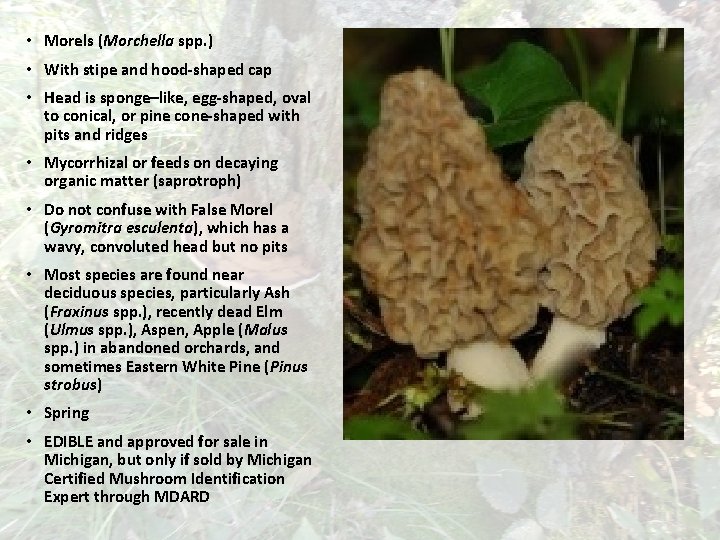
• Morels (Morchella spp. ) • With stipe and hood-shaped cap • Head is sponge–like, egg-shaped, oval to conical, or pine cone-shaped with pits and ridges • Mycorrhizal or feeds on decaying organic matter (saprotroph) • Do not confuse with False Morel (Gyromitra esculenta), which has a wavy, convoluted head but no pits • Most species are found near deciduous species, particularly Ash (Fraxinus spp. ), recently dead Elm (Ulmus spp. ), Aspen, Apple (Malus spp. ) in abandoned orchards, and sometimes Eastern White Pine (Pinus strobus) • Spring • EDIBLE and approved for sale in Michigan, but only if sold by Michigan Certified Mushroom Identification Expert through MDARD
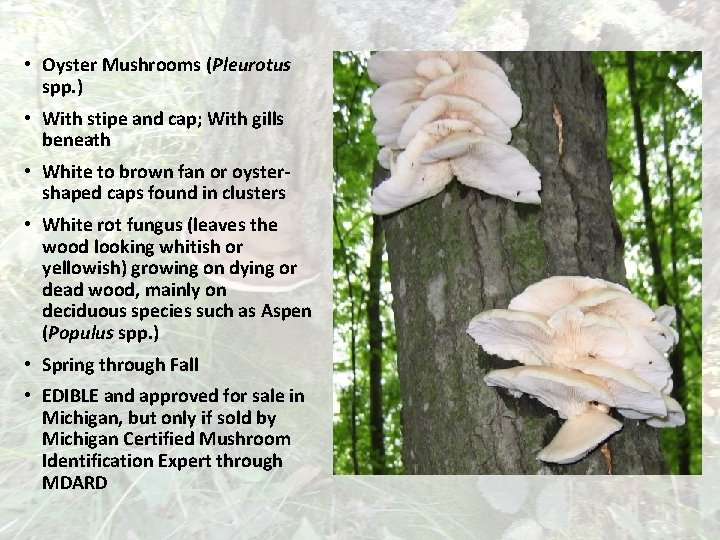
• Oyster Mushrooms (Pleurotus spp. ) • With stipe and cap; With gills beneath • White to brown fan or oystershaped caps found in clusters • White rot fungus (leaves the wood looking whitish or yellowish) growing on dying or dead wood, mainly on deciduous species such as Aspen (Populus spp. ) • Spring through Fall • EDIBLE and approved for sale in Michigan, but only if sold by Michigan Certified Mushroom Identification Expert through MDARD
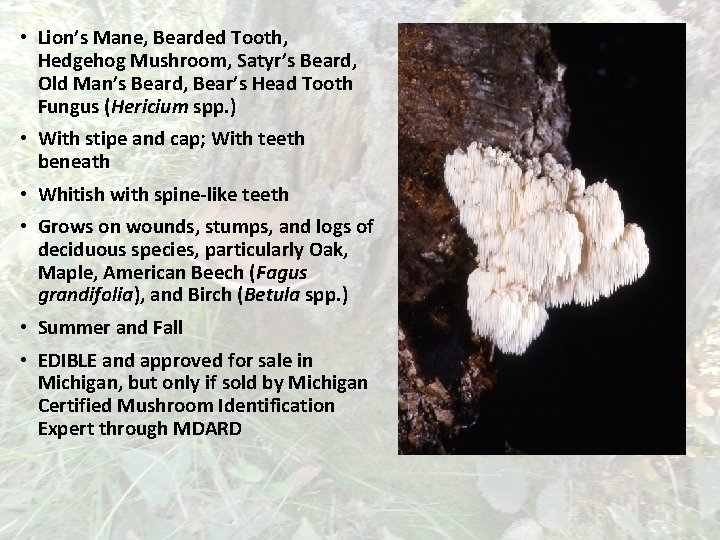
• Lion’s Mane, Bearded Tooth, Hedgehog Mushroom, Satyr’s Beard, Old Man’s Beard, Bear’s Head Tooth Fungus (Hericium spp. ) • With stipe and cap; With teeth beneath • Whitish with spine-like teeth • Grows on wounds, stumps, and logs of deciduous species, particularly Oak, Maple, American Beech (Fagus grandifolia), and Birch (Betula spp. ) • Summer and Fall • EDIBLE and approved for sale in Michigan, but only if sold by Michigan Certified Mushroom Identification Expert through MDARD
Other species approved for sale by MDARD Ø Chanterelle (Cantharellus spp. ) Ø Inky Cap (Coprinus comatus) Ø Horn of Plenty (Craterellus spp. ) Ø Aborted Entoloma (Entoloma abortivum) Ø Artist Conk (Ganoderma spp. ) Ø Hen of the Woods (Grifola frondosa) Ø Hedgehog Mushroom, Sweet Tooth (Hydnum spp. ) Ø Lobster Mushroom (Hypomyces lactifluorum) Ø Dryads Saddle, Pheasant’s Back Mushroom (Polyporus squamosus) Ø Umbrella Polypore (Polyporus umbellatus) Ø Composter Mushroom, Burgundy Mushroom, Garden Giant (Stropharia rugoso-annulata) Ø Turkey Tail Fungus (Trametes versicolor) Ø Michigan Truffles (Tuber canaliculatum)
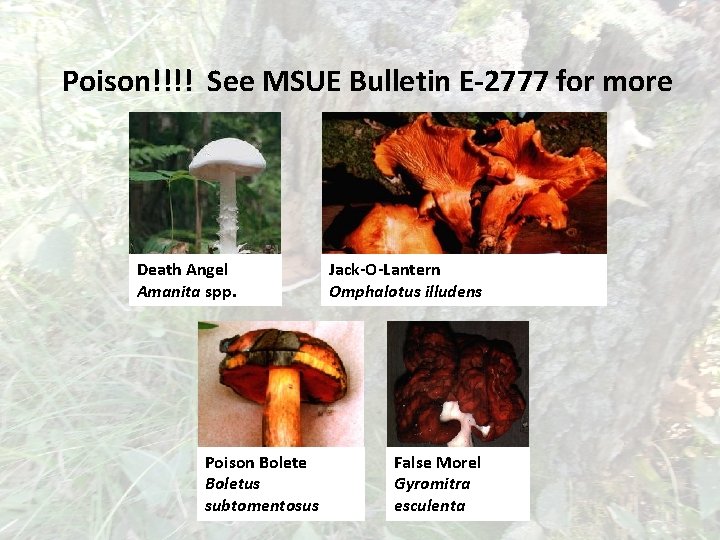
Poison!!!! See MSUE Bulletin E-2777 for more Death Angel Amanita spp. Poison Bolete Boletus subtomentosus Jack-O-Lantern Omphalotus illudens False Morel Gyromitra esculenta
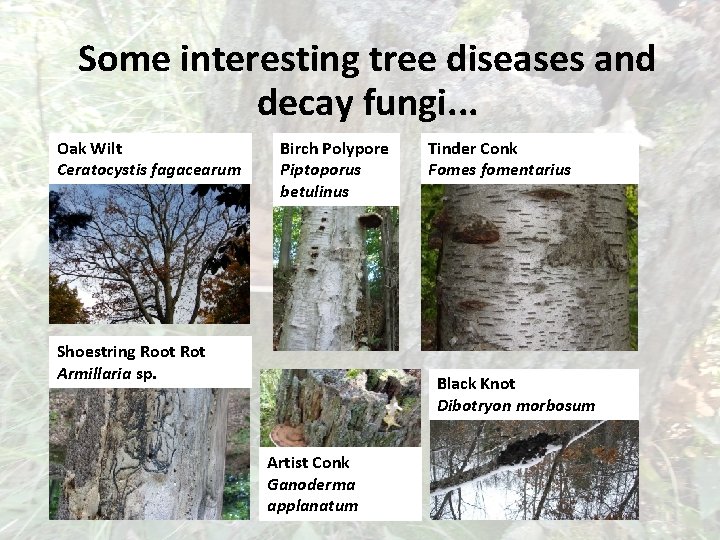
Some interesting tree diseases and decay fungi. . . Oak Wilt Ceratocystis fagacearum Birch Polypore Piptoporus betulinus Shoestring Root Rot Armillaria sp. Tinder Conk Fomes fomentarius Black Knot Dibotryon morbosum Artist Conk Ganoderma applanatum
Mushroom identification and ecology cannot be taught in one hour Contact Linda Scribner, Michigan Certified Mushroom Identification Expert, for a more thorough workshop ØEmail scribneroutfitters@gmail. com
Recommended resources Books: • Kuo, M. 2007. 100 edible mushrooms. The University of Michigan Press. • Kuo, M. and Methven, A. S. 2014. Mushrooms of the Midwest. University of Illinois Press. • Lincoff, G. H. , 1989. The Audubon Society Field Guide to North American Mushrooms, No. 635. 8 L 5. • Meuninck, J. 2015. A Falcon Guide: Basic Illustrated Edible and Medicinal Mushrooms. Falcon Guides, Guilford, CT, and Helena, MT, USA, 97 p. • Michigan State University Extension. 2002. Don’t Pick Poison When Gathering Mushrooms for Food in Michigan. Extension Bulletin E-2777. • Pacioni, G. 1981. Simon and Schuster’s Guide to Mushrooms. Edited by Lincoff, G. Simon and Schuster, Inc. , New York, NY, USA, 512 p. • Smith, A. H. , and Weber, N. S. 1996. The Mushroom Hunter’s Field Guide: All Color and Enlarged. The University of Michigan Press, USA, 316 p. Websites: • Midwest American Mycological Information - http: //www. midwestmycology. org/Index. html • Michigan Department of Agriculture and Rural Development (MDARD) Wild Foraged Mushroom Information - http: //www. michigan. gov/mdard/0, 4610, 7 -125 -50772_45851_45853 -361582 --, 00. html • Michigan Mushroom Hunters Club - https: //www. michiganmushroomhunters. org/ • Mushroom. Expert. Com - http: //mushroomexpert. com/
Contact information for your speakers Josh Shields, Forestry Assistance Program (FAP) at Manistee and Mason-Lake Conservation Districts; Phone 231 -889 -9666, Email joshua. shields@macd. org Kama Ross, FAP at Leelanau, Grand Traverse, and Benzie Conservation Districts; Phone 231 -256 -9783, Email kama. ross@macd. org
Image/Figure Citations (Chronological Order of Appearance in Presentation) • Slide background photo – Josh Shields • Leafless oak photo – Josh Shields • Josh Shields teaching photo – Dr. Michael Jenkins, Purdue University • White rot decay fungus photo – Josh Shields • White morel photo http: //www. midwestmycology. org/Mushrooms/Species%20 listed/Morel%20 species. html • Chicken of the woods photo http: //www. midwestmycology. org/Mushrooms/Species%20 listed/Laetiporous%20 species. html • Life cycle of a fungus diagram – Pacioni (1981) • Chaga photo – Josh Shields • Armillaria photo http: //www. midwestmycology. org/Mushrooms/Species%20 listed/Armillaria%20 species. html • Giant puffball photo http: //www. midwestmycology. org/Mushrooms/Species%20 listed/Calvatia%20 species. html • Oyster mushrooms photo http: //www. midwestmycology. org/Mushrooms/Species%20 listed/Pleurotus%20 species. html
Image/Figure Citations (Chronological Order of Appearance in Presentation) - Continued • Bear’s head tooth fungus photo http: //www. midwestmycology. org/Mushrooms/Species%20 listed/Hericium%20 species. html • Amanita photo - http: //www. midwestmycology. org/Mushrooms/Poisonous%20 species. html • Jack-o-lantern photo – Michigan State University Extension (2002) • Poison bolete photo – Michigan State University Extension (2002) • False morel photo – Michigan State University Extension (2002) • Oak wilt photo – Josh Shields • Birch polypore photo – Josh Shields • Tinder conk photo – Josh Shields • Shoestring root rot photo – Josh Shields • Artist conk photo – Josh Shields • Black knot photo – Josh Shields
References from slides • Blackwell, M. , 2011. The Fungi: 1, 2, 3… 5. 1 million species? . American journal of Botany 98: 426 -438. • Chaudhry, Q. , Blom-Zandstra, M. , Gupta, S. K. and Joner, E. 2005. Utilising the synergy between plants and rhizosphere microorganisms to enhance breakdown of organic pollutants in the environment (15 pp). Environmental Science and Pollution Research, 12: 34 -48. • Kendrick, B. 2001. Fungi: ecological importance and impact on humans. e. LS. Published online, DOI: 10. 1002/9780470015902. a 0000369. pub 2 • Lange, L. 2014. The importance of fungi and mycology for addressing major global challenges. IMA fungus, 5: 463 -471. • Lemieszek, M. K. , Langner, E. , Kaczor, J. , Kandefer-Szerszen, M. , Sanecka, B. , Mazurkiewicz, W. and Rzeski, W. 2011. Anticancer effects of fraction isolated from fruiting bodies of Chaga medicinal mushroom, Inonotus obliquus (Pers. : Fr. ) Pilát (Aphyllophoromycetideae): in vitro studies. International Journal of Medicinal Mushrooms 13. • Michigan State University Extension. 2002. Don’t Pick Poison When Gathering Mushrooms for Food in Michigan. Extension Bulletin E-2777. • Pacioni, G. 1981. Simon and Schuster’s Guide to Mushrooms. Edited by Lincoff, G. Simon and Schuster, Inc. , New York, NY, USA, 512 p. • Sadler, M. 2003. Nutritional properties of edible fungi. Nutrition Bulletin 28: 305 -308. • Van der Heijden, M. G. , Klironomos, J. N. , Ursic, M. and Moutoglis, P. 1998. Mycorrhizal fungal diversity determines plant biodiversity, ecosystem variability and productivity. Nature 396: 69.