
Forest Mensuration II Lecture 4 Stratified Random Sampling
- Slides: 12
Forest Mensuration II Lecture 4 Stratified Random Sampling Avery and Burkhart, Chapter 3 Shiver and Borders, Chapter 5 Lecture 4 Forestry 3218
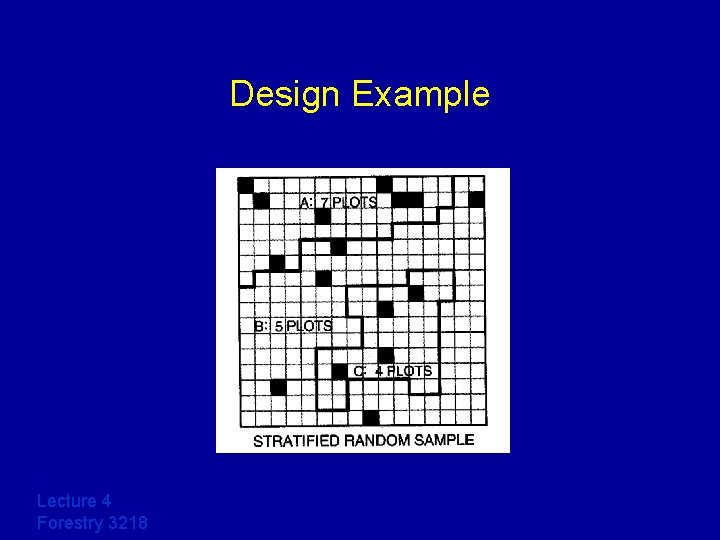
What is Stratified Random Sampling? • A population is subdivided into subpopulations of known sizes • A simple random sample (or systematic sampling) of at least two units is drawn from each subpopulation Lecture 4 Forestry 3218
Why Stratified Random Sampling? • To obtain a more precise estimate of the population mean when – Sample size is the same – The variations within subpopulations are smaller than the total population variance • To obtain an estimate of the subpopulations Lecture 4 Forestry 3218
How to stratify? • Assign each sampling unit to one and only one stratum • Defining strata can be easy or difficult; normally done prior to sampling, but can be reassigned/re-classified Lecture 4 Forestry 3218
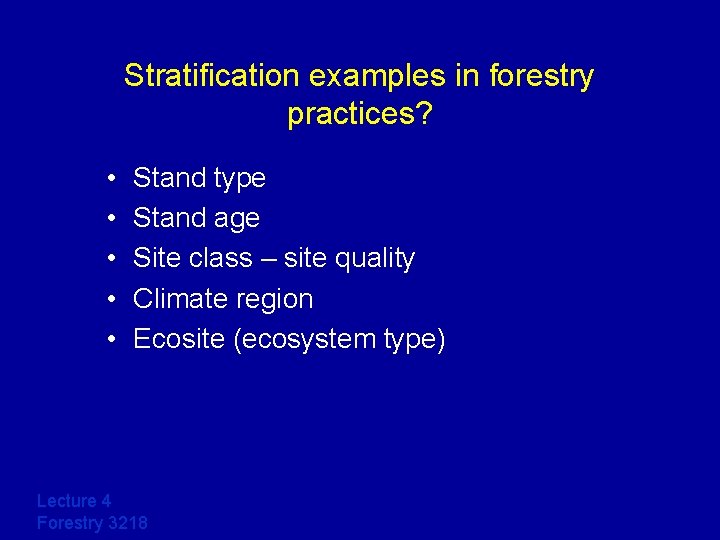
Stratification examples in forestry practices? • • • Stand type Stand age Site class – site quality Climate region Ecosite (ecosystem type) Lecture 4 Forestry 3218
Design Example Lecture 4 Forestry 3218
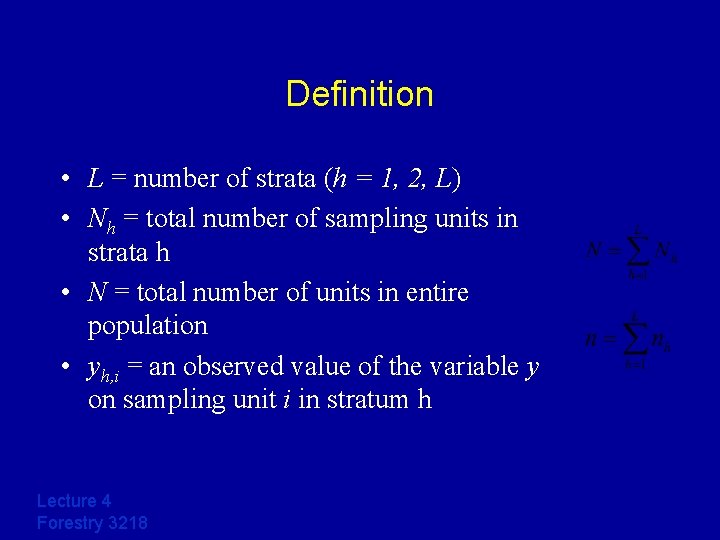
Definition • L = number of strata (h = 1, 2, L) • Nh = total number of sampling units in strata h • N = total number of units in entire population • yh, i = an observed value of the variable y on sampling unit i in stratum h Lecture 4 Forestry 3218
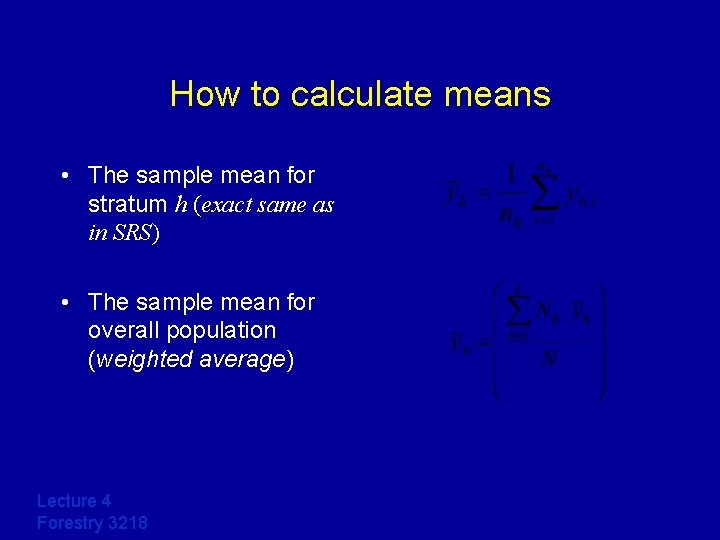
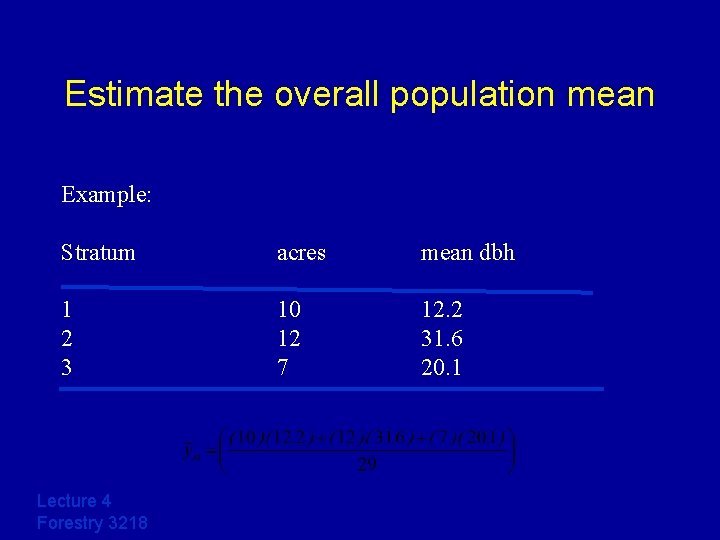
How to calculate means • The sample mean for stratum h (exact same as in SRS) • The sample mean for overall population (weighted average) Lecture 4 Forestry 3218
Estimate the overall population mean Example: Stratum acres mean dbh 1 2 3 10 12 7 12. 2 31. 6 20. 1 Lecture 4 Forestry 3218
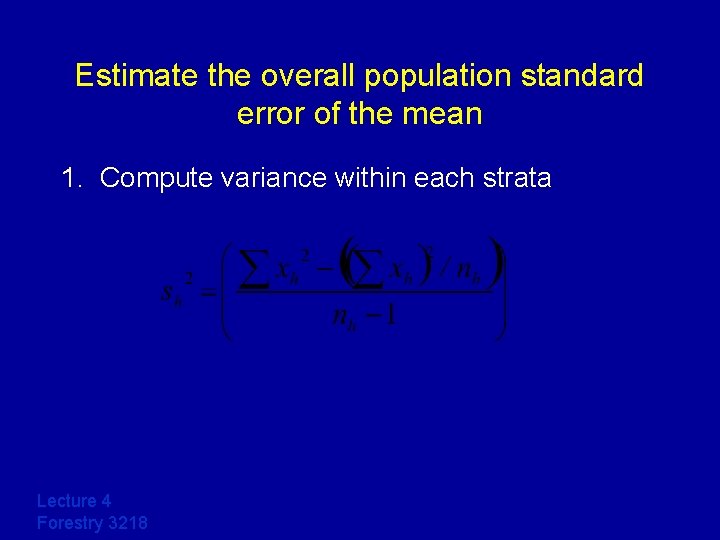
Estimate the overall population standard error of the mean 1. Compute variance within each strata Lecture 4 Forestry 3218
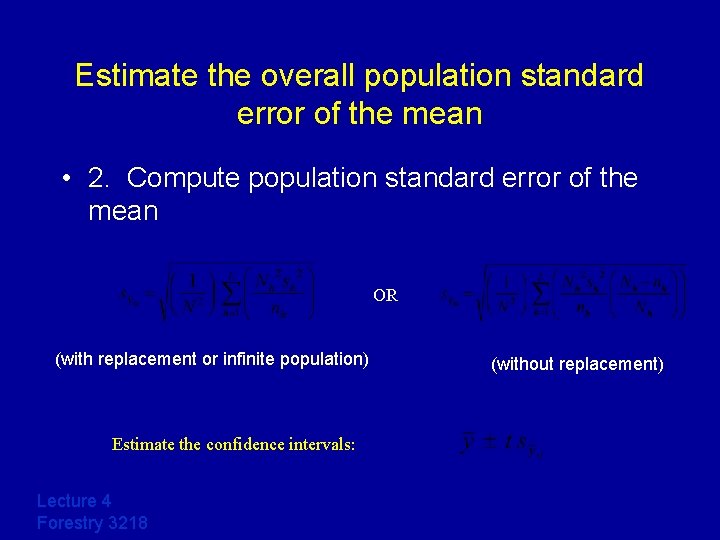
Estimate the overall population standard error of the mean • 2. Compute population standard error of the mean OR (with replacement or infinite population) Estimate the confidence intervals: Lecture 4 Forestry 3218 (without replacement)
Additional Reading for Lecture 5 • Chen, H. Y. H. , and K. Klinka. 2003. Aboveground production of mixed-species western hemlock and redcedar stands in British Columbia. Forest Ecology and Management 184: 46 -55. • You can download from: flash. lakeheau. ca/~hchen Lecture 4 Forestry 3218