
Forest Inventory Methods and Carbon Analysis In Support
Forest Inventory Methods and Carbon Analysis In Support of the United States Submission on Land-Use, Land-Use Change, and Forestry Lyon, France 9 September 2000 Linda S. Heath Richard A. Birdsey USDA Forest Service Northeastern Research Station
Outline of Presentation • The United States Forest Inventory • Methods to Estimate Carbon in Forests • Estimates for Article 3. 3 of the Kyoto Protocol – Afforestation, Deforestation, and Reforestation • Estimates for Article 3. 4 of the Kyoto Protocol – Forest Management Activities

Inventory Sample Design • Phase One – Remote Sensing to Stratify Forest Area – 3, 000 forest sample points, each equals 100 ha • Phase Two – Ground Sampling of Forest Attributes – 120, 000 forest sample points, each equals 2200 ha • Phase Three – Forest Health Monitoring – 4, 500 forest sample points, each equals 38, 500 ha
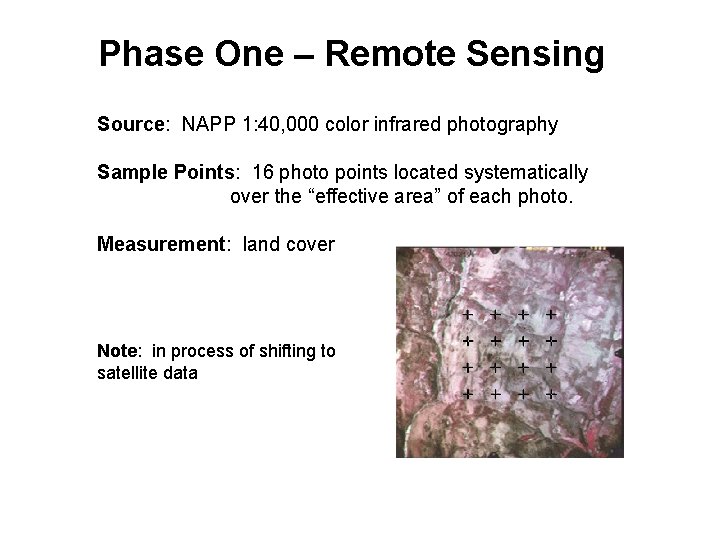
Phase One – Remote Sensing Source: NAPP 1: 40, 000 color infrared photography Sample Points: 16 photo points located systematically over the “effective area” of each photo. Measurement: land cover Note: in process of shifting to satellite data
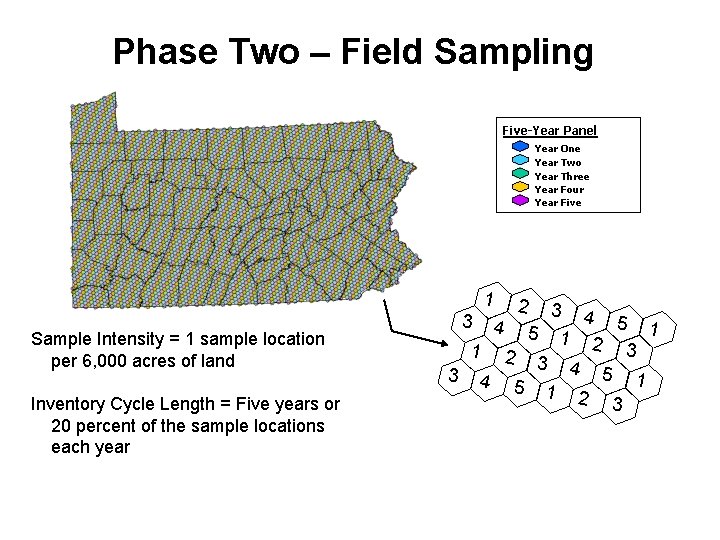
Phase Two – Field Sampling Five-Year Panel Year One Year Two Year Three Year Four Year Five Sample Intensity = 1 sample location per 6, 000 acres of land Inventory Cycle Length = Five years or 20 percent of the sample locations each year 1 2 3 4 5 1 2 3
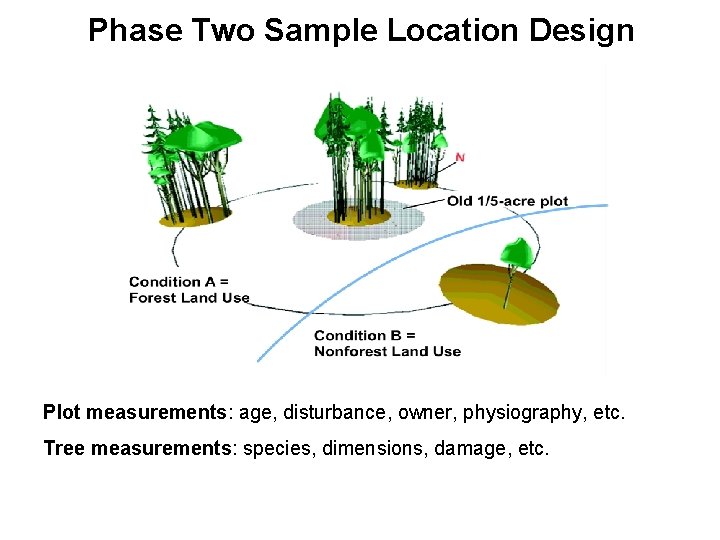
Phase Two Sample Location Design Plot measurements: age, disturbance, owner, physiography, etc. Tree measurements: species, dimensions, damage, etc.
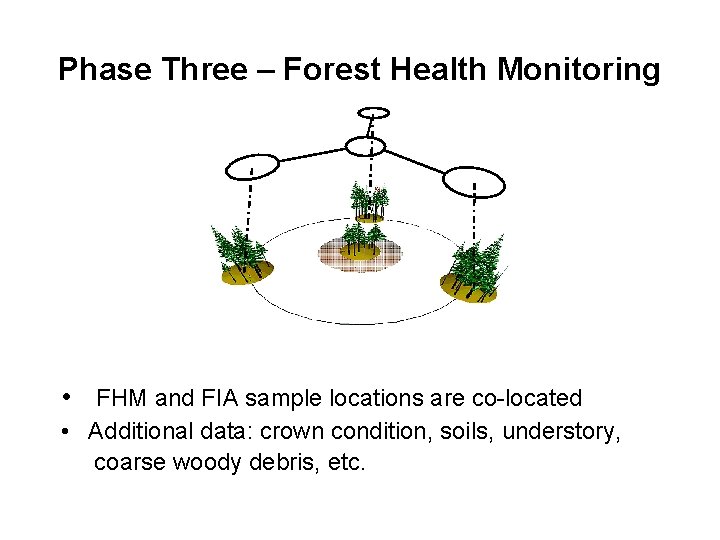
Phase Three – Forest Health Monitoring • FHM and FIA sample locations are co-located • Additional data: crown condition, soils, understory, coarse woody debris, etc.
Forest Inventory Estimates as a Basis for Carbon Analysis (Trends by State and Region) • • Area by land class (reconciled with NRI) Area by forest type, owner, age class Tree volume by species and size class Tree biomass by species and size class
Methods to estimate carbon I. Calculating carbon based using inventory data II. Estimating forest sector carbon III. Uncertainty

Basic estimation of carbon stocks and stock changes • Carbon stock = CARBON/AREA times AREA • Carbon stock change = C stock at time 2 minus C stock at time 1 Divide by length of period = carbon/year • Estimated values can be obtained from measured data or from using models

How to calculate carbon stock estimates from forest inventory data? • Calculate biomass and convert to carbon (carbon = 50% of dry weight biomass) • Estimate forest floor carbon using simple relationships • Estimate soil carbon based on USDA State Soil Geographic database (STATSGO), coupled with historical land use change knowledge and assumptions of soil dynamics following land use change and disturbance • Sum carbon pools
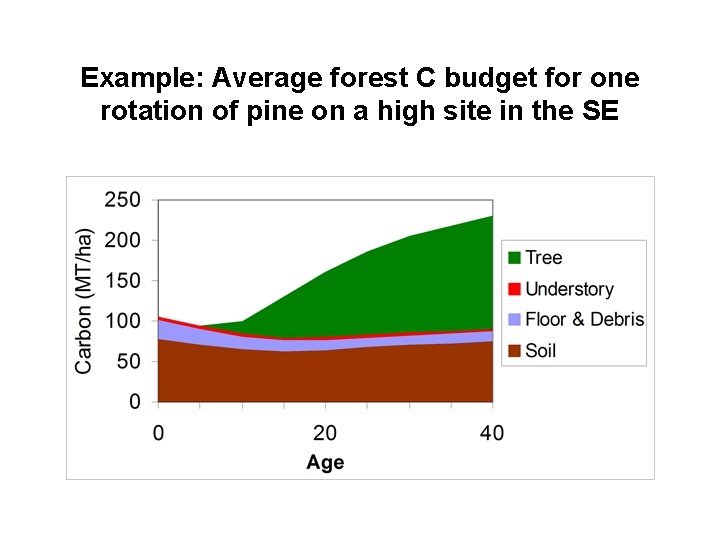
Example: Average forest C budget for one rotation of pine on a high site in the SE
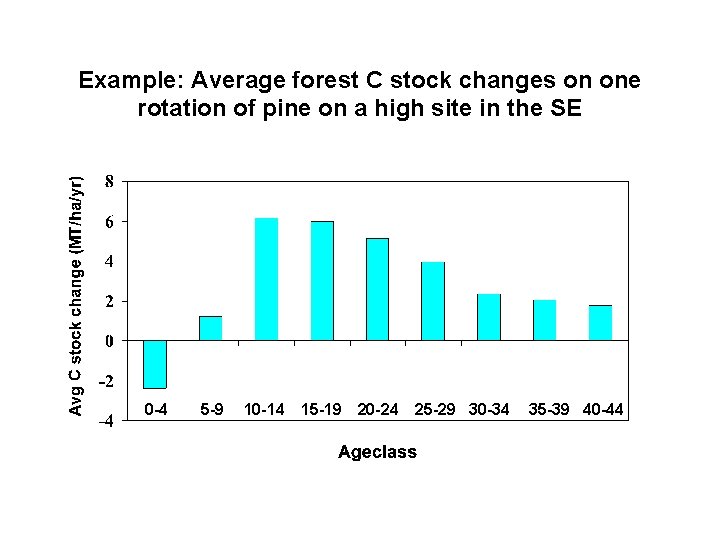
Example: Average forest C stock changes on one rotation of pine on a high site in the SE 0 -4 5 -9 10 -14 15 -19 20 -24 25 -29 30 -34 35 -39 40 -44
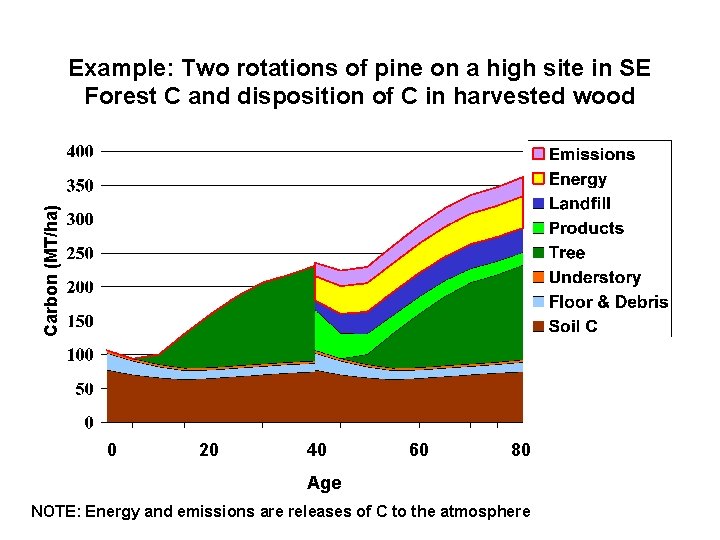
Carbon (MT/ha) Example: Two rotations of pine on a high site in SE Forest C and disposition of C in harvested wood 0 20 40 60 80 Age NOTE: Energy and emissions are releases of C to the atmosphere
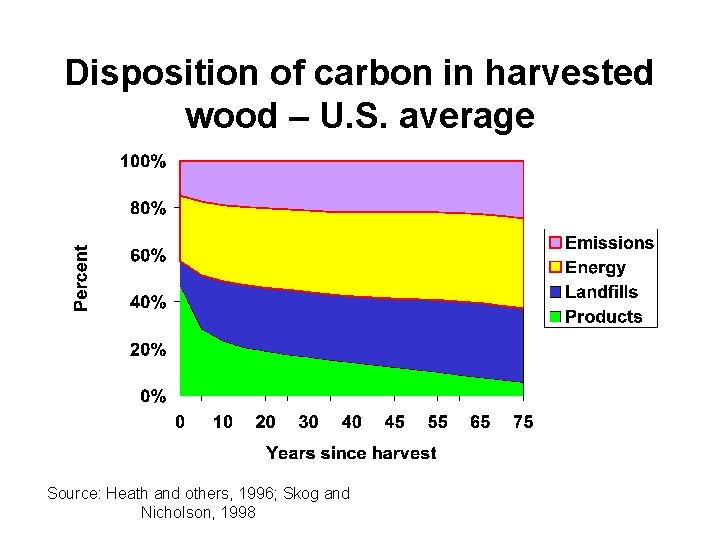
Disposition of carbon in harvested wood – U. S. average Source: Heath and others, 1996; Skog and Nicholson, 1998
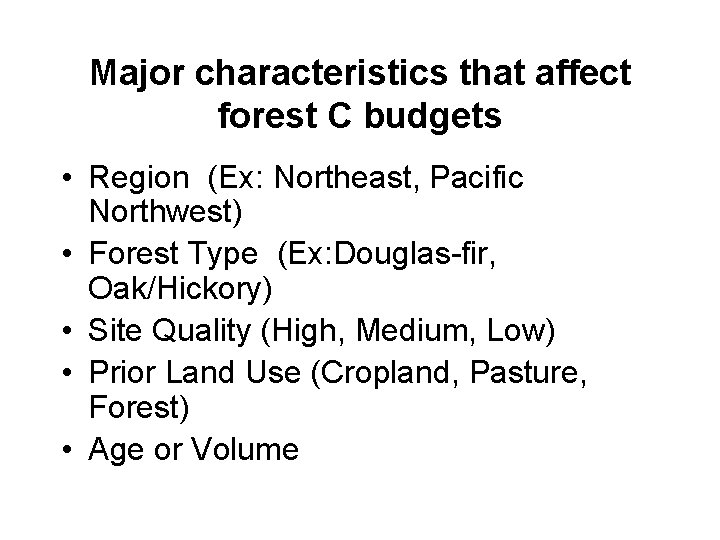
Major characteristics that affect forest C budgets • Region (Ex: Northeast, Pacific Northwest) • Forest Type (Ex: Douglas-fir, Oak/Hickory) • Site Quality (High, Medium, Low) • Prior Land Use (Cropland, Pasture, Forest) • Age or Volume
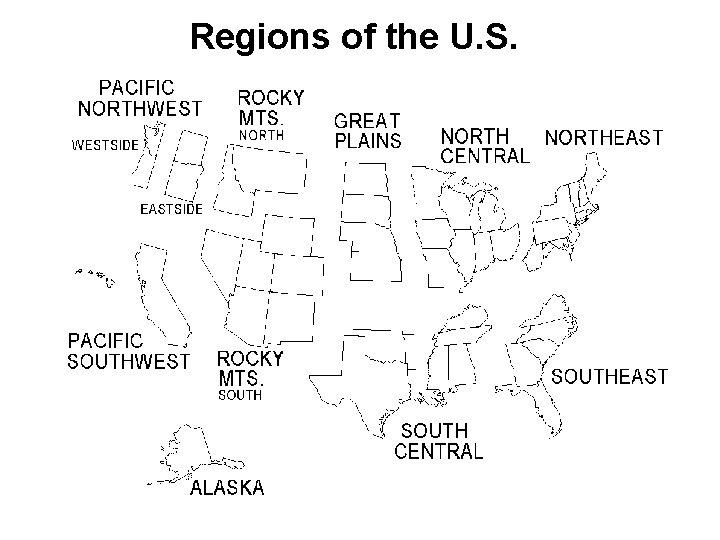
Regions of the U. S.
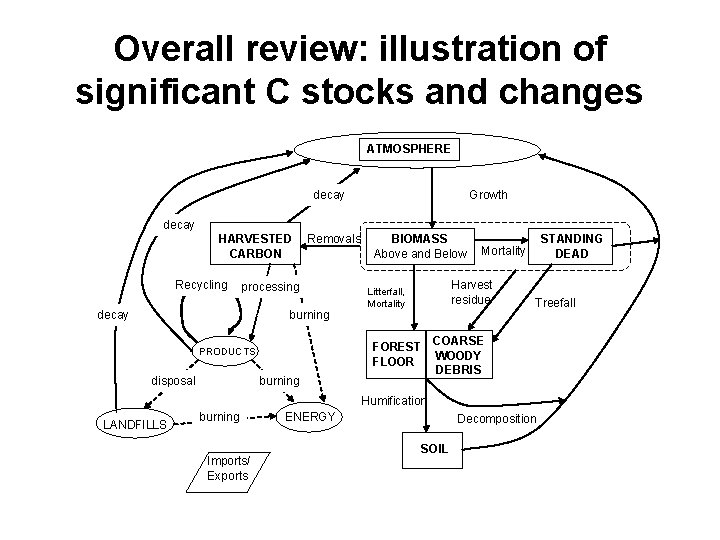
Overall review: illustration of significant C stocks and changes ATMOSPHERE decay Growth decay HARVESTED CARBON Recycling Removals processing decay burning PRODUCTS disposal burning BIOMASS Above and Below Harvest residue Litterfall, Mortality STANDING DEAD Mortality Treefall FOREST COARSE WOODY FLOOR DEBRIS Humification LANDFILLS burning Imports/ Exports ENERGY Decomposition SOIL
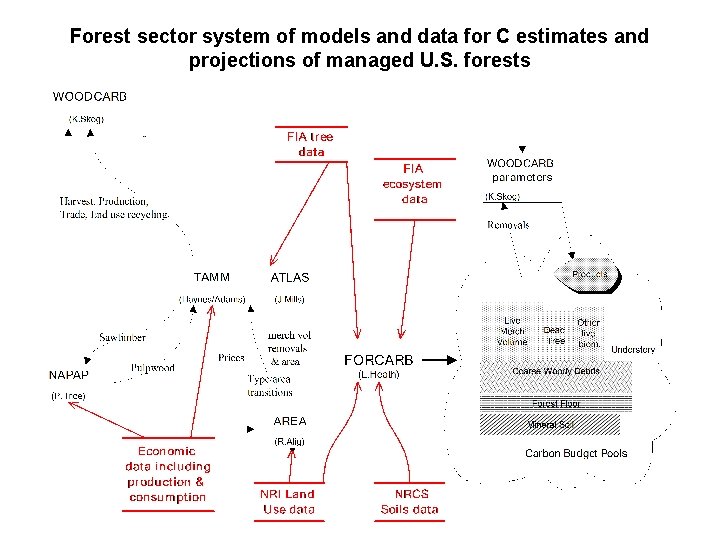
Forest sector system of models and data for C estimates and projections of managed U. S. forests
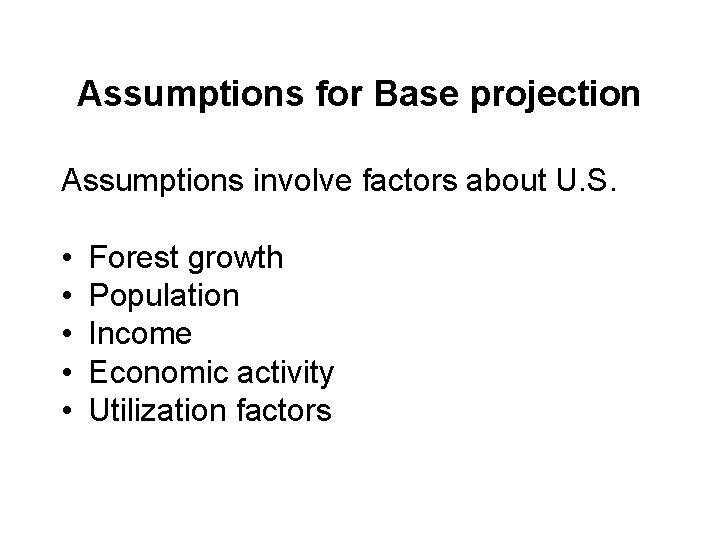
Assumptions for Base projection Assumptions involve factors about U. S. • • • Forest growth Population Income Economic activity Utilization factors
What is uncertainty? – IPCC guidelines • Generic definition of uncertainty • IPCC guidelines suggest that it is more useful to express uncertainty quantitatively and systematically in the form of well-developed confidence intervals.
Uncertainty - definition and method • Uncertainty: an expression of likely values for an estimate when the true value is not exactly known. • Methods: We use Monte Carlo simulations to represent uncertainty as probability distributions
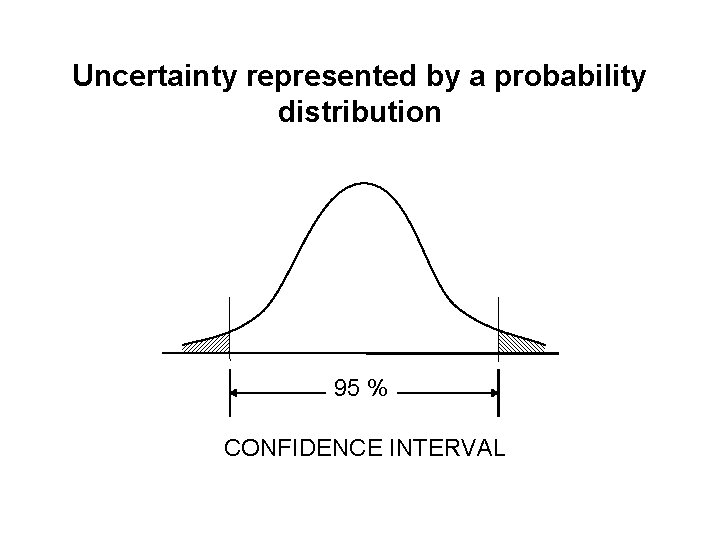
Uncertainty represented by a probability distribution 95 % CONFIDENCE INTERVAL
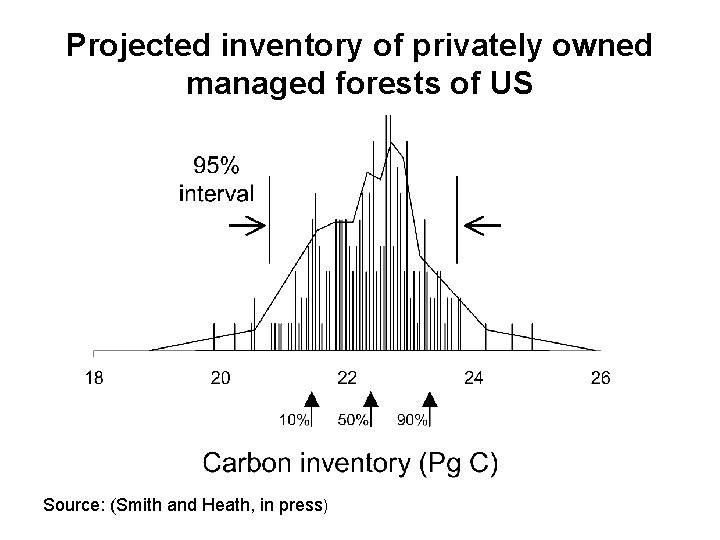
Projected inventory of privately owned managed forests of US Source: (Smith and Heath, in press)

Absolute and relative uncertainty C estimates on private managed forests of the U. S. Inventory: Flux: 80% confidence interval 22, 400 +/- 950 MMT 74 +/- 11. 5 MMT 22, 400 +/- 4% MMT 74 +/- 15% MMT Source: Smith and Heath, in press; C in harvests not included in these estimates; also based on older inventory data.
Summary of methods for Articles 3. 3 and 3. 4 • Followed IPCC definitions and accounting • All C pools included where appropriate • Estimates based on comprehensive forest inventory data and carbon estimation models • Used multiple strata (region, owner, forest type, . . ) • Used projection models and adjusted periodic estimates to required reporting dates
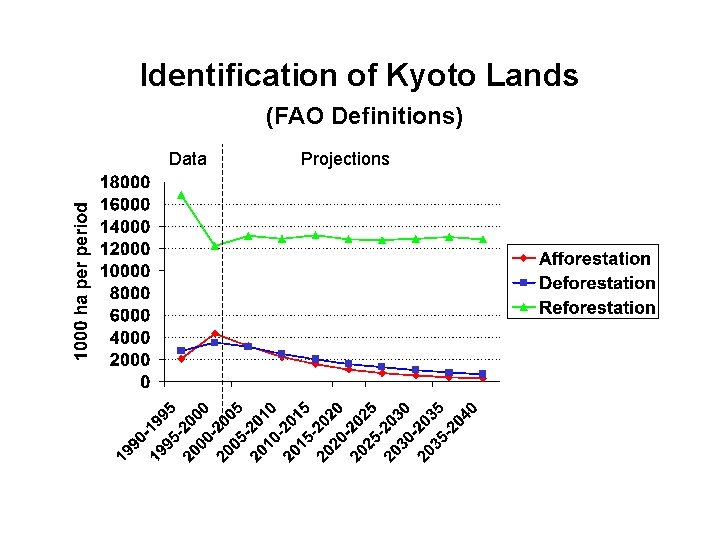
Identification of Kyoto Lands (FAO Definitions) Data Projections
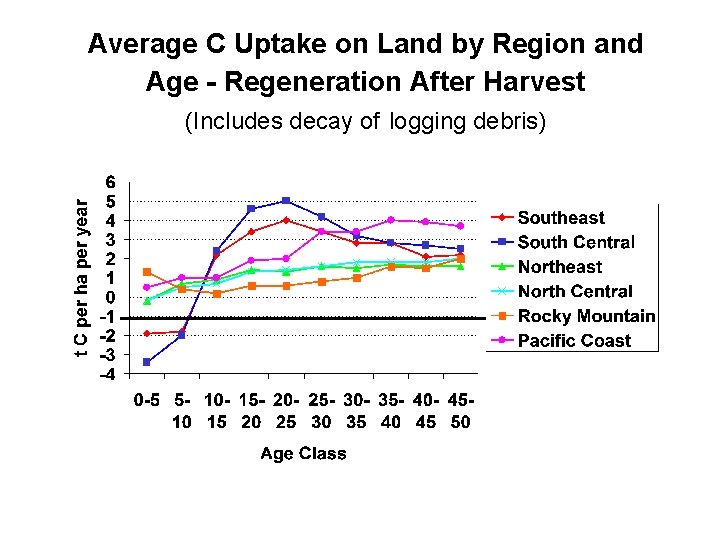
Average C Uptake on Land by Region and Age - Regeneration After Harvest (Includes decay of logging debris)
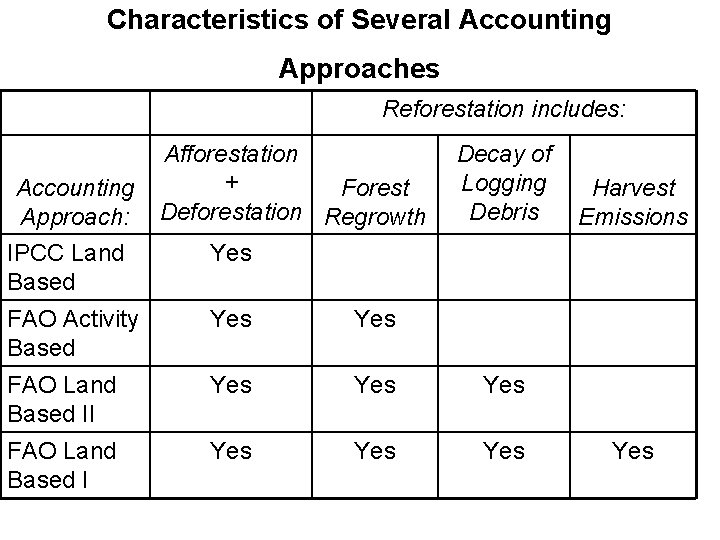
Characteristics of Several Accounting Approaches Reforestation includes: Accounting Approach: Afforestation + Forest Deforestation Regrowth Decay of Logging Debris IPCC Land Based Yes FAO Activity Based Yes FAO Land Based II Yes Yes FAO Land Based I Yes Yes Harvest Emissions Yes
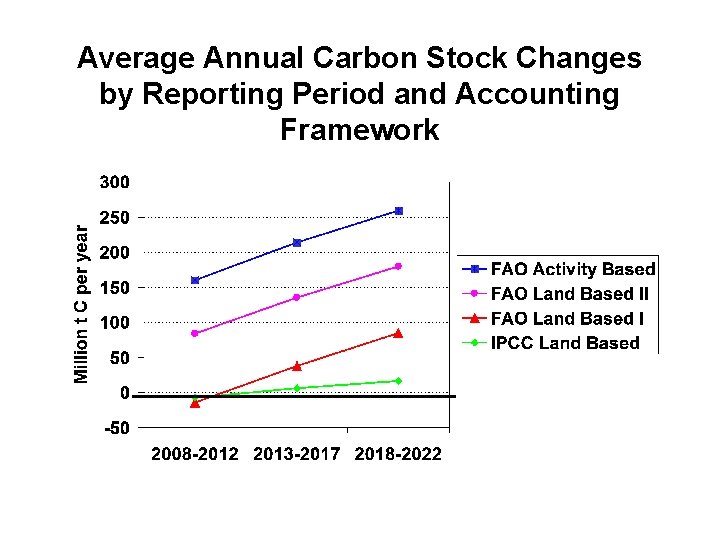
Average Annual Carbon Stock Changes by Reporting Period and Accounting Framework
U. S. submission for Article 3. 4 • Proposes inclusion of three broad land management activities: Forest Management, Cropland Management, and Grazing Land Management • Proposes a comprehensive land-based accounting system
Definition of managed forests Forest management is an activity involving the: • Regeneration, tending, protection • Harvest, access, and utilization of forest resources to meet the purposes of the forest landowner.
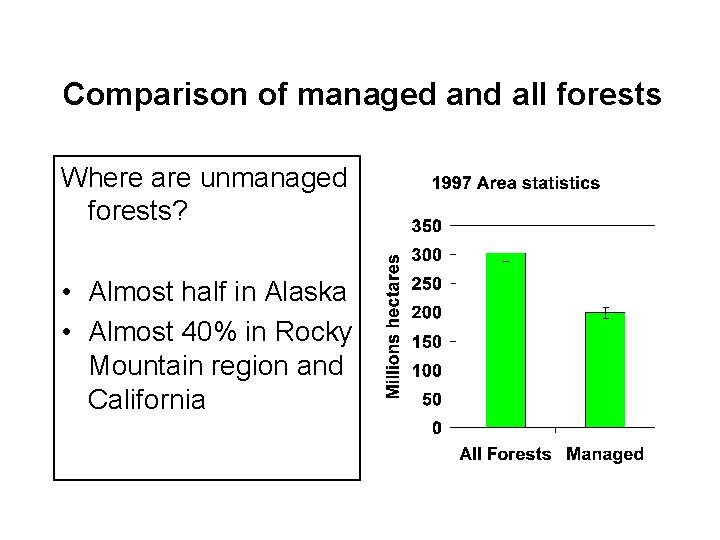
Comparison of managed and all forests Where are unmanaged forests? • Almost half in Alaska • Almost 40% in Rocky Mountain region and California
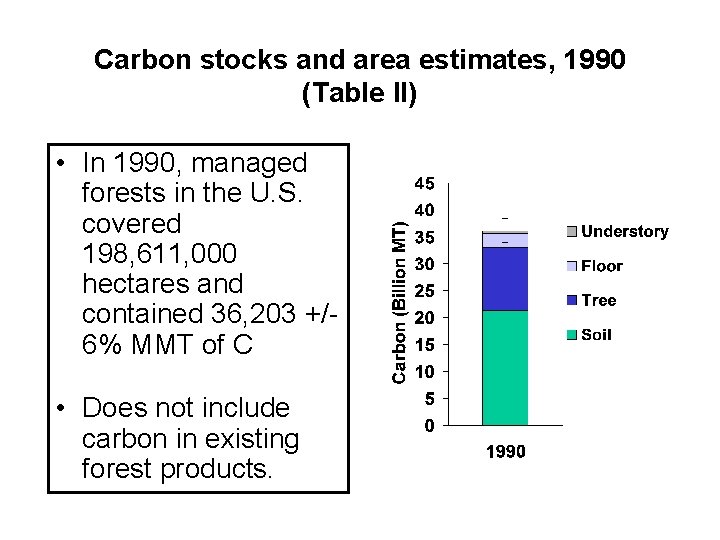
Carbon stocks and area estimates, 1990 (Table II) • In 1990, managed forests in the U. S. covered 198, 611, 000 hectares and contained 36, 203 +/- 6% MMT of C • Does not include carbon in existing forest products.
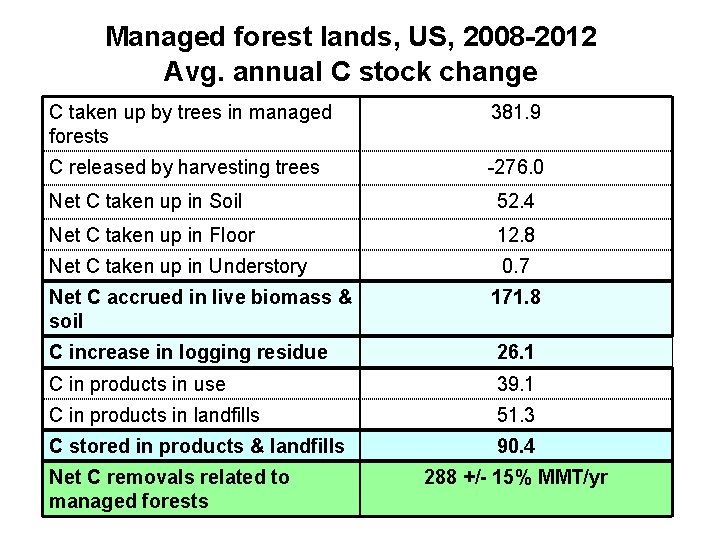
Managed forest lands, US, 2008 -2012 Avg. annual C stock change C taken up by trees in managed forests 381. 9 C released by harvesting trees -276. 0 Net C taken up in Soil 52. 4 Net C taken up in Floor 12. 8 Net C taken up in Understory 0. 7 Net C accrued in live biomass & soil 171. 8 C increase in logging residue 26. 1 C in products in use 39. 1 C in products in landfills 51. 3 C stored in products & landfills 90. 4 Net C removals related to managed forests 288 +/- 15% MMT/yr

Trend of carbon sequestration on managed forests, U. S. Data Projections
- Slides: 37