
FORESHADOWING Foreshadowing occurs in a literary text when
- Slides: 12
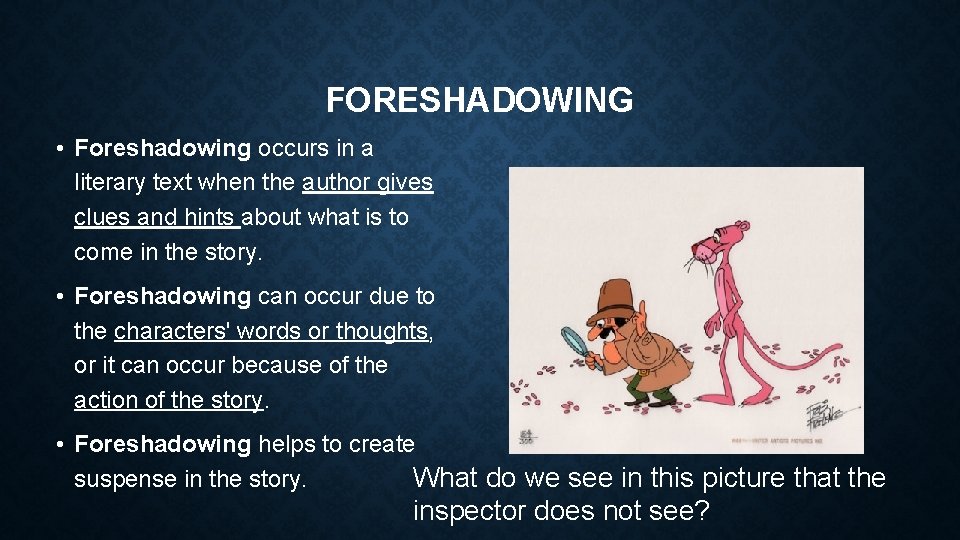
FORESHADOWING • Foreshadowing occurs in a literary text when the author gives clues and hints about what is to come in the story. • Foreshadowing can occur due to the characters' words or thoughts, or it can occur because of the action of the story. • Foreshadowing helps to create What do we see in this picture that the suspense in the story. inspector does not see?
*Foreshadowing creates suspense and makes readers eager to find out what will happen. *the function of foreshadowing is to build anticipation in the minds of readers about what might happen next, thus adding dramatic tension to a story
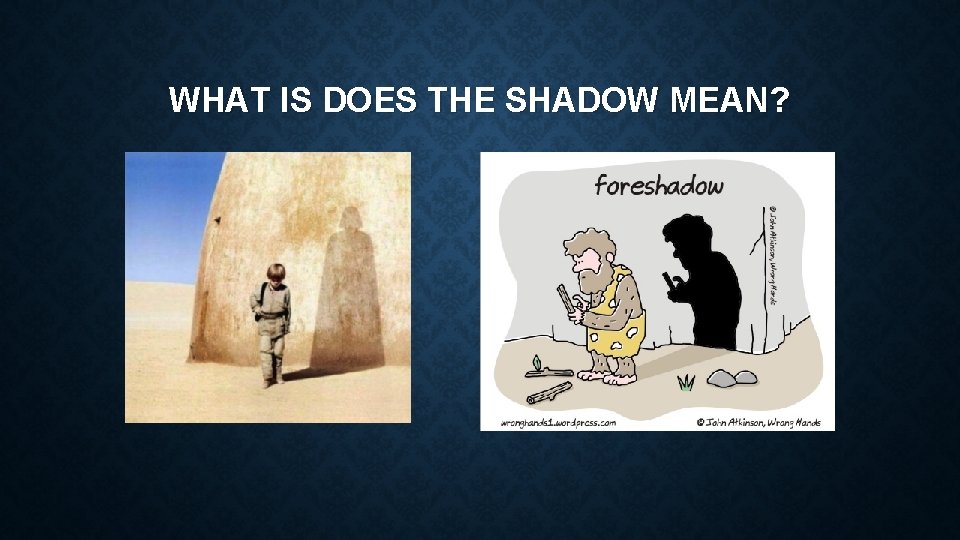
WHAT IS DOES THE SHADOW MEAN?
Watch the following video clip and IDENTIFY examples of FORESHADOWING on your dry erase board. Look at your list of FORESHADOWING examples and answer the following question with your partner: What do you think is going to happen later in the movie (make a prediction!)? Gremlins
Examples of Foreshadowing in writing: 1. A pipe is going to burst, but before it does, the author writes a scene where the family notices a small dark spot on the ceiling, but ignores it. 2. A character in a story comments on the weather, and says, "I think a storm is coming. " This can signify a physical storm or a metaphorical storm that is coming in the story.
Other types of FORESHADOWING (cont. ): Setting: Read the passages from the short story, “The Monkey’s Paw. ” Highlight any descriptions of the setting that FORESHADOW. Vocabulary: “Without” – In this context, you could replace this word with “Outside” “torrent” – a strong and fast-moving stream of water or other liquid. -- In this context, Mr. White is saying the “road is so wet it’s a river”
Imagery can also be used to Foreshadow by the writer Imagery: visually descriptive or figurative language, especially in a literary work. … 1. I could hear the popping and crackling as mom dropped the bacon into the frying pan, and soon the salty, greasy smell wafted toward me. 2. Glittering white, the blanket of snow covered everything in sight. 3. “Let's stay up all night, ' Kat whispers. 'Let's wait for the moon to kiss the morning star. ” ― Kiss the Morning Star by Elissa Janine Hoole
Let’s see how Mary Shelley uses imagery to create “The blood flowed freely in my veins, but a weight of despair and remorse pressed on my heart, which nothing could remove. Sleep fled from my eyes; I wandered like an evil spirit, for I had committed deeds of mischief beyond description horrible, and more, much more (I persuaded myself), was yet behind. ” – Frankenstein by Mary Shelley … She is very intentional about the words that she chose in her descriptions!
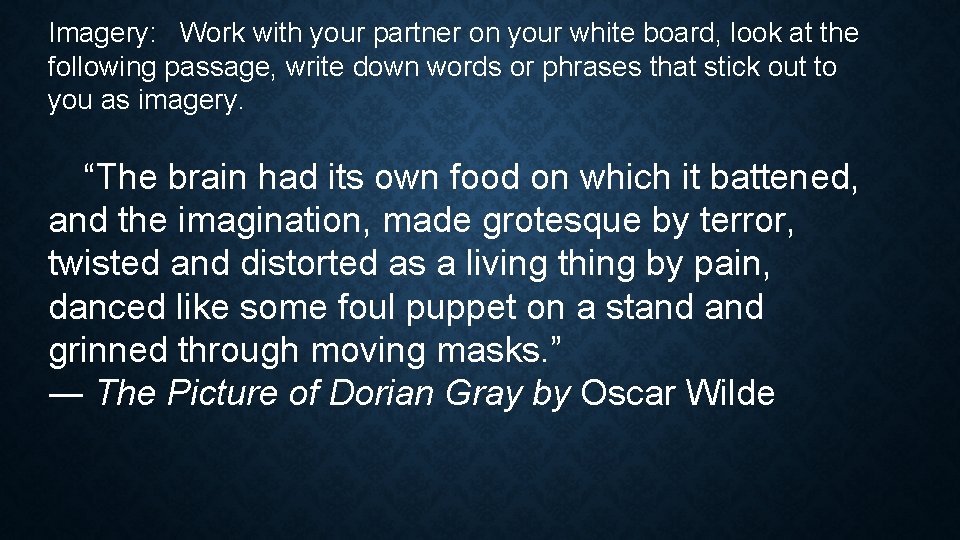
Imagery: Work with your partner on your white board, look at the following passage, write down words or phrases that stick out to you as imagery. “The brain had its own food on which it battened, and the imagination, made grotesque by terror, twisted and distorted as a living thing by pain, danced like some foul puppet on a stand grinned through moving masks. ” ― The Picture of Dorian Gray by Oscar Wilde
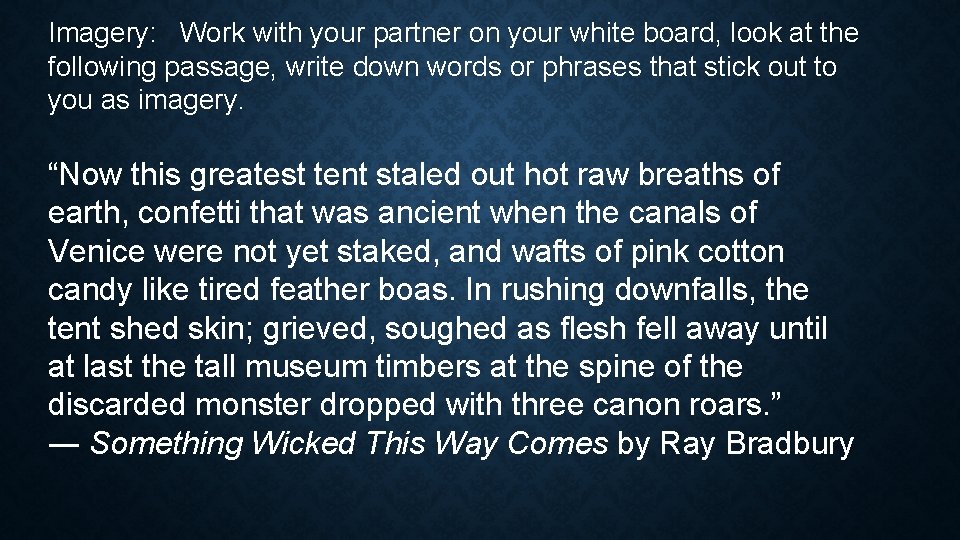
Imagery: Work with your partner on your white board, look at the following passage, write down words or phrases that stick out to you as imagery. “Now this greatest tent staled out hot raw breaths of earth, confetti that was ancient when the canals of Venice were not yet staked, and wafts of pink cotton candy like tired feather boas. In rushing downfalls, the tent shed skin; grieved, soughed as flesh fell away until at last the tall museum timbers at the spine of the discarded monster dropped with three canon roars. ” ― Something Wicked This Way Comes by Ray Bradbury
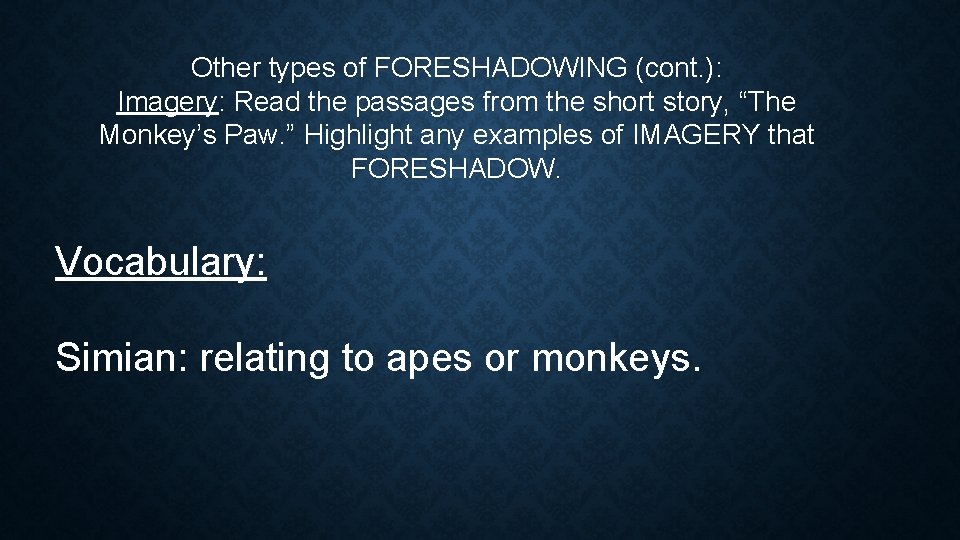
Other types of FORESHADOWING (cont. ): Imagery: Read the passages from the short story, “The Monkey’s Paw. ” Highlight any examples of IMAGERY that FORESHADOW. Vocabulary: Simian: relating to apes or monkeys.
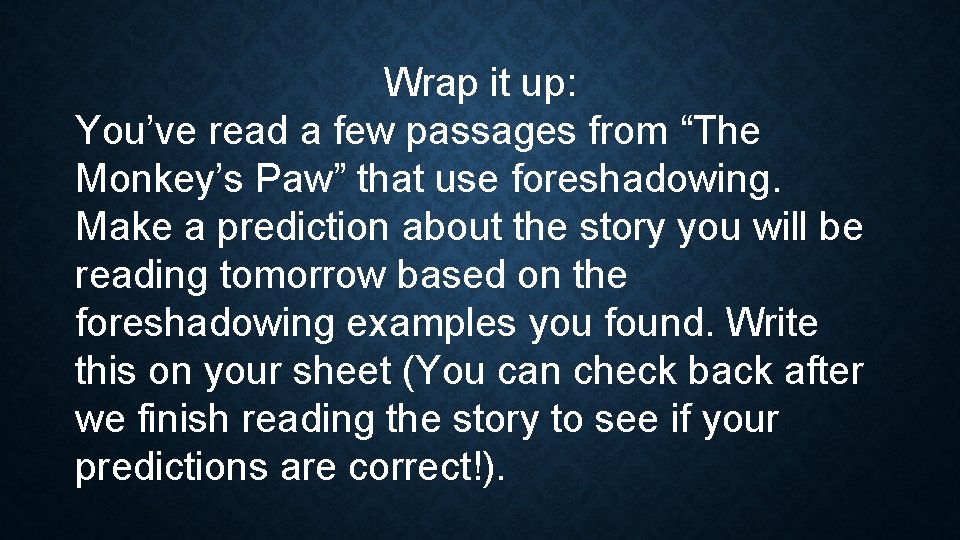
Wrap it up: You’ve read a few passages from “The Monkey’s Paw” that use foreshadowing. Make a prediction about the story you will be reading tomorrow based on the foreshadowing examples you found. Write this on your sheet (You can check back after we finish reading the story to see if your predictions are correct!).