
Forensics for the body farm Preferences for the
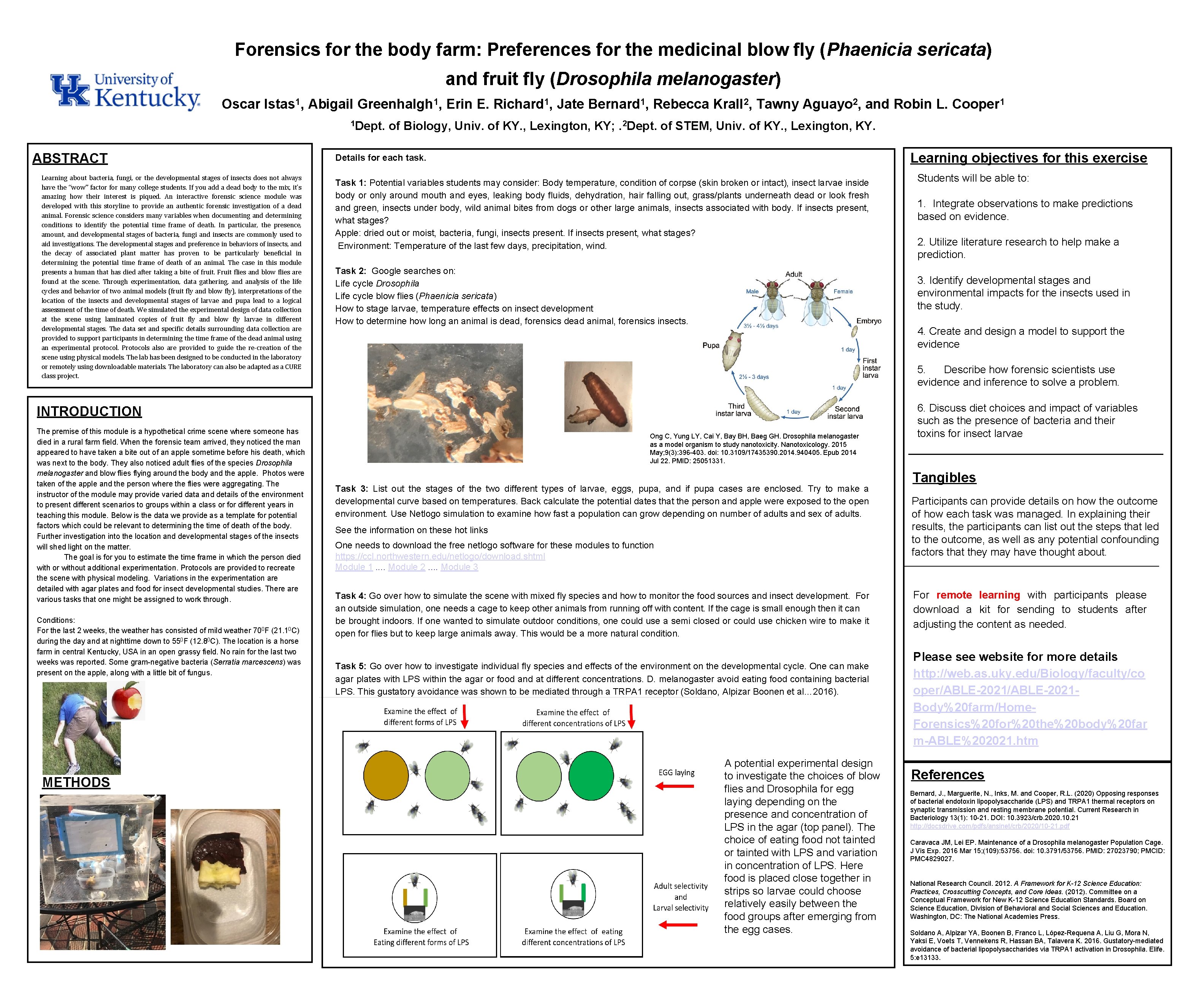
Forensics for the body farm: Preferences for the medicinal blow fly (Phaenicia sericata) and fruit fly (Drosophila melanogaster) Oscar Istas 1, Abigail Greenhalgh 1, Erin E. Richard 1, Jate Bernard 1, Rebecca Krall 2, Tawny Aguayo 2, and Robin L. Cooper 1 1 Dept. ABSTRACT Learning about bacteria, fungi, or the developmental stages of insects does not always have the “wow” factor for many college students. If you add a dead body to the mix, it’s amazing how their interest is piqued. An interactive forensic science module was developed with this storyline to provide an authentic forensic investigation of a dead animal. Forensic science considers many variables when documenting and determining conditions to identify the potential time frame of death. In particular, the presence, amount, and developmental stages of bacteria, fungi and insects are commonly used to aid investigations. The developmental stages and preference in behaviors of insects, and the decay of associated plant matter has proven to be particularly beneficial in determining the potential time frame of death of an animal. The case in this module presents a human that has died after taking a bite of fruit. Fruit flies and blow flies are found at the scene. Through experimentation, data gathering, and analysis of the life cycles and behavior of two animal models (fruit fly and blow fly), interpretations of the location of the insects and developmental stages of larvae and pupa lead to a logical assessment of the time of death. We simulated the experimental design of data collection at the scene using laminated copies of fruit fly and blow fly larvae in different developmental stages. The data set and specific details surrounding data collection are provided to support participants in determining the time frame of the dead animal using an experimental protocol. Protocols also are provided to guide the re-creation of the scene using physical models. The lab has been designed to be conducted in the laboratory or remotely using downloadable materials. The laboratory can also be adapted as a CURE class project. of Biology, Univ. of KY. , Lexington, KY; . 2 Dept. of STEM, Univ. of KY. , Lexington, KY. Learning objectives for this exercise Details for each task. Task 1: Potential variables students may consider: Body temperature, condition of corpse (skin broken or intact), insect larvae inside body or only around mouth and eyes, leaking body fluids, dehydration, hair falling out, grass/plants underneath dead or look fresh and green, insects under body, wild animal bites from dogs or other large animals, insects associated with body. If insects present, what stages? Apple: dried out or moist, bacteria, fungi, insects present. If insects present, what stages? Environment: Temperature of the last few days, precipitation, wind. Task 2: Google searches on: Life cycle Drosophila Life cycle blow flies (Phaenicia sericata) How to stage larvae, temperature effects on insect development How to determine how long an animal is dead, forensics dead animal, forensics insects. Conditions: For the last 2 weeks, the weather has consisted of mild weather 700 F (21. 10 C) during the day and at nighttime down to 550 F (12. 80 C). The location is a horse farm in central Kentucky, USA in an open grassy field. No rain for the last two weeks was reported. Some gram-negative bacteria (Serratia marcescens) was present on the apple, along with a little bit of fungus. METHODS 1. Integrate observations to make predictions based on evidence. 2. Utilize literature research to help make a prediction. 3. Identify developmental stages and environmental impacts for the insects used in the study. 4. Create and design a model to support the evidence 5. Describe how forensic scientists use evidence and inference to solve a problem. INTRODUCTION The premise of this module is a hypothetical crime scene where someone has died in a rural farm field. When the forensic team arrived, they noticed the man appeared to have taken a bite out of an apple sometime before his death, which was next to the body. They also noticed adult flies of the species Drosophila melanogaster and blow flies flying around the body and the apple. Photos were taken of the apple and the person where the flies were aggregating. The instructor of the module may provide varied data and details of the environment to present different scenarios to groups within a class or for different years in teaching this module. Below is the data we provide as a template for potential factors which could be relevant to determining the time of death of the body. Further investigation into the location and developmental stages of the insects will shed light on the matter. The goal is for you to estimate the time frame in which the person died with or without additional experimentation. Protocols are provided to recreate the scene with physical modeling. Variations in the experimentation are detailed with agar plates and food for insect developmental studies. There are various tasks that one might be assigned to work through. Students will be able to: Ong C, Yung LY, Cai Y, Bay BH, Baeg GH. Drosophila melanogaster as a model organism to study nanotoxicity. Nanotoxicology. 2015 May; 9(3): 396 -403. doi: 10. 3109/17435390. 2014. 940405. Epub 2014 Jul 22. PMID: 25051331. Task 3: List out the stages of the two different types of larvae, eggs, pupa, and if pupa cases are enclosed. Try to make a developmental curve based on temperatures. Back calculate the potential dates that the person and apple were exposed to the open environment. Use Netlogo simulation to examine how fast a population can grow depending on number of adults and sex of adults. See the information on these hot links One needs to download the free netlogo software for these modules to function https: //ccl. northwestern. edu/netlogo/download. shtml Module 1. . Module 2. . Module 3 Task 4: Go over how to simulate the scene with mixed fly species and how to monitor the food sources and insect development. For an outside simulation, one needs a cage to keep other animals from running off with content. If the cage is small enough then it can be brought indoors. If one wanted to simulate outdoor conditions, one could use a semi closed or could use chicken wire to make it open for flies but to keep large animals away. This would be a more natural condition. Task 5: Go over how to investigate individual fly species and effects of the environment on the developmental cycle. One can make agar plates with LPS within the agar or food and at different concentrations. D. melanogaster avoid eating food containing bacterial LPS. This gustatory avoidance was shown to be mediated through a TRPA 1 receptor (Soldano, Alpizar Boonen et al… 2016). A potential experimental design to investigate the choices of blow flies and Drosophila for egg laying depending on the presence and concentration of LPS in the agar (top panel). The choice of eating food not tainted or tainted with LPS and variation in concentration of LPS. Here food is placed close together in strips so larvae could choose relatively easily between the food groups after emerging from the egg cases. 6. Discuss diet choices and impact of variables such as the presence of bacteria and their toxins for insect larvae Tangibles Participants can provide details on how the outcome of how each task was managed. In explaining their results, the participants can list out the steps that led to the outcome, as well as any potential confounding factors that they may have thought about. For remote learning with participants please download a kit for sending to students after adjusting the content as needed. Please see website for more details http: //web. as. uky. edu/Biology/faculty/co oper/ABLE-2021 Body%20 farm/Home. Forensics%20 for%20 the%20 body%20 far m-ABLE%202021. htm References Bernard, J. , Marguerite, N. , Inks, M. and Cooper, R. L. (2020) Opposing responses of bacterial endotoxin lipopolysaccharide (LPS) and TRPA 1 thermal receptors on synaptic transmission and resting membrane potential. Current Research in Bacteriology 13(1): 10 -21. DOI: 10. 3923/crb. 2020. 10. 21 http: //docsdrive. com/pdfs/ansinet/crb/2020/10 -21. pdf Caravaca JM, Lei EP. Maintenance of a Drosophila melanogaster Population Cage. J Vis Exp. 2016 Mar 15; (109): 53756. doi: 10. 3791/53756. PMID: 27023790; PMCID: PMC 4829027. National Research Council. 2012. A Framework for K-12 Science Education: Practices, Crosscutting Concepts, and Core Ideas. (2012). Committee on a Conceptual Framework for New K-12 Science Education Standards. Board on Science Education, Division of Behavioral and Social Sciences and Education. Washington, DC: The National Academies Press. Soldano A, Alpizar YA, Boonen B, Franco L, López-Requena A, Liu G, Mora N, Yaksi E, Voets T, Vennekens R, Hassan BA, Talavera K. 2016. Gustatory-mediated avoidance of bacterial lipopolysaccharides via TRPA 1 activation in Drosophila. Elife. 5: e 13133.
- Slides: 1