
FORENSICS Chapter 1 Introduction to Forensic Science Introduction
- Slides: 31
FORENSICS Chapter 1: Introduction to Forensic Science
Introduction n Laws are a necessity to regulate… n The quality of our food n The potency of drugs n The quality of water n The preservation of nature n The honesty and integrity of man. n Ensure the safety and security of lawabiding citizens against criminal acts.
What is Forensics? n The application of science to criminal and civil law that are enforced by police agencies in a criminal justice system. n Forensic science owes its origins to individuals who developed the principles and techniques needed to identify and compare physical evidence.
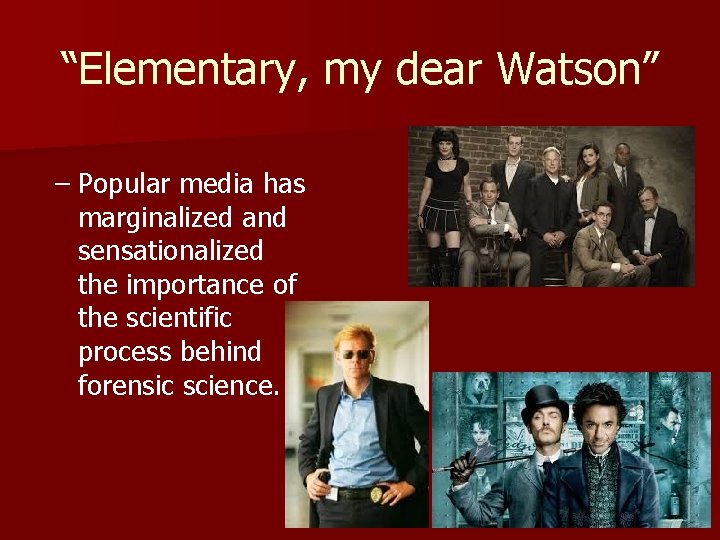
“Elementary, my dear Watson” – Popular media has marginalized and sensationalized the importance of the scientific process behind forensic science.
History n Mathieu Orfila – the father of forensic toxicology. n Alphonse Bertillion - devised the first scientific system of personal identification in 1879. n Francis Galton – conducted the first definitive study of fingerprints and their classification. n Leone Lattes – developed a procedure to determine blood type from dried blood stains.
History n Walter Mc. Crone – utilized microscopy and other analytical methodologies to examine evidence. n Hans Gross – wrote the first treatise describing the application of scientific principles to the field of criminal investigation. n Edmond Locard – incorporated Gross’ principles within a workable crime laboratory. n Locard’s Exchange Principle – states that a crosstransfer of evidence occurs when a criminal comes in contact with an object or person.
The Crime Lab n Rapid growth n Lack of national and regional planning and coordination. n Paul Leland Kirk (1902 -1970) was head of first criminalistics department at the University of California Berkeley. n 350 public crime labs operating at four levels of government – federal, state, county, and municipal.
Is Forensic Science Infallible? n http: //www. nytimes. com/2014/05/19/us/d na-analysis-exposes-an-inexact-forensicscience. html
The Crime Lab n Increasing numbers of crime labs partly on the rise due to… – Supreme Court decisions in the 1960 s § police to build cases on scientifically evaluated evidence. – High levels of drug abuse § crime labs unable to keep up with demands. – DNA profiling technology
Technical Support n Five basic services. n Physical Science Unit – use of chemistry, physics, and geology to identify and compare physical evidence. n Biology Unit – use of biology to investigate blood samples, body fluids, hair, and fiber samples. n Firearms Unit investigates discharged bullets, cartridge cases, shotgun shells, and ammunition.
Technical Support n Document Unit analyzes handwriting and questioned-document issues. n Photographic Unit applies specialized photographic techniques for examining and recording physical evidence.
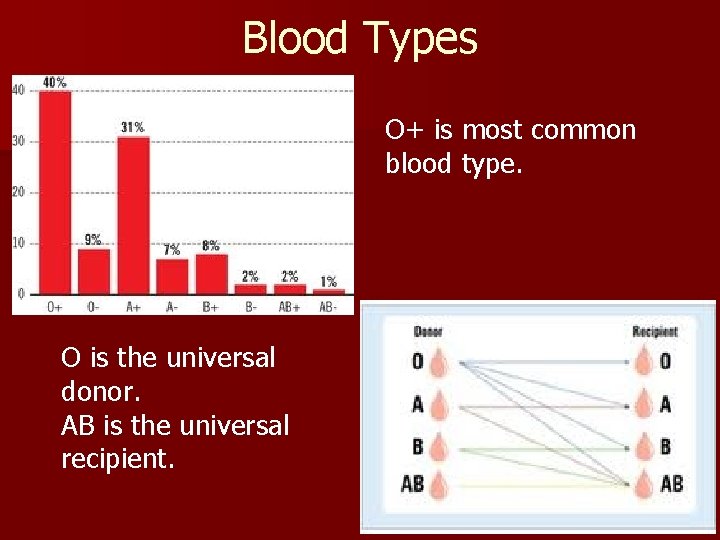
DO NOW n Which Blood Typing blood type is the universal donor? n Which blood type is the universal recipient? n Justify your answers… WHY? (Here is a little bit of Biology!)
Blood Types O+ is most common blood type. O is the universal donor. AB is the universal recipient.
Optional Tech Services n Toxicology Unit examines body fluids and organs for the presence of drugs and poisons. n Latent Fingerprint Unit n Polygraph Unit n Voiceprint Analysis Unit analyze voice patterns. n Evidence Collection Unit specially trained individuals collect and preserve physical evidence.
Special Forensic Services n Forensic Entomology is the study of insects and their relation to a criminal investigation often to estimate time of death. n Forensic Psychiatry involves the relationship between human behavior and legal proceedings. n Forensic Odontology involves the use of teeth and bite marks to assist in identifying a victim in an unrecognizable state.
Special Forensic Services n Forensic Engineering involves failure analysis, accident reconstruction, and the causes and origins of fires and explosions. n Forensic Computer Science involves the examination of digital evidence.
Special Forensic Services n Forensic Pathology involves the investigation of unnatural, unexplained, or violent deaths. n Medical examiners or coroners determine the cause of death. n Autopsy or medical dissection and examination of a body.
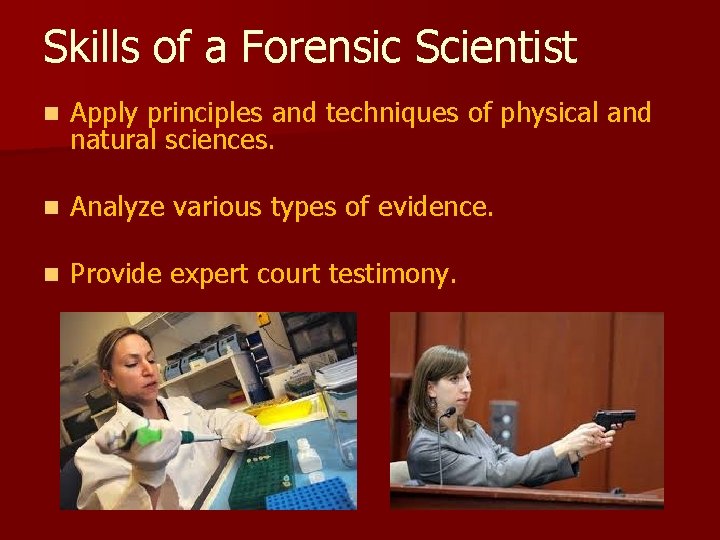
Skills of a Forensic Scientist n Apply principles and techniques of physical and natural sciences. n Analyze various types of evidence. n Provide expert court testimony.
Skills of a Forensic Scientist n Expert witness – determined by the court to possess knowledge relevant to a trial that is not expected of the average person. Evaluates evidence based on training and experience that the court lacks the expertise to do. n Provides an expert opinion as to the significance of findings. n Assist in the training of law enforcement in the proper recognition, collection, and preservation of physical evidence. n
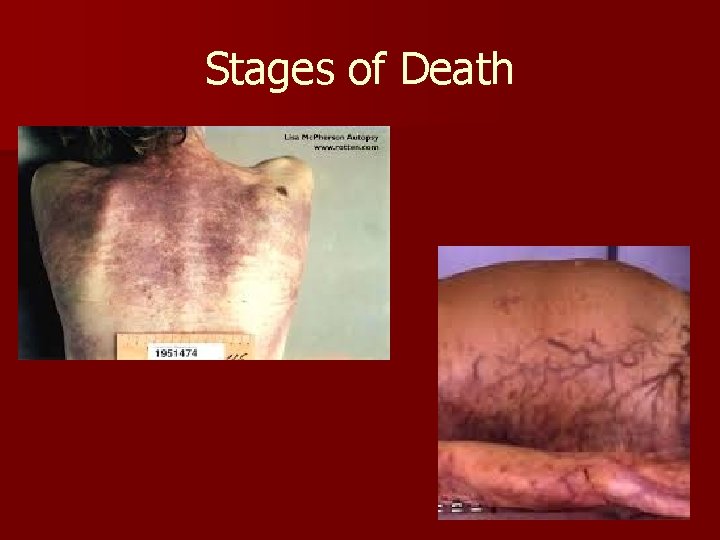
Stages of Death RIGOR mortis results in the shortening of muscle tissue and stiffening of body parts in the position at death. Occurs within first 24 hours and disappears within 36 hours. LIVOR mortis results in the settling of blood in areas of body closest to the ground. Begins immediately on death up to 12 hours after death.
Special Forensic Services ALGOR mortis results in loss of body heat. General rule – begins an hour after death. Body loses heat at a rate of 1 to 1. 5 degrees F per hour until body reaches environmental temperature.
Stages of Death
Forensics at Work n http: //www. abc. net. au/btn/story/s 352774 4. htm
FRYE vs. the United States 1923 n Defendant was convicted of Second Degree Murder. n An early form of a Polygraph test was used by prosecution as key evidence in the case. n Systolic Blood Pressure Deception Test
n Scientific experiments have demonstrated that fear, rage, and pain always produce a rise of systolic blood pressure. n Conscious deception or falsehood, concealment of facts, or guilt of crime, accompanied by fear of detection. n Indicates the struggle going on in the subject's mind between fear and attempted control of that fear under examination.
THE RULING n Expert testimony deduced from a wellrecognized scientific principle or discovery. n Deduction made must be sufficiently established to have gained general acceptance in the particular field in which it belongs.
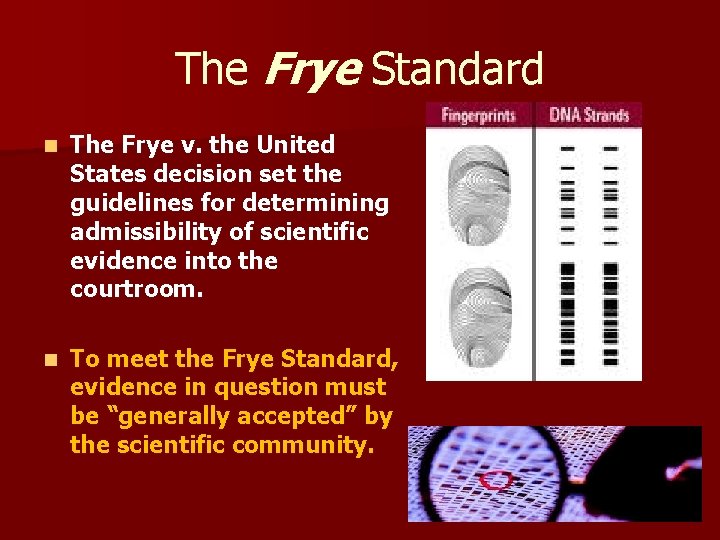
The Frye Standard n The Frye v. the United States decision set the guidelines for determining admissibility of scientific evidence into the courtroom. n To meet the Frye Standard, evidence in question must be “generally accepted” by the scientific community.
Frye Not Absolute 1993 case of Daubert v. Merrell Dow Pharmaceutical, Inc. U. S. Supreme Court asserted that Frye Standard is not an absolute prerequisite to the admissibility of scientific evidence. Trial judges are ultimately responsible as “gatekeepers” for the admissibility and validity of scientific evidence presented in their courts as well as expert testimony.
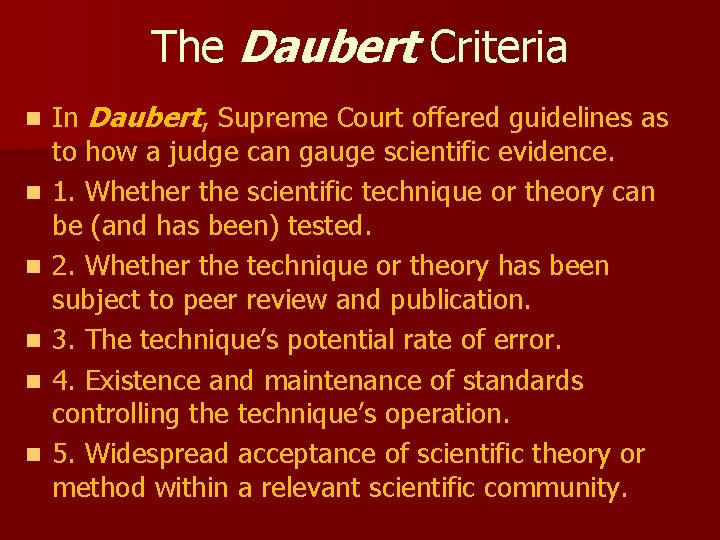
The Daubert Criteria n n n In Daubert, Supreme Court offered guidelines as to how a judge can gauge scientific evidence. 1. Whether the scientific technique or theory can be (and has been) tested. 2. Whether the technique or theory has been subject to peer review and publication. 3. The technique’s potential rate of error. 4. Existence and maintenance of standards controlling the technique’s operation. 5. Widespread acceptance of scientific theory or method within a relevant scientific community.
Unsolved Crimes n http: //www. youtube. com/watch? v=s 27 fx. R k 9 dp. E
Investigation n What n Pay the following video clip? close attention to the piece of evidence in question. n http: //www. youtube. com/watch? v=z. Vr. Ubk HJu. HY