
FORENSICS AND EXPERTS Dr Melissa de VelPalumbo OUTLINE

FORENSICS AND EXPERTS Dr Melissa de Vel-Palumbo
OUTLINE 1 What is forensic evidence and who are the experts? 2 The dangers of expert evidence 3 Evidence and narratives
WHAT IS FORENSIC EVIDENCE AND WHO ARE THE EXPERTS? § The history of forensic science § What counts as forensic evidence? § Who are forensic experts?
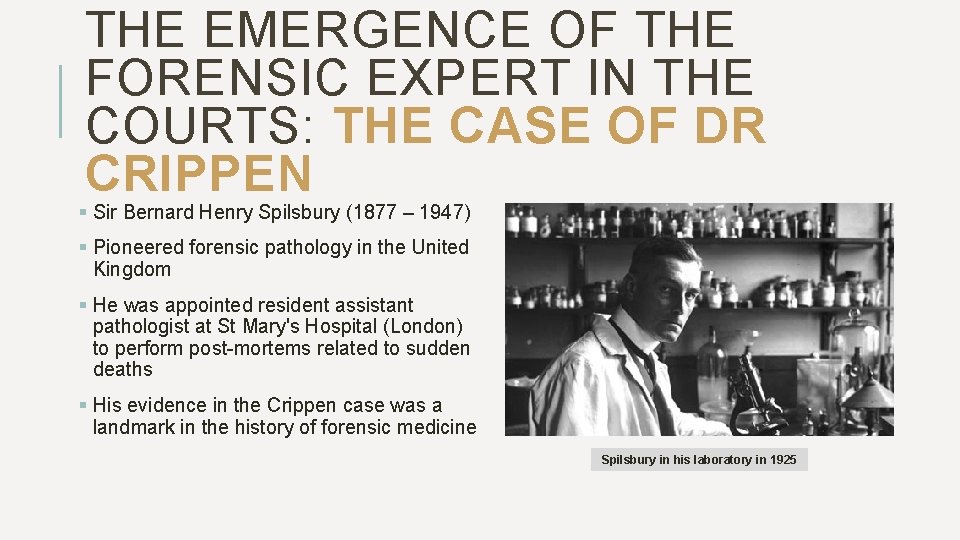
THE EMERGENCE OF THE FORENSIC EXPERT IN THE COURTS: THE CASE OF DR CRIPPEN § Sir Bernard Henry Spilsbury (1877 – 1947) § Pioneered forensic pathology in the United Kingdom § He was appointed resident assistant pathologist at St Mary's Hospital (London) to perform post-mortems related to sudden deaths § His evidence in the Crippen case was a landmark in the history of forensic medicine Spilsbury in his laboratory in 1925
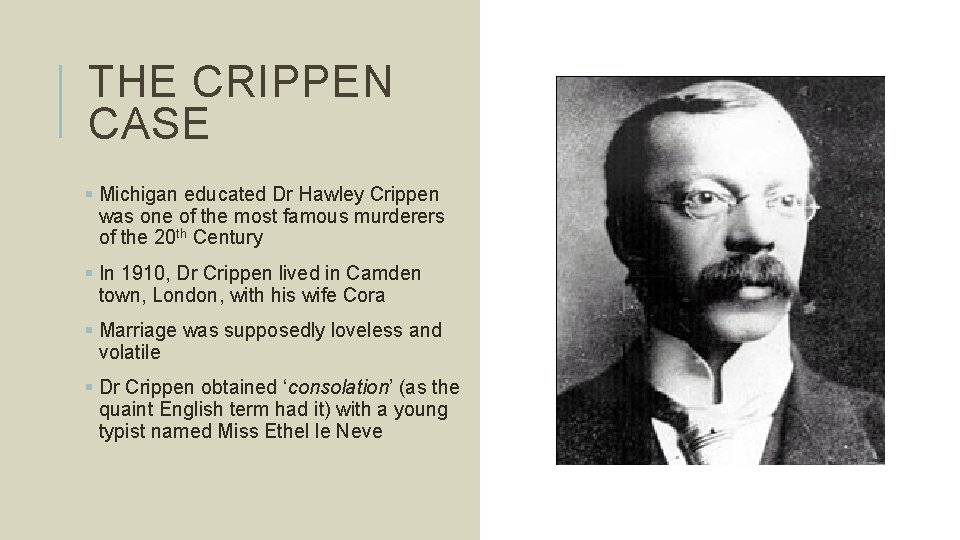
THE CRIPPEN CASE § Michigan educated Dr Hawley Crippen was one of the most famous murderers of the 20 th Century § In 1910, Dr Crippen lived in Camden town, London, with his wife Cora § Marriage was supposedly loveless and volatile § Dr Crippen obtained ‘consolation’ (as the quaint English term had it) with a young typist named Miss Ethel le Neve
THE CRIPPEN CASE: THE CRIME § Dr Crippen purchased and administered the poison hyoscine to his wife on Jan 31, 1910 and she died the next day § He told Cora’s friends that she had gone to the USA (where she later “died”) § The police were finally alerted when a friend of Mrs Crippen couldn’t trace her during a visit to the States § After the police called to see Crippen he at last lost his nerve and fled across the Atlantic with le Neve disguised as a boy! § Police found headless and de-boned human remains wrapped in old pyjamas under the cellar floor § Crippen claimed that the body must had been placed there prior to his moving in 6
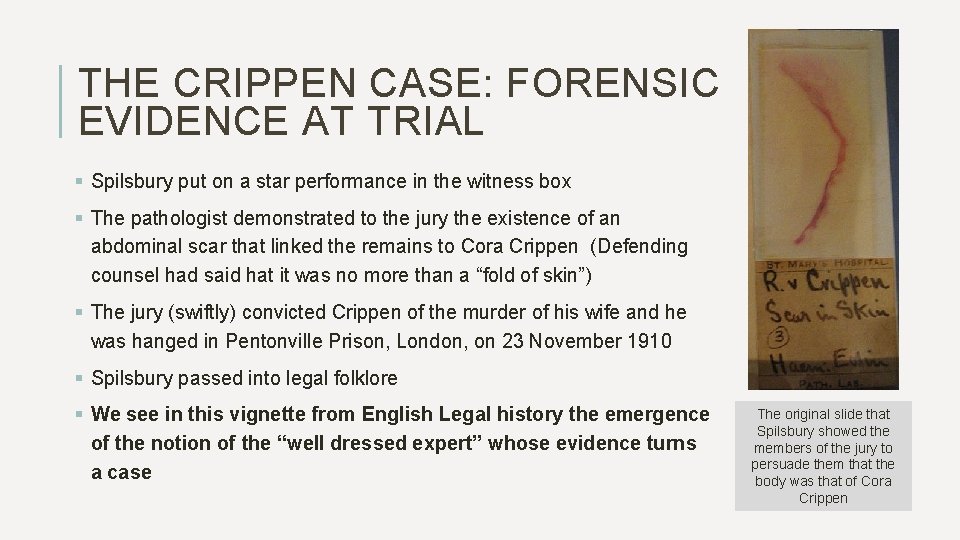
THE CRIPPEN CASE: FORENSIC EVIDENCE AT TRIAL § Spilsbury put on a star performance in the witness box § The pathologist demonstrated to the jury the existence of an abdominal scar that linked the remains to Cora Crippen (Defending counsel had said hat it was no more than a “fold of skin”) § The jury (swiftly) convicted Crippen of the murder of his wife and he was hanged in Pentonville Prison, London, on 23 November 1910 § Spilsbury passed into legal folklore § We see in this vignette from English Legal history the emergence of the notion of the “well dressed expert” whose evidence turns a case The original slide that Spilsbury showed the members of the jury to persuade them that the body was that of Cora Crippen
WHAT IS FORENSIC EVIDENCE? § The application of scientific methods and techniques to the investigation of crime § Reliability of evidence is key (Frye 1923, Daubert 1993) • Peer reviewed and generally accepted by the scientific community • Sound methodology • Known error rate § The expert’s role is help the CJS decipher and interpret the meaning of evidence
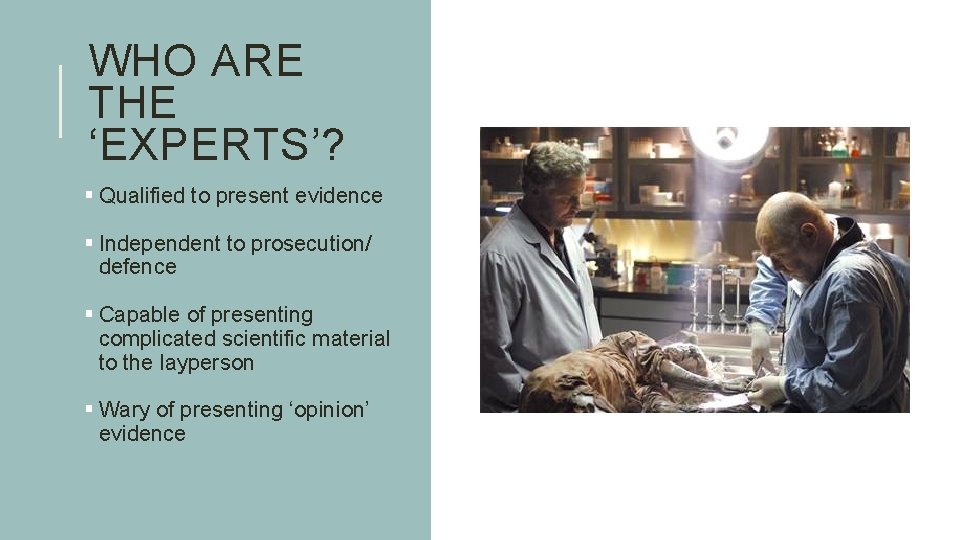
WHO ARE THE ‘EXPERTS’? § Qualified to present evidence § Independent to prosecution/ defence § Capable of presenting complicated scientific material to the layperson § Wary of presenting ‘opinion’ evidence
TYPES OF FORENSIC EXPERTS: Forensic psychology - forensic psychologists provide expert advice about motivations underpinning human behaviour Forensic psychiatry - a field that examines systems and functions of the brain. Covers evaluations of competency to stand trial, insanity, and particular relationships between certain neuropsychological conditions and behaviour Can testify about effects of medication on behaviour

TYPES OF FORENSIC EXPERTS: Forensic pathology - forensic pathologists perform autopsies. The expertise involves the medico-legal investigation of sudden, unnatural, unexplained, or violent deaths Forensic odontology - also called forensic dentistry, this is the study of teeth enamel. With the use of dental records, X-rays, casts, or even a photograph of a person's smile, experts can often make identifications and comparisons A subspecialty is ‘bite mark’ analysis.

TYPES OF FORENSIC EXPERTS: Forensic biology – examine dried bloodstains, other body fluids (semen), and DNA § Subfield of toxicology. Forensic anthropology – study of bones. E. g. , perform reconstructions of facial appearance from skeletal remains Forensic entomology - the study of insects and their relation to a criminal investigation, such as the analysis of larvae and maggots (from dead bodies)
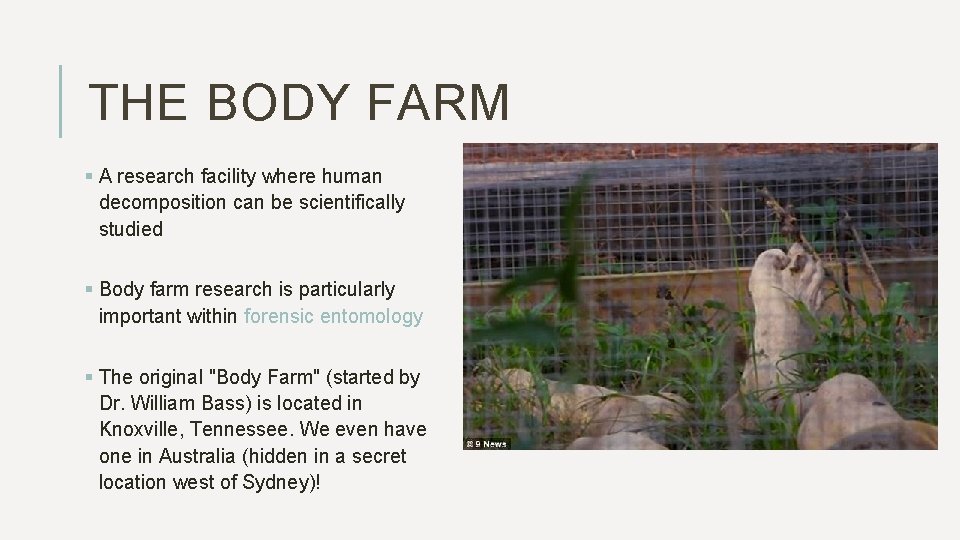
THE BODY FARM § A research facility where human decomposition can be scientifically studied § Body farm research is particularly important within forensic entomology § The original "Body Farm" (started by Dr. William Bass) is located in Knoxville, Tennessee. We even have one in Australia (hidden in a secret location west of Sydney)!
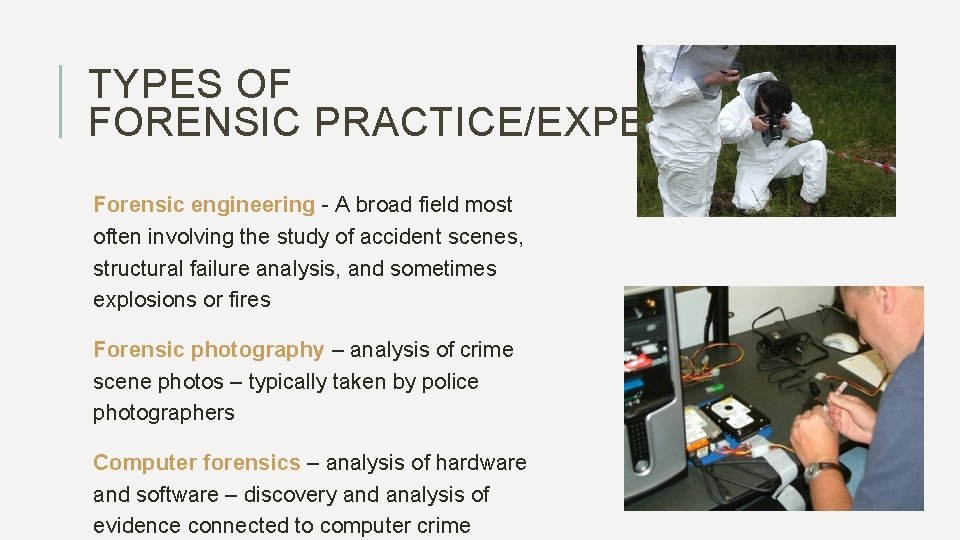
TYPES OF FORENSIC PRACTICE/EXPERTISE: Forensic engineering - A broad field most often involving the study of accident scenes, structural failure analysis, and sometimes explosions or fires Forensic photography – analysis of crime scene photos – typically taken by police photographers Computer forensics – analysis of hardware and software – discovery and analysis of evidence connected to computer crime
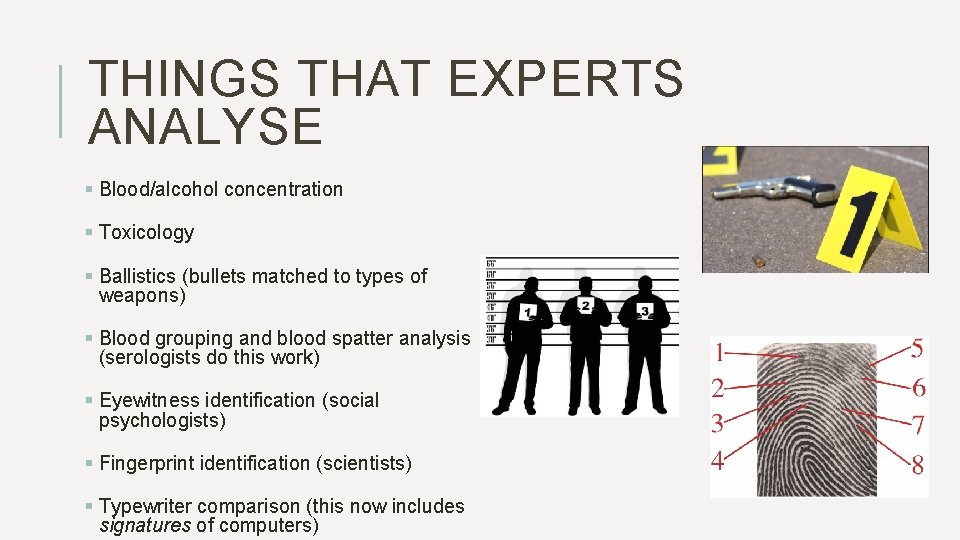
THINGS THAT EXPERTS ANALYSE § Blood/alcohol concentration § Toxicology § Ballistics (bullets matched to types of weapons) § Blood grouping and blood spatter analysis (serologists do this work) § Eyewitness identification (social psychologists) § Fingerprint identification (scientists) § Typewriter comparison (this now includes signatures of computers)
‘EXPERTS’ ELSEWHERE IN LAW/CJS? § Social workers - juvenile offenders § Chemists - environmental cases § Engineers - industrial homicide § Criminologists? (often quite removed from criminal activity!)
THE DANGERS OF EXPERT EVIDENCE § The celebrity status of experts § Pitfalls of expert evidence § The mythology of CSI
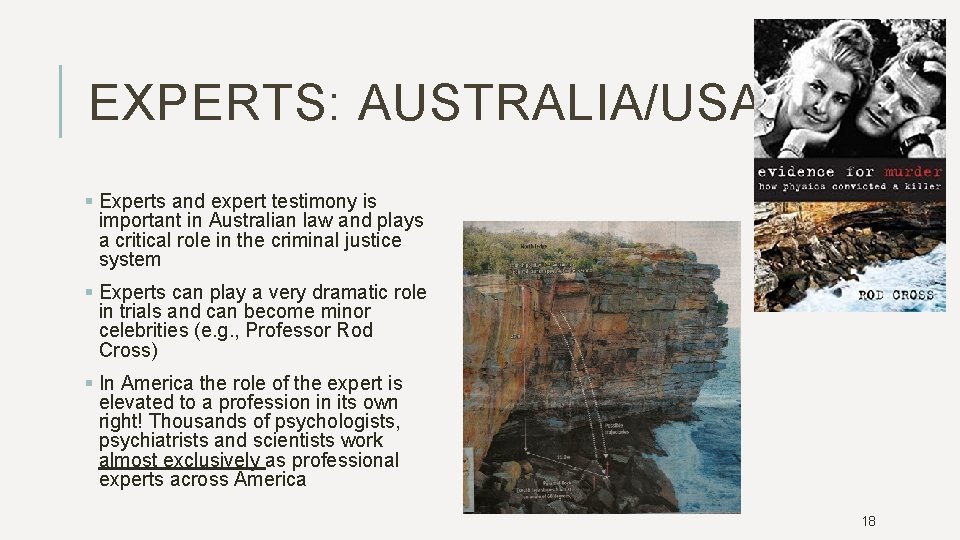
EXPERTS: AUSTRALIA/USA § Experts and expert testimony is important in Australian law and plays a critical role in the criminal justice system § Experts can play a very dramatic role in trials and can become minor celebrities (e. g. , Professor Rod Cross) § In America the role of the expert is elevated to a profession in its own right! Thousands of psychologists, psychiatrists and scientists work almost exclusively as professional experts across America 18
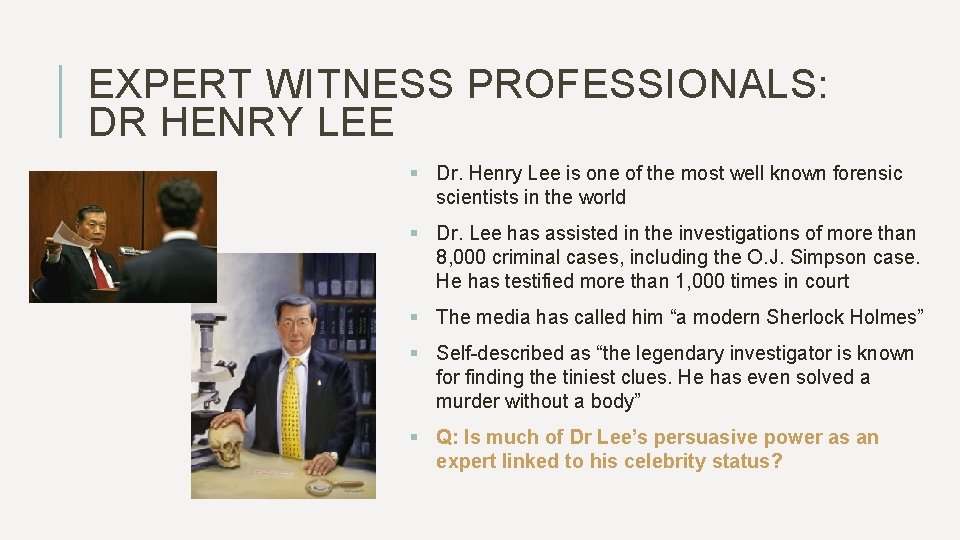
EXPERT WITNESS PROFESSIONALS: DR HENRY LEE § Dr. Henry Lee is one of the most well known forensic scientists in the world § Dr. Lee has assisted in the investigations of more than 8, 000 criminal cases, including the O. J. Simpson case. He has testified more than 1, 000 times in court § The media has called him “a modern Sherlock Holmes” § Self-described as “the legendary investigator is known for finding the tiniest clues. He has even solved a murder without a body” § Q: Is much of Dr Lee’s persuasive power as an expert linked to his celebrity status?
THE PITFALLS OF EXPERT EVIDENCE § Expert may not be sufficiently impartial § Prosecution/defence may only present experts that support their case § Scientists may disagree on the validity of methodologies § Expert evidence can be misinterpreted § Scientific methods can change § Experts can be wrong!!! § This is a problem! Research shows that juries place considerable weight on expert testimony. § “Forensic evidence … may often have a prejudicial effect on the minds of the jury which far outweighs its probative value. The jury, being people without scientific training, may often be impressed by an expert’s qualifications, appointments and experience and the confident manner in which he expresses his opinions” (Maurice J, R v Lewis (1987) 29 A Crim R 267)
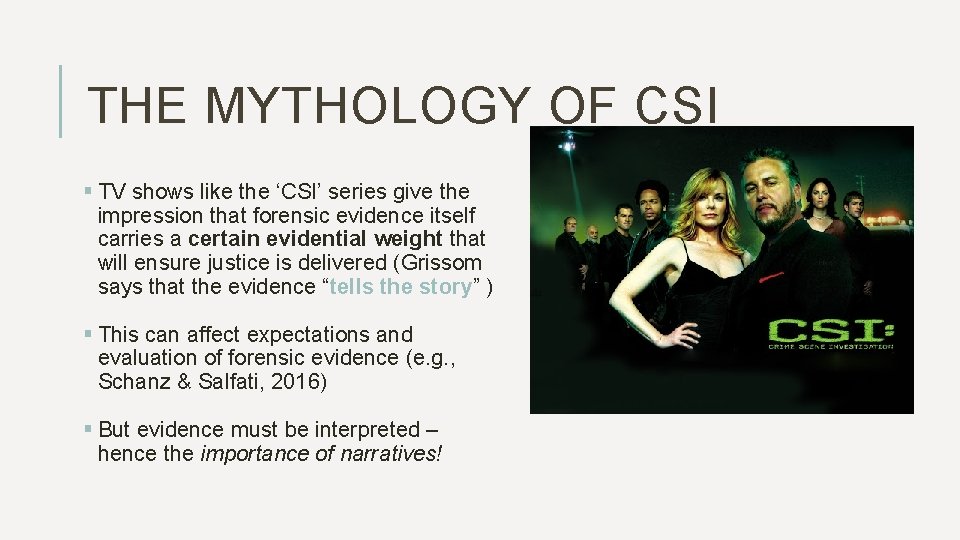
THE MYTHOLOGY OF CSI § TV shows like the ‘CSI’ series give the impression that forensic evidence itself carries a certain evidential weight that will ensure justice is delivered (Grissom says that the evidence “tells the story” ) § This can affect expectations and evaluation of forensic evidence (e. g. , Schanz & Salfati, 2016) § But evidence must be interpreted – hence the importance of narratives!
EVIDENCE AND NARRATIVES § How evidence is used to support narratives § Case study: R v Alice Lynne (Lindy) and Michael Leigh Chamberlain
A STARTING POINT… Evidence does not necessarily tell us what happened – it has to be actively constructed and deconstructed’ (Edmond 1998) The meaning attributed to evidence is always contested in court
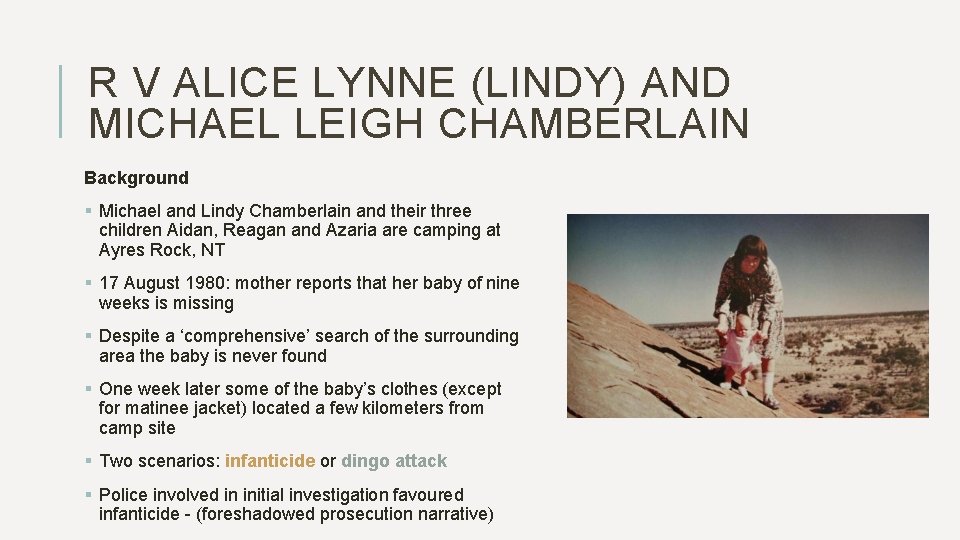
R V ALICE LYNNE (LINDY) AND MICHAEL LEIGH CHAMBERLAIN Background § Michael and Lindy Chamberlain and their three children Aidan, Reagan and Azaria are camping at Ayres Rock, NT § 17 August 1980: mother reports that her baby of nine weeks is missing § Despite a ‘comprehensive’ search of the surrounding area the baby is never found § One week later some of the baby’s clothes (except for matinee jacket) located a few kilometers from camp site § Two scenarios: infanticide or dingo attack § Police involved in initial investigation favoured infanticide - (foreshadowed prosecution narrative)
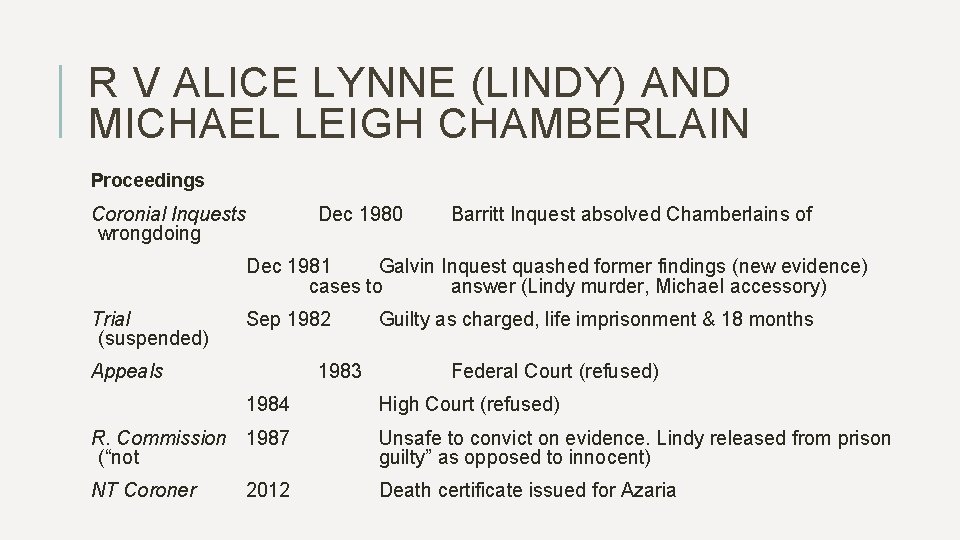
R V ALICE LYNNE (LINDY) AND MICHAEL LEIGH CHAMBERLAIN Proceedings Coronial Inquests wrongdoing Dec 1980 Barritt Inquest absolved Chamberlains of Dec 1981 Galvin Inquest quashed former findings (new evidence) cases to answer (Lindy murder, Michael accessory) Trial (suspended) Sep 1982 Appeals 1983 1984 Guilty as charged, life imprisonment & 18 months Federal Court (refused) High Court (refused) R. Commission 1987 (“not Unsafe to convict on evidence. Lindy released from prison guilty” as opposed to innocent) NT Coroner Death certificate issued for Azaria 2012
NARRATIVE AND (EXPERT) EVIDENCE Why experts? § There is a traditional attitude of deference to, and regard for, the role of the expert Science’s privileged position in Western society guarantees its members high credibility in respect of matters relating to rationality, objectivity and value-free judgments § All these characteristics are highly sought after by the law in its administration of justice
EXPERT TESTIMONY STRENGTHENS BASIS FOR DECISION MAKING ABOUT GUILT AND INNOCENCE This is achieved in 4 ways: 1. Neutrality 2. Credentials/entitlement to testify 3. Objective process of investigation 4. Consensus among like groups § But science and/or expertise are NEVER entirely neutral/objective § Science/expertise are premised on and feed into particular ideologies, political agendas, or, more accurately, particular narratives
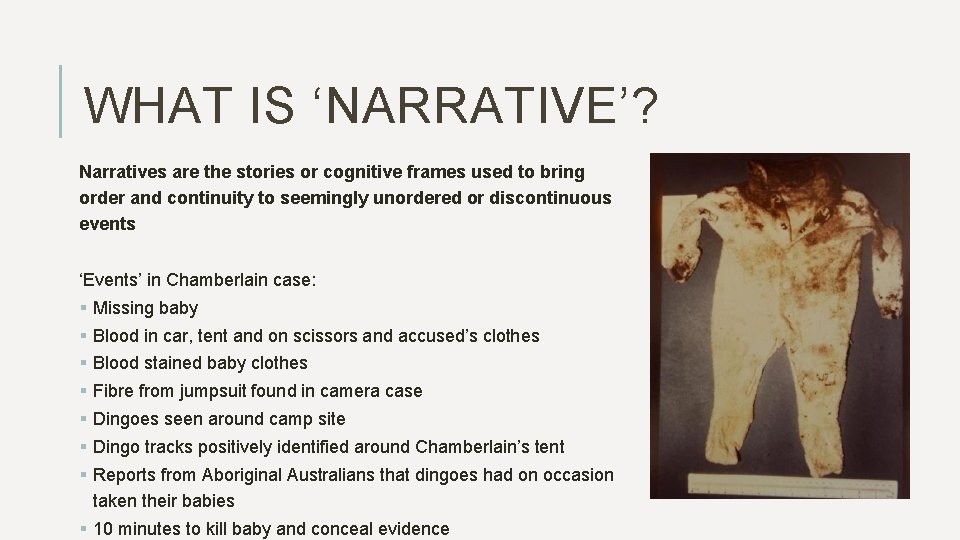
WHAT IS ‘NARRATIVE’? Narratives are the stories or cognitive frames used to bring order and continuity to seemingly unordered or discontinuous events ‘Events’ in Chamberlain case: § Missing baby § Blood in car, tent and on scissors and accused’s clothes § Blood stained baby clothes § Fibre from jumpsuit found in camera case § Dingoes seen around camp site § Dingo tracks positively identified around Chamberlain’s tent § Reports from Aboriginal Australians that dingoes had on occasion taken their babies § 10 minutes to kill baby and conceal evidence
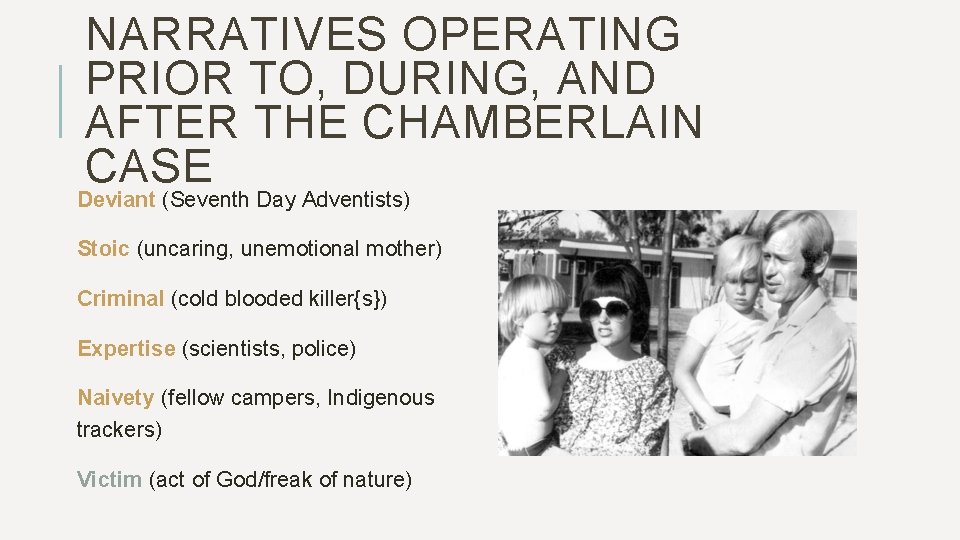
NARRATIVES OPERATING PRIOR TO, DURING, AND AFTER THE CHAMBERLAIN CASE Deviant (Seventh Day Adventists) Stoic (uncaring, unemotional mother) Criminal (cold blooded killer{s}) Expertise (scientists, police) Naivety (fellow campers, Indigenous trackers) Victim (act of God/freak of nature)
TRIALS AS SITES FOR THE CONVERGENCE AND CONTESTATION OF NARRATIVES § They are not sites for the uncovering of absolute truth § Trials are sites of contestation [A trial] … provides a vivid example of how the ability to see a meaningful event is not a transparent, psychological process but instead a socially situated activity accomplished through the deployment of a range of historically constituted discursive practices 364) (Goodwin cited in Edmond, 1998:
PROSECUTION EVIDENCE Case for infanticide: § ‘Foetal blood’ in car - ‘a spray pattern - consistent with the arterial spray of a child - underneath the passenger side dash’ (later found to not be blood) § Blood also ‘found or observed’ on scissors, clothes worn by accused, camera bag § Cuts in jumpsuit determined to be made by scissors § Material and hair in camera bag ‘consistent with’ baby clothing and baby hair
PROSECUTION NARRATIVE Case for infanticide: § Accused cut throat of victim (baby Azaria) with nail scissors in the car § Went to tent (20 m from where husband others were cooking dinner) and removed blood stained clothes § Blood smeared on a number of items in tent § Returned to group cooking dinner § After initial search for baby accused told her husband what she’d done § One or both parents buried body, later exhumed it, removed clothing, and reburied body § Accused cut clothing and placed it near a dingo den
DEFENCE EVIDENCE Case against infanticide: § Dingo tracks found around tent § Tracks confirmed by Indigenous trackers to indicate an animal carrying something heavy in its mouth § Only 10 minutes within which to kill baby, dispose of body, and return to fellow campers § Baby was heard by more than one witness to cry out (from tent) after the time at which death was supposed to occur § Indigenous residents told of babies being taken by dingoes
DEFENCE NARRATIVE Case against infanticide: § Accused put baby to sleep in tent and returned to group cooking dinner § A cry came from direction of tent § Dingo entered tent, seized baby, and disappeared into surrounding bush § Blood in tent came from initial attack
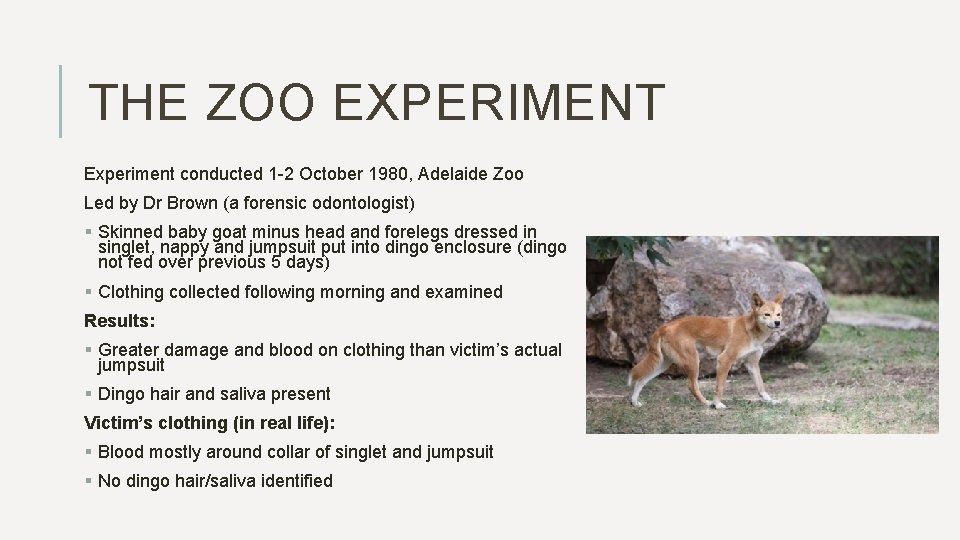
THE ZOO EXPERIMENT Experiment conducted 1 -2 October 1980, Adelaide Zoo Led by Dr Brown (a forensic odontologist) § Skinned baby goat minus head and forelegs dressed in singlet, nappy and jumpsuit put into dingo enclosure (dingo not fed over previous 5 days) § Clothing collected following morning and examined Results: § Greater damage and blood on clothing than victim’s actual jumpsuit § Dingo hair and saliva present Victim’s clothing (in real life): § Blood mostly around collar of singlet and jumpsuit § No dingo hair/saliva identified
THE ZOO EXPERIMENT § The zoo experiment was given merit due to the “experts” who oversaw it and commented on it at trial § BUT consider the rigor of the experiment itself. The matinee jacket was not included in experiment (due to suspicion of Lindy Chamberlain’s account that Azaria was wearing it at the time she disappeared) § This suggests that uncovering the “truth” was not the goal of the experiment so much as deriving data that would support a preconceived narrative (infanticide) § The court and jury’s acceptance of this (shoddy) evidence exposes our faith in the positivist method (that scientific tests help establish facts)
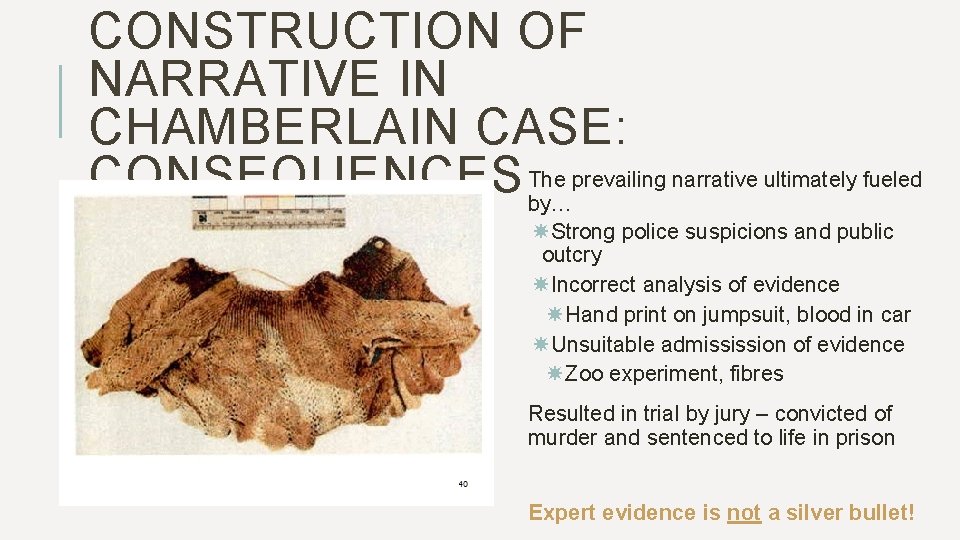
CONSTRUCTION OF NARRATIVE IN CHAMBERLAIN CASE: prevailing narrative ultimately fueled CONSEQUENCES The by… Strong police suspicions and public outcry Incorrect analysis of evidence Hand print on jumpsuit, blood in car Unsuitable admissission of evidence Zoo experiment, fibres Resulted in trial by jury – convicted of murder and sentenced to life in prison Expert evidence is not a silver bullet!
- Slides: 37