
Forensic Serology Blood and other body fluids Golden

Forensic Serology Blood and other body fluids

Golden Rule • If it’s wet and sticky and it’s not yours…. . DON’T TOUCH IT! • Live long enough to get more out of your retirement fund than you put in

Transfer of biological evidence • Direct • Indirect – The biological evidence is transferred to an item or at the crime scene – There is no direct contact between the source and the target surface – The victim’s blood (DNA) on the suspect’s clothing – Semen on the victim’s clothing gets onto a hospital sheet – The suspect was never in contact with the sheet but his DNA is there
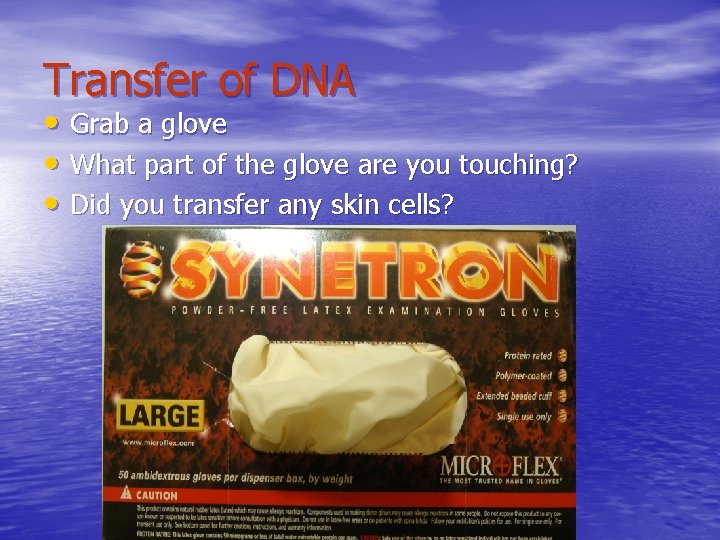
Transfer of DNA • Grab a glove • What part of the glove are you touching? • Did you transfer any skin cells?
Collecting a bloodstain • It MUST be • • photographed To give orientation in the scene The photos will provide: – – Location Pattern Condition (drying, wet) Indication of volume
Forensic Characterization of Blood Is it blood? – Presumptive testing at the scene What species? – What else will our test react with? Can it be associated with a particular person? Is it a degraded sample or a mixture

Selecting a Presumptive Test • Specificity – false positives • Sensitivity – at what point does it not work • Easy to use • Safe to use • Non-destructive to scene or evidence • Legal acceptability • Chemical stability
Presumptive blood testing • Indicates that blood MAY be present • It does not tell what species the blood is from • All presumptive tests have false positives

What tests are available • Phenolphthalein • Luminol • Hema-stix • Pick the test(s) that work best for your needs
We have chosen… • Phenolphthalein – 3 step test – Easy to use – Stable and sensitive • Luminol – Very sensitive – Requires practice to interpret results – Difficult to photograph
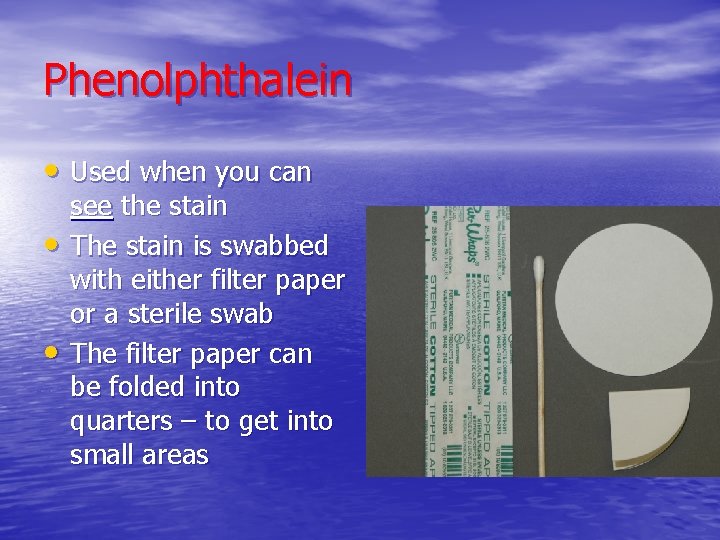
Phenolphthalein • Used when you can • • see the stain The stain is swabbed with either filter paper or a sterile swab The filter paper can be folded into quarters – to get into small areas

Phenolphthalein • The stain is rubbed • • slightly (dry) A portion of the stain is transferred to the paper or swab The paper or swab has the chemicals applied to it – the stain remains dry & is not diluted
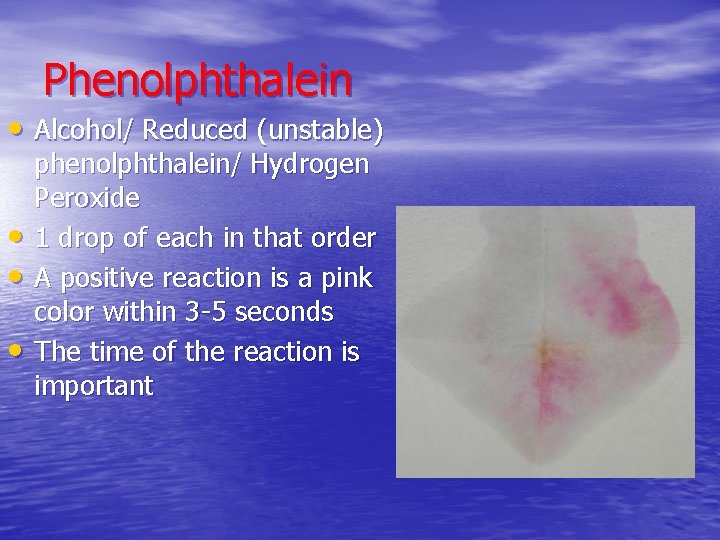
Phenolphthalein • Alcohol/ Reduced (unstable) • • • phenolphthalein/ Hydrogen Peroxide 1 drop of each in that order A positive reaction is a pink color within 3 -5 seconds The time of the reaction is important
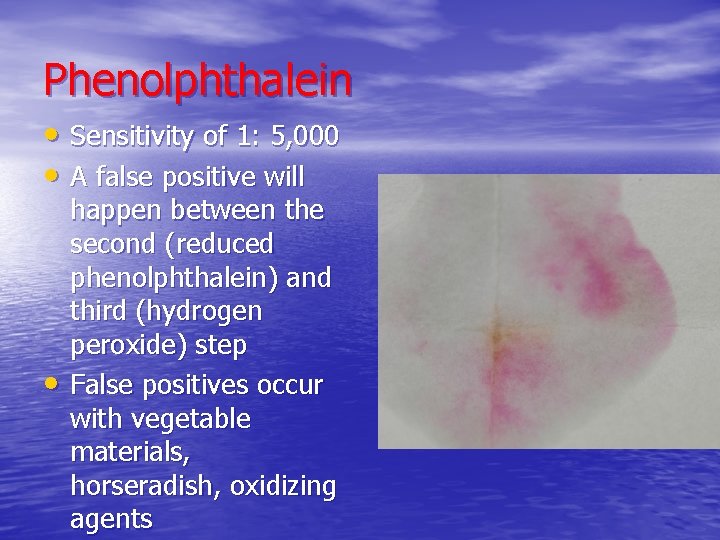
Phenolphthalein • Sensitivity of 1: 5, 000 • A false positive will • happen between the second (reduced phenolphthalein) and third (hydrogen peroxide) step False positives occur with vegetable materials, horseradish, oxidizing agents
Hemastix • Not designed forensic purposes • Designed to detect blood in urine • Sensitivity of about 1: 10, 000* • False positives – Vegetables and oxidizing agents
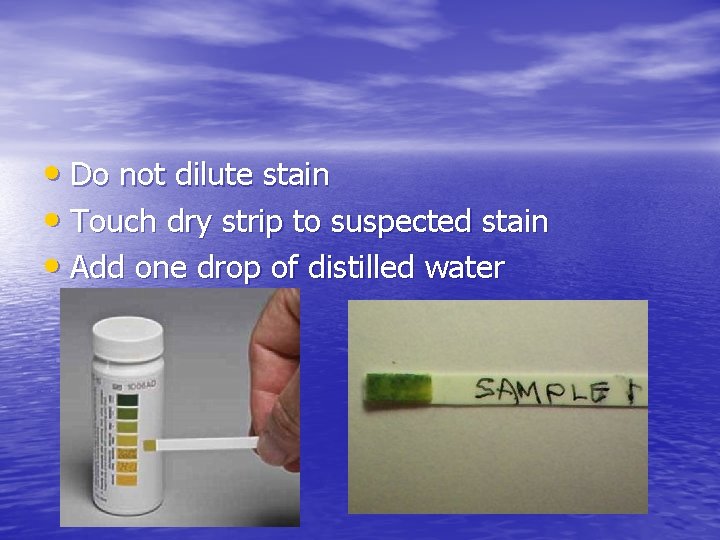
• Do not dilute stain • Touch dry strip to suspected stain • Add one drop of distilled water
Luminol • This is the LAST thing you • • • would do to look for blood Used when you suspect blood is present but you can’t see it Applied in complete darkness Results in the creation of light
Luminol • Once mixed it has a • • shelf life of 8 hours False positives include some metals, particularly copper, oxidizing agents and porcelain A positive luminol result should be followed with phenolphthalein
Luminol • Luminol has a • sensitivity of 1: 1 million Followed with phenolphthalein because of differences in sensitivity
Luminol photography • Complete darkness • Camera on tripod • Bulb setting – 2 • • minute exposure Bounce flashlight off ceiling at end of exposure Close shutter



Collecting a wet stain • If it can be taken – • • • take it Soak the stain with sterile gauze or a sterile swab If it is drying – let it dry Air dry the gauze or swab out of direct sunlight
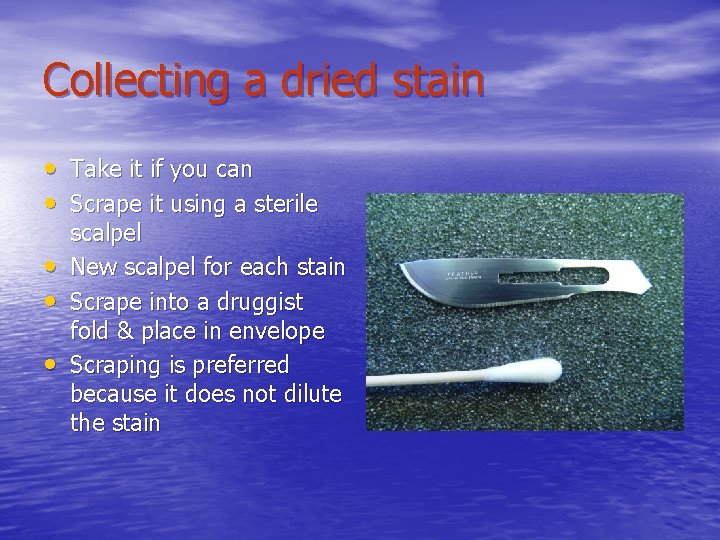
Collecting a dried stain • Take it if you can • Scrape it using a sterile • • • scalpel New scalpel for each stain Scrape into a druggist fold & place in envelope Scraping is preferred because it does not dilute the stain
Dried stain • Swab it with a sterile • • swab and distilled water DO NOT use saline – it will break open the cells Air dry the swab prior to packaging
Collecting Blood Evidence • Take it • Scrape it • Swab it
Liquid Blood Samples • Should be submitted at the same time so the comparison can be done • The tube used will depend upon what testing you want done on the sample

Red capped tube • No preservatives • A sterile tube used for general ABO grouping • Not used much…

Gray capped tube • Contains the • • preservative sodium fluoride Prevents the formation of residual alcohol in blood Used for BAC and toxicology testing

Purple capped tube • Contains the • • preservative EDTA An anti-coagulant that keeps the cells from breaking open Used for DNA analysis

Finger stick kit • An easier way to • • collect a sample for DNA analysis Does not require a phlebotomist Make sure the person is not a hemophiliac

Finger stick kit • A small lancet is used • to stick the finger and the blood drops are placed onto four quarter sized circles Best to stick them on the side of the finger – the pad of the finger tends to be more calloused & harder to get blood from
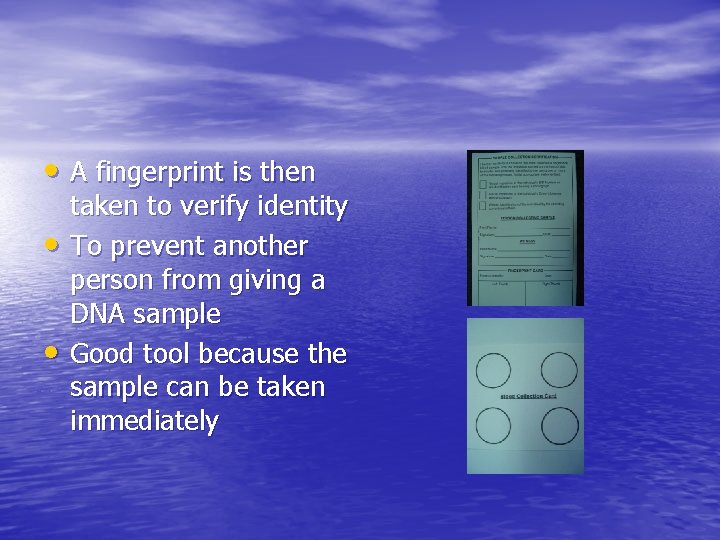
• A fingerprint is then • • taken to verify identity To prevent another person from giving a DNA sample Good tool because the sample can be taken immediately
Known blood samples • Liquid blood must be • Tape over the stopper • The expiration date • The additive is the refrigerated on the tube is important – it guarantees the sterility of the tube or the chemistry if it to be shipped important part – the color of the cap may vary
Sex Crime Investigation • Physical evidence possibilities – – Scene Victim Suspect Items
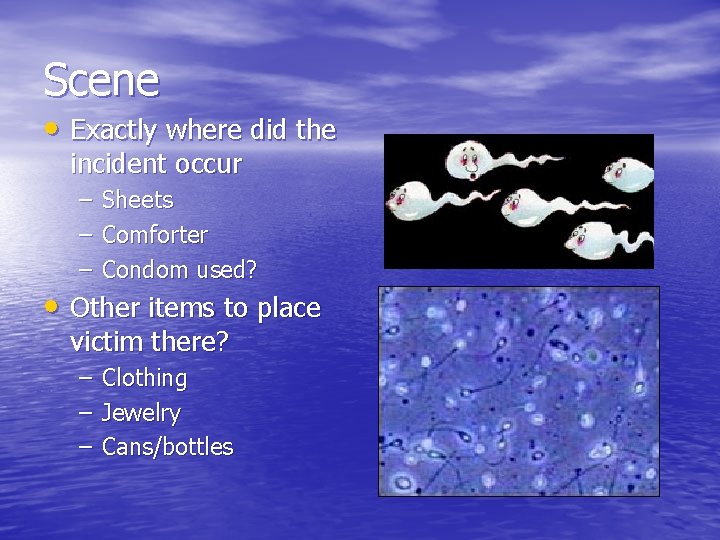
Scene • Exactly where did the incident occur – – – Sheets Comforter Condom used? • Other items to place victim there? – – – Clothing Jewelry Cans/bottles
Suspect • Collect the same • • • evidence that is collected from the victim Penile swabs Finger swabs Suspect kits available through the State Lab
Victim • Kit – might be two • • parts – urine sample Paperwork from kit Photos of injuries Missing clothing or other items (jewelry, buttons) Anonymous kit – retained for 90 days
It’s been _____ since it happened…should I do a kit? • Normally sperm can last 3 -4 days in the vaginal cavity of a living person • Normally about 12 hours in the rectal cavity of a living person • Normally about 6 hours in the oral cavity of a living person
State Lab Policy • Females – Kits collected more than 7 days post-assault will not be accepted • Males – Kits collected more than 3 days post-assault will not be accepted • Exceptions – Patient held captive and/or not able to be up walking, bathing or showering – Patient found unconscious – Bedridden or wheelchair bound
From the literature…. . • Found in a frozen body’s vaginal cavity after 19 days • Found in a frozen body’s rectal cavity after 3 years • Found in mummified body’s vaginal cavity after 3 years
If in doubt… • Have the kit done if the time frame is close • You also get the victim’s known samples with the kit • If you don’t get a result it is not a surprise
• Sexual Assault Forensic Examiners (SAFE) • Medical personnel who have received extensive training in evidence documentation, preservation and collection
Sex Crimes Kit Contents • Oral swabs and smears • Nasal swabs • Nasal mucous sample • Fingernails scrapings • Known blood collection • Known head hair sample – 25 hairs total from the front, back, crown and 2 temporal areas
Sex Crimes Kit Contents • Foreign material collection • Debris collection • Dried secretions • Pubic combing • Known pubic hair sample • Genital/penile swabs
Sex Crimes Kit Contents • Rectal swabs/smears • Vaginal swabs/smears • Cervical swabs/smears • Miscellaneous swabs/smears • Urine specimen • BAC specimen

Reasons for not finding sperm • Acidic environment • Low sperm count • Time (since incident) • Poor quality sperm • Victim bathed • Suspect didn’t • • • ejaculate Bacteria Condom used It didn’t happen
Locating a semen stain • Ultraviolet light is an easy way to search • Semen reflects light and will fluoresce • Stains can be located on light and dark surfaces • Useful for searching large items
Locating stain using UV light


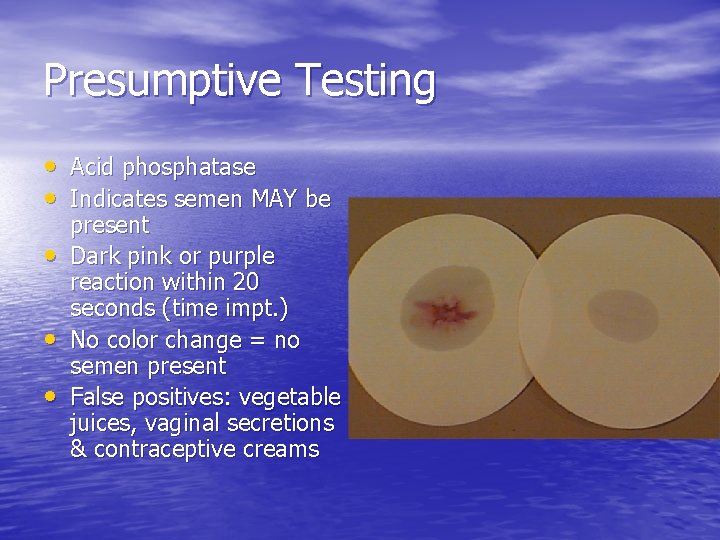
Presumptive Testing • Acid phosphatase • Indicates semen MAY be • • • present Dark pink or purple reaction within 20 seconds (time impt. ) No color change = no semen present False positives: vegetable juices, vaginal secretions & contraceptive creams

Confirmatory testing • The presence of semen must be confirmed after a positive presumptive test • Semen is confirmed with: – Sperm observed with a microscope – Testing for the presence of the p 30 antigen
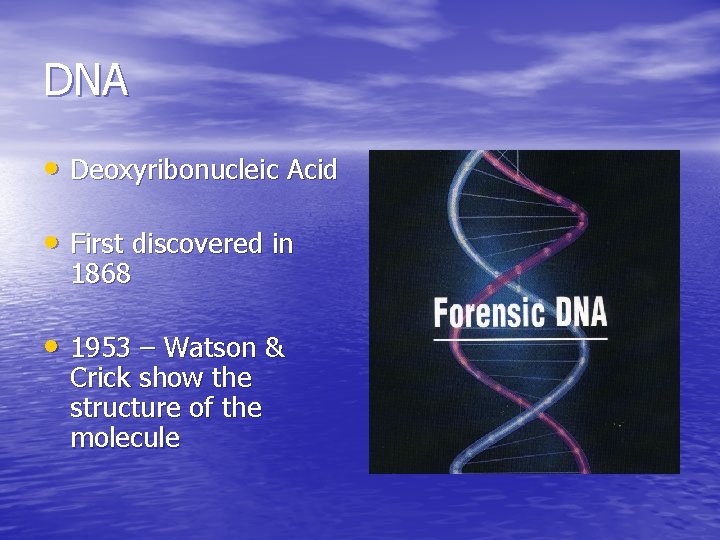
DNA • Deoxyribonucleic Acid • First discovered in 1868 • 1953 – Watson & Crick show the structure of the molecule
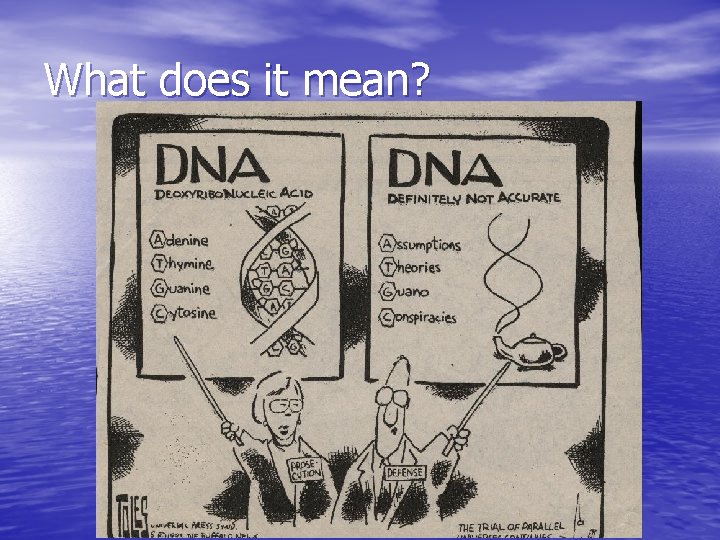
What does it mean?
Use of DNA in criminal cases • The Blooding - details • • a criminal case in Narborough England One murder occurs in 1983 and a second in 1986 DNA proves it is the same man but NOT the man in custody
Use of DNA in criminal cases • The police collect samples from all males • • between ages 13 & 34 No suspect is identified Colin Pitchfork has a friend provide a sample under Pitchfork’s name The friend is overheard telling what he’d done… Colin Pitchfork is the first criminal apprehended using DNA evidence
First use of DNA in U. S. • The first criminal conviction occurred in Florida in 1987 • Randall Scott Jones is convicted of murder after his semen is identified in a homicide victim
Base Pairs • A - Adenine • T - Thymine • G - Guanine • C – Cytosine • A only pairs with T • G only pairs with C • Allows for amplification of small samples
Testing Methods • RFLP – original method – Requires large sample size (quarter sized) • PCR – small samples are amplified – Smaller sample (Head of a pin)
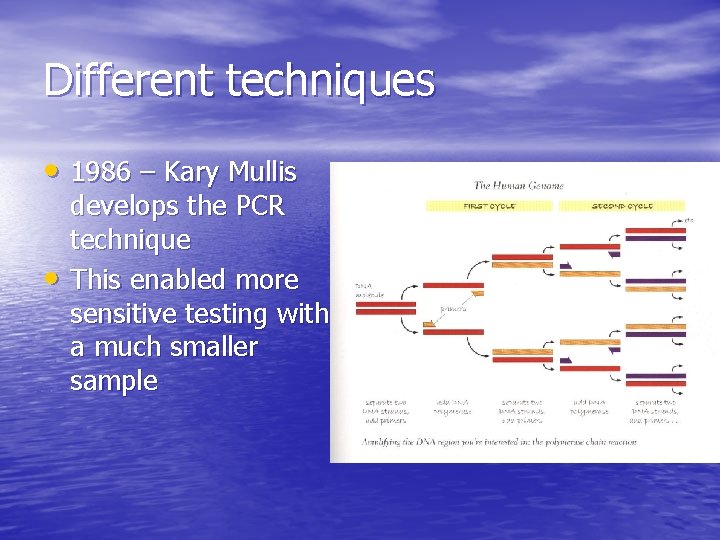
Different techniques • 1986 – Kary Mullis • develops the PCR technique This enabled more sensitive testing with a much smaller sample
Current Testing • Short Tandem Repeats – 13 locations (alleles) are tested for repeating sequence of DNA – Statistical combination of repeats within each of the 13 alleles • Y-STR – Male specific Y chromosome – Can be used to separate in mixed samples • Mitochondrial
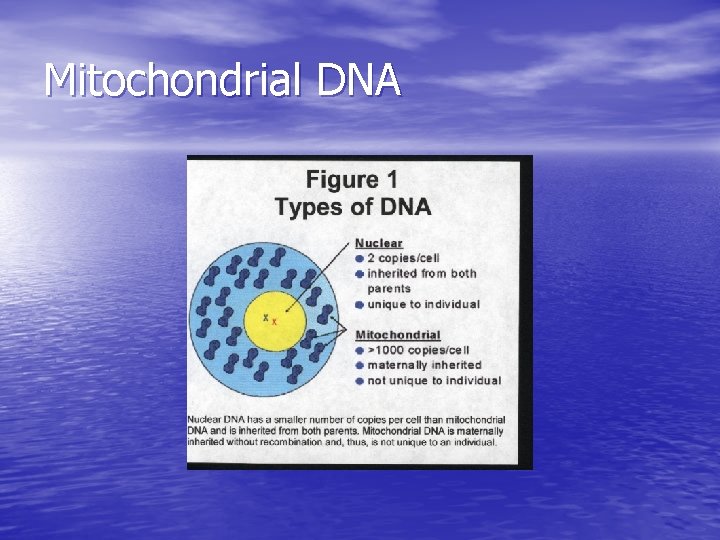
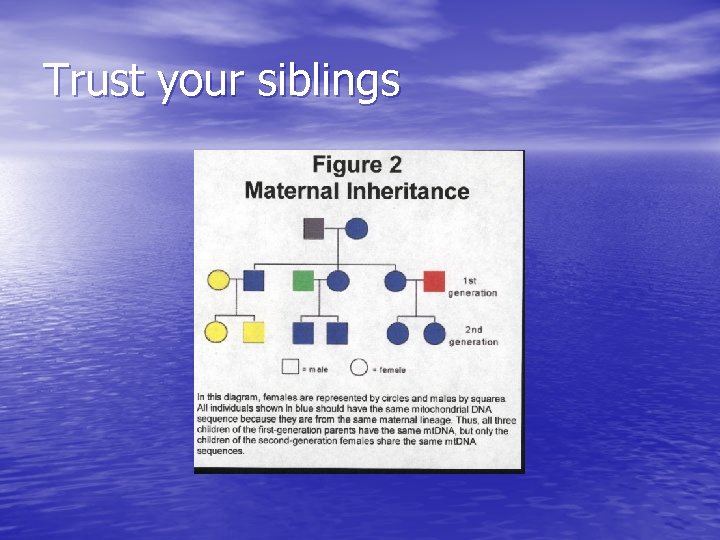
Mitochondrial DNA • Found outside the nucleus of the cell • Usually outlasts nuclear DNA • Maternally inherited – people with the same mother have the same mito DNA
Mitochondrial DNA
Trust your siblings
Samples for mito DNA • Hairs without root • Teeth • Skeletal remains • Finger/toe nails • Skin tissue • Testing requires unique equipment and not • many labs do this testing Regional labs are being established (CT. & NJ) – check with State Lab for submission of samples
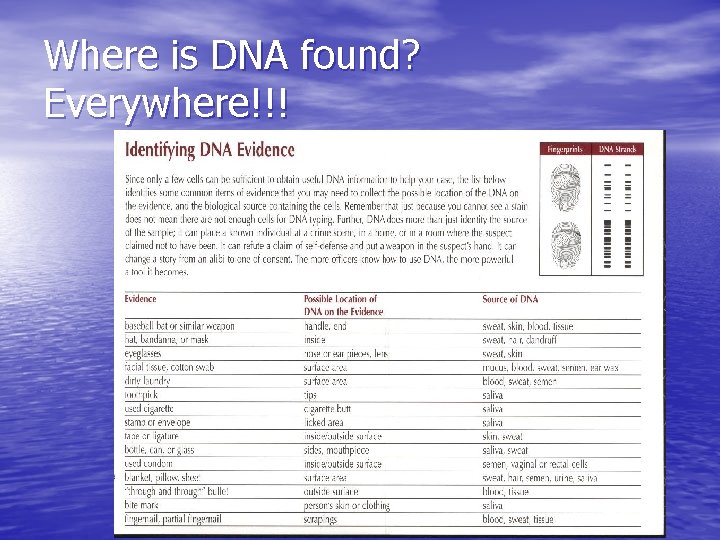
Where is DNA found? Everywhere!!!
DNA has been isolated in: • Blood & bloodstains • Semen & seminal stains • Tissue & cells (particularly skin cells) • Bones & organs • Hair with root (nuclear DNA) • Hair without root (mitochondrial DNA) • Saliva (skin cells)
“Touch” DNA • Sensitivity of DNA • testing allows for results to be had from items that were only touched Makes contamination by us that much more important
Evidence that is not suitable for DNA Analysis • Tears • Perspiration • Serum • On their own these items are not likely to yield DNA • In reality skin cells are present in sufficient quantity to get DNA from these items
Investigative sources of DNA • • • Jewelry Gun grips Collars/cuffs Hats Chapstick/ lipstick Popsicle stick Gear shift lever Steering wheel Tattoo goo Door handles • • • Seal of Ziploc bag Pipes Chewed tobacco Knife handle Jeans – front pocket seam Airbags Trigger Latex and knit gloves Baseball bat (both ends) Eyeglasses Rim of bottle/can
Contamination is a MAJOR issue • Because of the sensitivity of the current testing methods careful handling is critical • Mishandling at the scene and in the lab can create contamination • Individually packaged gloves are becoming the norm – to prevent transfer from reaching in to the box
Non-biological contamination • Soaps or chemicals interfere with the procedure to extract the DNA • This results in an inconclusive test or no DNA being extracted

Non-human biological contamination • Bacteria and fungi present at the scene degrade the DNA present • The DNA gets degraded and results are more difficult to interpret • It does not get converted into somebody else’s DNA
Human contamination • By far the most important form of contamination • The mistaken addition of another humans DNA during or after the sample collection • Mixed sample – contains DNA from more than one person and occurs before or during the crime
Swabbing for DNA evidence • Sterile swab • Distilled water • Swab box • Wet the swab without • the water container touching the swab Roll the swab over the area or through the stain
It’s a test… What does this investigation show?
• The investigation determined there was seamen on the vehicle
DNA in the crime lab • It will degrade if exposed to heat, moisture, chemicals, UV light or bacteria • Get the sample to the lab ASAP • Freeze it - if it not being submitted immediately – particularly if it is an epi-cell swab (skin cells or “touch” DNA)

National Missing Person Database Program • An off-shoot of CODIS • Uses nuclear and mitochondrial DNA • Two indexes: – Relatives of Missing Persons – Unidentified Human Remains • The two are compared to associate recovered remains with missing persons
Missing Persons • Get a DNA sample • from mother, father or siblings If not available – DNA samples from items used by missing person – – – Hair brush Tooth brush Specimens from medical work
Databases • Combined DNA Index System (CODIS) • A nationwide database of DNA samples • Regional databases also exist and are then uploaded into CODIS

CODIS – September 2016 • 12. 5 million convicted offender/detainee profiles • 2. 4 million arrestee profiles • 733, 000 forensic profiles • 346, 000+ hits to date
Two indexes in CODIS • Forensic Index – Contains DNA profiles from crime scene evidence – Used to link crime scenes together – ID’s serial offenders – Helps to coordinate investigations – connect the crime and other investigative info can be compared
CODIS Indexes • Offender Index – Contains DNA profiles of convicted sex offenders and other violent crimes – All states now have legislation requiring a DNA sample be submitted upon conviction – This was an issue with the Dawn Rossignol case at Colby
• On June 3, 2013, the United States Supreme Court ruled in Maryland v. King that a state law permitting the collection of DNA samples from arrestees is constitutional and does not violate the Fourth Amendment.
CODIS • An initial “hit” in CODIS does not result in immediate arrest • It gives probable cause to obtain a new sample and conduct a new test • This provides a safeguard against clerical errors or sample switching
CODIS • Privacy concerns exist about the database • Chase case • “John Doe” warrants • Deprez case
Maine Law • Title 25 Section 1574 • Allows a DNA sample to be taken upon conviction • Sample collection allowed since 1996 • Based upon the initial offense charged – taking into account plea bargains
Bitemark Evidence • If there is an • allegation but no visible mark – swab the area If there is a visible mark swab it and photograph it with an ABFO scale
Bitemark Evidence • The injury should be photographed at regular intervals over the next week • As the wound heals more detail may become visible
- Slides: 92