
FORENSIC SCIENCE Prints 1 Prints Dactyloscopy the study

- Slides: 28
FORENSIC SCIENCE Prints 1
Prints Dactyloscopy: the study of fingerprints l Making Prints – Rolling prints – Modus Operandi--primary identification number l Lifting Prints – Black, white and fluorescent powder – Chemicals--ninhydrin, iodine, silver nitrate, cyanoacrylate l Other Types of Prints – Palm, lip, teeth, eye, ear, voice, shoe and feet prints 2
Dactyloscopy The study of fingerprints Historically § William Herschel—required Indians to put their fingerprints on contracts, and also as a means of identifying prisoners § Henry Faulds—claimed that fingerprints did not change over time and that they could be classified for identification § Alphonse Bertillon—proposed body measurements as a means of identification; termed anthropometry § Francis Galton—developed a primary classification scheme based on loops, arches and whorls. § Edward Richard Henry—in collaboration with Galton instituted a numerical classification system § Juan Vucetich—developed a fingerprint classification based on Galton’s that is used in Spanish-speaking countries Kendall/Hunt Publishing Company 3
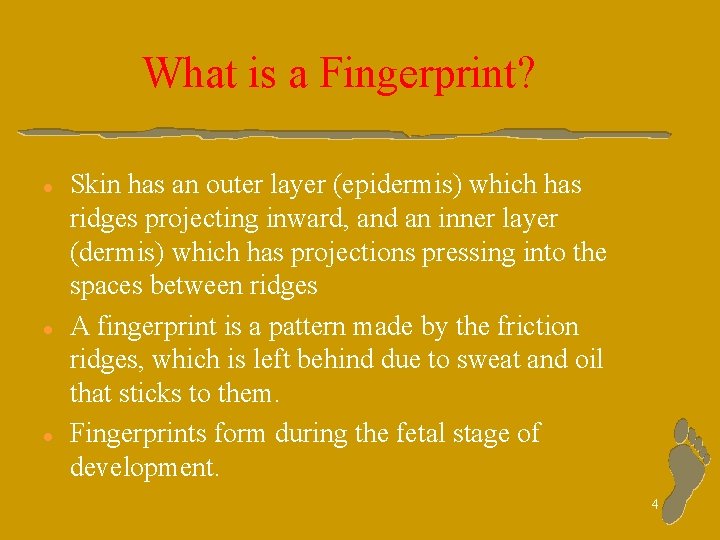
What is a Fingerprint? l l l Skin has an outer layer (epidermis) which has ridges projecting inward, and an inner layer (dermis) which has projections pressing into the spaces between ridges A fingerprint is a pattern made by the friction ridges, which is left behind due to sweat and oil that sticks to them. Fingerprints form during the fetal stage of development. 4
Fundamental Principles of Fingerprints l A fingerprint is an individual characteristic. l A fingerprint will remain unchanged during an individual’s lifetime. l Fingerprints have general characteristics ridge patterns that permit them to be systematically classified. 5
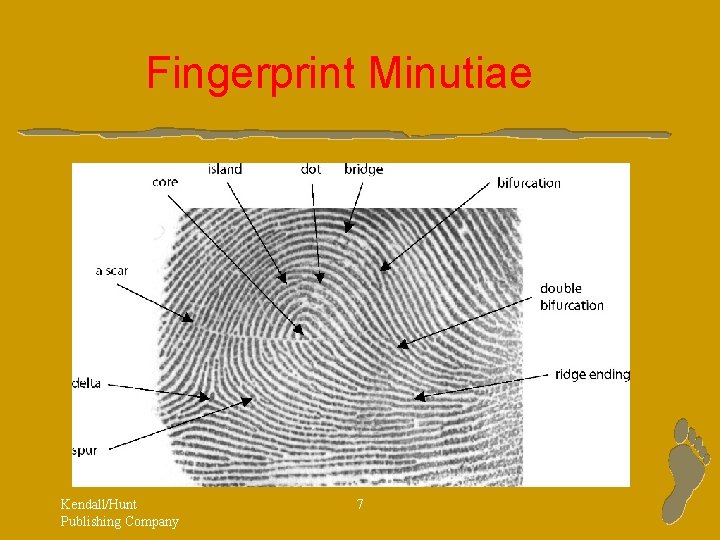
Ridge Characteristics Minutiae—characteristics of ridge patterns § § § § § Ridge ending Short ridge Dot or fragment Bifurcation Double bifurcation Trifurcation Bridge Island Enclosure Spur Kendall/Hunt Publishing Company 6
Fingerprint Minutiae Kendall/Hunt Publishing Company 7
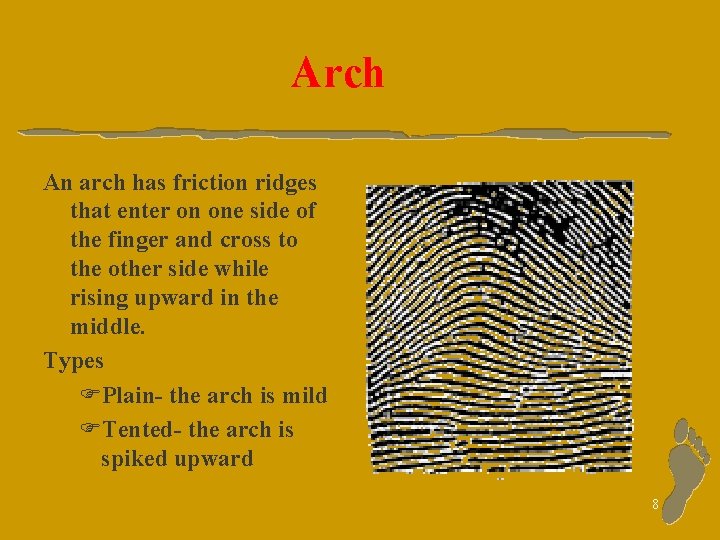
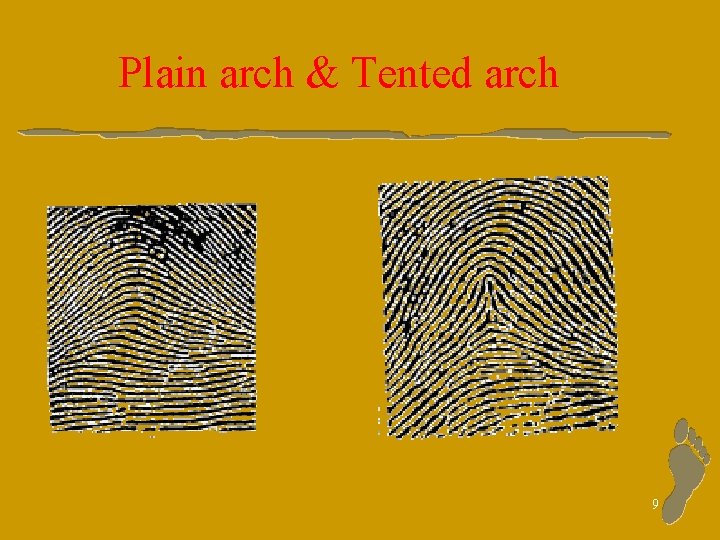
Arch An arch has friction ridges that enter on one side of the finger and cross to the other side while rising upward in the middle. Types FPlain- the arch is mild FTented- the arch is spiked upward 8
Plain arch & Tented arch 9
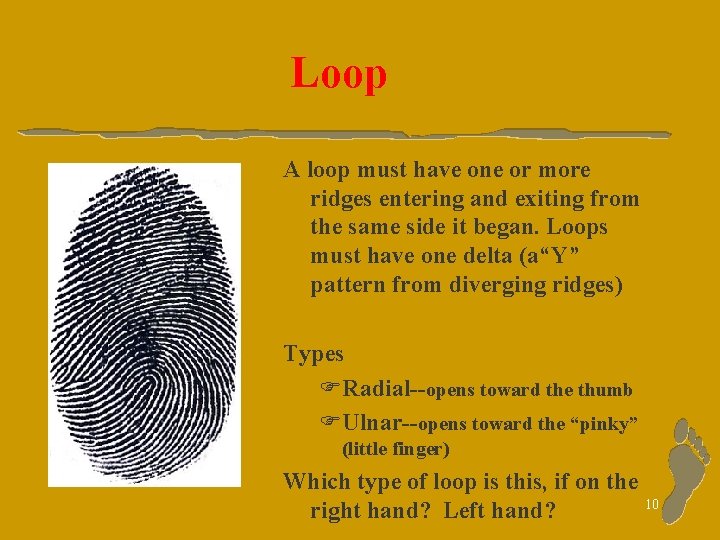
Loop A loop must have one or more ridges entering and exiting from the same side it began. Loops must have one delta (a“Y” pattern from diverging ridges) Types FRadial--opens toward the thumb FUlnar--opens toward the “pinky” (little finger) Which type of loop is this, if on the 10 right hand? Left hand?
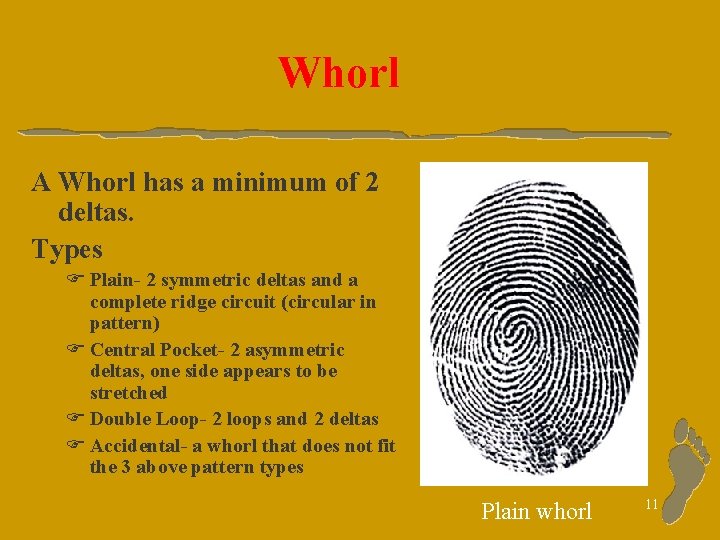
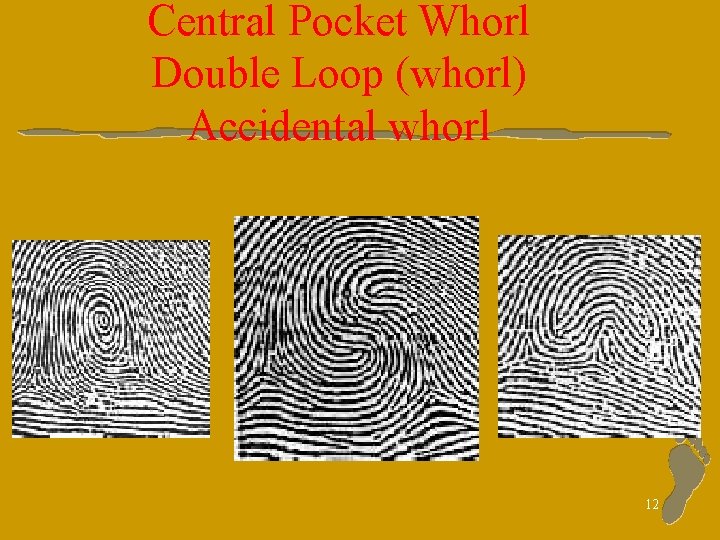
Whorl A Whorl has a minimum of 2 deltas. Types F Plain- 2 symmetric deltas and a complete ridge circuit (circular in pattern) F Central Pocket- 2 asymmetric deltas, one side appears to be stretched F Double Loop- 2 loops and 2 deltas F Accidental- a whorl that does not fit the 3 above pattern types Plain whorl 11
Central Pocket Whorl Double Loop (whorl) Accidental whorl 12
Human population fingerprint distribution Loops: 65% l Whorls: 30% l Arches: 5% l 13
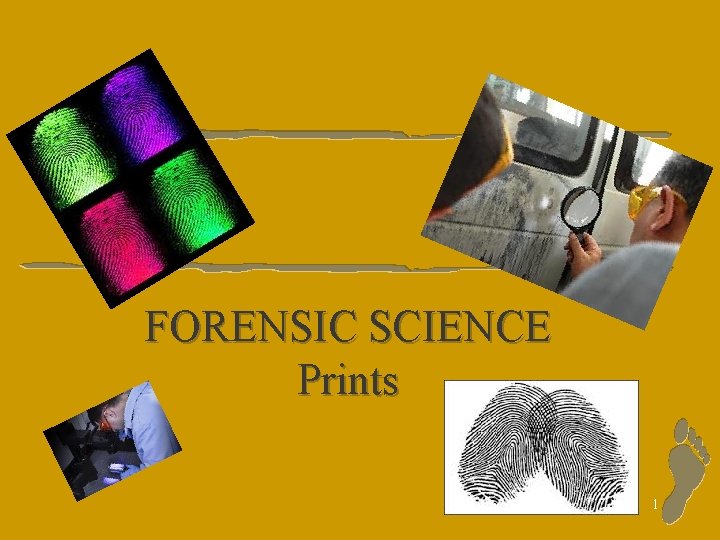
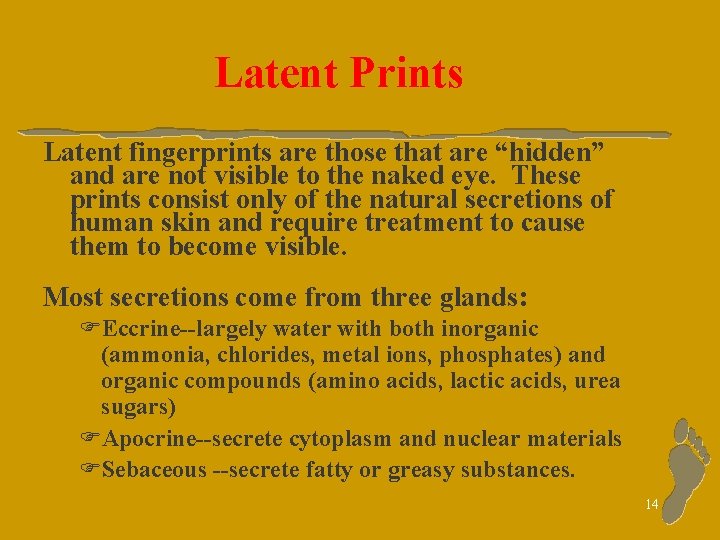
Latent Prints Latent fingerprints are those that are “hidden” and are not visible to the naked eye. These prints consist only of the natural secretions of human skin and require treatment to cause them to become visible. Most secretions come from three glands: FEccrine--largely water with both inorganic (ammonia, chlorides, metal ions, phosphates) and organic compounds (amino acids, lactic acids, urea sugars) FApocrine--secrete cytoplasm and nuclear materials FSebaceous --secrete fatty or greasy substances. 14
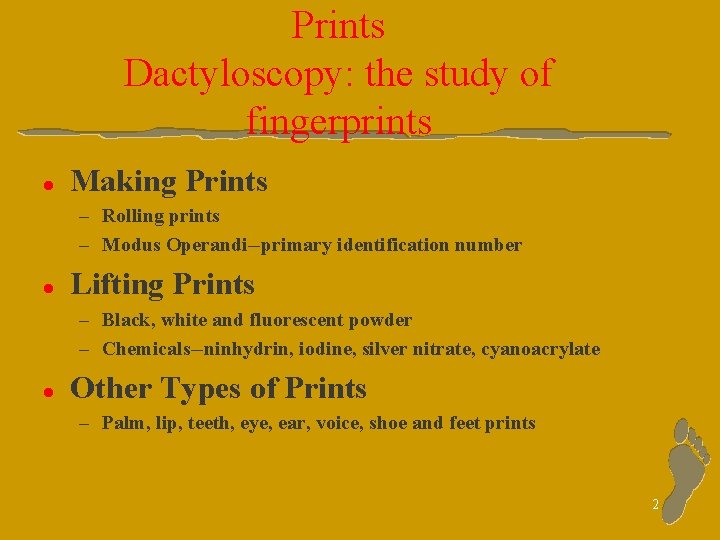
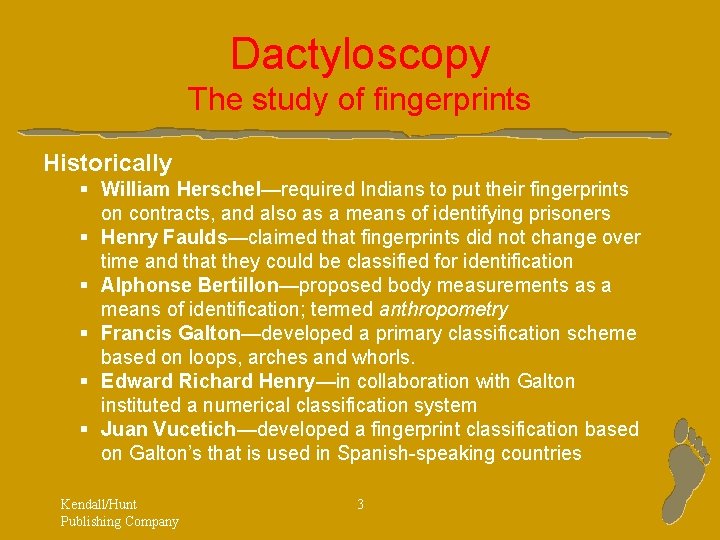
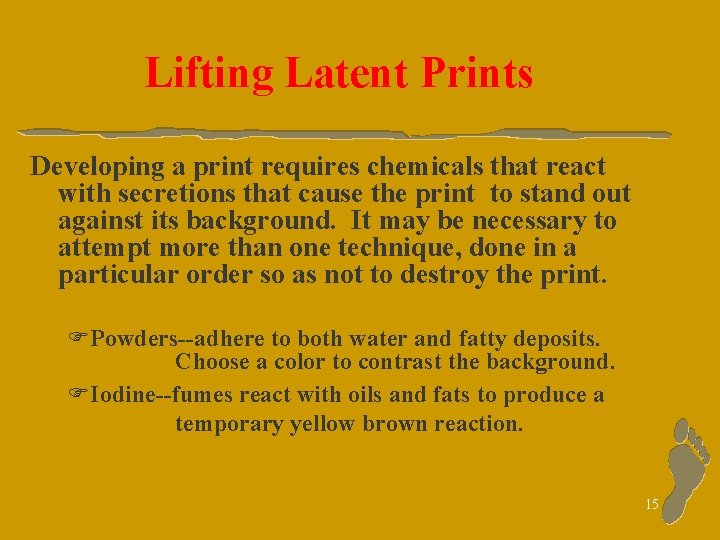
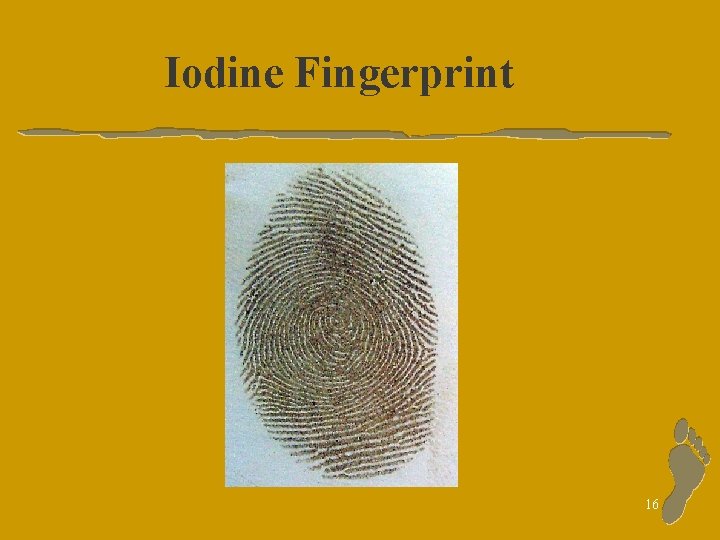
Lifting Latent Prints Developing a print requires chemicals that react with secretions that cause the print to stand out against its background. It may be necessary to attempt more than one technique, done in a particular order so as not to destroy the print. FPowders--adhere to both water and fatty deposits. Choose a color to contrast the background. FIodine--fumes react with oils and fats to produce a temporary yellow brown reaction. 15
Iodine Fingerprint 16
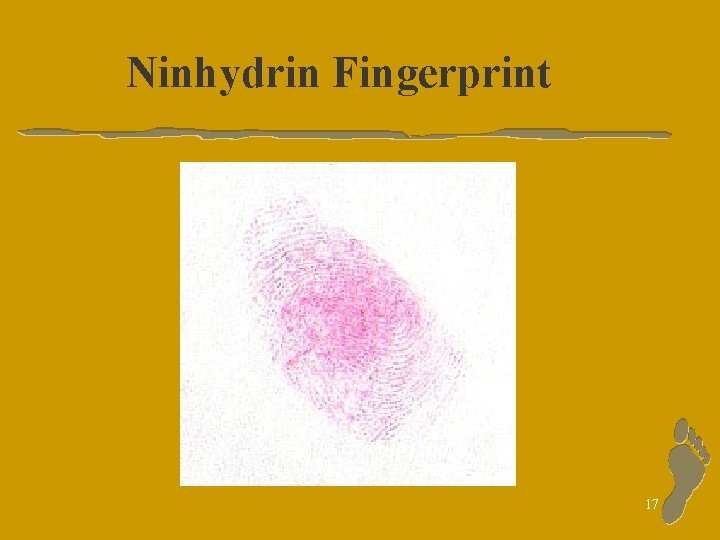
Ninhydrin Fingerprint 17
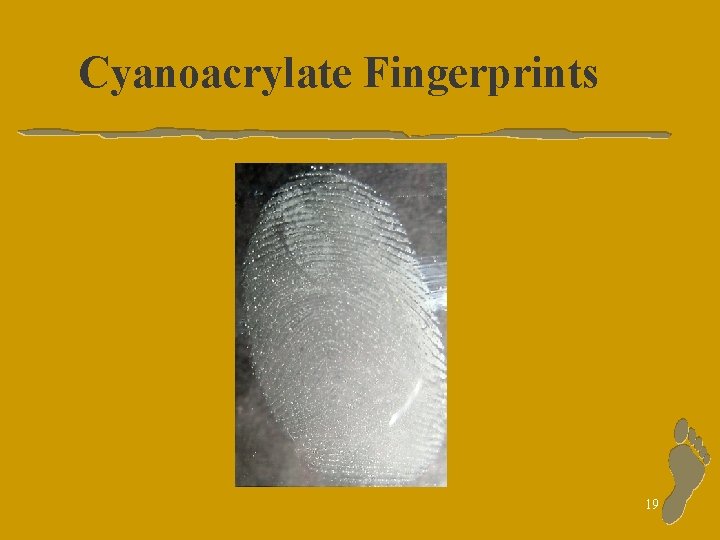
Lifting Latent Prints (cont) F FNinhydrin--reacts with amino acids to produce a purple reaction. FSilver nitrate--react with chlorides to form silver chloride, a material which turns gray when exposed to light. FCyanoacrylate--”super glue” fumes react with water and other fingerprint constituents to form a hard, whitish deposit. In modern labs and criminal investigations, lasers and alternative light sources are used to view latent fingerprints. It was first used by the FBI in 1978. Since lasers can damage the retina of the eye, special precautions must be taken and a filter used. 18
Cyanoacrylate Fingerprints 19
AFIS § § The Automated Fingerprint Identification System - a computer system for storing and retrieving fingerprints Began in the early 1970’s to: § Search large files for a set of prints taken from an individual § Compare a single print, usually a latent print developed from a crime scene § § By the 1990’s most large jurisdictions had their own system in place. The problem - a person’s fingerprints may be in one AFIS but not in others IAFIS—the FBI’s Integrated Automated Fingerprint Identification system which is a national database of all 10 -print cards from all over the country Kendall/Hunt Publishing Company 20
Biometrics § § Use of some type of body metrics for the purpose of identification. (The Bertillon system may actually have been the first biometry system. ) Used today in conjunction with AFIS Examples include retinal or iris patterns, voice recognition, hand geometry Other functions for biometrics—can be used to control entry or access to computers or other structures; can identify a person for security purposes; can help prevent identity theft or control social services fraud. Kendall/Hunt Publishing Company 21
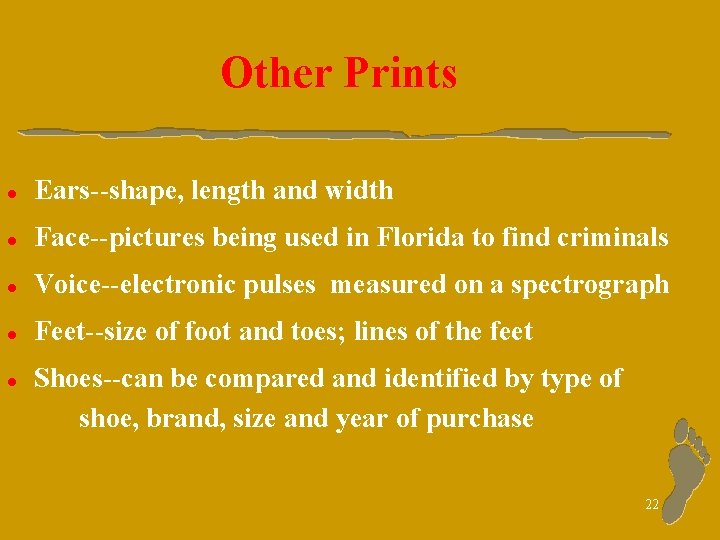
Other Prints l Ears--shape, length and width l Face--pictures being used in Florida to find criminals l Voice--electronic pulses measured on a spectrograph l Feet--size of foot and toes; lines of the feet l Shoes--can be compared and identified by type of shoe, brand, size and year of purchase 22
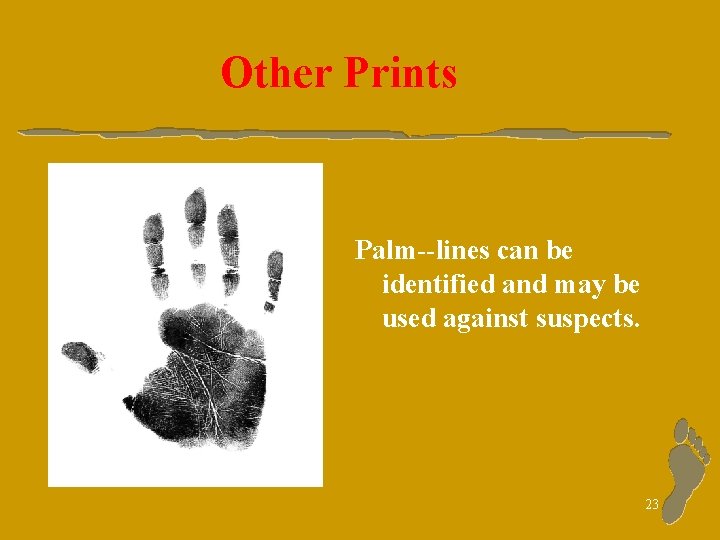
Other Prints Palm--lines can be identified and may be used against suspects. 23
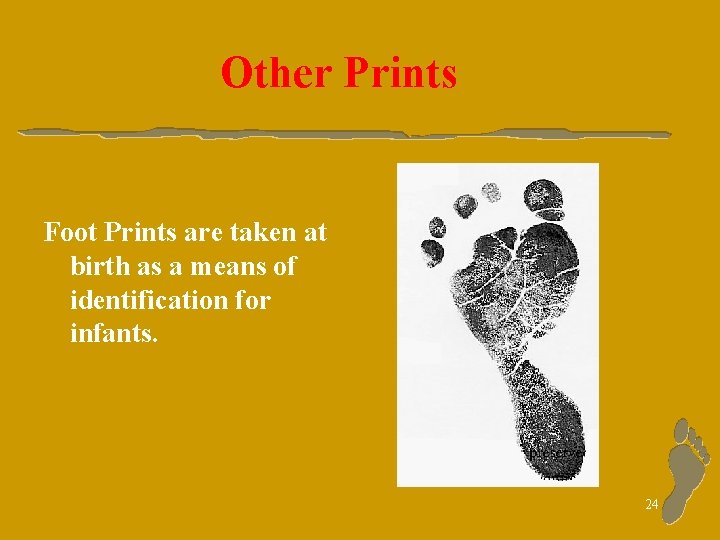
Other Prints Foot Prints are taken at birth as a means of identification for infants. 24
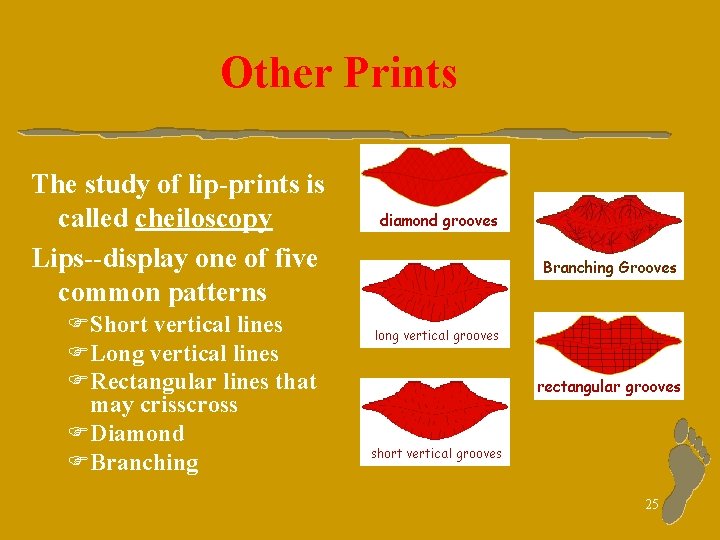
Other Prints The study of lip-prints is called cheiloscopy Lips--display one of five common patterns FShort vertical lines FLong vertical lines FRectangular lines that may crisscross FDiamond FBranching 25
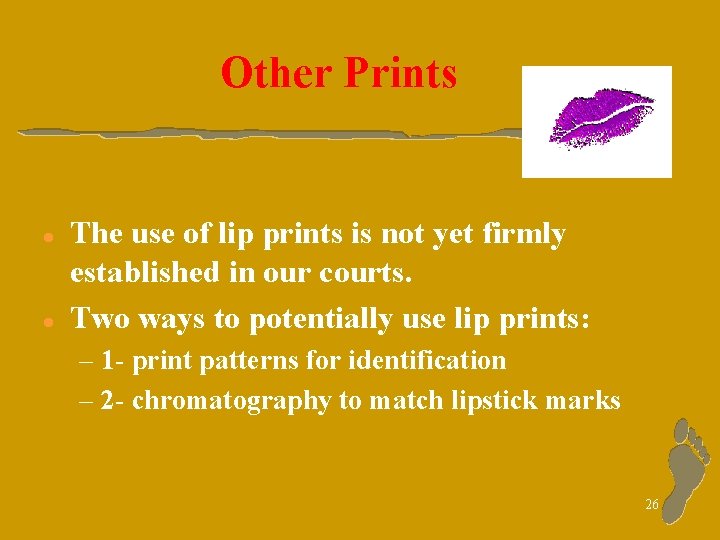
Other Prints l l The use of lip prints is not yet firmly established in our courts. Two ways to potentially use lip prints: – 1 - print patterns for identification – 2 - chromatography to match lipstick marks 26
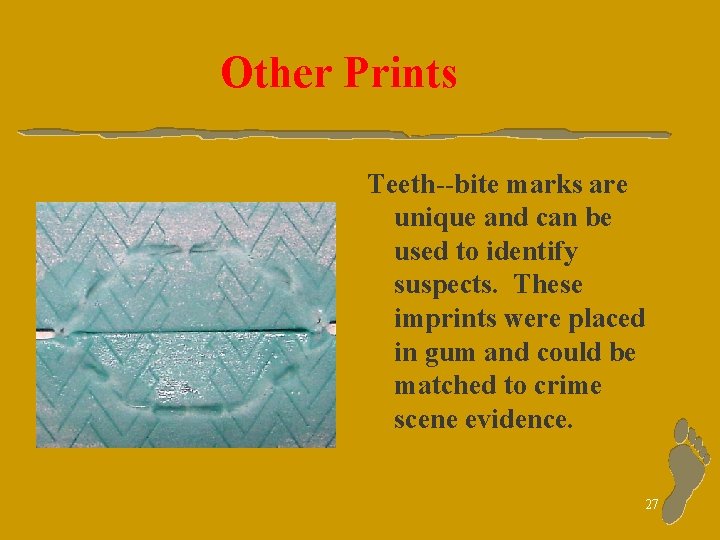
Other Prints Teeth--bite marks are unique and can be used to identify suspects. These imprints were placed in gum and could be matched to crime scene evidence. 27
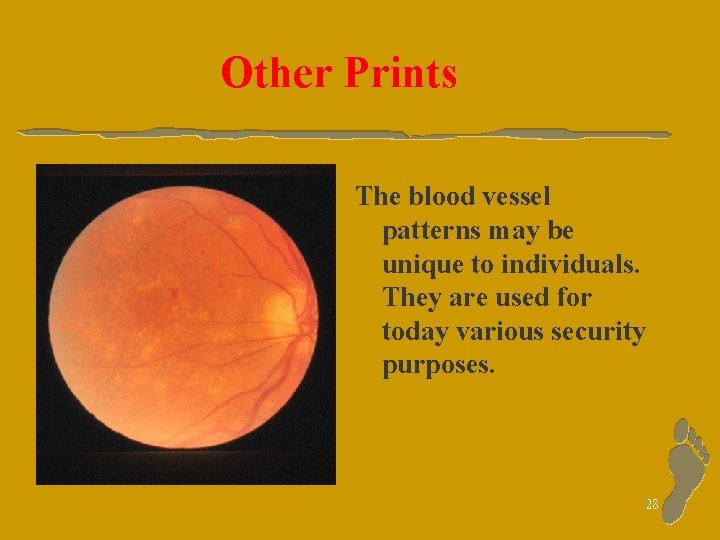
Other Prints The blood vessel patterns may be unique to individuals. They are used for today various security purposes. 28