
FORENSIC SCIENCE Fingerprints 1 History 3000 years ago




- Slides: 55
FORENSIC SCIENCE Fingerprints 1
History 3000 years ago: Chinese used fingerprints to sign legal documents 1880: Henry Faulds suggested that friction ridges be used to identify criminals. (Faulds actually wrote a letter to Charles Darwin regarding fingerprinting but Darwin thought that his cousin Galton would find it more interesting. ) Several years before Bertillon: William Hershel required natives of India to sign contracts with the imprint of their right hand. (There was a dispute between Faulds and Hershel over which of the two was the first to propose fingerprints as a method of identification. ) 2
History cont. 1883 - Bertillon introduced anthropometrics 1891 – Dr. Juan Vucetich uses the work of Galton to refine a classification system (still used in Spanish speaking countries). 1892 – Galton describes loops, whorls, and arches 1897 – Sir Edward Henry develops the classification system that is used in the U. S. 1924 – FBI Identification Division Established 3
AFIS Automated Fingerprint Identification System AFIS is one of the three significant electronic databases for law enforcement purposes. There are two types of files: 1. Knowns: Contains prints of known individuals 2. Forensic files: Consists of images from unsolved cases 4
Fundamental Principles of Fingerprints 1) A fingerprint is an individual characteristic. 2) A fingerprint will remain unchanged during an individual’s lifetime. 3) Fingerprints have general characteristics ridge patterns that permit them to be systematically classified (arch, loop or whorl). 5
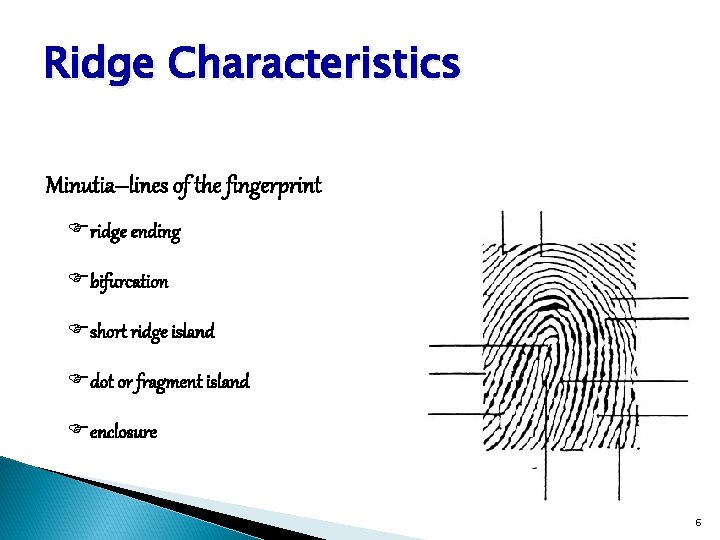
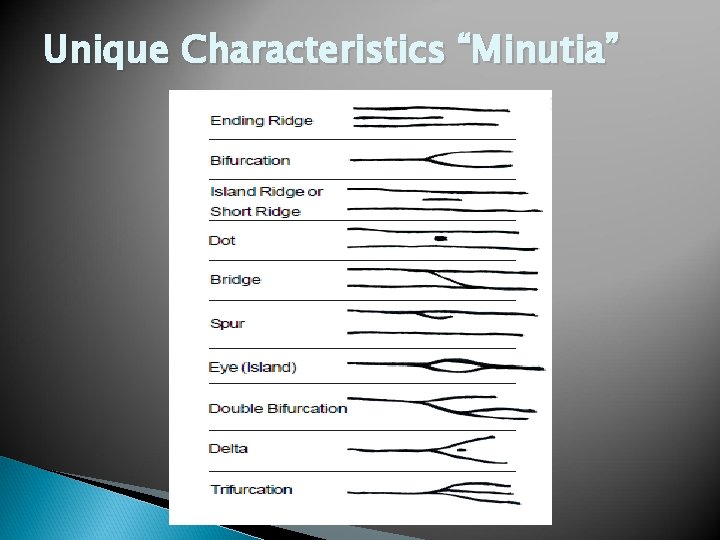
Ridge Characteristics Minutia--lines of the fingerprint Fridge ending Fbifurcation Fshort ridge island Fdot or fragment island Fenclosure 6
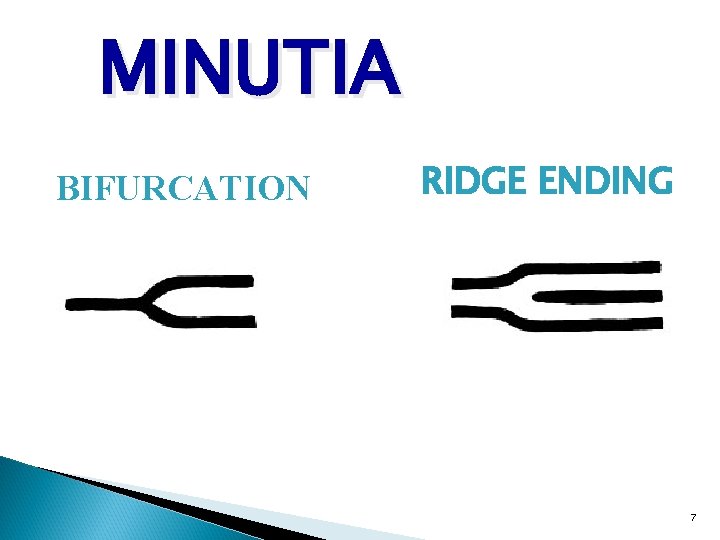
MINUTIA BIFURCATION RIDGE ENDING 7
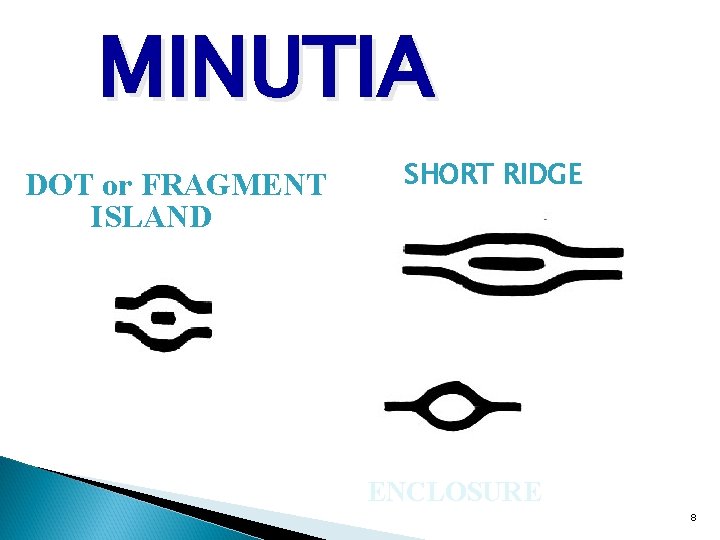
MINUTIA DOT or FRAGMENT ISLAND SHORT RIDGE ENCLOSURE 8
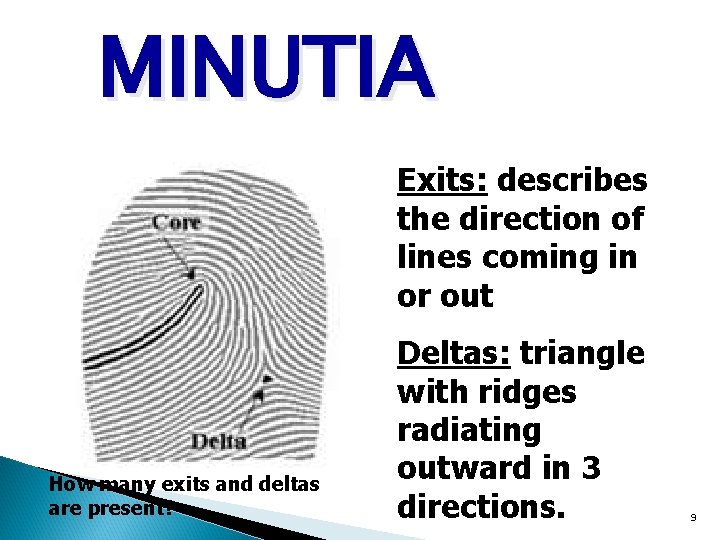
MINUTIA Exits: describes the direction of lines coming in or out How many exits and deltas are present? Deltas: triangle with ridges radiating outward in 3 directions. 9
Fingerprint Patterns Arch Loop Whorl 10
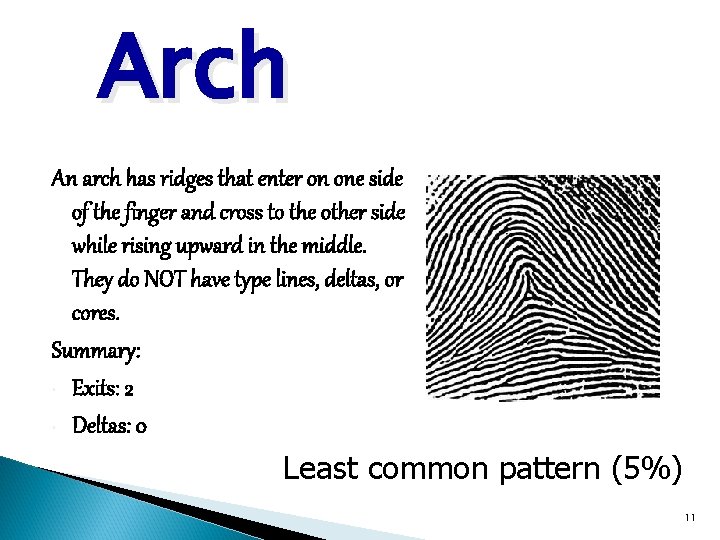
Arch An arch has ridges that enter on one side of the finger and cross to the other side while rising upward in the middle. They do NOT have type lines, deltas, or cores. Summary: • Exits: 2 • Deltas: 0 Least common pattern (5%) 11
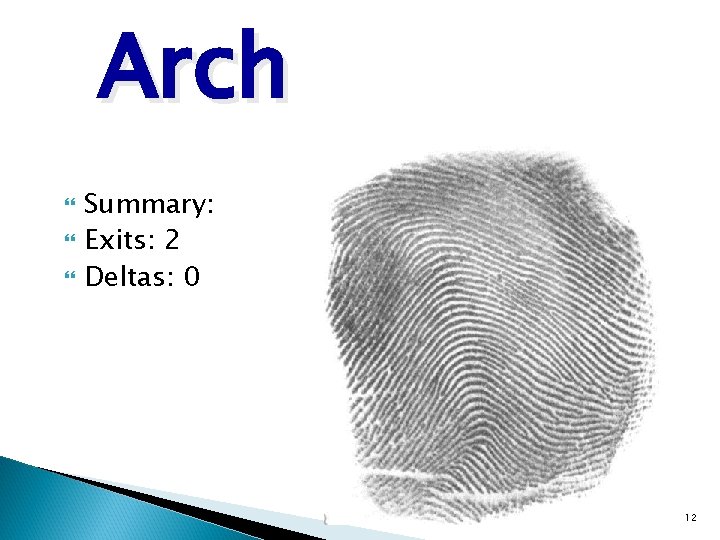
Arch Summary: Exits: 2 Deltas: 0 12
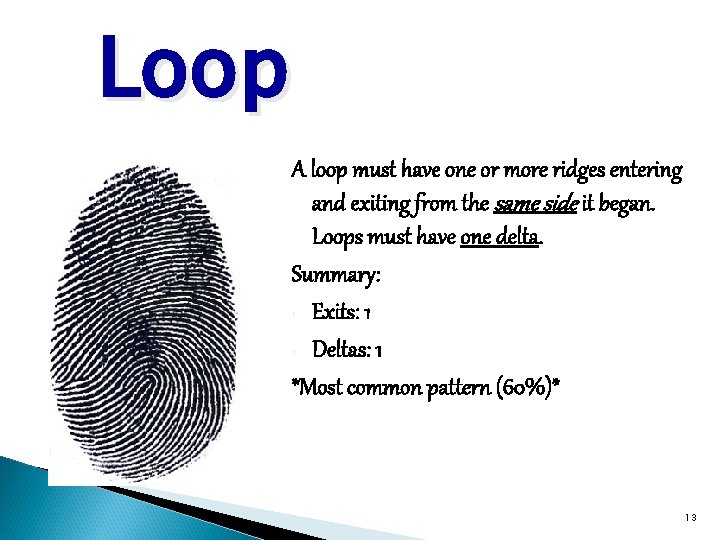
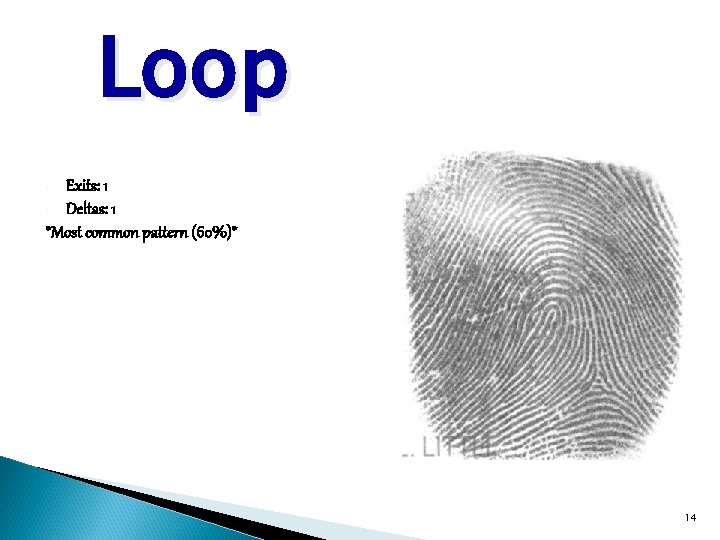
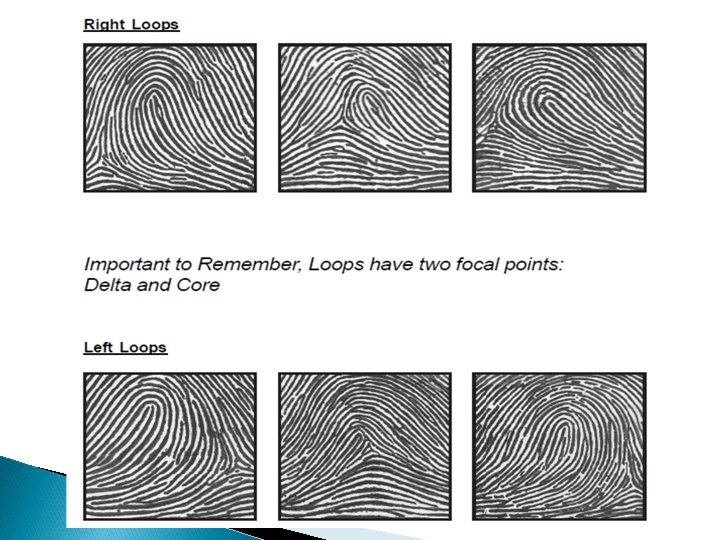
Loop A loop must have one or more ridges entering and exiting from the same side it began. Loops must have one delta. Summary: • Exits: 1 • Deltas: 1 *Most common pattern (60%)* 13
Loop Exits: 1 • Deltas: 1 *Most common pattern (60%)* • 14
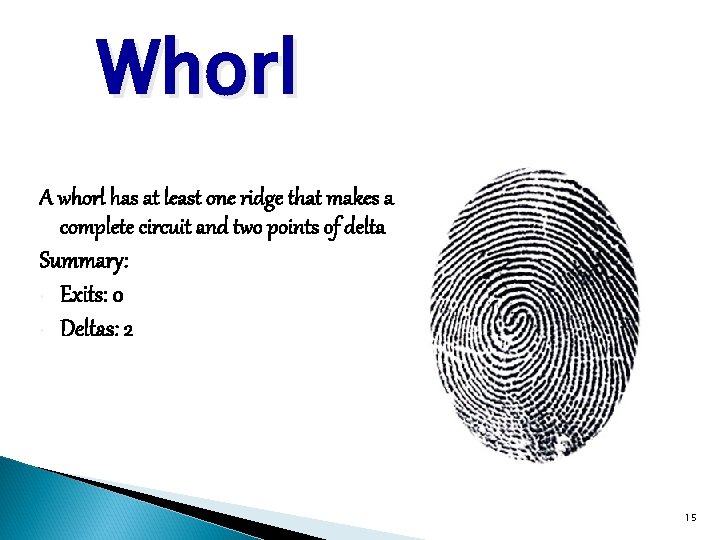
Whorl A whorl has at least one ridge that makes a complete circuit and two points of delta Summary: • Exits: 0 • Deltas: 2 15
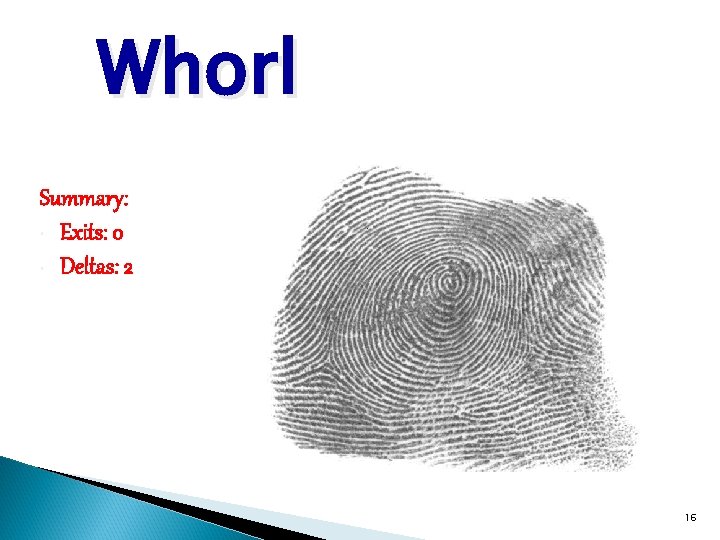
Whorl Summary: • Exits: 0 • Deltas: 2 16
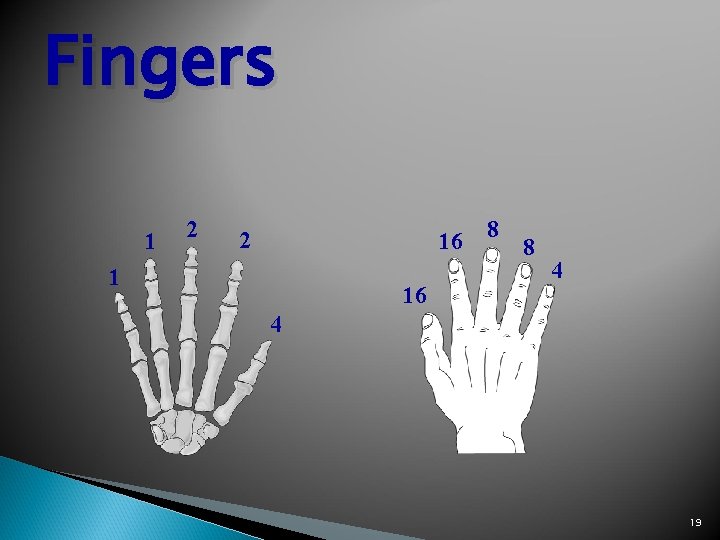
Fingers 1 2 2 16 1 16 8 8 4 4 19
Dactyloscopy the practice of using fingerprints to identify someone 20
Tracking Down Fingerprints Patent Prints Plastic Prints Latent Prints 21
Patent Prints Patent prints occur when a substance such as blood, ink, paint, dirt, or grease on the fingers of the perpetrator of a crime leaves behind a readily visible print. 22
Plastic Prints Plastic prints have a threedimensional quality and occur when the perpetrator impresses a print into a soft substance such as wax, putty, caulk, soap, cold butter or even dust. 23
Latent Prints Latent fingerprints are those that are “hidden” and are not visible to the naked eye. These prints consist only of the natural secretions of human skin and require treatment to cause them to become visible. 24
Latent Prints Most secretions come from three glands: FEccrine--largely water with both inorganic (ammonia, chlorides, metal ions, phosphates) and organic compounds (amino acids, lactic acids, urea, sugars) FApocrine--secrete cytoplasm and nuclear materials FSebaceous --secrete fatty or greasy substances. 25
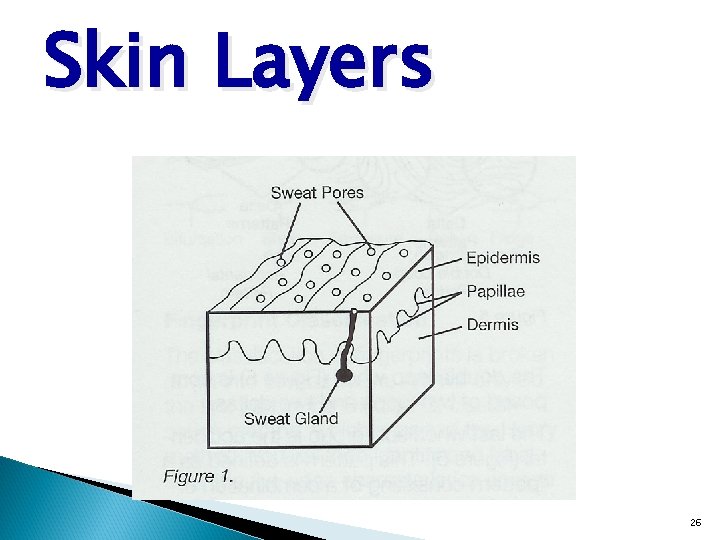
Skin Layers 26
Lifting Latent Prints Here’s where the chemistry comes in……. . Developing a print requires chemicals that react with secretions that cause the print to stand out against its background. It may be necessary to attempt more than one technique, done in a particular order so as not to destroy the print. FPowders--adhere to both water and fatty deposits. Choose a color to contrast the background. 27
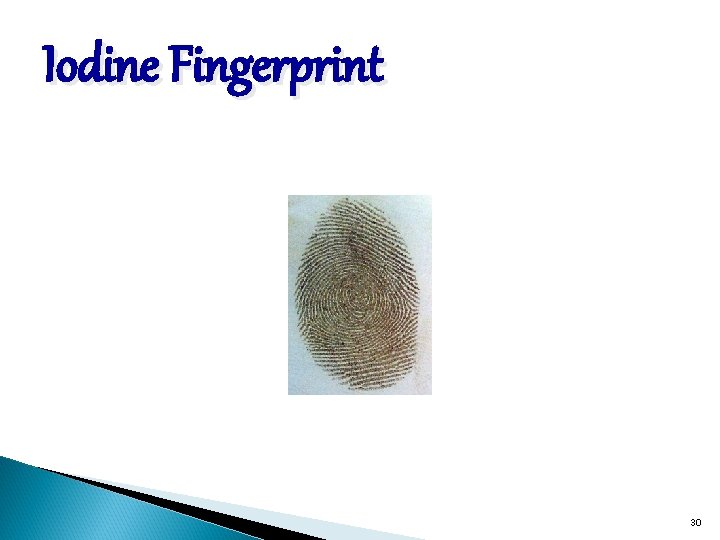
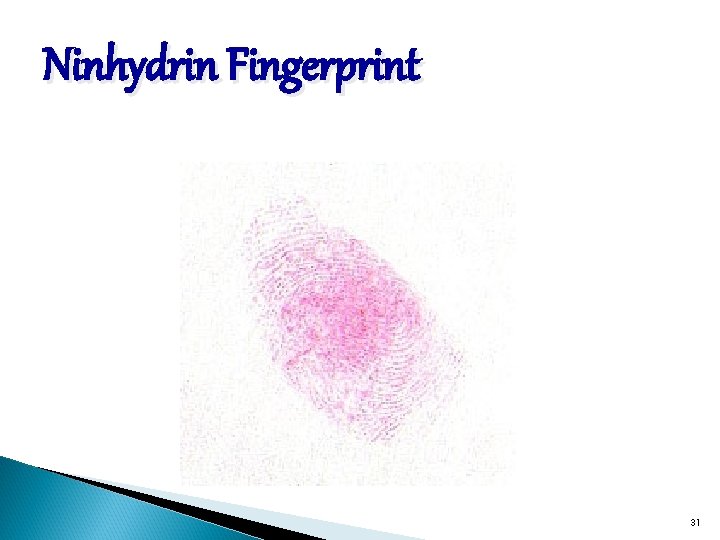
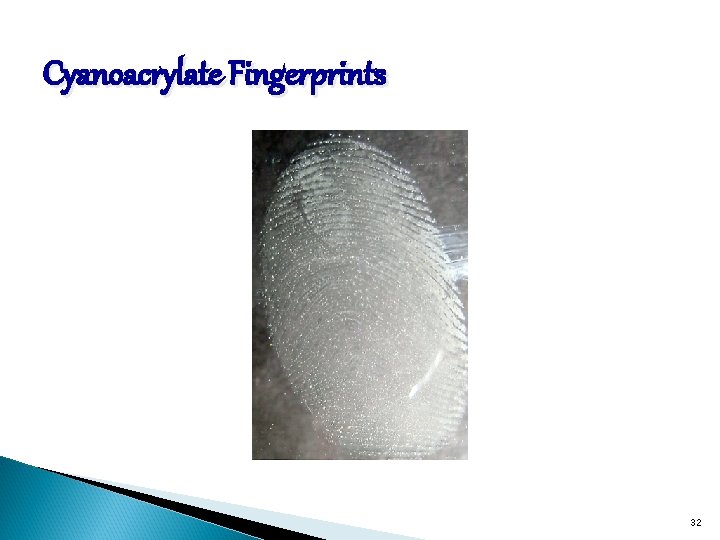
Lifting Latent Prints (cont) FIodine-- fumes react with oils and fats to produce a temporary yellow brown reaction. FNinhydrin--reacts with amino acids to produce a purple reaction. FSilver nitrate--react with chlorides to form silver chloride, a material which turns gray when exposed to light. FCyanoacrylate--”super glue” fumes react with water and other fingerprint constituents to form a hard, whitish deposit. 28
Lifting Latent Prints (cont) FIn modern labs and criminal investigations, lasers and alternative light sources are used to view latent fingerprints. It was first used by the FBI in 1978. Since lasers can damage the retina of the eye, special precautions must be taken and a filter used. 29
Iodine Fingerprint 30
Ninhydrin Fingerprint 31
Cyanoacrylate Fingerprints 32
Will West & William West May 1, 1903 – Will West went to Leavenworth Penitentiary in Kansas. The clerk thought that he looked familiar but Will denied ever being there. Coincidentally, there was another inmate named William West. They looked very much the same and had the same Bertillon anthropometric measurements but they denied ever knowing each other. 33
Will West & William West Fingerprints helped authorities distinguish between the two Wills. So much for measuring the width of a person’s head. Leavenworth immediately dumped the Bertillon anthropometric system and switched to a fingerprint system. P. S. This wasn’t just a bizarre coincidence. A report in the Journal of Police Science and Administration in 1980 revealed that they were indeed identical twins and each wrote letters to the same brother and five sisters and the same Uncle George. 34
Bertillon’s Embarrassing Moment Bertillon reluctantly agreed to add fingerprints to his bertillonage profile. However, he added only those of the right hand. Big mistake! 35
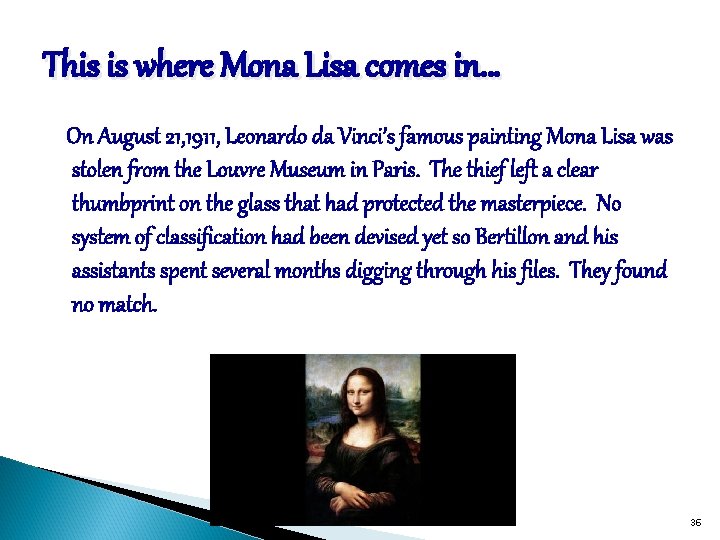
This is where Mona Lisa comes in… On August 21, 1911, Leonardo da Vinci’s famous painting Mona Lisa was stolen from the Louvre Museum in Paris. The thief left a clear thumbprint on the glass that had protected the masterpiece. No system of classification had been devised yet so Bertillon and his assistants spent several months digging through his files. They found no match. 36
Mona Lisa cont. Two years later police apprehended the thief, Vicenzo Perugia. His prints matched the ones found at the newest crime scene. It turns out that Perugia’s prints were among those in Bertillon’s possession the whole time. No match had turned up because the print found at the scene of Mona Lisa was from Peruglia’s left thumb and Bertillon’s files contained only that of Peruglia’s right thumb. 37
Homework Questions 1. 2. 3. 4. 5. What is dactyloscopy? List and describe (exits and deltas) the 3 fingerprint patterns. Draw the following minutia: A. bifurcation B. short ridge Identify and describe the 3 kinds of fingerprints (not patterns). List the different ways in which we can lift prints. What color do prints appear for each method? 38
Fingerprinting Expanded
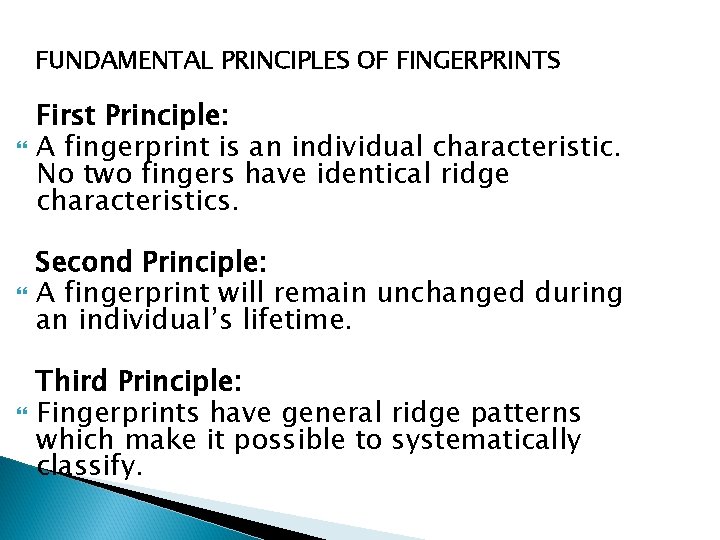
FUNDAMENTAL PRINCIPLES OF FINGERPRINTS First Principle: A fingerprint is an individual characteristic. No two fingers have identical ridge characteristics. Second Principle: A fingerprint will remain unchanged during an individual’s lifetime. Third Principle: Fingerprints have general ridge patterns which make it possible to systematically classify.
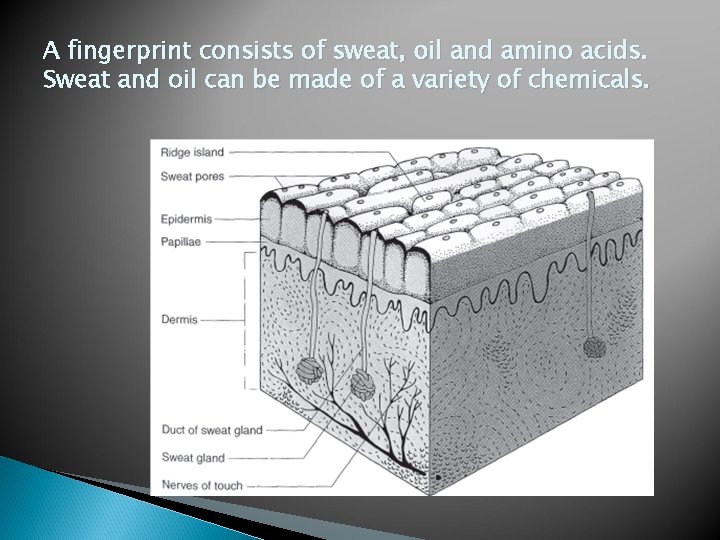
A fingerprint consists of sweat, oil and amino acids. Sweat and oil can be made of a variety of chemicals.
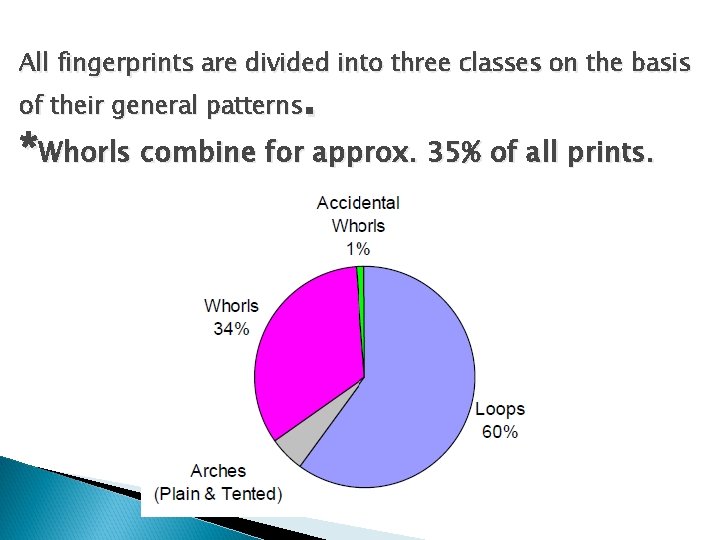
All fingerprints are divided into three classes on the basis . of their general patterns *Whorls combine for approx. 35% of all prints.
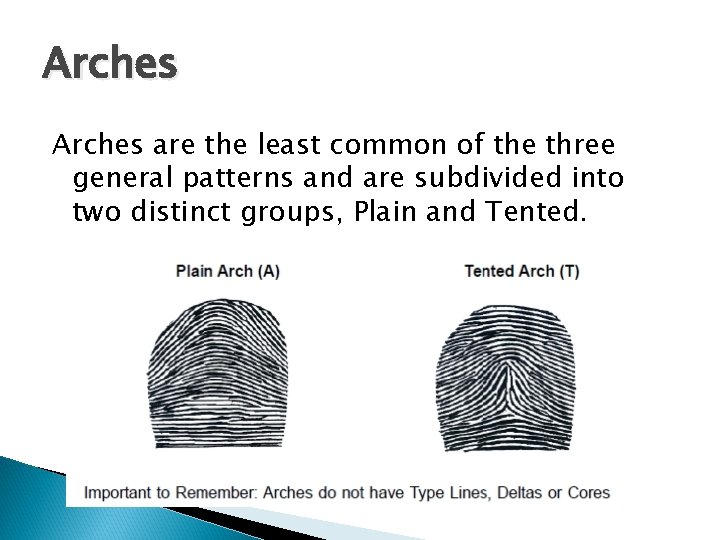
Arches are the least common of the three general patterns and are subdivided into two distinct groups, Plain and Tented.
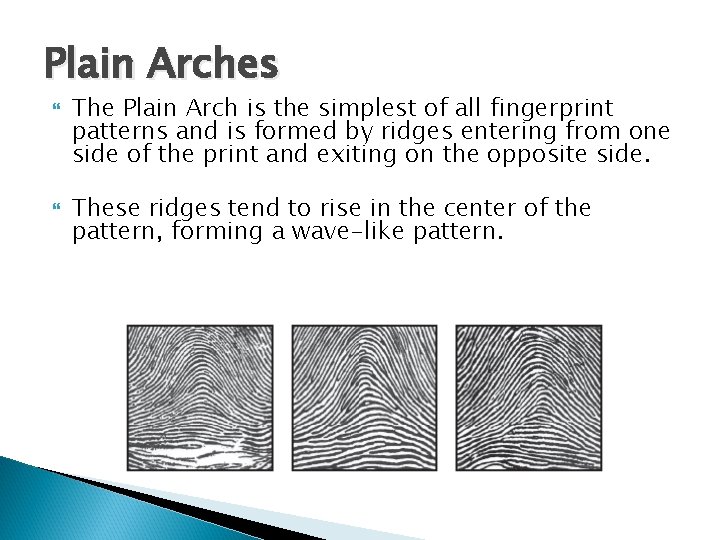
Plain Arches The Plain Arch is the simplest of all fingerprint patterns and is formed by ridges entering from one side of the print and exiting on the opposite side. These ridges tend to rise in the center of the pattern, forming a wave-like pattern.
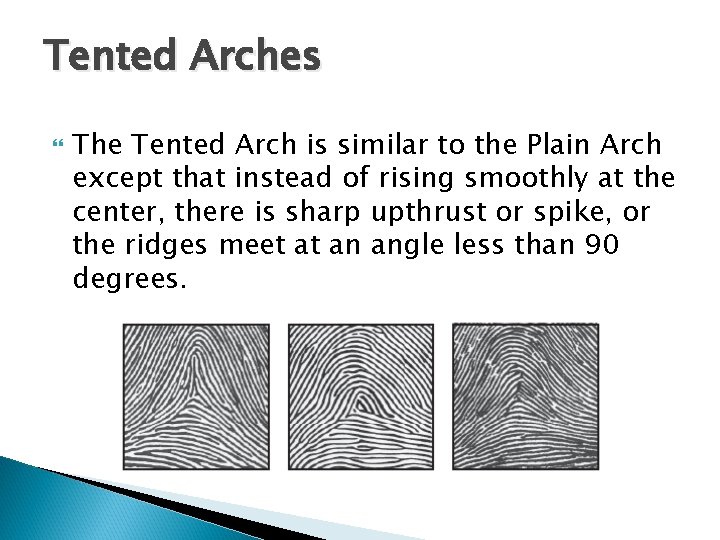
Tented Arches The Tented Arch is similar to the Plain Arch except that instead of rising smoothly at the center, there is sharp upthrust or spike, or the ridges meet at an angle less than 90 degrees.
Loops The most common general pattern. A Loop is a type of pattern in which one or more ridges enter either side, recurve, touch or pass an imaginary line between Delta and Core, and tend to exit the same side as the ridge entry.
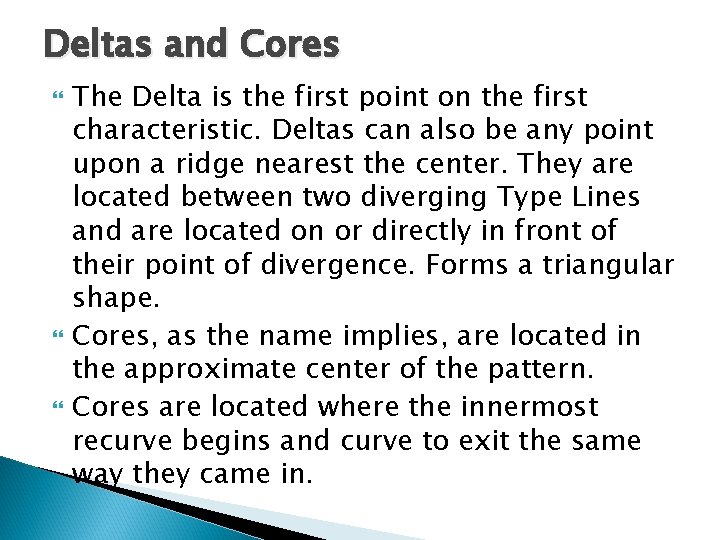
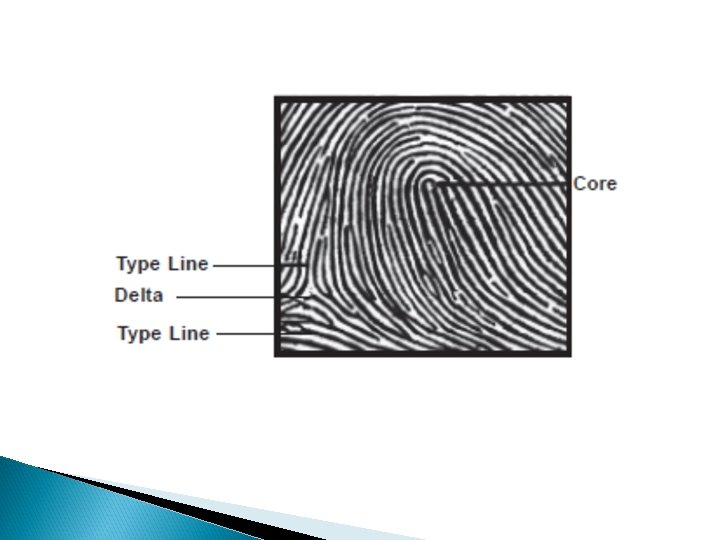
Deltas and Cores The Delta is the first point on the first characteristic. Deltas can also be any point upon a ridge nearest the center. They are located between two diverging Type Lines and are located on or directly in front of their point of divergence. Forms a triangular shape. Cores, as the name implies, are located in the approximate center of the pattern. Cores are located where the innermost recurve begins and curve to exit the same way they came in.
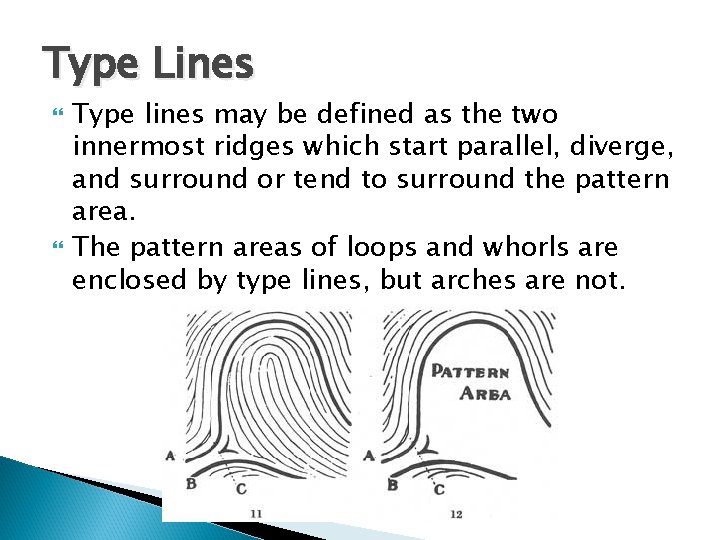
Type Lines Type lines may be defined as the two innermost ridges which start parallel, diverge, and surround or tend to surround the pattern area. The pattern areas of loops and whorls are enclosed by type lines, but arches are not.
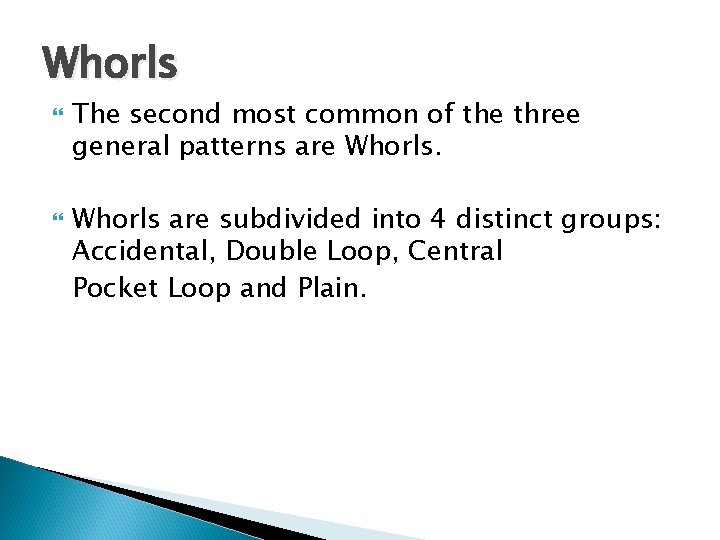
Whorls The second most common of the three general patterns are Whorls are subdivided into 4 distinct groups: Accidental, Double Loop, Central Pocket Loop and Plain.
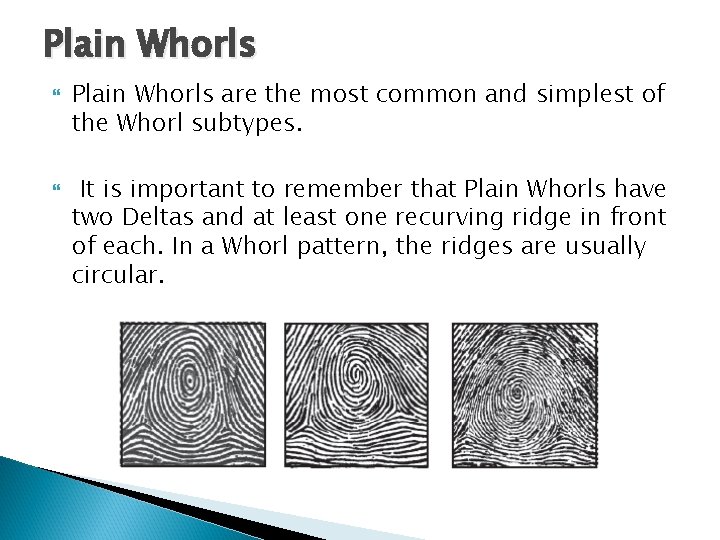
Plain Whorls are the most common and simplest of the Whorl subtypes. It is important to remember that Plain Whorls have two Deltas and at least one recurving ridge in front of each. In a Whorl pattern, the ridges are usually circular.
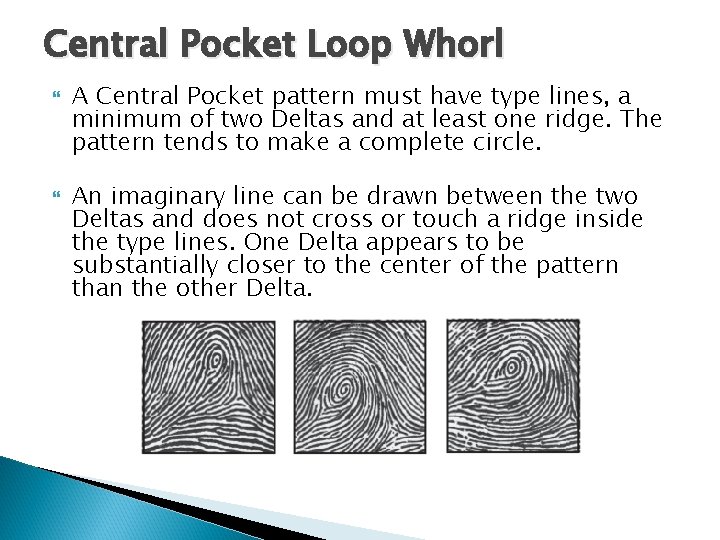
Central Pocket Loop Whorl A Central Pocket pattern must have type lines, a minimum of two Deltas and at least one ridge. The pattern tends to make a complete circle. An imaginary line can be drawn between the two Deltas and does not cross or touch a ridge inside the type lines. One Delta appears to be substantially closer to the center of the pattern than the other Delta.
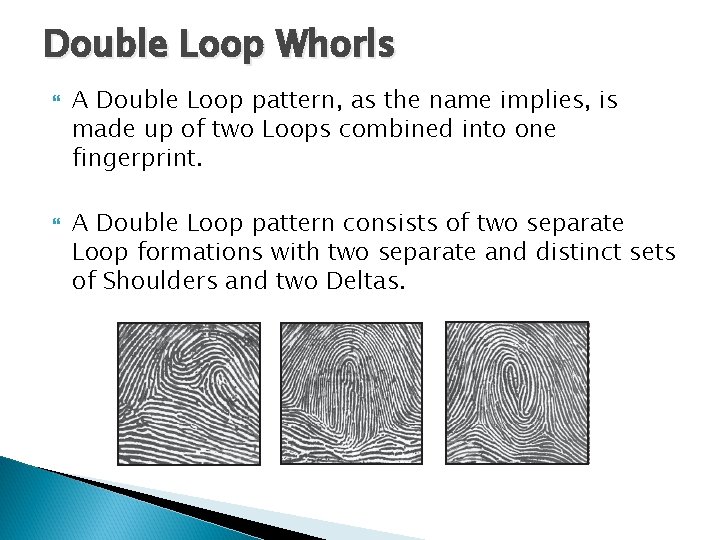
Double Loop Whorls A Double Loop pattern, as the name implies, is made up of two Loops combined into one fingerprint. A Double Loop pattern consists of two separate Loop formations with two separate and distinct sets of Shoulders and two Deltas.
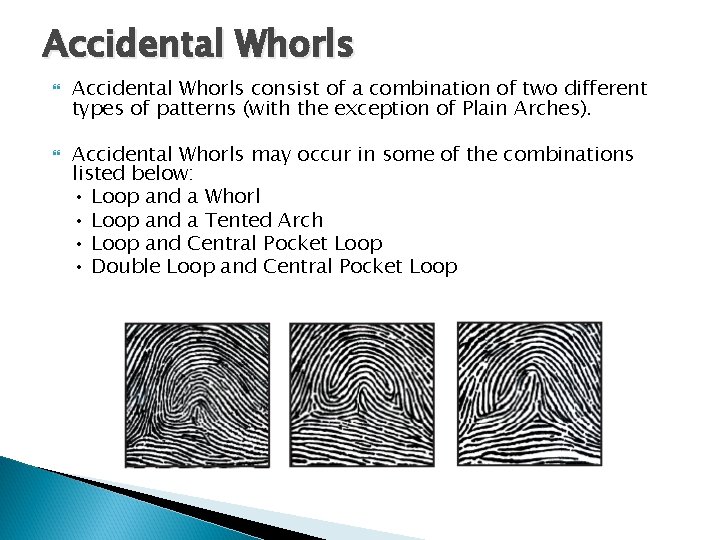
Accidental Whorls consist of a combination of two different types of patterns (with the exception of Plain Arches). Accidental Whorls may occur in some of the combinations listed below: • Loop and a Whorl • Loop and a Tented Arch • Loop and Central Pocket Loop • Double Loop and Central Pocket Loop
Unique Characteristics The general pattern does not make a fingerprint unique. Uniqueness results from the combination and location of the other characteristics. It is these characteristics that AFIS (Automated Fingerprint Identification System) uses to find a match
Unique Characteristics “Minutia”