
Forensic Psychology History of Forensic Psychology 1911 several


- Slides: 39
Forensic Psychology
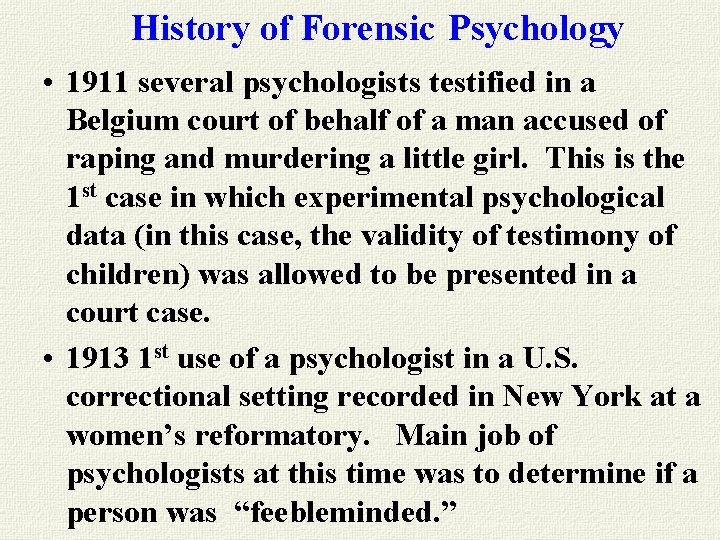
History of Forensic Psychology • 1911 several psychologists testified in a Belgium court of behalf of a man accused of raping and murdering a little girl. This is the 1 st case in which experimental psychological data (in this case, the validity of testimony of children) was allowed to be presented in a court case. • 1913 1 st use of a psychologist in a U. S. correctional setting recorded in New York at a women’s reformatory. Main job of psychologists at this time was to determine if a person was “feebleminded. ”
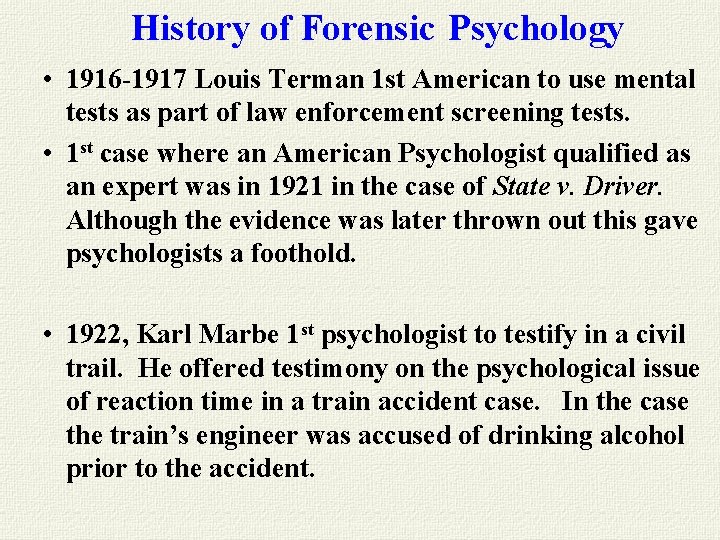
History of Forensic Psychology • 1916 -1917 Louis Terman 1 st American to use mental tests as part of law enforcement screening tests. • 1 st case where an American Psychologist qualified as an expert was in 1921 in the case of State v. Driver. Although the evidence was later thrown out this gave psychologists a foothold. • 1922, Karl Marbe 1 st psychologist to testify in a civil trail. He offered testimony on the psychological issue of reaction time in a train accident case. In the case the train’s engineer was accused of drinking alcohol prior to the accident.
Even More History • 1940, People v. Hawthorne, set the U. S. precedent for psychologist testifying as an expert witness on competence and criminal responsibility. This case overruled an earlier lower courts decision to disallow a psychologist testimony. • Canada’s 1 st Correctional Psychologist hired in 1955 at St. Vincent de Paul Penitentiary. • Hans Toch, the 1 st psychologist to edit a book on psychological criminology called: Legal and Criminal Psychology in 1960. This is considered the 1 st book about psychology and the law written by a psychologist.
What Forensic Psychology is NOT. Forensic Scientist Forensic Psychiatrist v. Analyze, compare, identify & interpret v. Apply Psychiatry to physical evidence the Law v. Identify evidence & v. Expert witnesses in link it to the court suspect, victim & v. Application of crime scene medical treatment in forensic settings
Who Employs Forensic Psychologists? • Federal, state & local government & facilities: i. e. prisons, jails, police departments, corrections facilities, probation and parole, military, etc. • Treatment facilities: i. e. drug/chemical rehabilitation, short/long term residential facilities, counseling centers, mental hospitals, etc. • Courts, attorneys and legal advocacy groups • Self employed, private practice & consultants
Subfields of Forensic Psychology • Clinical-Forensic Psychology Very similar to clinical psychology. Clients here are not only suffering from some type of mental problem, but their issues are of importance to legal decision making as well. • Developmental Psychology Deals w/ juveniles, the elderly, and the law. Focus on policy making rather than treatment of those with mental problems. • Social Psychology Concerned with how jurors interact and arrive at a group decision. • Cognitive Psychology Closely associated w/social psychology subfield, but looks more into how people make decisions in legal cases. • Criminal Investigative Psychology
Clinical Forensic Psychology • • • Jury Selection Consultation with Lawyers Expert Witness Competency Assessment Insanity Assessment Lethality Assessment Custody Assessment Researcher Law Enforcement Screening
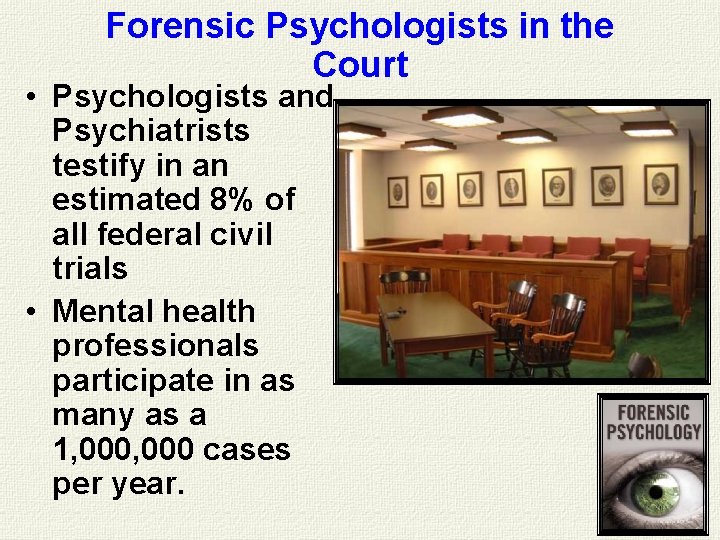
Forensic Psychologists in the Court • Psychologists and Psychiatrists testify in an estimated 8% of all federal civil trials • Mental health professionals participate in as many as a 1, 000 cases per year.
Jury Selection • Lawyers hire psychologists as jury selection consultants • Psychologist use empirically-based procedures to select jurors – Focus groups – Shadow juries – Systematic rating of prospective jurors – Surveys of community to detect bias
Areas Psychologists Testify as an Expert Witness • Commitment to mental hospitals • Child custody issues • Offender Treatment Programs • Release from involuntary confinement • Jury Selection • Criminal Profiling • Advice to attorneys regarding factors that will affect jurors’ • Predicting dangerousness • Rights of a mentally disabled person in an institution • Competency to stand trial • Criminal Responsibility (Insanity Defense) • Battered Women
Family Court • • Child Custody Evaluations Visitation Risk Assessments Grandparent Visitation Evaluations Mediation of Parental Conflicts about Children Child Abuse Evaluations Adoption Readiness Evaluations Development of Family Reunification Plans Evaluations to Assess Termination of Parental Rights
Civil Court • Personal Injury Evaluations • IME Second Opinion Evaluations • Assessment of Emotional Factors in Sexual Harassment and Discrimination • Worker's Compensation Evaluations • Civil Competency Evaluations • Psychological Autopsies
Criminal Court • Evaluations of Juveniles accused of criminal acts • Juvenile Pre-sentencing Evaluations • Juvenile Probation Evaluations • Juvenile Waiver Evaluations • Evaluating the Credibility of Child Witnesses • Assessment of Juvenile and Adult Sexual Offenders • Competency and Diminished Capacity Evaluations • Adult Pre-sentencing Evaluations.
Insanity vs. Competence • Relates to the refers exclusively defendants to the defendants mental state at mental abilities at the time of the offense occurs. proceeding.
Insanity Defense An insanity defense is based on theory that most people can choose to follow the law; But a few select persons cannot be held accountable because mental disease or disability deprives them of the ability to make a rational/voluntary choice
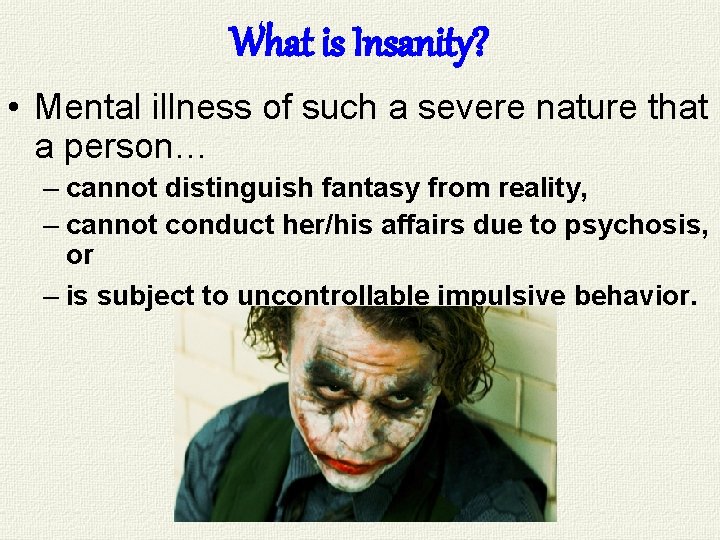
What is Insanity? • Mental illness of such a severe nature that a person… – cannot distinguish fantasy from reality, – cannot conduct her/his affairs due to psychosis, or – is subject to uncontrollable impulsive behavior.
Legal Standards of Insanity • Mc. Naughton Rule – States that, in order to establish insanity, it must be proven that at the time of a crime, the accused had a mental defect (i. e. such as a mental disease) so that she/he did/could not know the nature or quality of their crime at the time of offense--or if the accused did not know that what she/he did was wrong. • The Durham Rule – States that the accused is not criminally responsible if her/his unlawful conduct is or was the product of mental disease or
The Original test • The insanity defense traces its roots back to the 1843 when Englishman Daniel Mc. Naughton shot and killed the secretary of the British Prime Minister, believing that the Prime Minister was conspiring against him. • The court acquitted Mc. Naughton "by reason of insanity, " and • He was placed in a mental institution for the rest of his life. • However, the case caused a public uproar, and Queen Victoria ordered the court to develop a stricter test for insanity.
The Mc. Naughton Test • also called the "right-wrong test" • a person was not criminally responsible if at the time of the crime, he did not know the nature of the act or that it was wrong.
The Jury was required to answer two questions: 1. Did the defendant know what he was doing when he committed the crime? 2. Did the defendant understand that his actions were wrong? – This test allowed a prosecutor to prove sanity easily by simply showing a defendant understood the moral consequences of an action; mental illness did not matter.
AMERICAN LAW INSTITUTE (ALI) TEST Under the ALI test the defendant must prove by a pre-ponderance of the evidence of the time of the crime because of a mental disorder, he lacked substantial capacity either to appreciate the criminality of his conduct or to conform his conduct to the requirements of law This test is more favorable to defendants because it excuses a defendant of whether his cognitive or volitional capacity was substantially impaired; it doesn’t require complete impairment.
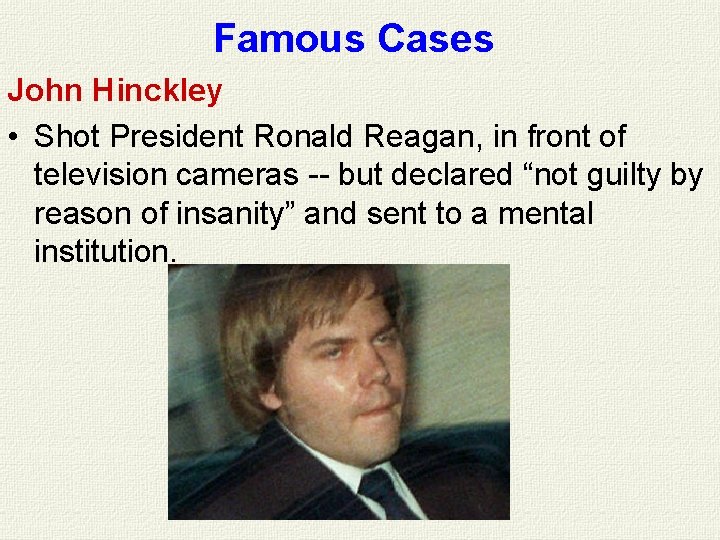
Famous Cases John Hinckley • Shot President Ronald Reagan, in front of television cameras -- but declared “not guilty by reason of insanity” and sent to a mental institution.
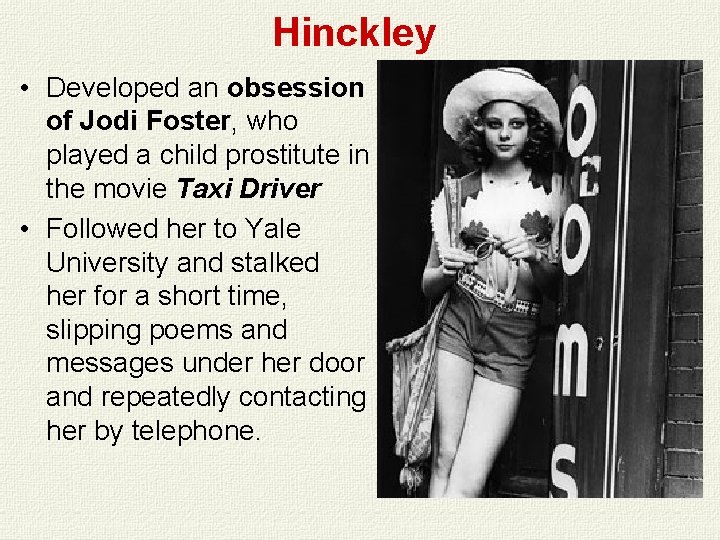
Hinckley • Developed an obsession of Jodi Foster, who played a child prostitute in the movie Taxi Driver • Followed her to Yale University and stalked her for a short time, slipping poems and messages under her door and repeatedly contacting her by telephone.
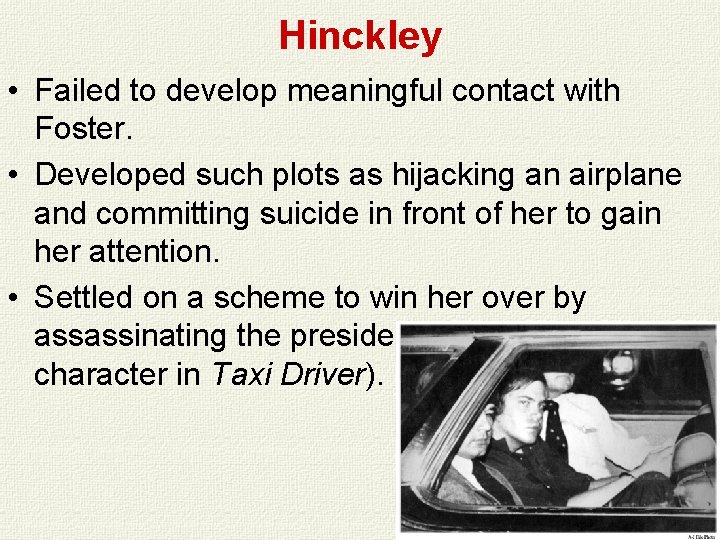
Hinckley • Failed to develop meaningful contact with Foster. • Developed such plots as hijacking an airplane and committing suicide in front of her to gain her attention. • Settled on a scheme to win her over by assassinating the president (just like the main character in Taxi Driver).
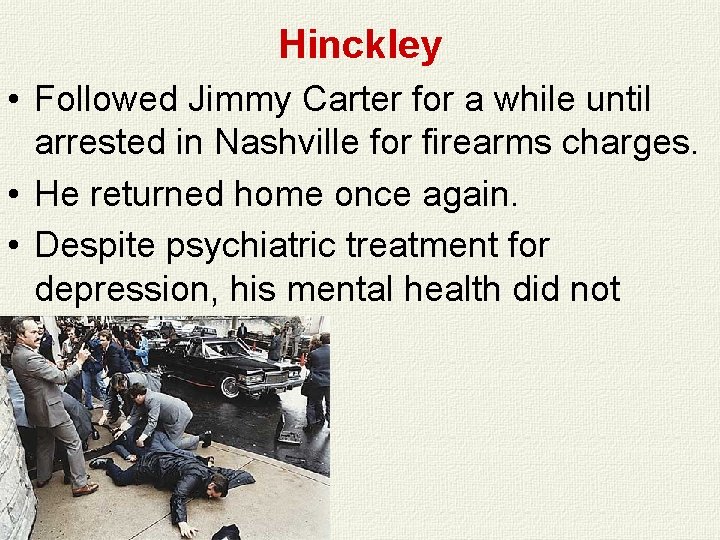
Hinckley • Followed Jimmy Carter for a while until arrested in Nashville for firearms charges. • He returned home once again. • Despite psychiatric treatment for depression, his mental health did not improve.
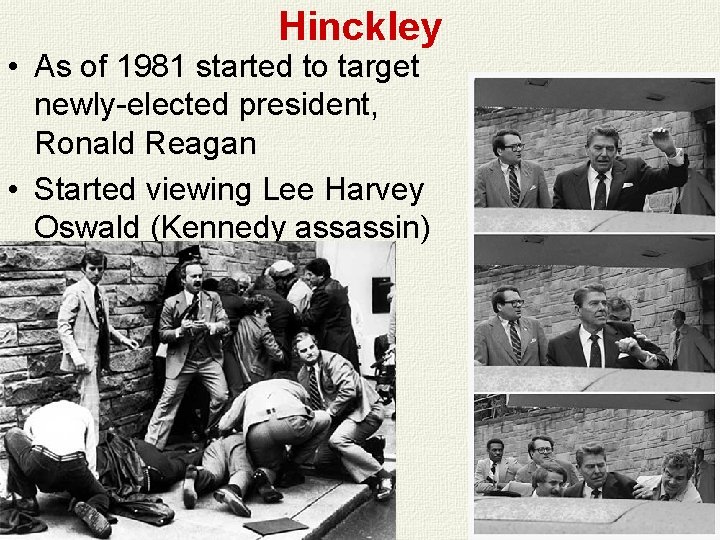
Hinckley • As of 1981 started to target newly-elected president, Ronald Reagan • Started viewing Lee Harvey Oswald (Kennedy assassin) as hero
Hinckley • Just prior to Hinckley's failed attempt on Reagan's life, he wrote to Foster • "Over the past seven months I've left you dozens of poems, letters and love messages in the faint hope that you could develop an interest in me. Although we talked on the phone a couple of times I never had the nerve to simply approach you and introduce myself. [. . . ] the reason I'm going ahead with this attempt now is because I cannot wait any longer to impress you. "
Hinckley • On March 30, 1981, Hinckley fired a. 22 caliber Röhm RG-14 revolver six times at President Reagan, as he left the Hilton Hotel in Washington, D. C. after addressing an AFL-CIO conference. • Wounded press secretary James Brady, police officer Thomas Delahanty and Secret Service agent Timothy Mc. Carthy. • Bullet ricochet off the side of the limousine and hit President Reagan in the chest. • All victims survived, but Brady -- hit in the right side of the head -- endured a long recuperation period and remained paralyzed on the left side
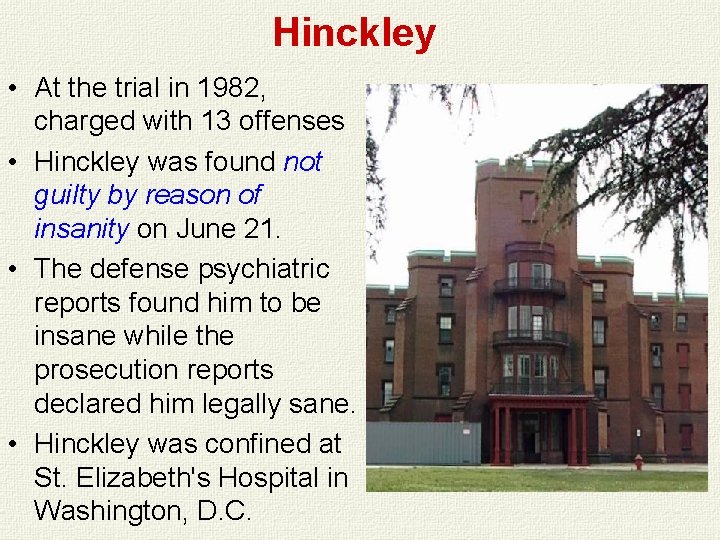
Hinckley • At the trial in 1982, charged with 13 offenses • Hinckley was found not guilty by reason of insanity on June 21. • The defense psychiatric reports found him to be insane while the prosecution reports declared him legally sane. • Hinckley was confined at St. Elizabeth's Hospital in Washington, D. C.
Hinckley • The verdict led to widespread dismay • The U. S. Congressand a number of states rewrote the law regarding the insanity defense. • Idaho, Kansas, Montana, and Utah have abolished the defense altogether. • Shortly after his trial, Hinckley wrote that the shooting was "the greatest love offering in the history of the world", and was upset that Foster did not reciprocate his love • To this day still resides in St. Elizabeth's Hospital with limited freedoms.
How can we tell if someone is competent?
Competency q. The mental state of the defendant at the time of trial q. Criminal proceedings should not continue against someone who cannot understand their nature and purpose. q. This rule applies at every stage of the Criminal Justice process, but is most often applied at pretrial hearings concerned with two topics: q. Competence to plead guilty q. Competence to stand trial
What About Forensic Psychologists in Corrections? • Work closely with inmates, probationers, and parolees • Administer psychological assessments, interpret results, and prepare comprehensive results – MMPI, Suicide, Lethality, Cognitive Assessments • Develop, organize, and administer individual and group therapy – Alcohol and Other Drugs, Sex Offender Treatment, Anger Management, Domestic Violence Counseling and Cognitive Intervention Counseling
Pros and Cons of a career in Forensic Psychology Continuing Education-Continuing Helping Others – Forensic psychology can be Education – Attending seminars and very rewarding when you conferences throughout one's make a difference in professional life is important for someone's life. keeping current in the field. Also, Opportunities it is not easy to get a job directly – There are many different out of the doctoral program subspecialties within the without additional training. field. Teamwork - Teamwork Changing Environment – Some people would rather work – When working in prisons independently. In this field, and with juvenile offenders, people are constantly working every day can be different. with the courts, police, and a Recognition variety of other professionals. – Those who act as expert Pay - Pay witnesses are usually well – The pay range for someone in known. this field does not always Personal Fulfillment compensate for the hard work and long hours. – When conducting research, psychologists' findings are Burnout Risk often beneficial to society. – Forensic psychology can be a Risk of Injury very stressful job. Often, people and situations cannot be -The people that forensic
How does the future look? • Forensic Psychology is growing for several reasons. – There a lot of topics on which mentalhealth professionals claim expertise. (It is important to attorney’s to be able to use their information) – The law permits and encourages expert testimony in a variety of areas. – Expert testimony by forensic psychologists is a lucrative business. It pays between $100 - $400 per hour. – Prisons are growing
Things are looking good • Forensic psychology has experienced steady growth in the past two decades. • It is predicted that research work, consultation, and clinical practice in psychology and the law will continue to grow over the next ten years. • The highest demand is predicted to be working with the courts, attorneys, and lawmakers. • Jobs will also continue to grow in colleges and universities where most of the research is conducted. • Laws are constantly changing, which can be good news for a forensic psychologist. • Exploring different ways of dealing with juvenile offenders is also becoming a popular subject; decisions related to dealing with these offenders often require the expert advise of a forensic psychologist. • Those who hold doctorate degrees will have many more career opportunities than those with only a master's degree. It is almost impossible to specialize in this field with only a bachelors degree.