
Forensic Investigations Bloodstain pattern analysis Introduction and History
Forensic Investigations Bloodstain pattern analysis

Introduction and History • • Blood typing can provide class evidence; whereas DNA profiling can provide individual evidence. A blood splatter pattern can give information about the truthfulness of an account by a witness or a suspect. It also can provide information about the origin of the blood, the angle and velocity of impact, and type of weapon used. Our understanding of blood began in ancient times and continues to grow today. 2
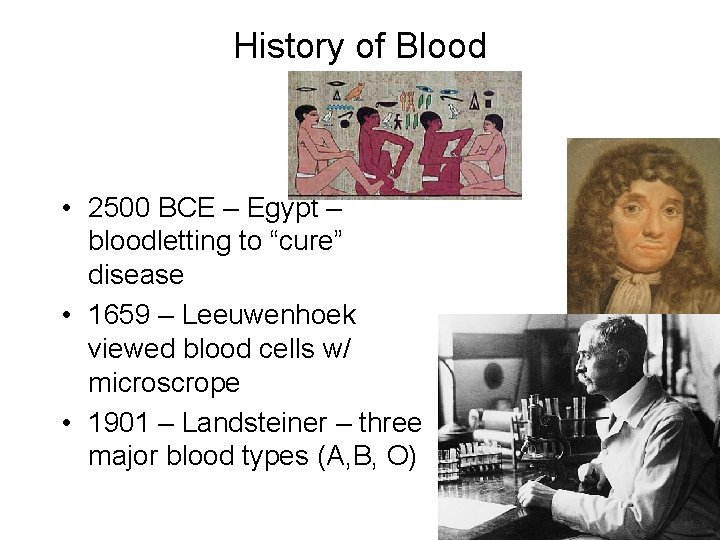
History of Blood • 2500 BCE – Egypt – bloodletting to “cure” disease • 1659 – Leeuwenhoek viewed blood cells w/ microscrope • 1901 – Landsteiner – three major blood types (A, B, O) 3
What is bloodstain pattern analysis? • The bloodstain patterns left by falling, projected or smeared blood can be analysed by trained crime scene investigators. • Careful observation and measurement of the position and shape of bloodstains can give lots of information about the direction of travel, angle of impact and the speed or velocity of the blood droplets.
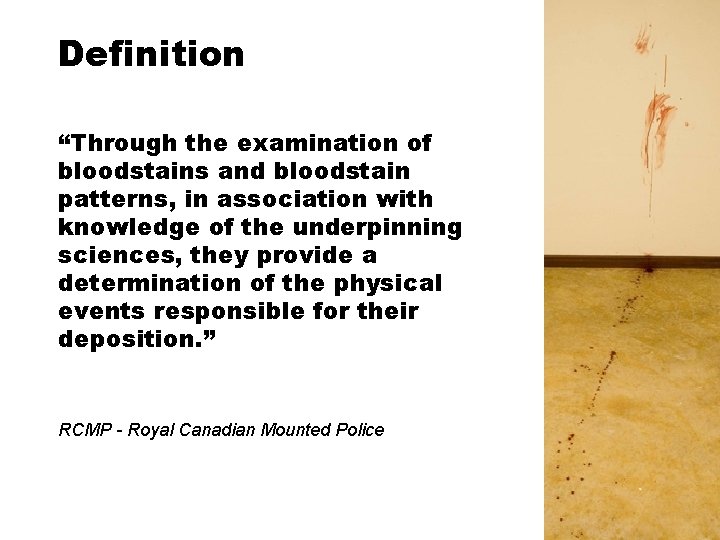
Definition “Through the examination of bloodstains and bloodstain patterns, in association with knowledge of the underpinning sciences, they provide a determination of the physical events responsible for their deposition. ” RCMP - Royal Canadian Mounted Police

Why is it important in forensics? • Bloodstain patterns can be used to prove or refute a suspect’s account of what happened. • The information from the bloodstain patterns can possibly be used to reconstruct a crime. • Bloodstain pattern analysis can tell us the “how” of a crime.
• • • Type of instrument used Direction of impact Position of people involved Movements during attack Number of blows
Blood • Blood is a fluid that makes up approximately 8% of the weight of a human body. • Females have approximately 4 -5 litres while males have between 5 -6 litres. • Blood is made up of cells (red blood cells and white blood cells) plus platelets in a yellowish liquid called plasma. • Plasma contains gases (oxygen, carbon dioxide) and molecules such as proteins, fats and carbohydrates (sugars).
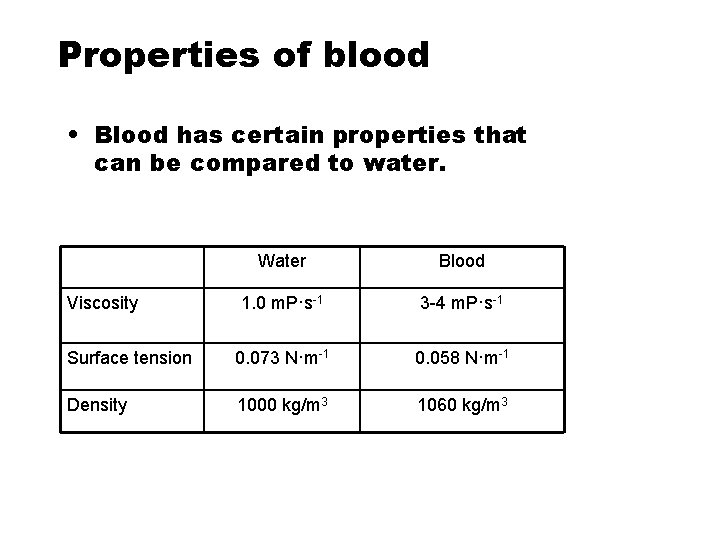
Properties of blood • Blood has certain properties that can be compared to water. Water Blood 1. 0 m. P·s-1 3 -4 m. P·s-1 Surface tension 0. 073 N·m-1 0. 058 N·m-1 Density 1000 kg/m 3 1060 kg/m 3 Viscosity
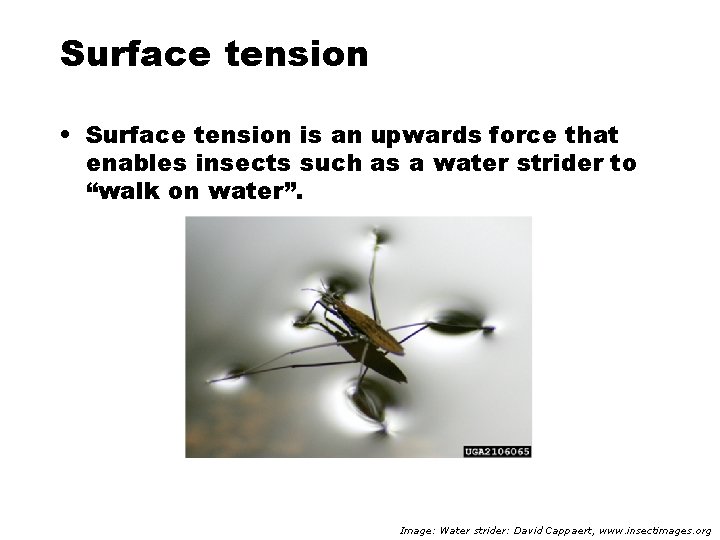
Surface tension • Surface tension is an upwards force that enables insects such as a water strider to “walk on water”. Image: Water strider: David Cappaert, www. insectimages. org
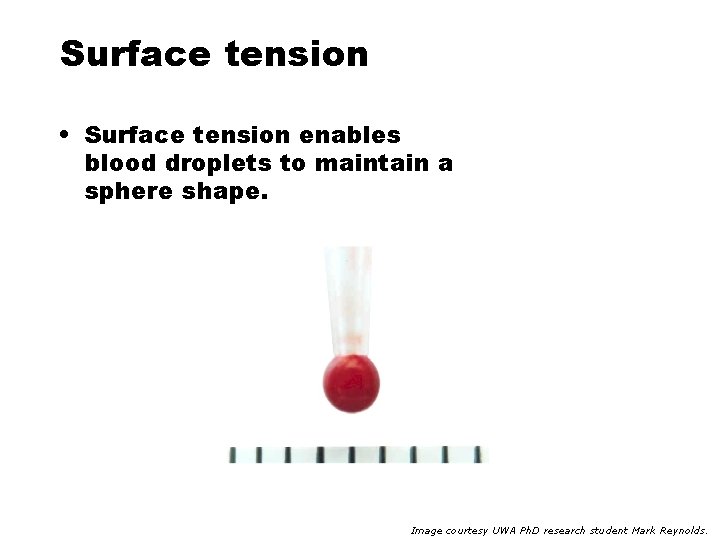
Surface tension • Surface tension enables blood droplets to maintain a sphere shape. Image courtesy UWA Ph. D research student Mark Reynolds.
Traveling blood droplets • When a force is applied to a mass of blood, the blood breaks into droplets. • The droplets fly through the air as “perfect” spheres due to surface tension. Image used with permission from Tom Bevel & Ross Gardner, June 2006.
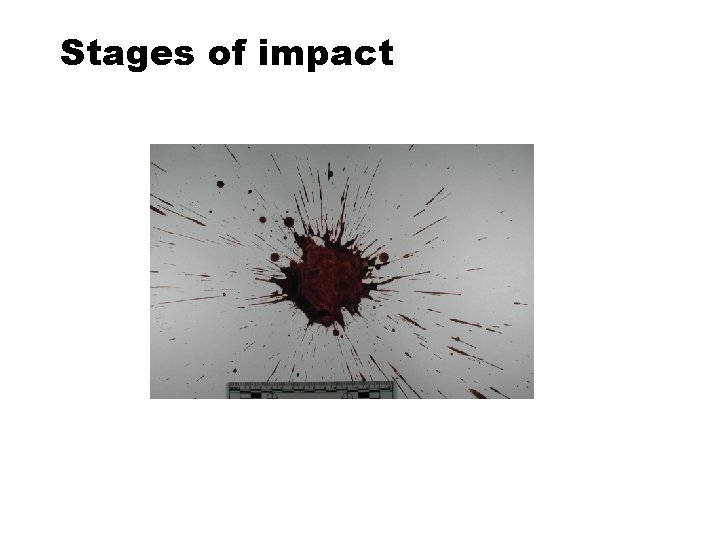
Stages of impact
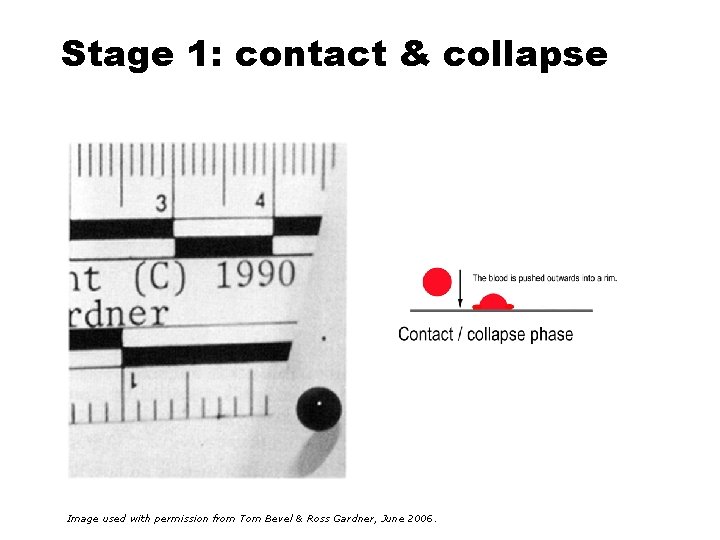
Stage 1: contact & collapse Image used with permission from Tom Bevel & Ross Gardner, June 2006.
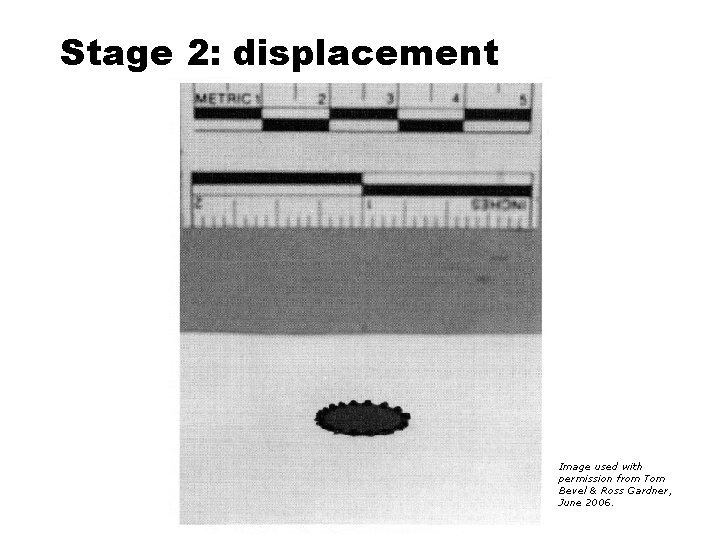
Stage 2: displacement Image used with permission from Tom Bevel & Ross Gardner, June 2006.
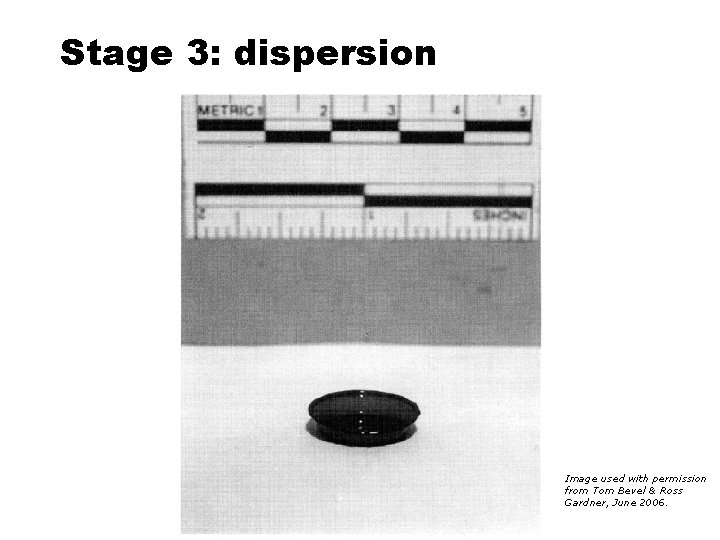
Stage 3: dispersion Image used with permission from Tom Bevel & Ross Gardner, June 2006.
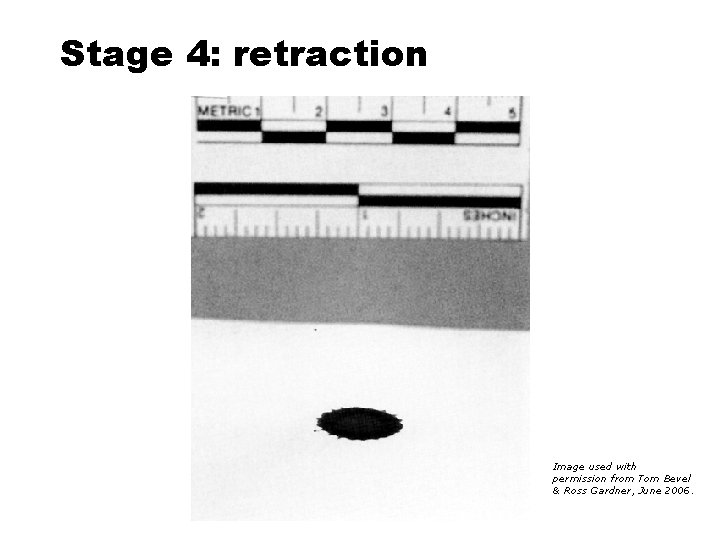
Stage 4: retraction Image used with permission from Tom Bevel & Ross Gardner, June 2006.
Height and size of blood drops • A blood droplet released from a 1 m height will be smaller than a blood droplet released from a 1. 5 m height. • This is because the velocity of the blood droplet released from a higher height is greater.
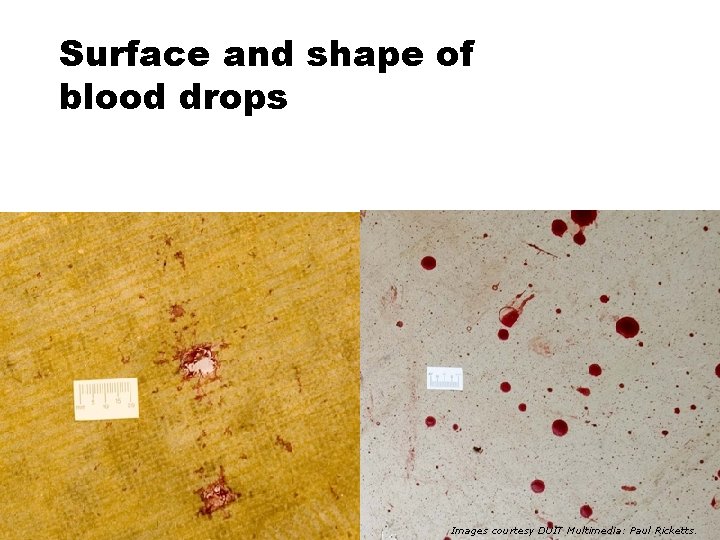
Surface and shape of blood drops Images courtesy DUIT Multimedia: Paul Ricketts.
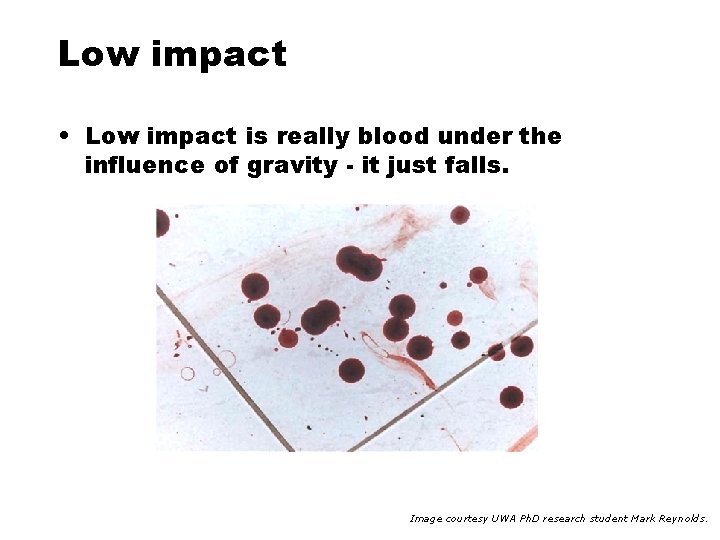
Low impact • Low impact is really blood under the influence of gravity - it just falls. Image courtesy UWA Ph. D research student Mark Reynolds.
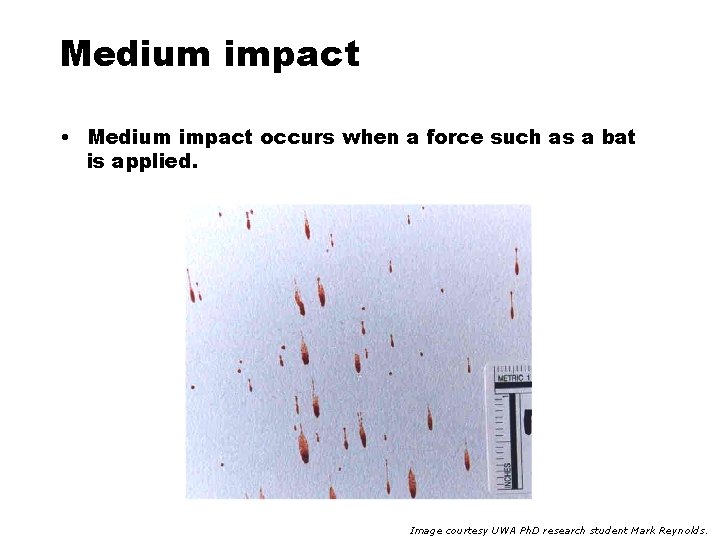
Medium impact • Medium impact occurs when a force such as a bat is applied. Image courtesy UWA Ph. D research student Mark Reynolds.
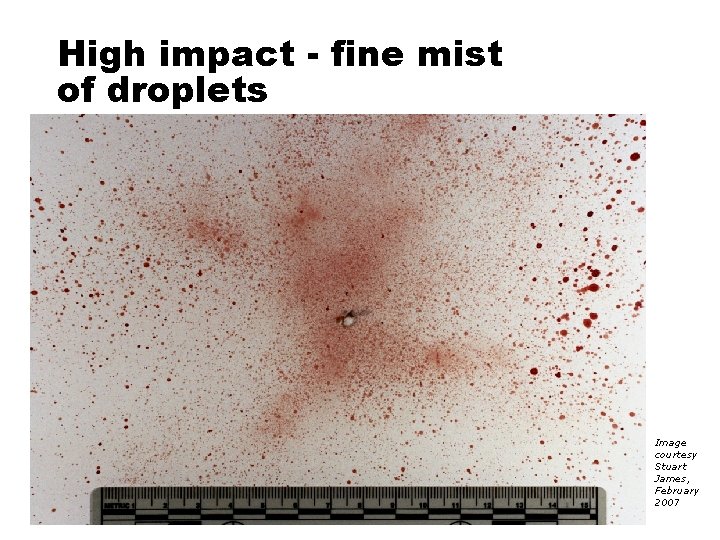
High impact - fine mist of droplets Image courtesy Stuart James, February 2007
Angle of Impact • Right angle produces an even circle • If blood strikes from a smaller angle it will create an elongated oval pattern with a narrow tail which is pointed. The point shows direction of drop • Smaller the angle the longer the oval
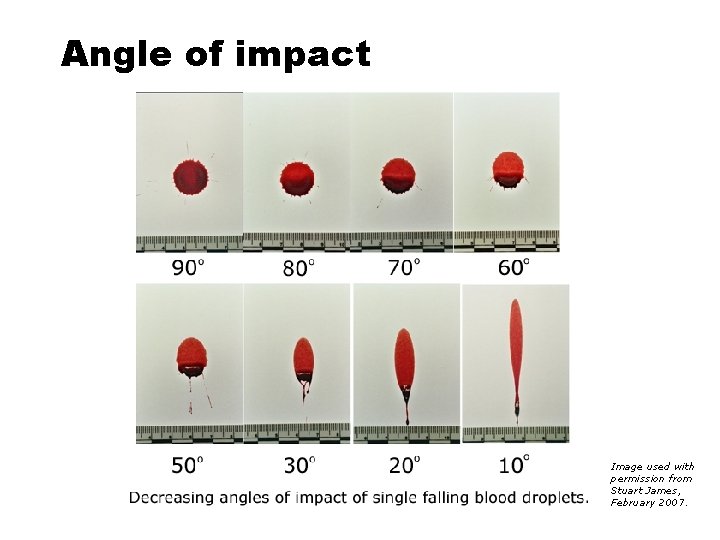
Angle of impact Image used with permission from Stuart James, February 2007.
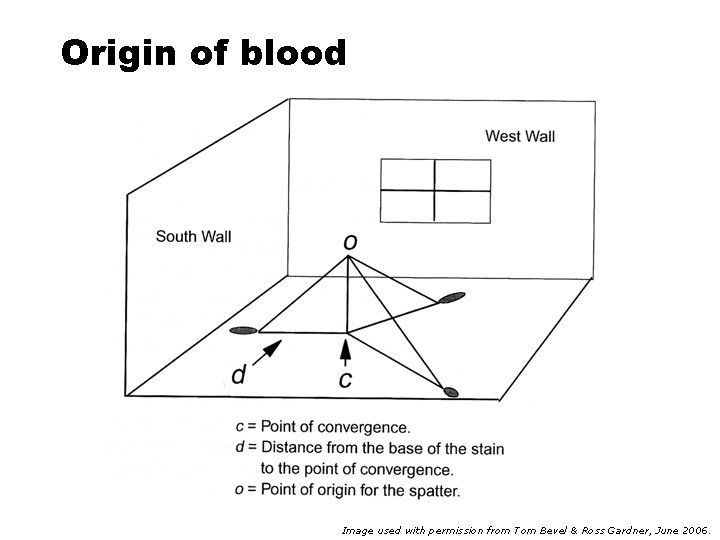
Origin of blood Image used with permission from Tom Bevel & Ross Gardner, June 2006.
- Slides: 25