
Forensic Entomology The Role of Insects in Medicolegal

- Slides: 70
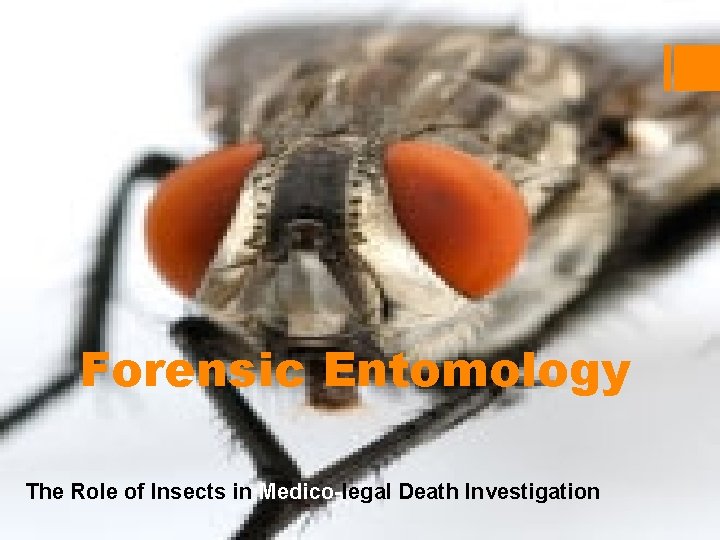
Forensic Entomology The Role of Insects in Medico-legal Death Investigation
Forensic Entomology
Forensic Entomology § Forensic Entomology is the use of insect knowledge in the investigation of crimes. § Forensic Entomology is not only a useful tool to decide how long human remains have been undetected, but forensic entomology can also be used to find out whether the corpse has been moved after death, the cause of death and also solves cases of contraband trafficking (Catts, 1995).
Forensic entomology can be divided into three categories §Urban §Store-product §Medicolegal
§Urban forensic entomology deals with insects that affect man and his immediate environment §May deal with pest infestations where there might be litigation, for example, landlord and tenants.
§Stored-product forensic entomology concentrates on commonly found insects in contaminated foods. §Legal issues on insect infesting stored products
§Medicolegal, which we primarily focus on, deals with the criminal component of the legal system and with insects that typically infest human remains or corpses. §Use of insect development and insect colonization to solve crime(s)
Medico-legal Entomology § Helps determine postmortem interval § Movement of body? ? ? § Determine scene of death § Proves or disproves suspect, witness or corroborating statements regarding death
§ http: //www. smithsonianchannel. com/site/sn/show. do? episode =141561 - measuring-time-with-maggots
Some History § 1200 s – Sung Tz’u, a Chinese “death investigator” uses the behavior of flies to solve a murder. Everyone in the small town where the murder took place is gathered together with their sickles (blades used for cutting grass). Though no obvious blood stains appear on the tools, Tz’u releases flies into the area which, drawn to the scent of blood, buzz around the murder weapon. The guilty person confesses.
1668 - Francesco Redi disproves theory of spontaneous generation of maggots in rotten meat. The prevailing thought of the day was that maggots appear from nowhere in the spoiled food, as if by magic. His experiment showed that the life cycle of the maggot is associated with the rate of decay, allowing scientists to better estimate a deceased person’s time of death.
1750 s – 1780 s – Carolus Linnaeus published a standardized system of biological classification. Scientists use this system to determine the location of a murder, as fly species live in certain habitats.
1855 – Dr. Berger d’Arbois, France’s premier coroner of the day, proves the innocence of residents of a home in which a body is found. By studying fly larvae and mites in the body he determines that they were laid before the body was sealed inside the home of the accused well before the current residents moved in.
1894 – Dr. Jean-Pere Megnin publishes. The Fauna of Corpses, describing eight stages of bodily decomposition. Included in these are the types of insects each stage attracts. This further aids scientists in determining a victims time of death and if the body has been moved.
1935 – Dr. Alexander Mearns of Glasgow University uses the development of maggot larvae in a body to determine the victim’s time of death. This, in conjunction with witness testimony and other evidence, allows a suspect to be convicted in court.
1986 – The first textbook devoted to forensic entomology, A Manual of Forensic Entomology, is published. This makes information on this branch of forensics readily available, allowing standardized training for aspiring scientists.
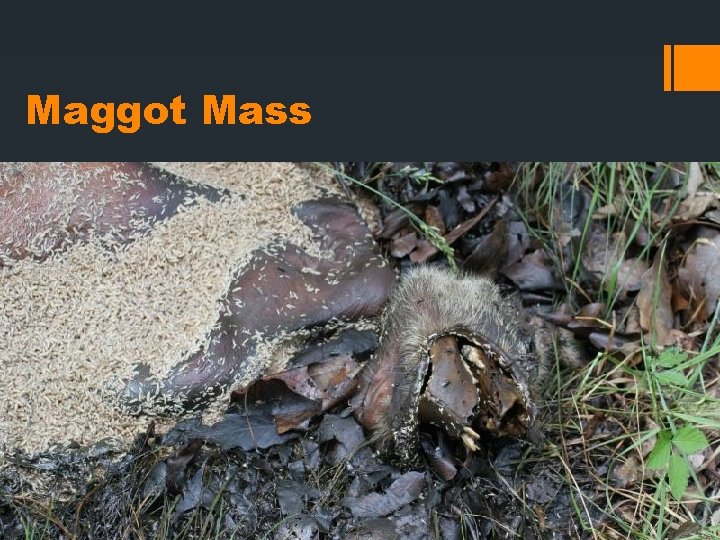
Maggot Mass
Medicolegal Entomology §Typically focuses on violent crimes §Determination of time of death §Determination of crime scene
A Forensic Entomologist: §Identifies the immature insects §Determines the size and development of the insects §Calculates the growth of the insects and the stages of the life cycle §Compares the growth against weather conditions to estimate time of ovipositions (egg laying)
Corpse as Insect Food Source § Bodily decomposition attracts flies § Flies and related insects have highly sensitive olfactory receptor sites on top of head. § Attracted to protein-rich environment which corpse provides § Insect activity on the corpse within minutes of death § Deposits eggs in natural or unnatural openings, a. k. a. , orifices or exposed wounds – eyes, ears, anus, etc. § Deposits eggs in orifices during daylight
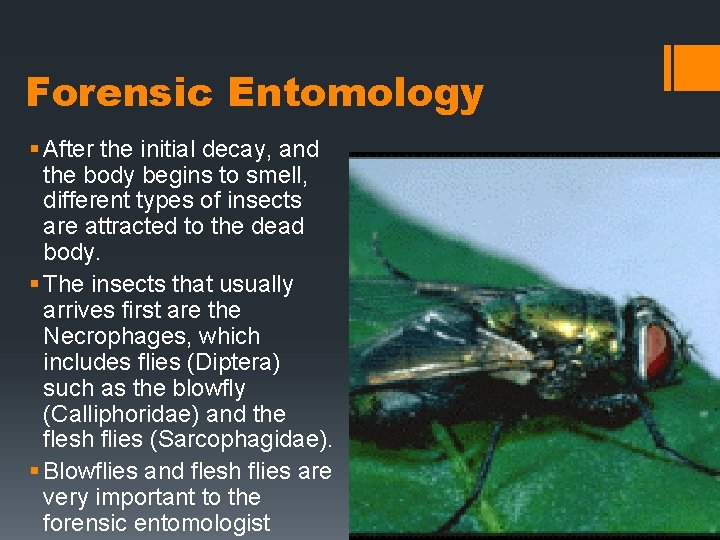
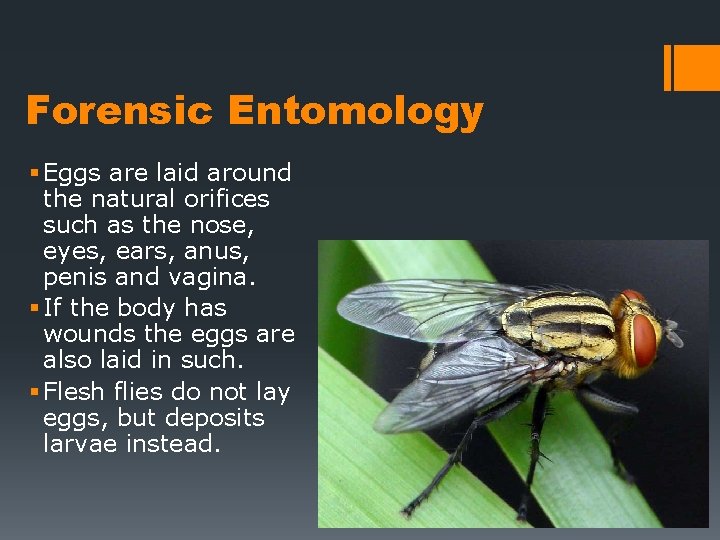
Forensic Entomology § After the initial decay, and the body begins to smell, different types of insects are attracted to the dead body. § The insects that usually arrives first are the Necrophages, which includes flies (Diptera) such as the blowfly (Calliphoridae) and the flesh flies (Sarcophagidae). § Blowflies and flesh flies are very important to the forensic entomologist
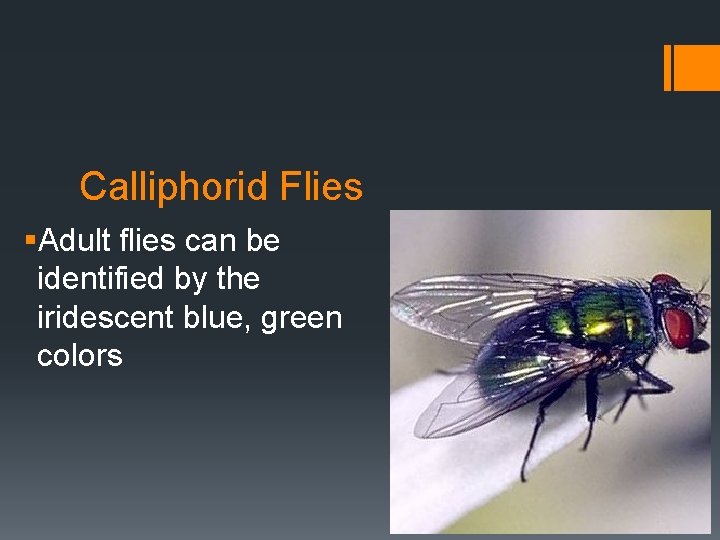
Calliphorid Flies §Adult flies can be identified by the iridescent blue, green colors
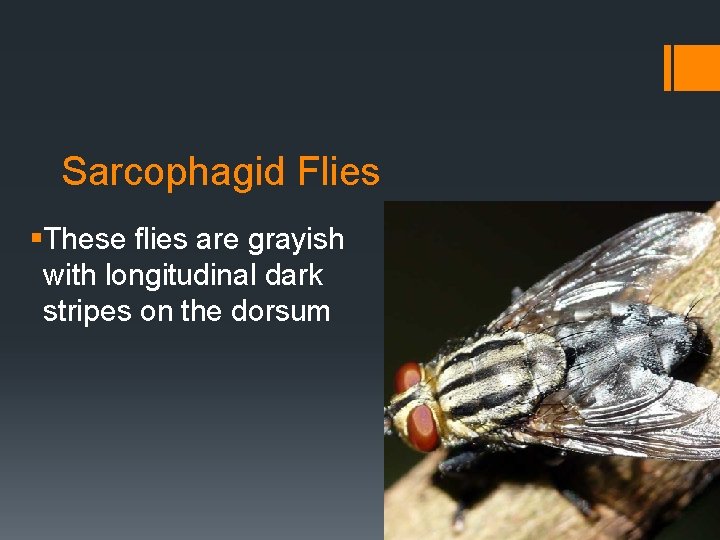
Sarcophagid Flies §These flies are grayish with longitudinal dark stripes on the dorsum
Omnivores § Omnivores, which include wasps, beetles and ants feed on the corpse along with the maggots left by the flies. § Omnivores may slow the rate of decomposition by decreasing the population of necrophages Parasites and Predators § Parasites and Predators – beetles and wasps eat immature flies § Others – spiders, mites, pill bugs and others use the corpse as a source of habitat
Forensic Entomology § Eggs are laid around the natural orifices such as the nose, eyes, ears, anus, penis and vagina. § If the body has wounds the eggs are also laid in such. § Flesh flies do not lay eggs, but deposits larvae instead.
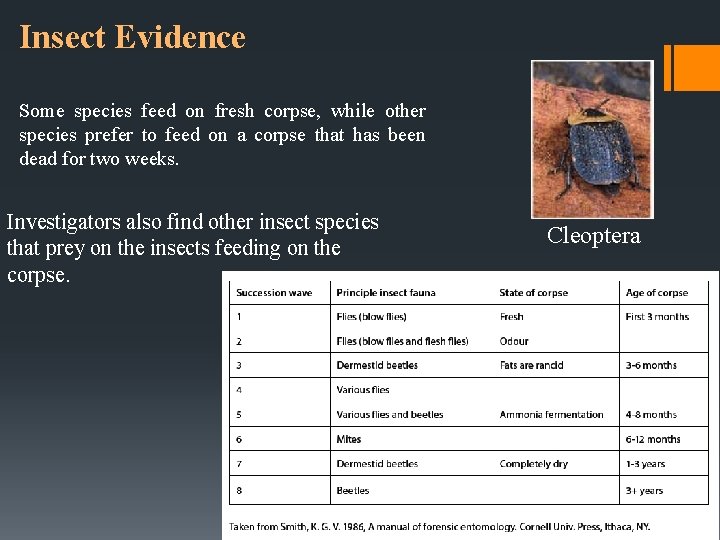
Insect Evidence Some species feed on fresh corpse, while other species prefer to feed on a corpse that has been dead for two weeks. Investigators also find other insect species that prey on the insects feeding on the corpse. Cleoptera
Forensic Entomology §The usual sites of oviposition on dead humans are natural openings. § Blowflies will most often lay their eggs in the facial region, and more seldom in the genitoanal region. § If there is a sexual assault prior to death, leading to bleeding in the genitoanal region, blowflies will be more likely to oviposit in these regions. § If there’s blowfly activity in the genitoanal region, a sexual crime is suggested.
Forensic Entomology § The sites of blowfly infestation on the corpse may be important in determining the cause of death § For example: if there has been trauma or mutilation of the body prior to death, this may lead to heavy infestation of other body parts than the usual sites when the victim is not mutilated. § Under a knife attack, it is usual to guard oneself with arms in front of thorax and head. This may lead to injury on the lower part of the arm. After death, blowfly may oviposit in these wounds.
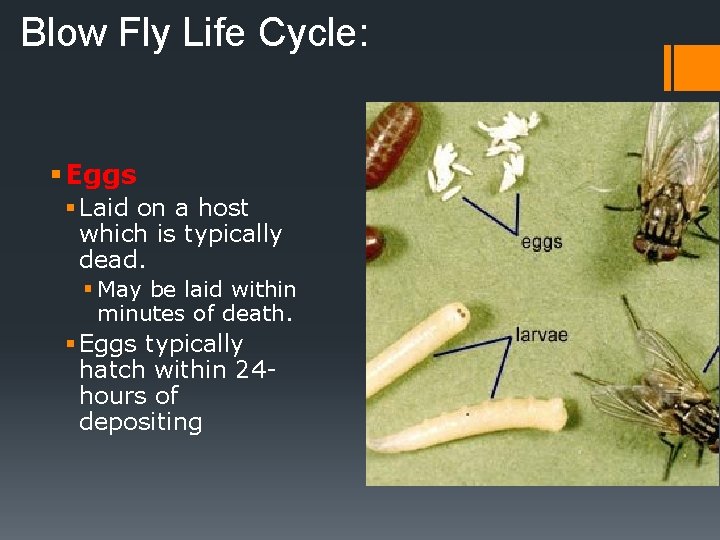
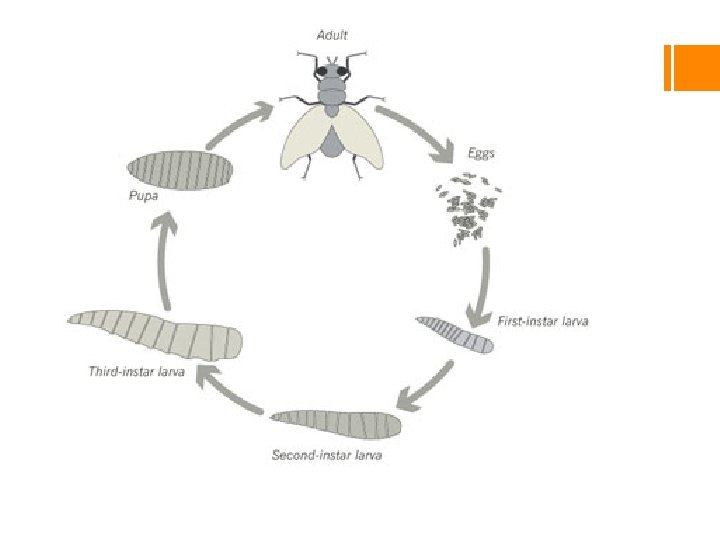
Blow Fly Life Cycle: § Eggs § Laid on a host which is typically dead. § May be laid within minutes of death. § Eggs typically hatch within 24 hours of depositing
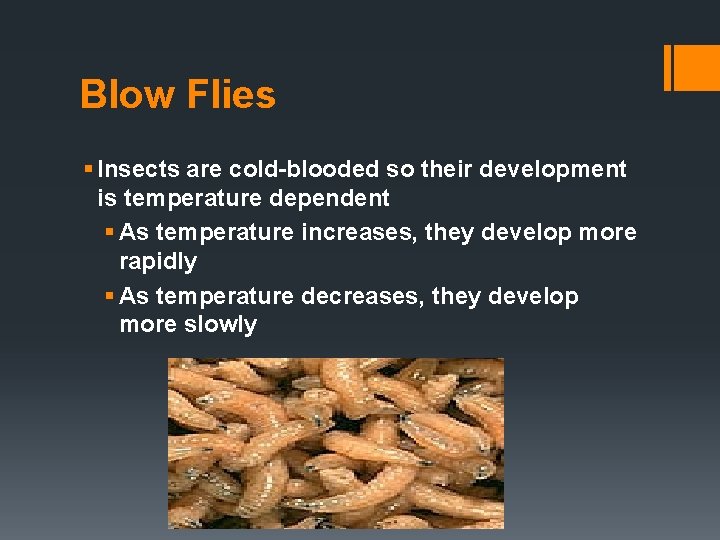
Blow Flies § Insects are cold-blooded so their development is temperature dependent § As temperature increases, they develop more rapidly § As temperature decreases, they develop more slowly
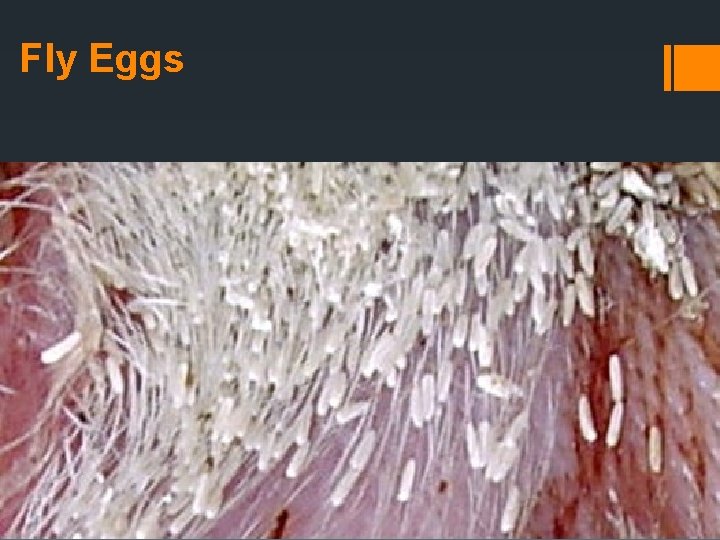
Fly Eggs
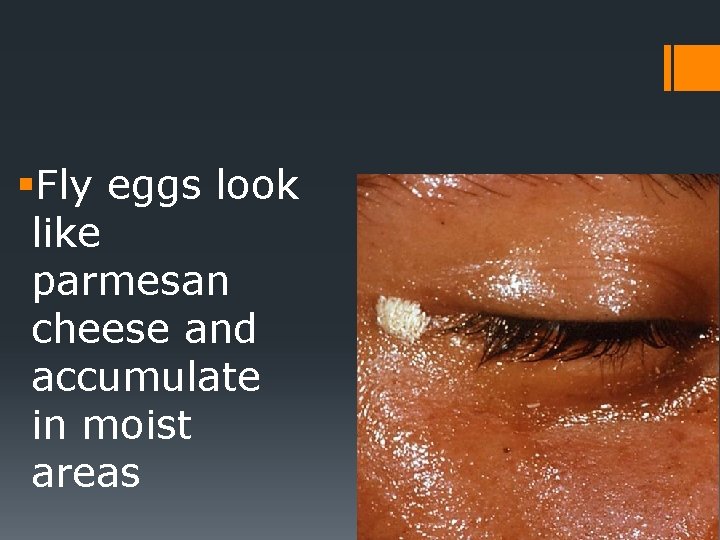
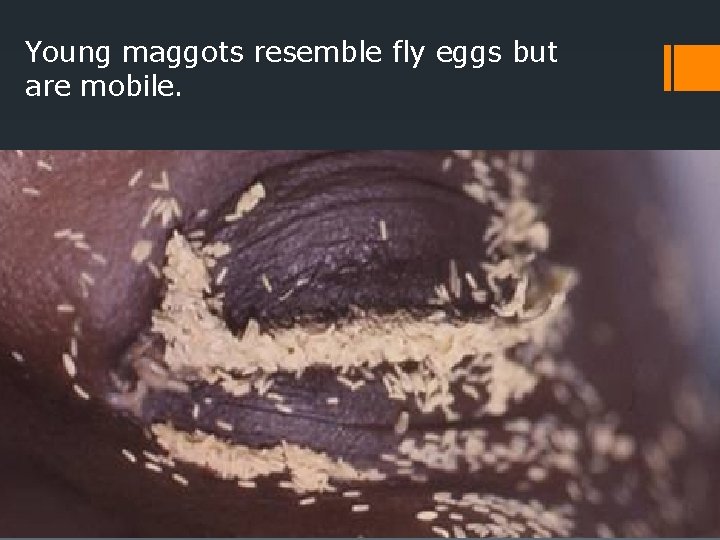
§Fly eggs look like parmesan cheese and accumulate in moist areas
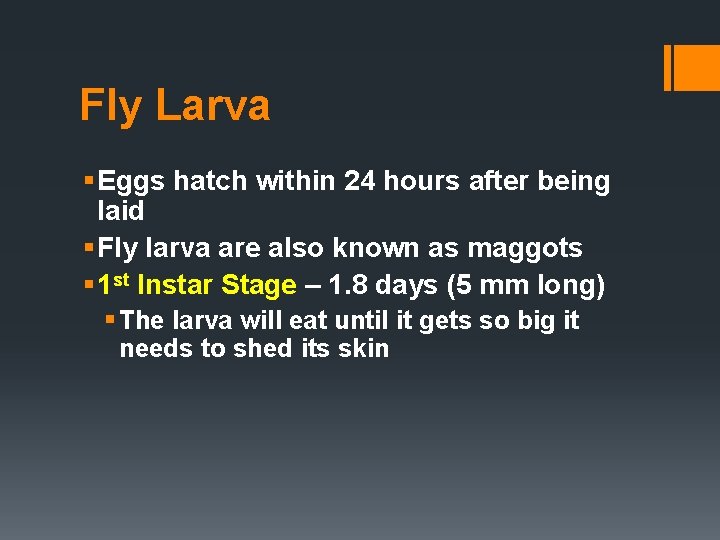
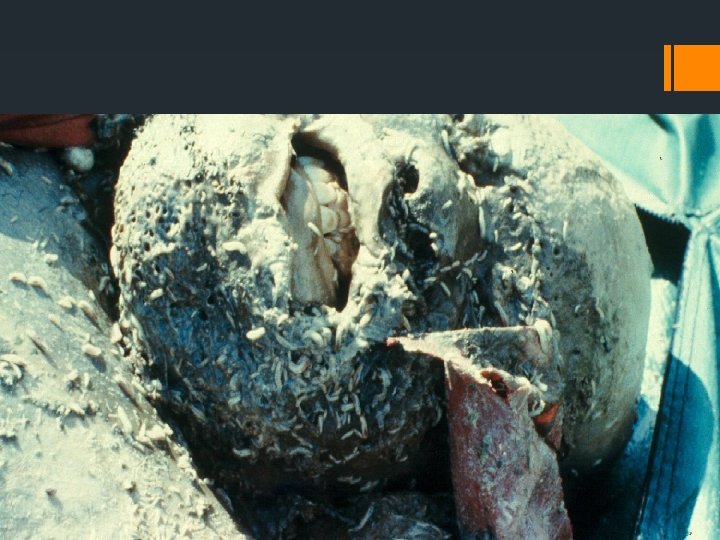
Fly Larva § Eggs hatch within 24 hours after being laid § Fly larva are also known as maggots § 1 st Instar Stage – 1. 8 days (5 mm long) § The larva will eat until it gets so big it needs to shed its skin
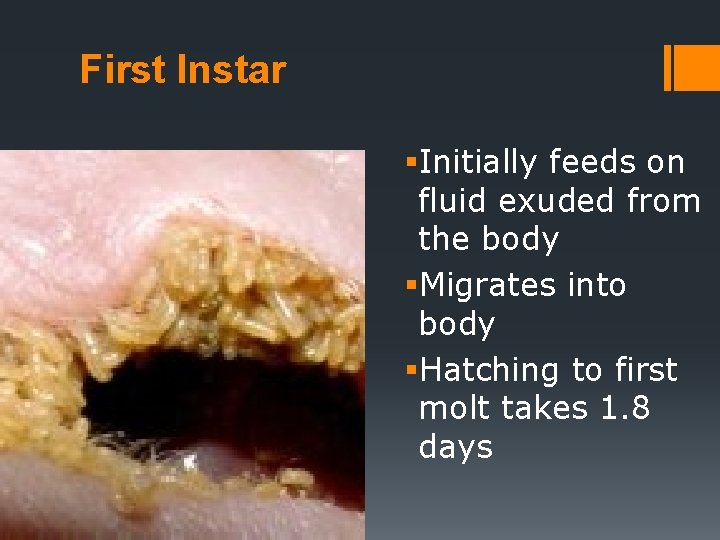
First Instar §Initially feeds on fluid exuded from the body §Migrates into body §Hatching to first molt takes 1. 8 days
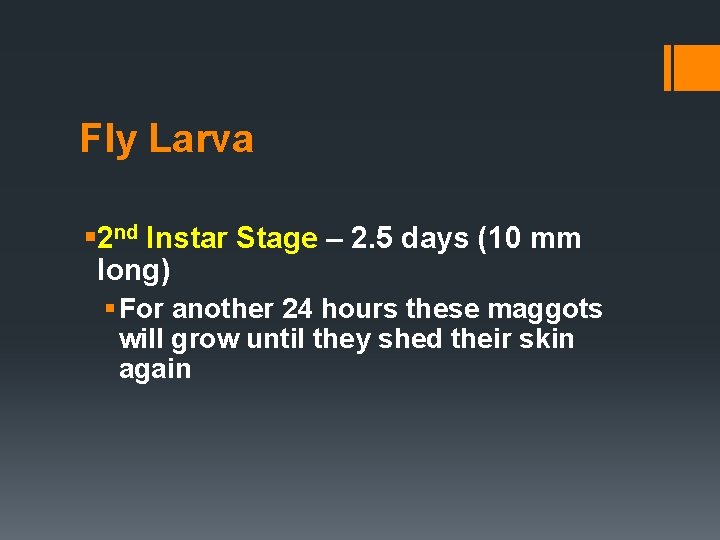
Fly Larva § 2 nd Instar Stage – 2. 5 days (10 mm long) § For another 24 hours these maggots will grow until they shed their skin again
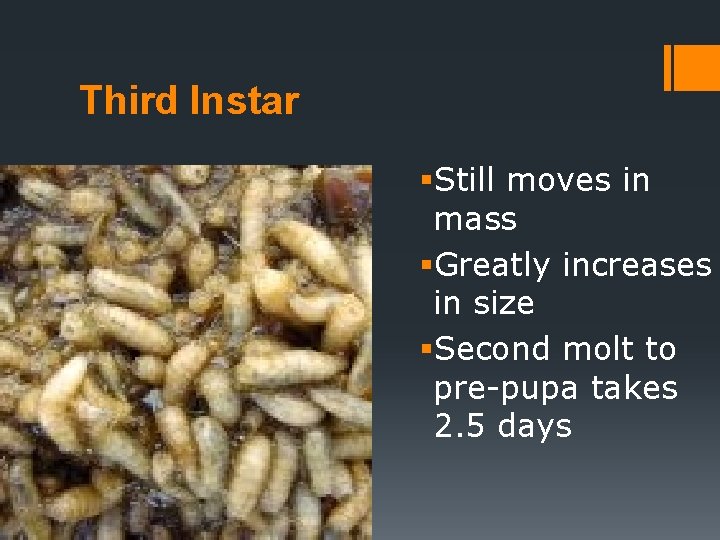
Third Instar §Still moves in mass §Greatly increases in size §Second molt to pre-pupa takes 2. 5 days
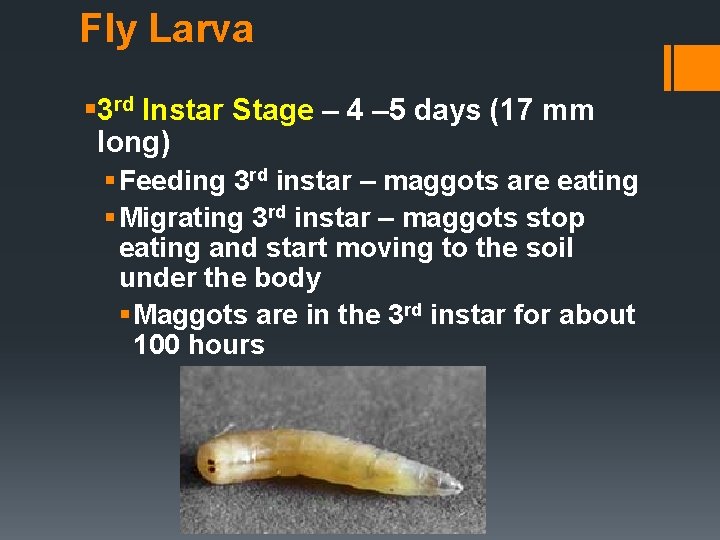
Fly Larva § 3 rd Instar Stage – 4 – 5 days (17 mm long) § Feeding 3 rd instar – maggots are eating § Migrating 3 rd instar – maggots stop eating and start moving to the soil under the body § Maggots are in the 3 rd instar for about 100 hours
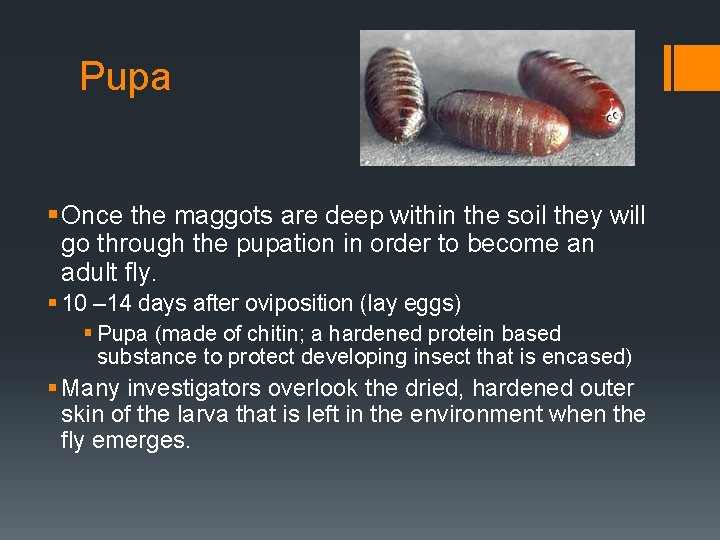
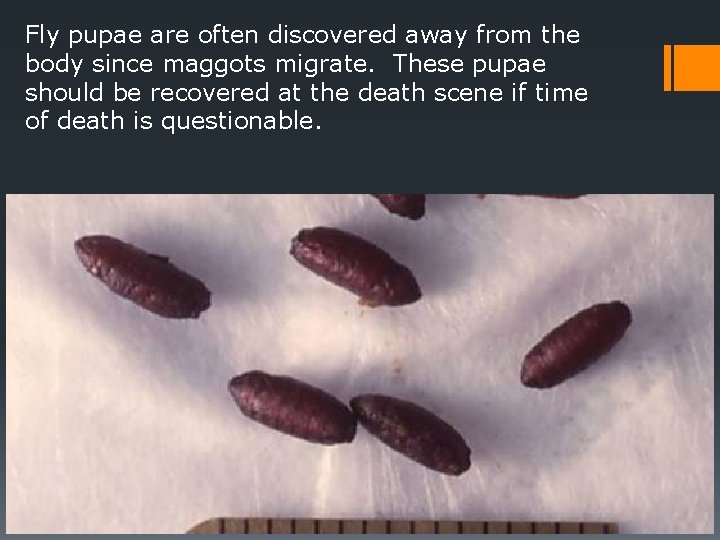
Pupa § Once the maggots are deep within the soil they will go through the pupation in order to become an adult fly. § 10 – 14 days after oviposition (lay eggs) § Pupa (made of chitin; a hardened protein based substance to protect developing insect that is encased) § Many investigators overlook the dried, hardened outer skin of the larva that is left in the environment when the fly emerges.
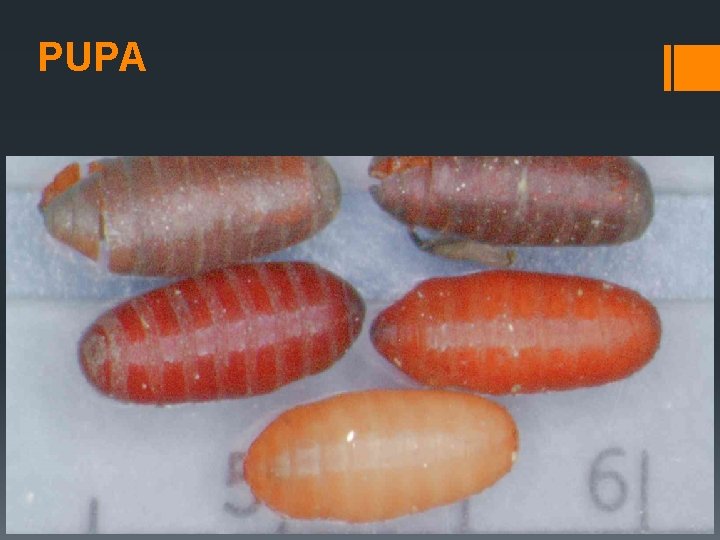
PUPA
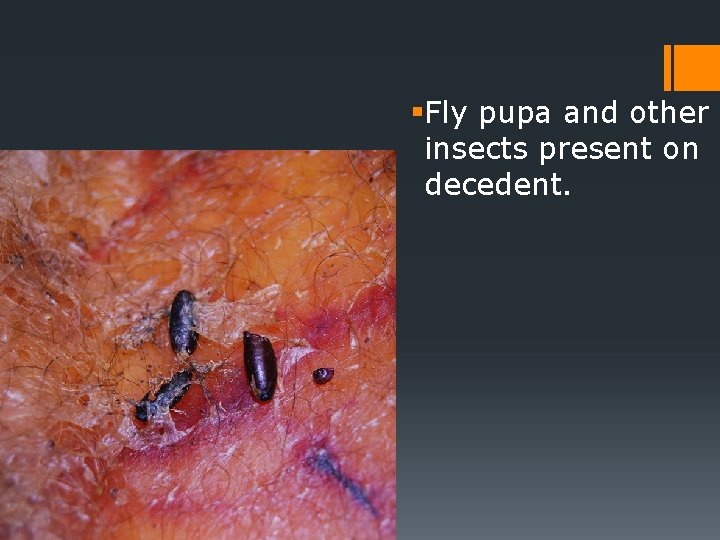
Fly pupae are often discovered away from the body since maggots migrate. These pupae should be recovered at the death scene if time of death is questionable.
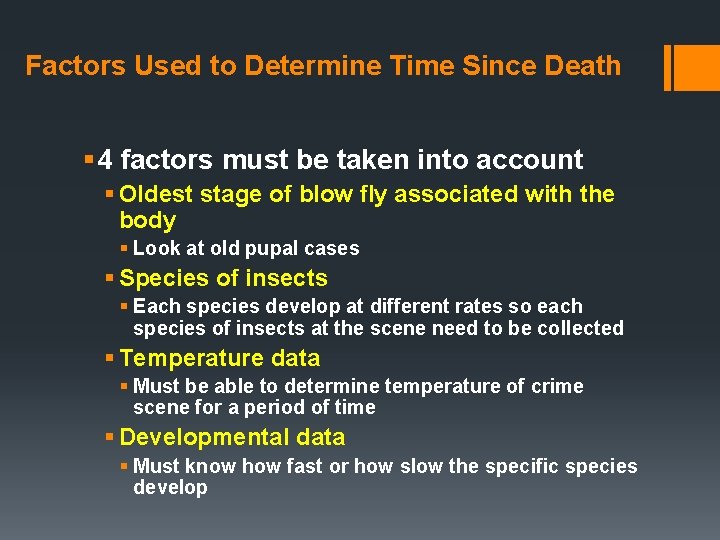
Blow Flies § Analysis of the oldest insect stage on the body, together with knowledge of the meteorological conditions at the scene, can be used to determine how long insects have been feeding on the body, and hence, how long the victim has been dead
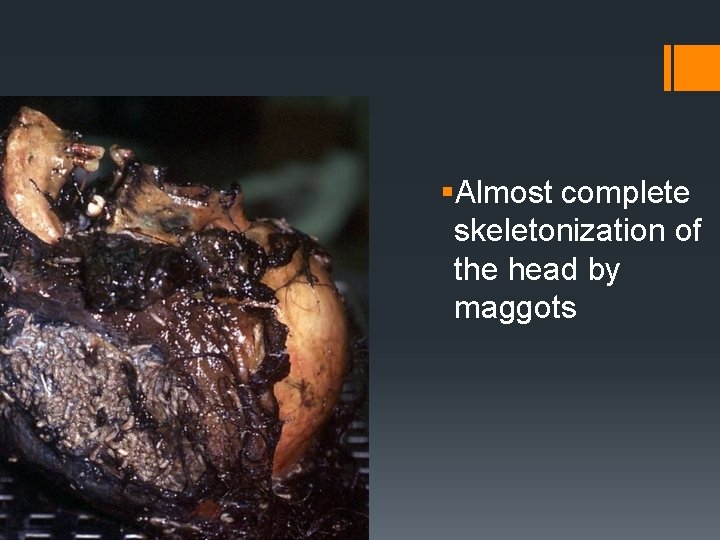
§Almost complete skeletonization of the head by maggots
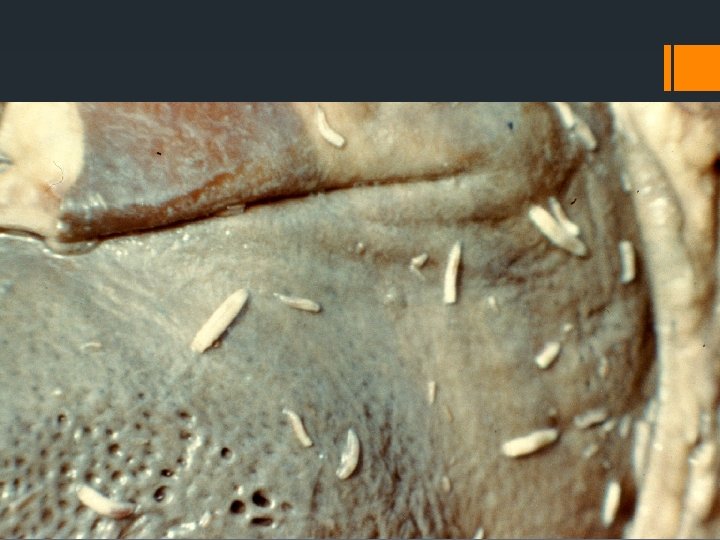
Young maggots resemble fly eggs but are mobile.
§Fly pupa and other insects present on decedent.
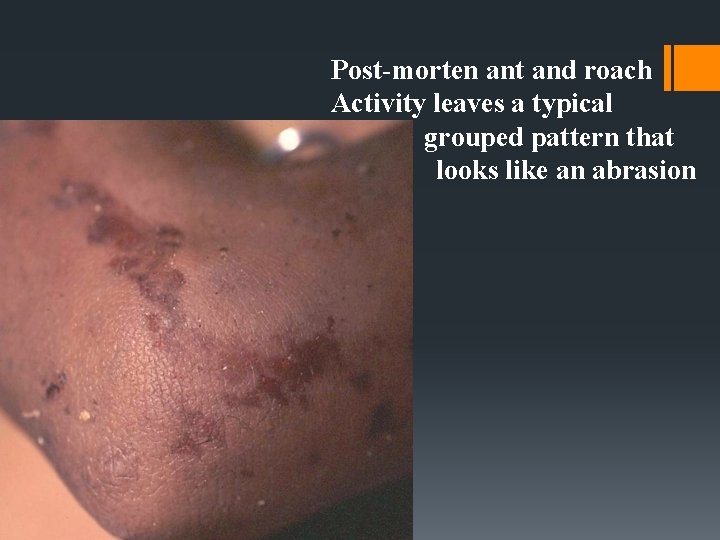
Post-morten ant and roach Activity leaves a typical grouped pattern that looks like an abrasion
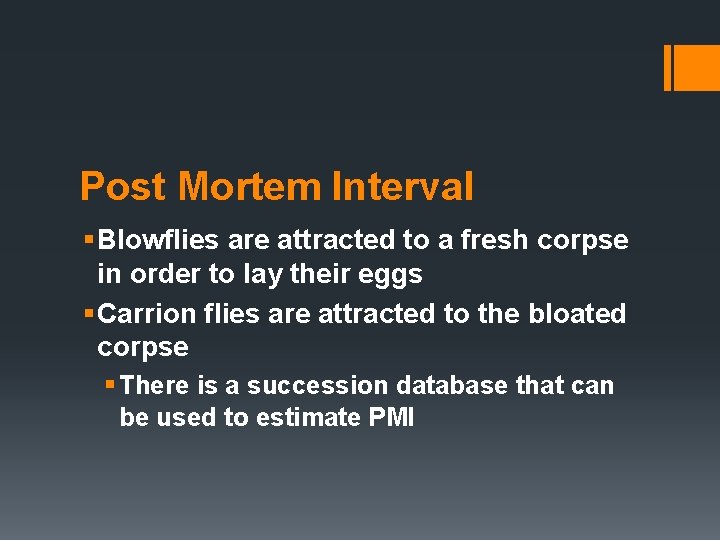
Post Mortem Interval § PMI – time interval from actual death to discovery of the body. § Cadavers decompose in four stages: § Fresh § Bloated § Decay § Dry § Certain insects are attracted to the corpse in each of the four stages of decomposition. § Succession = the order in which insects are attracted to the decomposing body § Succession pattern is useful to determine PMI
Post Mortem Interval § Blowflies are attracted to a fresh corpse in order to lay their eggs § Carrion flies are attracted to the bloated corpse § There is a succession database that can be used to estimate PMI
Factors Used to Determine Time Since Death § 4 factors must be taken into account § Oldest stage of blow fly associated with the body § Look at old pupal cases § Species of insects § Each species develop at different rates so each species of insects at the scene need to be collected § Temperature data § Must be able to determine temperature of crime scene for a period of time § Developmental data § Must know how fast or how slow the specific species develop
Degree Hours §Degrees since death § The life cycle of the insect is measured by degree-hours because temperature effects the cycle
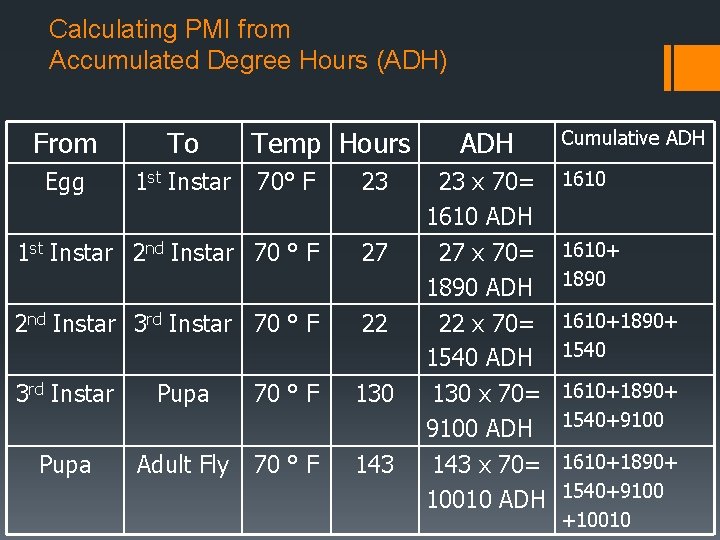
Calculating PMI from Accumulated Degree Hours (ADH) From To Egg 1 st Instar Temp Hours ADH Cumulative ADH 70° F 23 23 x 70= 1610 ADH 1610 1 st Instar 2 nd Instar 70 ° F 27 27 x 70= 1890 ADH 1610+ 1890 2 nd Instar 3 rd Instar 70 ° F 22 22 x 70= 1540 ADH 1610+1890+ 1540 3 rd Instar Pupa 70 ° F 130 x 70= 1610+1890+ 9100 ADH 1540+9100 Pupa Adult Fly 70 ° F 143 x 70= 1610+1890+ 10010 ADH 1540+9100 +10010
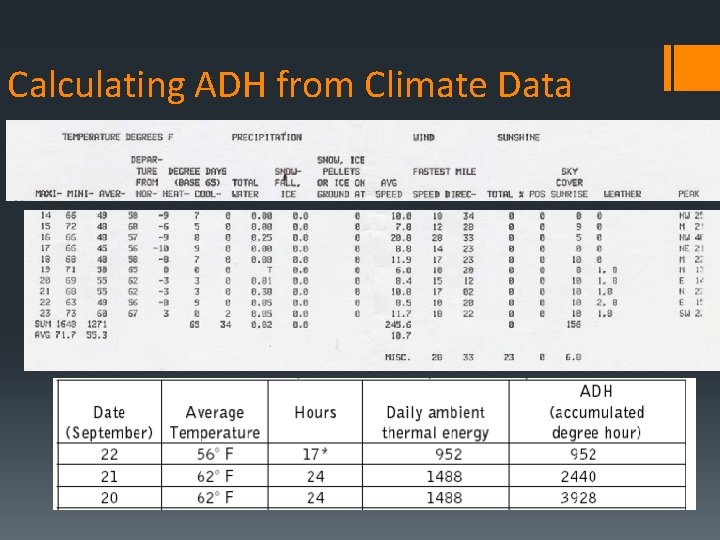
Calculating ADH from Climate Data
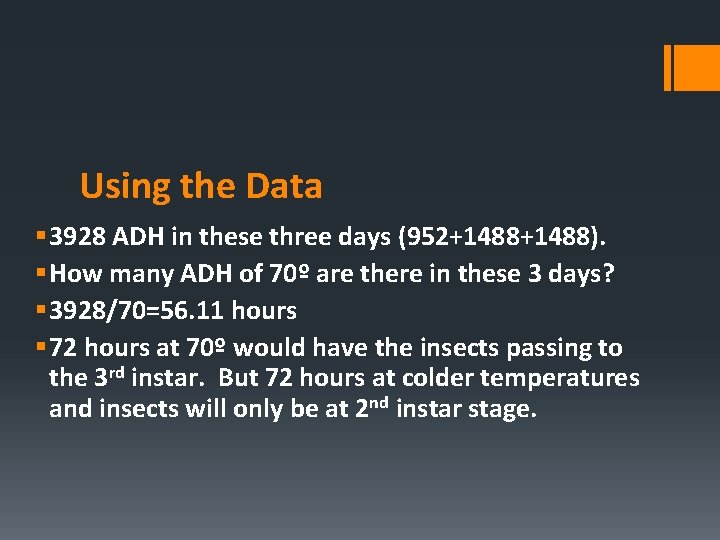
Using the Data § 3928 ADH in these three days (952+1488). § How many ADH of 70º are there in these 3 days? § 3928/70=56. 11 hours § 72 hours at 70º would have the insects passing to the 3 rd instar. But 72 hours at colder temperatures and insects will only be at 2 nd instar stage.
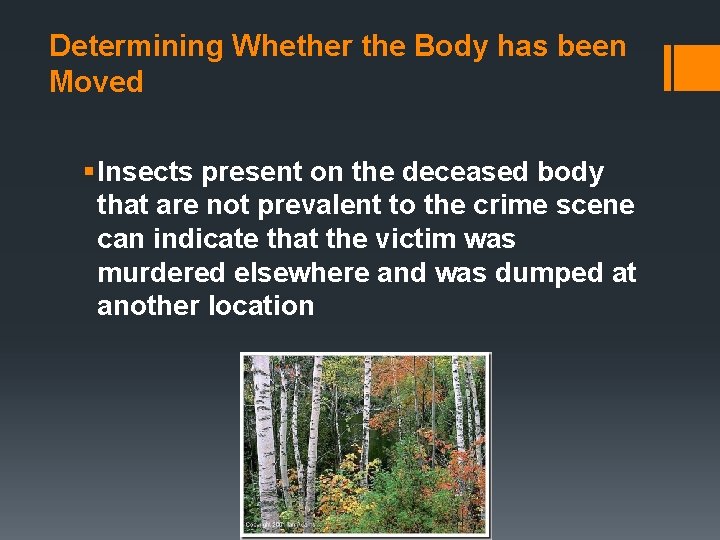
Determining Whether the Body has been Moved § Insects present on the deceased body that are not prevalent to the crime scene can indicate that the victim was murdered elsewhere and was dumped at another location
Linking Suspect to Scene § Sometimes, criminals carry entomological evidence on them unknowingly § This evidence can place them at the crime scene by examining the life cycles of the insects
Drugs §Insects that feed on the body of individuals that have been poisoned can be examined to determine what type of drug or toxin the person was poisoned with § It is important to note that specific drugs either speed up or slow down larval development § Can influence entomologist’s final report
Forensic Entomology § Analysis of larvae can assist in the identification of drugs used by decedent as well as their DNA • Triazolam • Oxazepam • Alimemazine • Chloripriamine • Phenobarbitol • Malathion • Mercury • Amyltryptiline • Nortriptyline • Cocaine • Phenycyclidine • Heroin
Forensic Entomology § Many of these chemicals will also influence the life-cycle of the maggot. § Cocaine accelerates the development of some sarcophagids. § Malathion, an insecticide, is commonly used in suicide, and is usually taken orally. § Amitriptyline, an antidepressant, can prolong the developmental time up to 77 hours, at least in one species of Sarcophagidae.
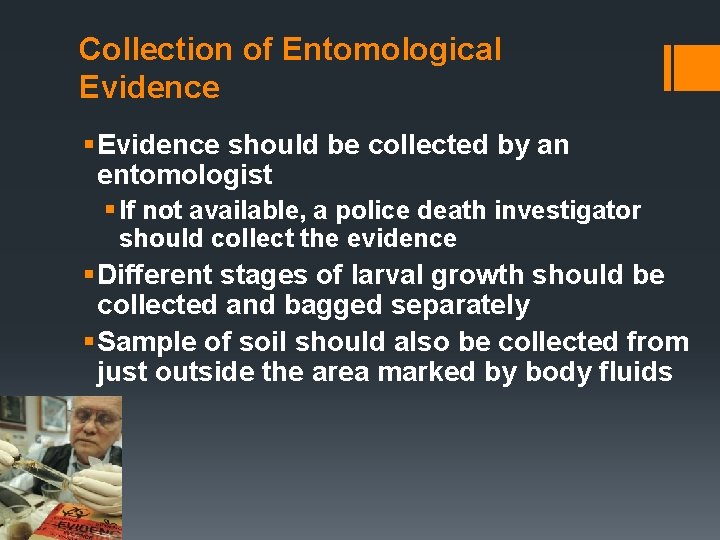
Collection of Entomological Evidence § Evidence should be collected by an entomologist § If not available, a police death investigator should collect the evidence § Different stages of larval growth should be collected and bagged separately § Sample of soil should also be collected from just outside the area marked by body fluids
Challenges to Forensic Entomology § 3 challenges exist § Temperature of crime scene and the temperature that the insects have been exposed to us unknown § Season § Entomology is valuable only in spring, summer, and fall § Exclusion of insects § Insects are excluded based on condition of body
Forensic Entomology §Blow fly pupae were collected from a body found. § The ambient temperature was approximately 75°F and the humidity was 20%. § Larva found on the body were approximately 10 mm long. § Estimate time since death.
Case Study (Decomposition) On a hot August day (90°F), the body of an elderly man was discovered in a ditch next to a country road. He was lying supine dressed in overalls, a short -sleeved work shirt, and socks without shoes. His abdomen and legs were covered by a blanket. There was marked maggot infestation of the head and neck, partially obscuring a posterior scalp defect, and a ligature around his neck.
Case Study (Decomposition) The skin of the upper chest, neck, and head were markedly darkened. The rest of the body was not decomposed. There was a slight greenish tinge to the abdominal area. There was no apparent blood on the ground surrounding the victim.
Case Study (Decomposition) The scalp defect was a four inch gaping laceration with no underlying bone or brain injury. The ligature was a small towel tightly compressing the neck and knotted in the back. There was no rigor mortis and livor mortis was posterior. When the body was turned the livor did not move with gravity.
Case Study (Decomposition) Stomach contents revealed fragments of sausage pieces, brown liquid and white semi-solid food particles. At least ten maggots were saved in a container of alcohol. The largest maggot was 4 mm in length. A diagnosis of ligature strangulation was rendered and the death was ruled a homicide.
Case Study (Decomposition) §When the wife came in to view his body she made a spontaneous statement, “I don’t understand, he looks fatter than normal. ”
Case Study (Decomposition) The next day a deputy sheriff called the pathologist to ask about the time of death. The deputy was holding a man in custody who had been seen with the decedent two days before the body was discovered. The suspect claimed that he was out of town the day before the man was found dead. The suspect had a good motive for the murder because of a soured business deal with the victim.
Case Study (Decomposition) Prior to making a formal arrest, the officer needed to make sure the postmortem interval was consistent with two days. What should the pathologist say about the postmortem interval in this case and why?