
Forensic DNA Typing and Prospects for Biometrics Dr
Forensic DNA Typing and Prospects for Biometrics Dr. John M. Butler NIST Biotechnology Division May 12, 2004
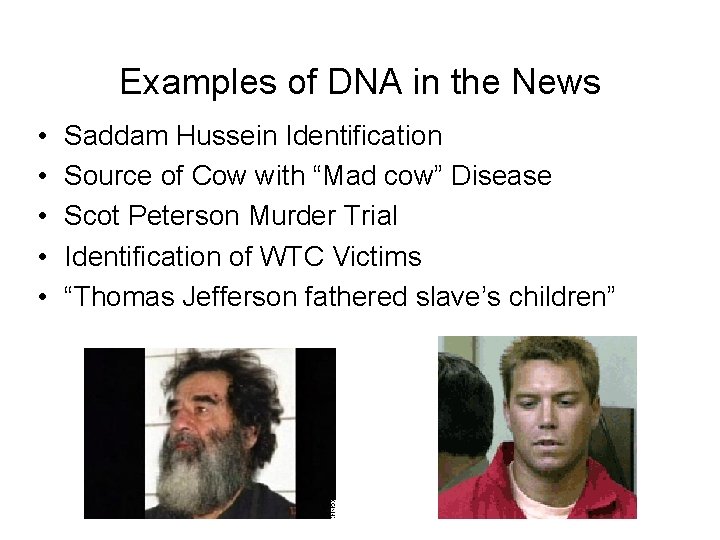
Examples of DNA in the News • • • Saddam Hussein Identification Source of Cow with “Mad cow” Disease Scot Peterson Murder Trial Identification of WTC Victims “Thomas Jefferson fathered slave’s children”
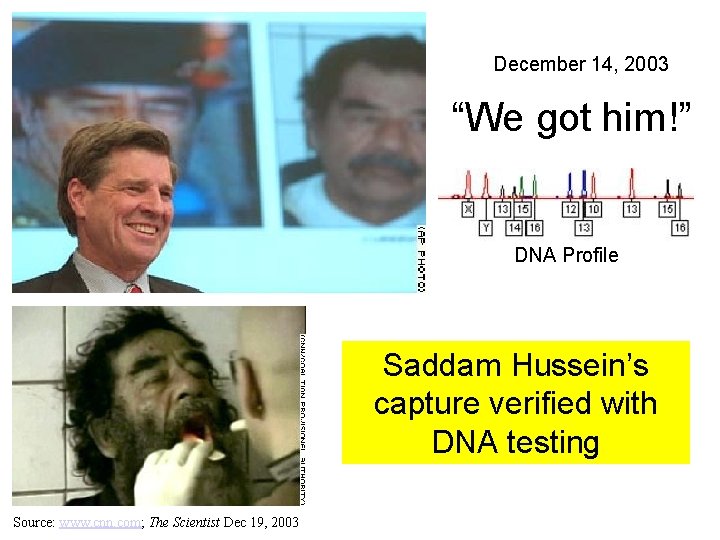
December 14, 2003 “We got him!” DNA Profile Saddam Hussein’s capture verified with DNA testing Source: www. cnn. com; The Scientist Dec 19, 2003
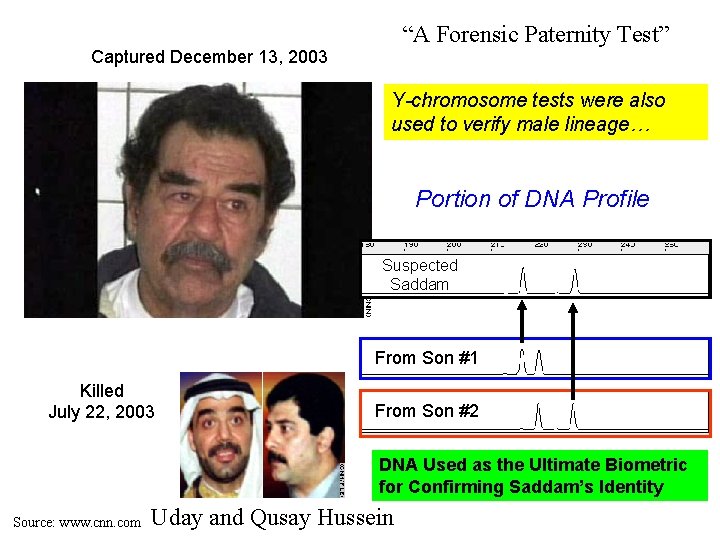
“A Forensic Paternity Test” Captured December 13, 2003 Y-chromosome tests were also used to verify male lineage… Portion of DNA Profile Suspected Saddam From Son #1 Killed July 22, 2003 From Son #2 DNA Used as the Ultimate Biometric for Confirming Saddam’s Identity Source: www. cnn. com Uday and Qusay Hussein

Our DNA Comes from our Parents Father’s Sperm Mother’s Egg Child’s Cell

Genetic Inheritance Pattern of DNA Profiles DAD CHILD MOM

PATERNITY TESTING Family Inheritance of STR Alleles (D 13 S 317) PCR product size (bp) Results of DNA Tests Impact Families 11 14 12 8 14 11 12 8 14 12 Father Me Child #1 Child #2 Child #3 Mother
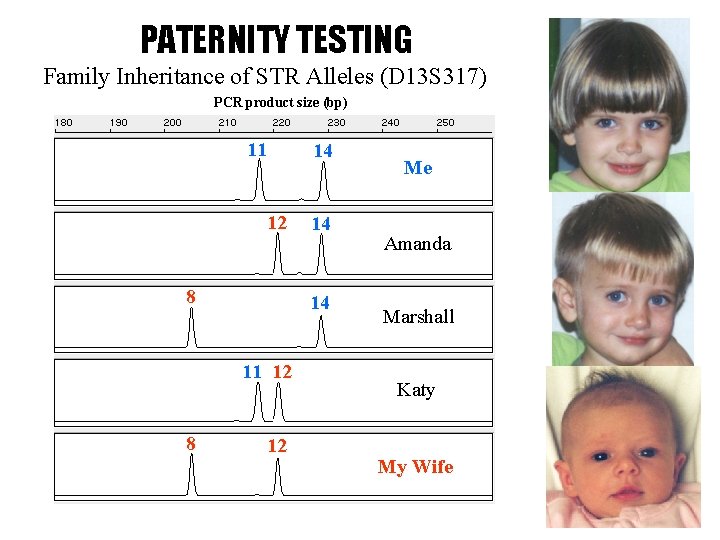
PATERNITY TESTING Family Inheritance of STR Alleles (D 13 S 317) PCR product size (bp) 11 14 12 8 14 11 12 8 14 12 Father Me Amanda Child #1 Child Marshall #2 Child Katy#3 Mother My Wife

Historical Investigation DNA Study (Matching Relatives to Remains or Relatives to Relatives) Failure to Exclude Jefferson as Eston Hemings’ Father Thomas Jefferson II Field Jefferson Peter Jefferson President Thomas Jefferson Thomas Woodson ? Eston Hemings Genetic Genealogy Companies Different Y Haplotype Jefferson Y Haplotype Same Y Haplotype Butler, J. M. (2001) Forensic DNA Typing, Figure 17. 4, ©Academic Press Nature article (Nov 1998)

Methods for Human Identification Fingerprints have been used since 1901 DNA since 1986
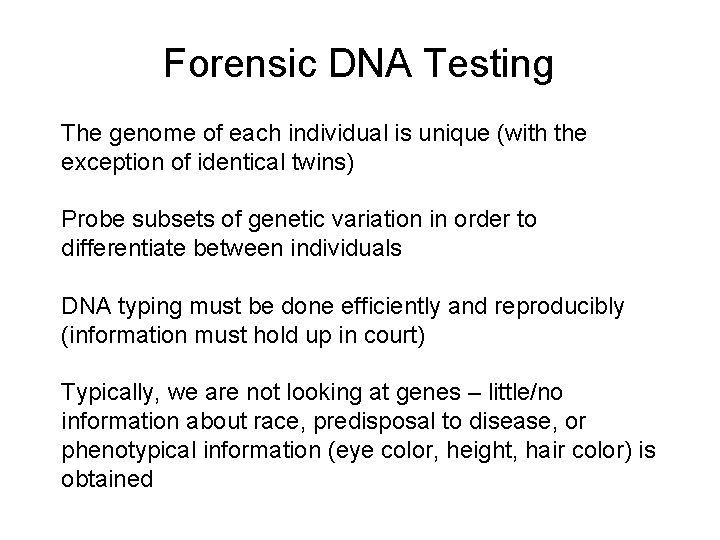
Forensic DNA Testing The genome of each individual is unique (with the exception of identical twins) Probe subsets of genetic variation in order to differentiate between individuals DNA typing must be done efficiently and reproducibly (information must hold up in court) Typically, we are not looking at genes – little/no information about race, predisposal to disease, or phenotypical information (eye color, height, hair color) is obtained
Law Enforcement Judicial Laboratory
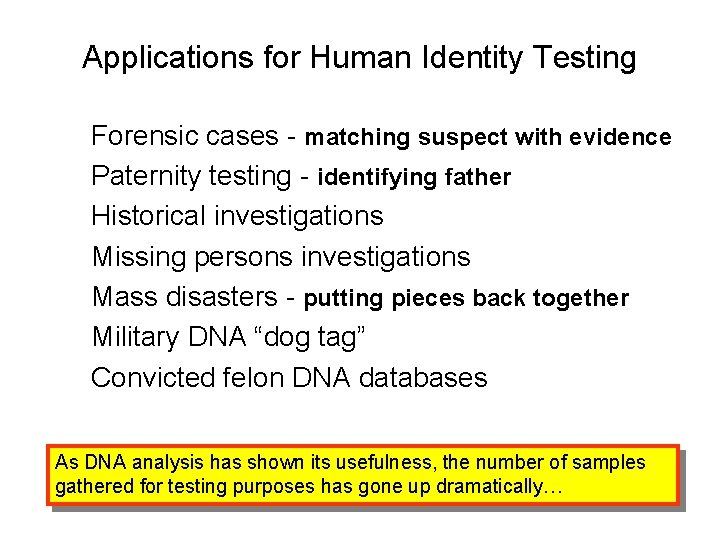
Applications for Human Identity Testing Forensic cases - matching suspect with evidence Paternity testing - identifying father Historical investigations Missing persons investigations Mass disasters - putting pieces back together Military DNA “dog tag” Convicted felon DNA databases As DNA analysis has shown its usefulness, the number of samples gathered for testing purposes has gone up dramatically…

Armed Forces DNA Repository >4. 5 million blood cards on file from members of U. S. military Are being used to identify remains in case of combat casualties in Iraq Located in Gaithersburg, Maryland

Tomb of Unknown Soldier Armed Forces DNA Identification Laboratory (Rockville, MD) Identification of Skeletal Remains from Previous Military Conflicts Identification of Michael J. Blassie - Vietnam Tomb of the Unknown >2100 Unaccounted for from Southeast Asia >8000 Unaccounted for from Korea >75, 000 Unaccounted for from WWII

Roles of Biological Evidence in Criminal Investigation Identify a person Exclude a suspect Link suspect, victim and crime scene Link weapon to victim Link witness to scene Prove or disprove an alibi Post-conviction DNA testing is used to exonerate falsely incarcerated individuals Reconstruct the scene (143 so far) Provide investigative leads
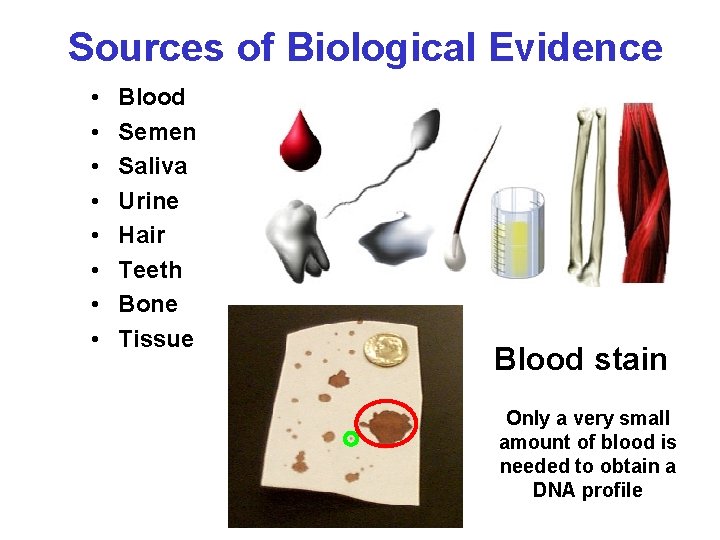
Sources of Biological Evidence • • Blood Semen Saliva Urine Hair Teeth Bone Tissue Blood stain Only a very small amount of blood is needed to obtain a DNA profile
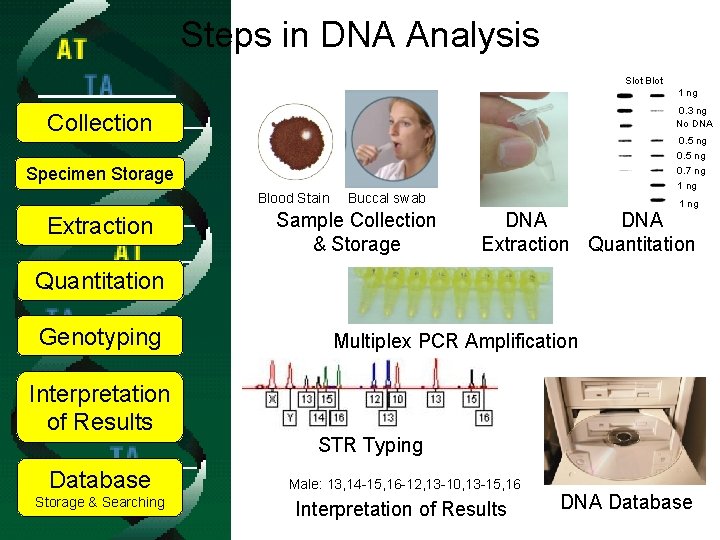
Steps in DNA Analysis Slot Blot 1 ng 0. 3 ng No DNA Collection 0. 5 ng 0. 7 ng Specimen Storage Blood Stain Extraction 1 ng Buccal swab Sample Collection & Storage 1 ng DNA Extraction Quantitation Genotyping Interpretation of Results Multiplex PCR Amplification STR Typing Database Male: 13, 14 -15, 16 -12, 13 -10, 13 -15, 16 Storage & Searching Interpretation of Results DNA Database
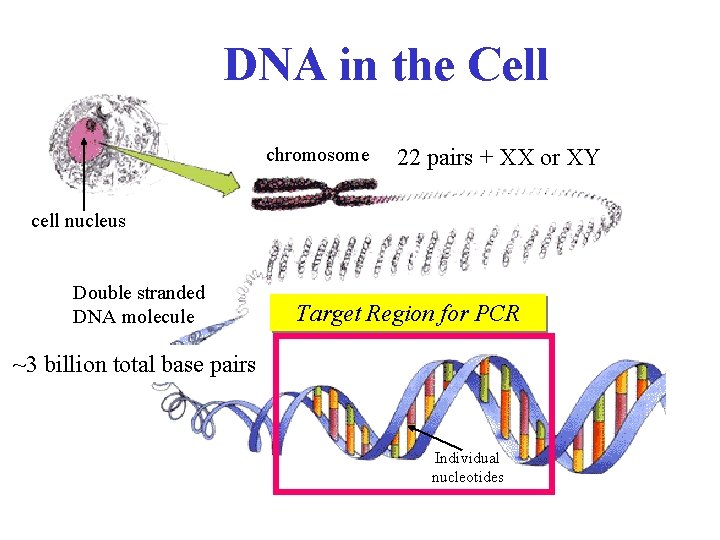
DNA in the Cell chromosome 22 pairs + XX or XY cell nucleus Double stranded DNA molecule Target Region for PCR ~3 billion total base pairs Individual nucleotides
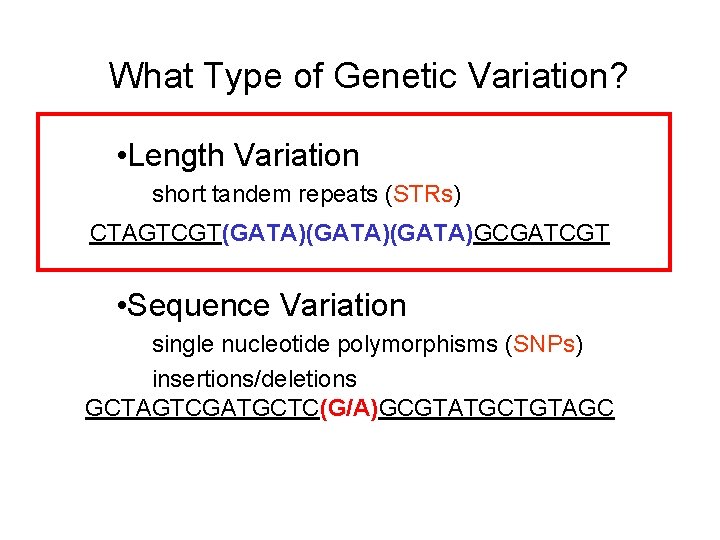
What Type of Genetic Variation? • Length Variation short tandem repeats (STRs) CTAGTCGT(GATA)(GATA)GCGATCGT • Sequence Variation single nucleotide polymorphisms (SNPs) insertions/deletions GCTAGTCGATGCTC(G/A)GCGTATGCTGTAGC
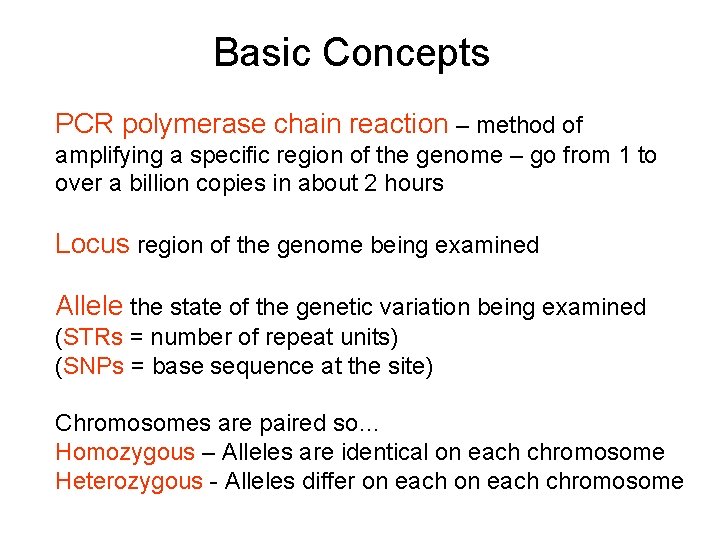
Basic Concepts PCR polymerase chain reaction – method of amplifying a specific region of the genome – go from 1 to over a billion copies in about 2 hours Locus region of the genome being examined Allele the state of the genetic variation being examined (STRs = number of repeat units) (SNPs = base sequence at the site) Chromosomes are paired so… Homozygous – Alleles are identical on each chromosome Heterozygous - Alleles differ on each chromosome
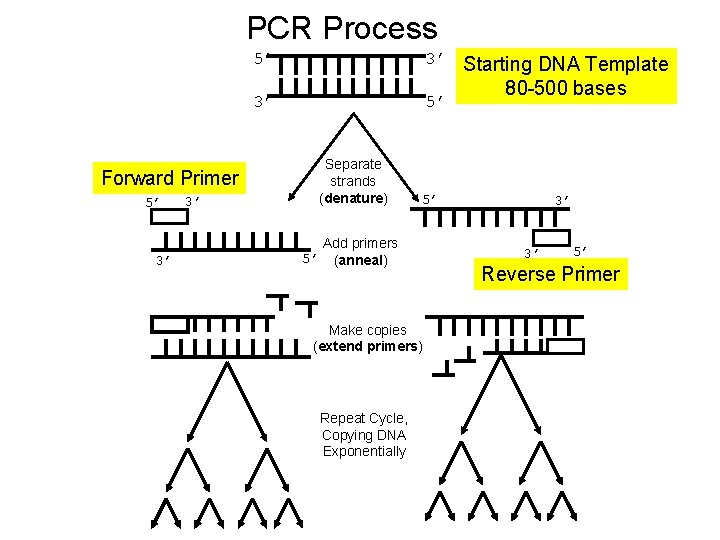
PCR Process 5’ 3’ Starting DNA Template 3’ 5’ Separate strands (denature) Forward Primer 5’ 3’ 3’ 5’ 5’ Add primers (anneal) Make copies (extend primers) Repeat Cycle, Copying DNA Exponentially 80 -500 bases 3’ 3’ 5’ Reverse Primer
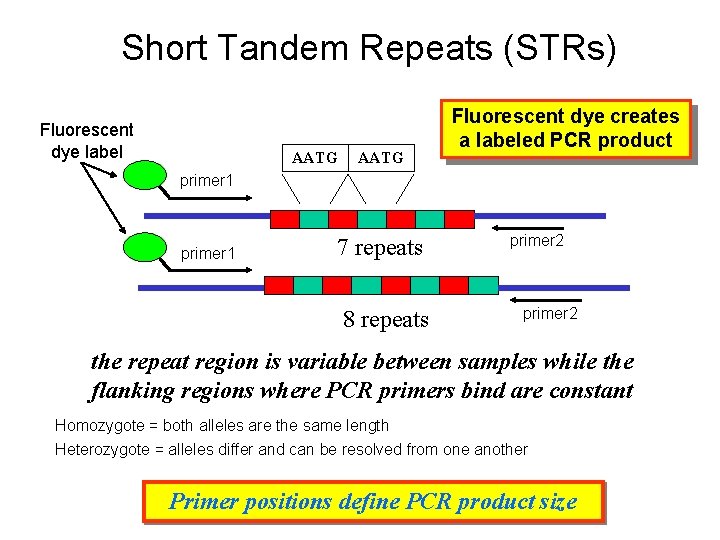
Short Tandem Repeats (STRs) Fluorescent dye label AATG Fluorescent dye creates a labeled PCR product primer 1 7 repeats 8 repeats primer 2 the repeat region is variable between samples while the flanking regions where PCR primers bind are constant Homozygote = both alleles are the same length Heterozygote = alleles differ and can be resolved from one another Primer positions define PCR product size

Position of Forensic STR Markers on Human Chromosomes 13 CODIS Core STR Loci TPOX D 3 S 1358 D 8 S 1179 D 5 S 818 FGA CSF 1 PO TH 01 VWA D 7 S 820 AMEL Sex-typing D 13 S 317 D 16 S 539 D 18 S 51 D 21 S 11 AMEL
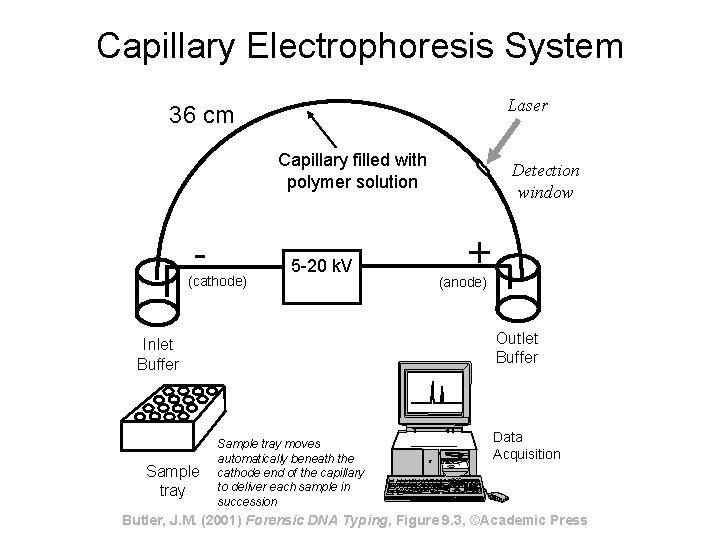
Capillary Electrophoresis System Laser 36 cm Capillary filled with polymer solution - (cathode) 5 -20 k. V + (anode) Outlet Buffer Inlet Buffer Sample tray Detection window Sample tray moves automatically beneath the cathode end of the capillary to deliver each sample in succession Data Acquisition Butler, J. M. (2001) Forensic DNA Typing, Figure 9. 3, ©Academic Press
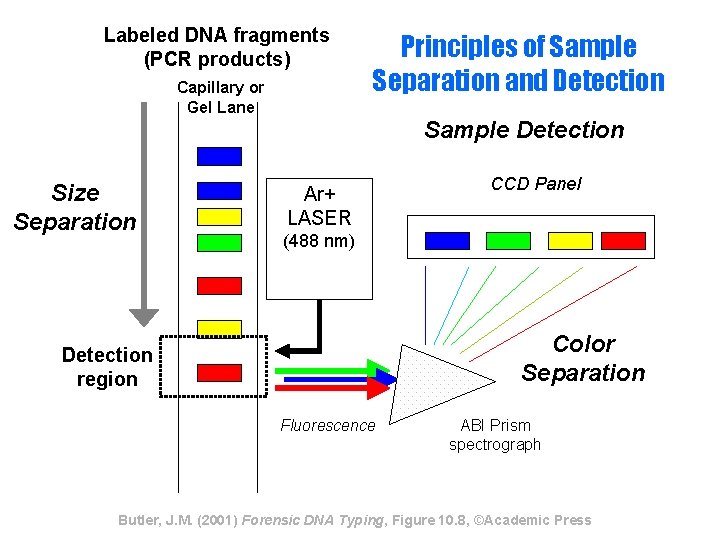
Labeled DNA fragments (PCR products) Capillary or Gel Lane Principles of Sample Separation and Detection Sample Detection Size Separation Ar+ LASER CCD Panel (488 nm) Color Separation Detection region Fluorescence ABI Prism spectrograph Butler, J. M. (2001) Forensic DNA Typing, Figure 10. 8, ©Academic Press
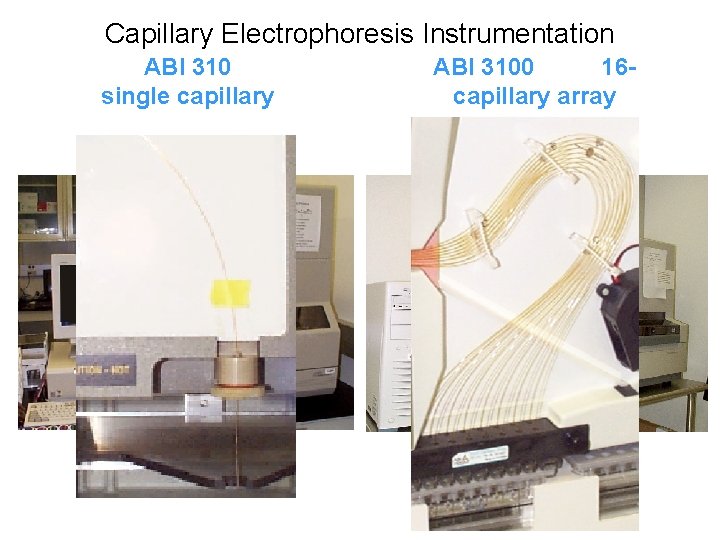
Capillary Electrophoresis Instrumentation ABI 310 single capillary ABI 3100 16 capillary array
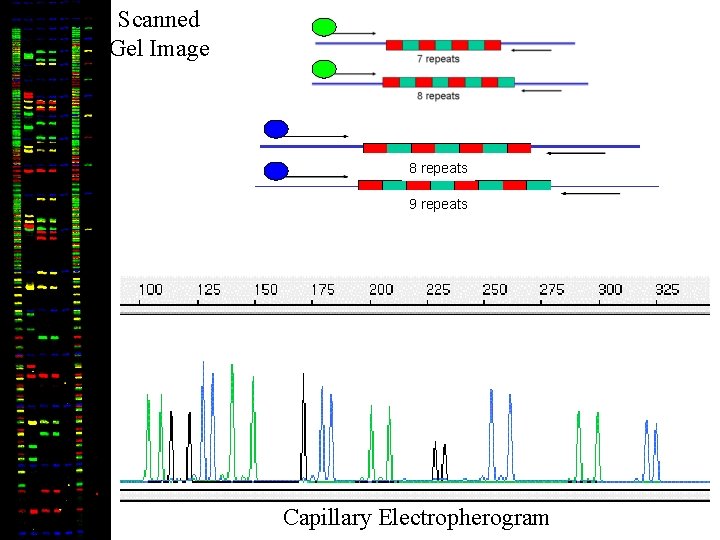
Scanned Gel Image 8 repeats 9 repeats Capillary Electropherogram
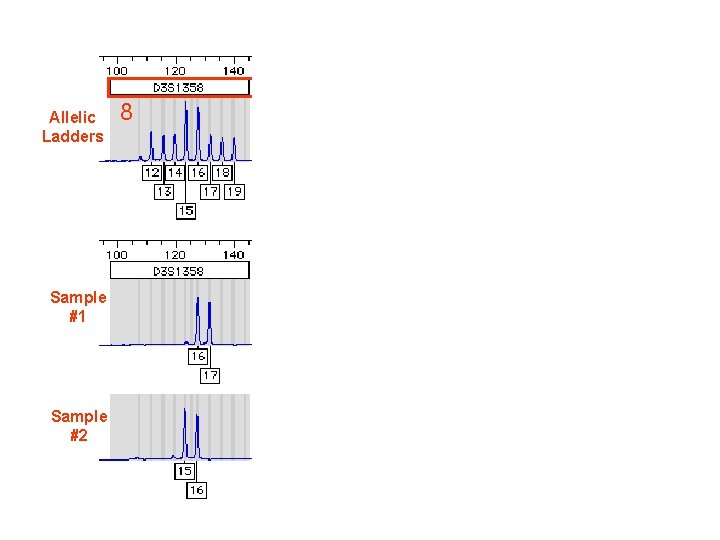
PCR Product Size (bp) loci Allelic Ladders 8 11 14 Sample #1 All heterozygous Sample #2
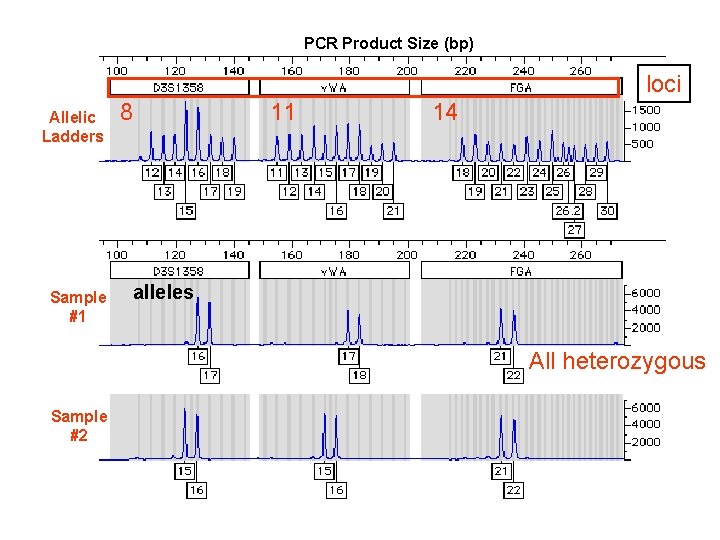
PCR Product Size (bp) loci Allelic Ladders Sample #1 8 11 14 alleles All heterozygous Sample #2
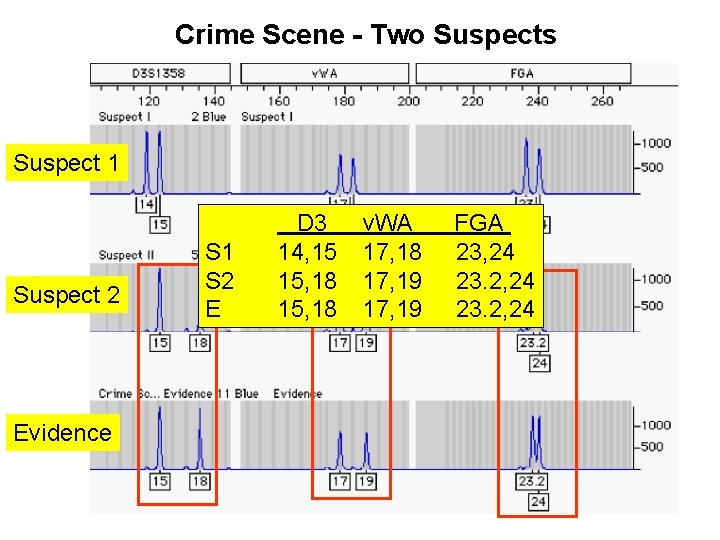
Crime Scene - Two Suspects Suspect 1 Suspect 2 Evidence S 1 S 2 E D 3 14, 15 15, 18 v. WA 17, 18 17, 19 FGA 23, 24 23. 2, 24
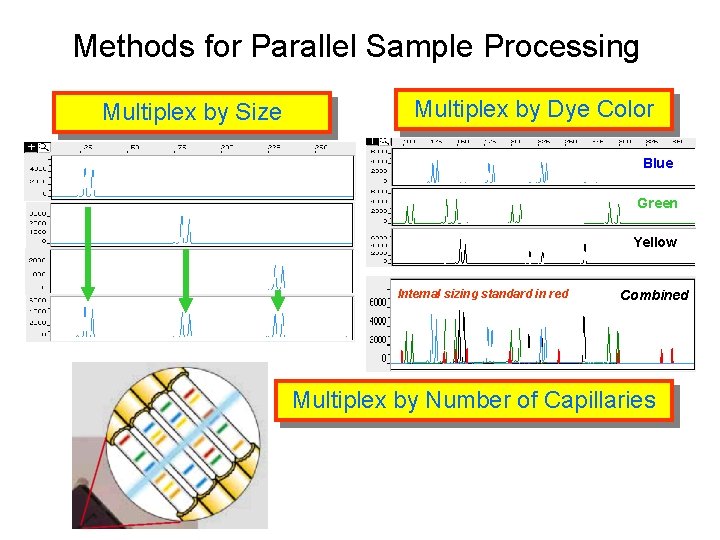
Methods for Parallel Sample Processing Multiplex by Size Multiplex by Dye Color Blue Green Yellow Internal sizing standard in red Combined Multiplex by Number of Capillaries
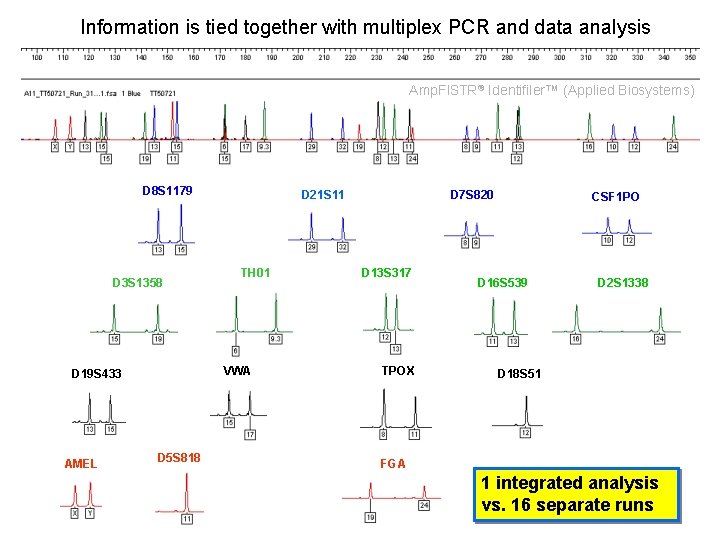
Information is tied together with multiplex PCR and data analysis Amp. Fl. STR® Identifiler™ (Applied Biosystems) D 8 S 1179 D 3 S 1358 TH 01 VWA D 19 S 433 AMEL D 21 S 11 D 5 S 818 D 7 S 820 D 13 S 317 TPOX CSF 1 PO D 16 S 539 D 2 S 1338 D 18 S 51 FGA 1 integrated analysis vs. 16 separate runs
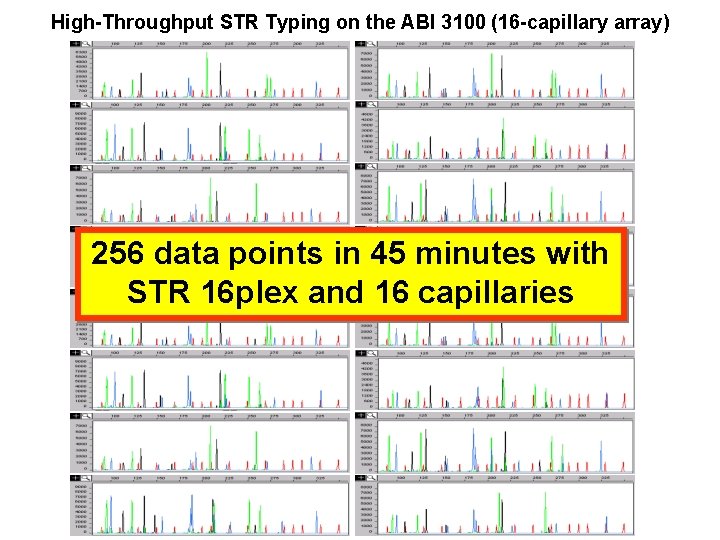
High-Throughput STR Typing on the ABI 3100 (16 -capillary array) 256 data points in 45 minutes with STR 16 plex and 16 capillaries
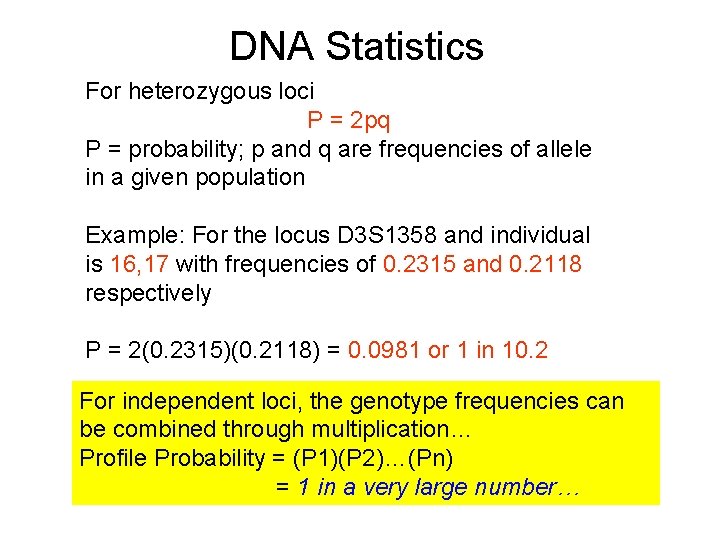
DNA Statistics For heterozygous loci P = 2 pq P = probability; p and q are frequencies of allele in a given population Example: For the locus D 3 S 1358 and individual is 16, 17 with frequencies of 0. 2315 and 0. 2118 respectively P = 2(0. 2315)(0. 2118) = 0. 0981 or 1 in 10. 2 For independent loci, the genotype frequencies can be combined through multiplication… Profile Probability = (P 1)(P 2)…(Pn) = 1 in a very large number…
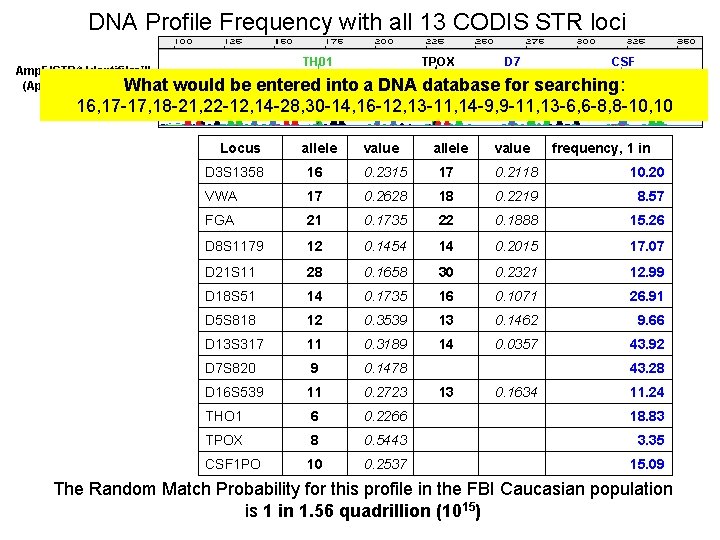
DNA Profile Frequency with all 13 CODIS STR loci TH 01 TPOX D 7 CSF Amp. Fl. STR® Identifiler™ D 13 D 16 (Applied Biosystems) What would be entered into a DNA database for searching: D 19 D 3 D 8 D 21 D 18 VWA AMEL D 5 FGA D 2 16, 17 -17, 18 -21, 22 -12, 14 -28, 30 -14, 16 -12, 13 -11, 14 -9, 9 -11, 13 -6, 6 -8, 8 -10, 10 Locus allele value frequency, 1 in D 3 S 1358 16 0. 2315 17 0. 2118 10. 20 VWA 17 0. 2628 18 0. 2219 8. 57 FGA 21 0. 1735 22 0. 1888 15. 26 D 8 S 1179 12 0. 1454 14 0. 2015 17. 07 D 21 S 11 28 0. 1658 30 0. 2321 12. 99 D 18 S 51 14 0. 1735 16 0. 1071 26. 91 D 5 S 818 12 0. 3539 13 0. 1462 9. 66 D 13 S 317 11 0. 3189 14 0. 0357 43. 92 D 7 S 820 9 0. 1478 D 16 S 539 11 0. 2723 THO 1 6 0. 2266 18. 83 TPOX 8 0. 5443 3. 35 CSF 1 PO 10 0. 2537 15. 09 43. 28 13 0. 1634 11. 24 The Random Match Probability for this profile in the FBI Caucasian population is 1 in 1. 56 quadrillion (1015)
CODIS DNA Database Combined DNA Index System Used for linking serial crimes and unsolved cases with repeat offenders Convicted offender and forensic case samples Launched October 1998 and links all 50 states Requires 13 core STR markers Current backlog of >750, 000 samples (millions of dollars are spent each year to reduce backlog)
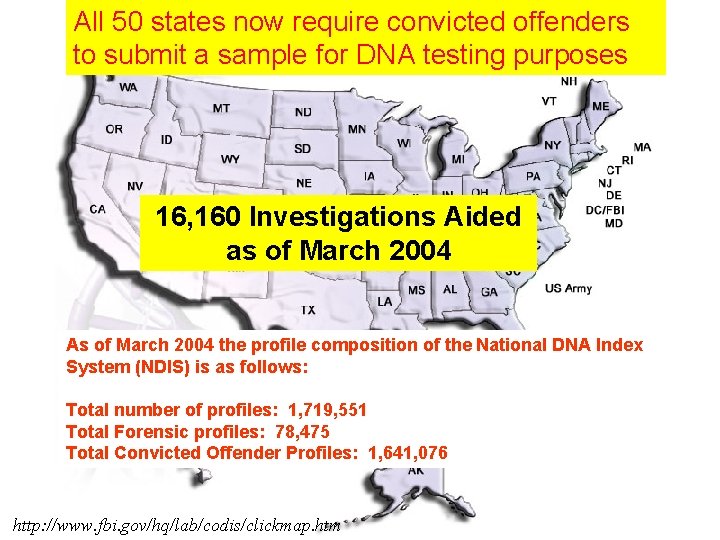
All 50 states now require convicted offenders to submit a sample for DNA testing purposes 16, 160 Investigations Aided as of March 2004 As of March 2004 the profile composition of the National DNA Index System (NDIS) is as follows: Total number of profiles: 1, 719, 551 Total Forensic profiles: 78, 475 Total Convicted Offender Profiles: 1, 641, 076 http: //www. fbi. gov/hq/lab/codis/clickmap. htm
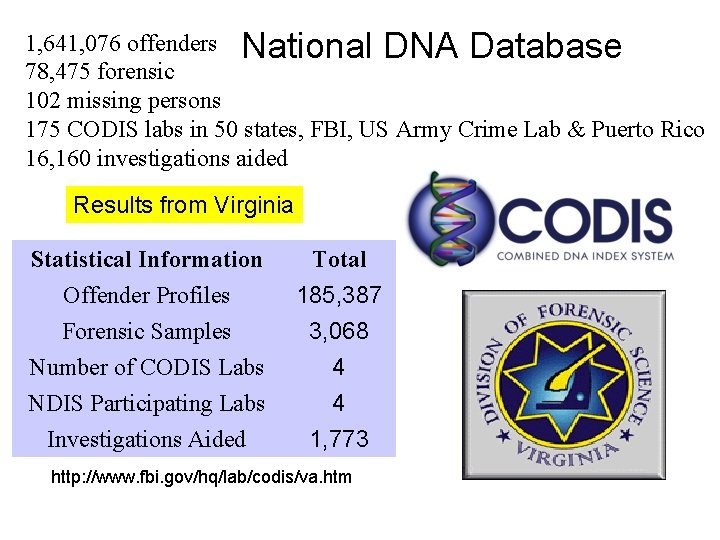
1, 641, 076 offenders National DNA Database 78, 475 forensic 102 missing persons 175 CODIS labs in 50 states, FBI, US Army Crime Lab & Puerto Rico 16, 160 investigations aided Results from Virginia Statistical Information Offender Profiles Forensic Samples Number of CODIS Labs Total 185, 387 3, 068 4 NDIS Participating Labs Investigations Aided 4 1, 773 http: //www. fbi. gov/hq/lab/codis/va. htm
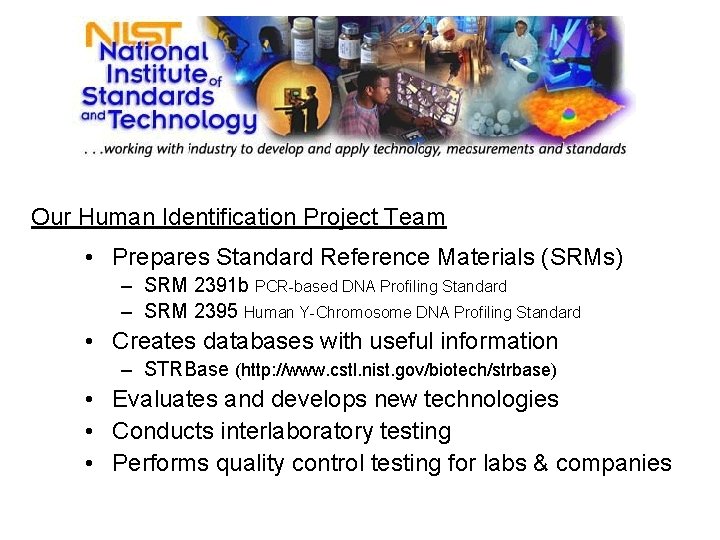
Our Human Identification Project Team • Prepares Standard Reference Materials (SRMs) – SRM 2391 b PCR-based DNA Profiling Standard – SRM 2395 Human Y-Chromosome DNA Profiling Standard • Creates databases with useful information – STRBase (http: //www. cstl. nist. gov/biotech/strbase) • Evaluates and develops new technologies • Conducts interlaboratory testing • Performs quality control testing for labs & companies
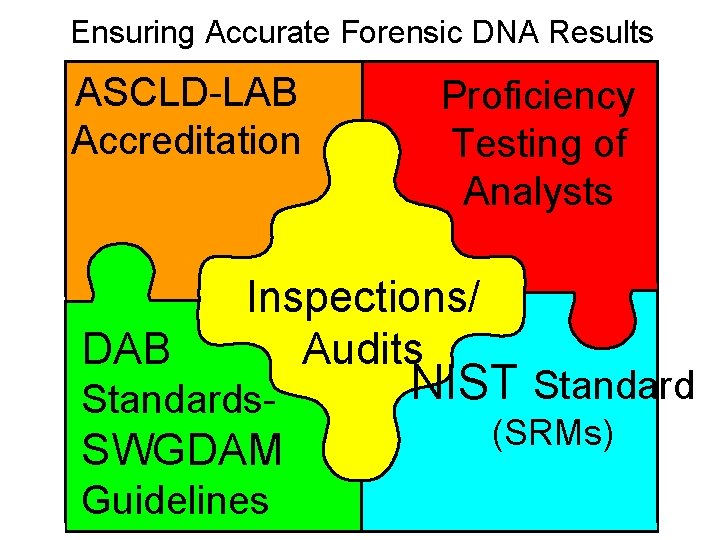
Ensuring Accurate Forensic DNA Results ASCLD-LAB Accreditation DAB Proficiency Testing of Analysts Inspections/ Audits Standards- SWGDAM Guidelines NIST Standard (SRMs)
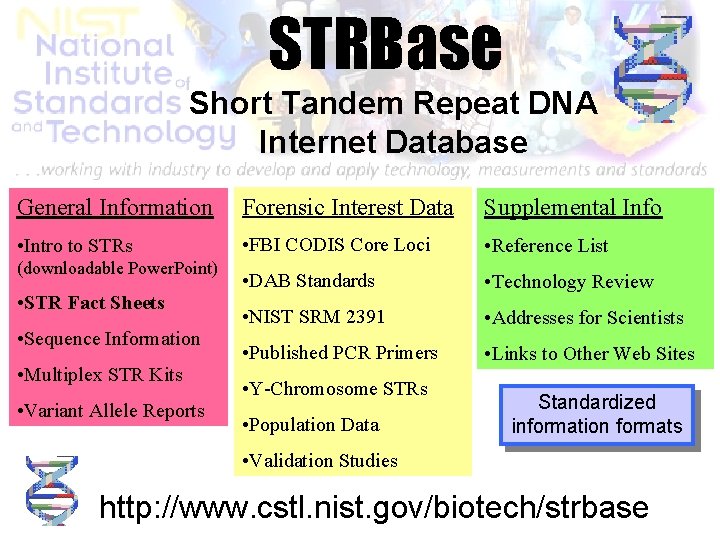
STRBase Short Tandem Repeat DNA Internet Database General Information Forensic Interest Data Supplemental Info • Intro to STRs • FBI CODIS Core Loci • Reference List • DAB Standards • Technology Review • NIST SRM 2391 • Addresses for Scientists • Published PCR Primers • Links to Other Web Sites (downloadable Power. Point) • STR Fact Sheets • Sequence Information • Multiplex STR Kits • Variant Allele Reports • Y-Chromosome STRs • Population Data Standardized information formats • Validation Studies http: //www. cstl. nist. gov/biotech/strbase
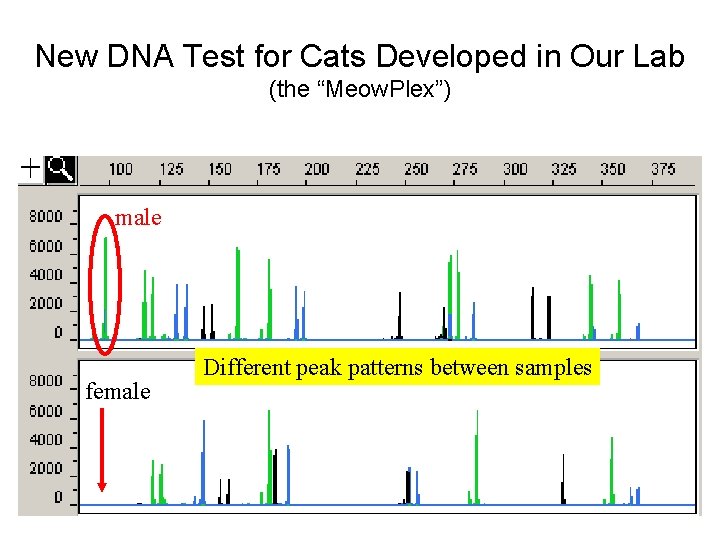
New DNA Test for Cats Developed in Our Lab (the “Meow. Plex”) male female Different peak patterns between samples
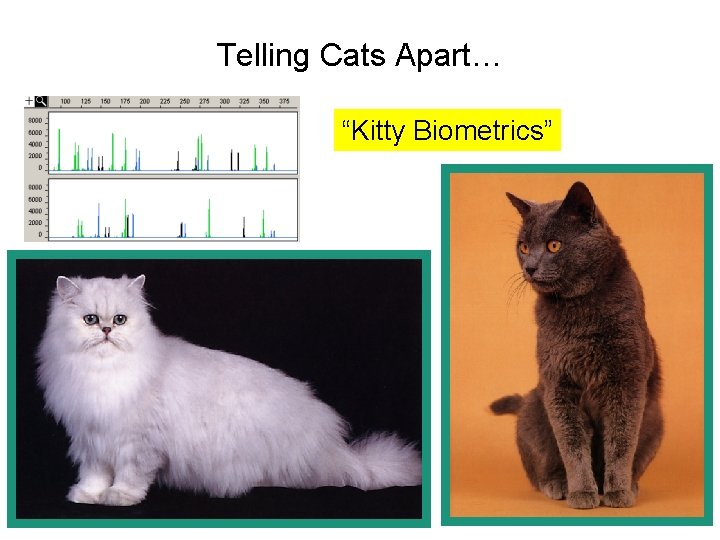
Telling Cats Apart… “Kitty Biometrics”
Disclaimer • Our laboratory performs research and development in human identification techniques involving DNA testing • I am not an “expert” in biometrics and therefore do not understand all of the issues involved • The following ideas are my own and in no way represent the official position of the National Institute of Standards and Technology (NIST)
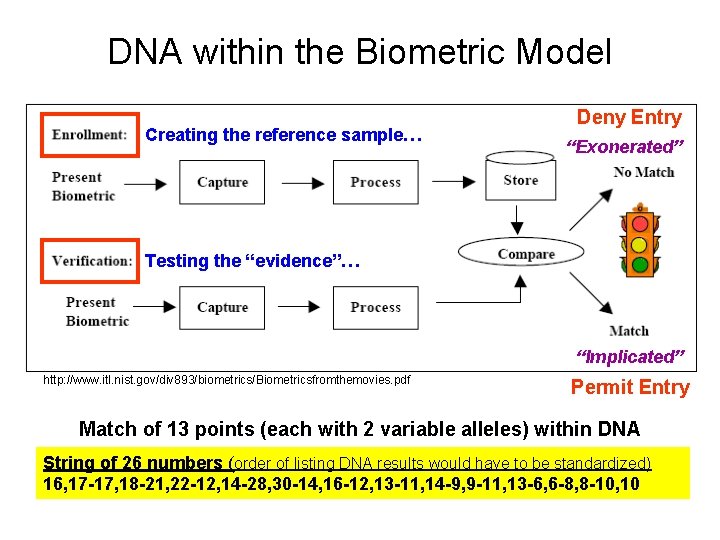
DNA within the Biometric Model Creating the reference sample… Deny Entry “Exonerated” Testing the “evidence”… “Implicated” http: //www. itl. nist. gov/div 893/biometrics/Biometricsfromthemovies. pdf Permit Entry Match of 13 points (each with 2 variable alleles) within DNA String of 26 numbers (order of listing DNA results would have to be standardized) 16, 17 -17, 18 -21, 22 -12, 14 -28, 30 -14, 16 -12, 13 -11, 14 -9, 9 -11, 13 -6, 6 -8, 8 -10, 10
Issues with DNA as a Biometric Tool Individualization of everyone except identical twins • Invasive collection of test sample (swab of cheek cells or finger prick for blood) • Concern over genetic privacy if sample is stored (would or could sample ever be used for other purposes? ) • Expense for testing (>$20 per sample; forensic testing is >$500) • Time required for testing (minimum 4 -5 hours with forensic markers) • Database search/storage of DNA profile (who controls access? ; would it ever be used for criminal investigations? ) • Development of reference databases for terrorists, etc. (how would a match be used? ) • Chance for falsifying your sample (e. g. , movie GATTACA)
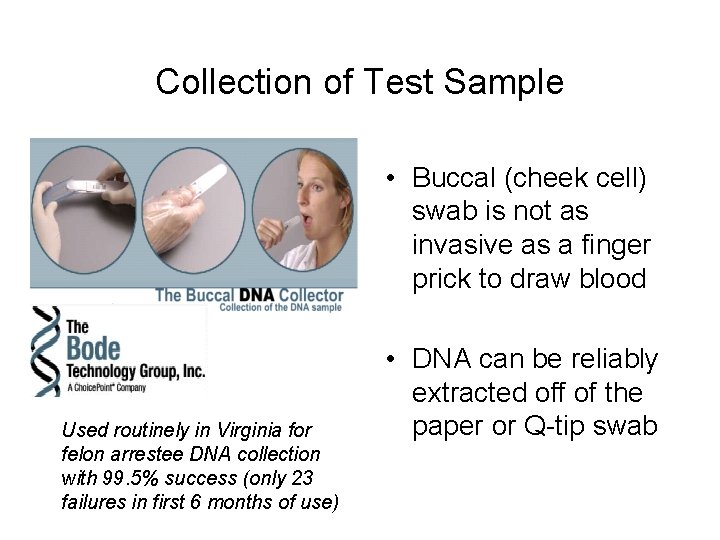
Collection of Test Sample • Buccal (cheek cell) swab is not as invasive as a finger prick to draw blood Used routinely in Virginia for felon arrestee DNA collection with 99. 5% success (only 23 failures in first 6 months of use) • DNA can be reliably extracted off of the paper or Q-tip swab
Genetic Privacy Concerns • The DNA profile itself is neutral (and uninformative)— just a string of numbers like a Social Security Number • DNA markers used in forensics were selected to be neutral and are located away from or between genes rather than being part of gene products and therefore are not generally thought to be associated with any genetic disease • Concern is really with the DNA sample collected— would it be retained and used for any other type of testing? (e. g. , Armed Forces DNA Repository can only be used for identifying combat casualties)
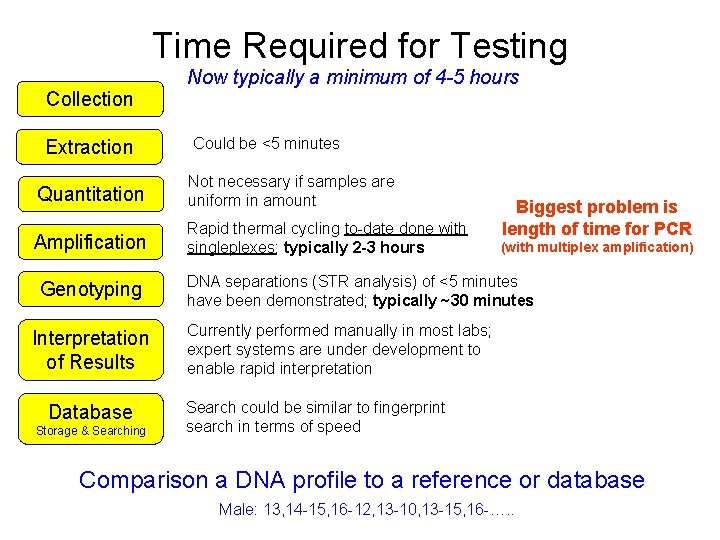
Time Required for Testing Now typically a minimum of 4 -5 hours Collection Extraction Could be <5 minutes Quantitation Not necessary if samples are uniform in amount Amplification Rapid thermal cycling to-date done with singleplexes; typically 2 -3 hours Genotyping Interpretation of Results Database Storage & Searching Biggest problem is length of time for PCR (with multiplex amplification) DNA separations (STR analysis) of <5 minutes have been demonstrated; typically ~30 minutes Currently performed manually in most labs; expert systems are under development to enable rapid interpretation Search could be similar to fingerprint search in terms of speed Comparison a DNA profile to a reference or database Male: 13, 14 -15, 16 -12, 13 -10, 13 -15, 16 -…. .
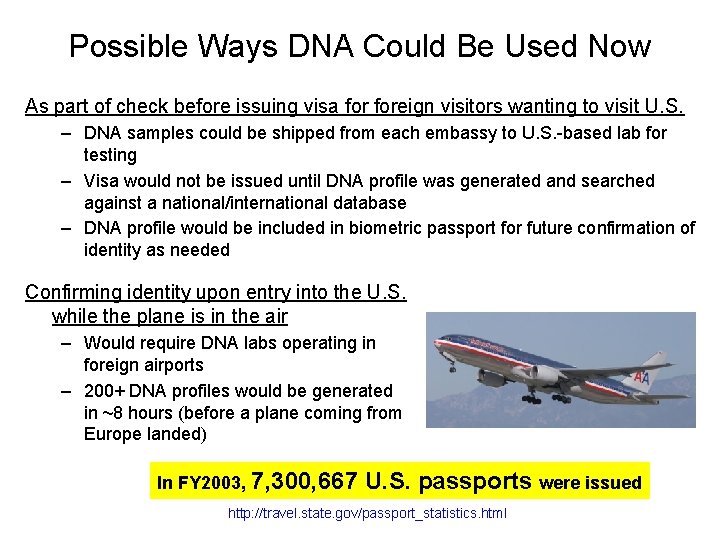
Possible Ways DNA Could Be Used Now As part of check before issuing visa foreign visitors wanting to visit U. S. – DNA samples could be shipped from each embassy to U. S. -based lab for testing – Visa would not be issued until DNA profile was generated and searched against a national/international database – DNA profile would be included in biometric passport for future confirmation of identity as needed Confirming identity upon entry into the U. S. while the plane is in the air – Would require DNA labs operating in foreign airports – 200+ DNA profiles would be generated in ~8 hours (before a plane coming from Europe landed) In FY 2003, 7, 300, 667 U. S. passports were issued http: //travel. state. gov/passport_statistics. html
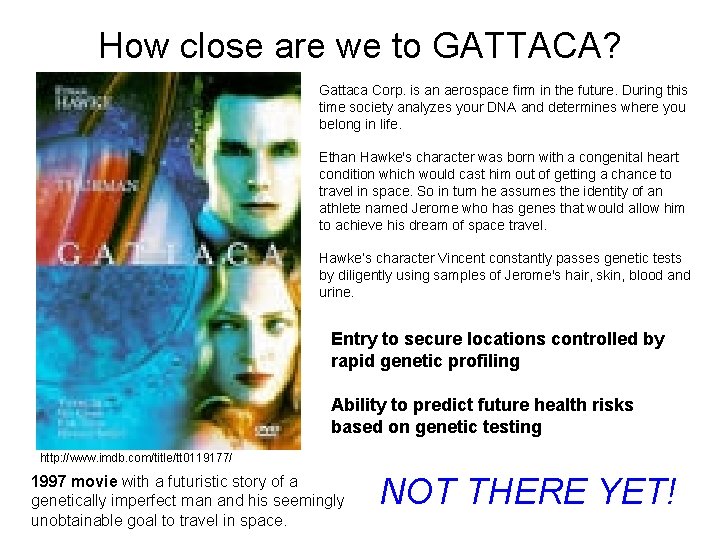
How close are we to GATTACA? Gattaca Corp. is an aerospace firm in the future. During this time society analyzes your DNA and determines where you belong in life. Ethan Hawke's character was born with a congenital heart condition which would cast him out of getting a chance to travel in space. So in turn he assumes the identity of an athlete named Jerome who has genes that would allow him to achieve his dream of space travel. Hawke’s character Vincent constantly passes genetic tests by diligently using samples of Jerome's hair, skin, blood and urine. Entry to secure locations controlled by rapid genetic profiling Ability to predict future health risks based on genetic testing http: //www. imdb. com/title/tt 0119177/ 1997 movie with a futuristic story of a genetically imperfect man and his seemingly unobtainable goal to travel in space. NOT THERE YET!
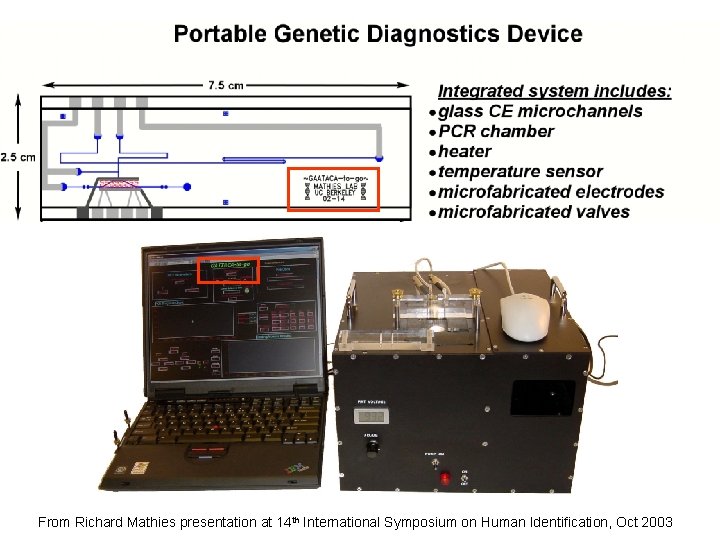
From Richard Mathies presentation at 14 th International Symposium on Human Identification, Oct 2003
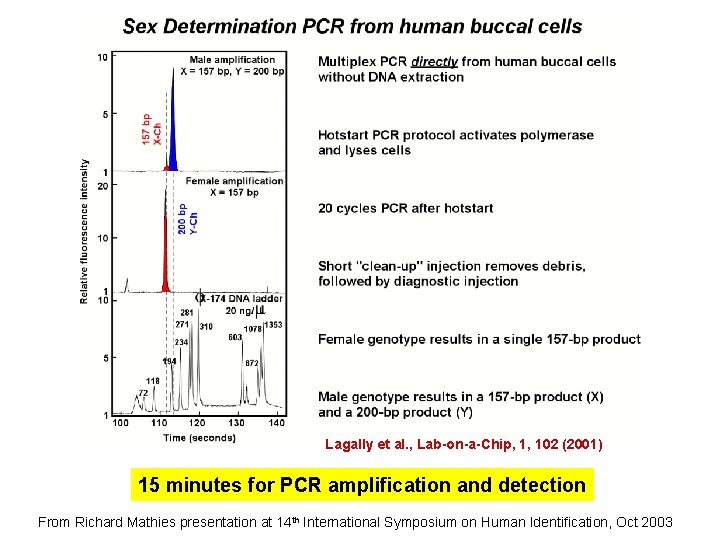
Lagally et al. , Lab-on-a-Chip, 1, 102 (2001) 15 minutes for PCR amplification and detection From Richard Mathies presentation at 14 th International Symposium on Human Identification, Oct 2003
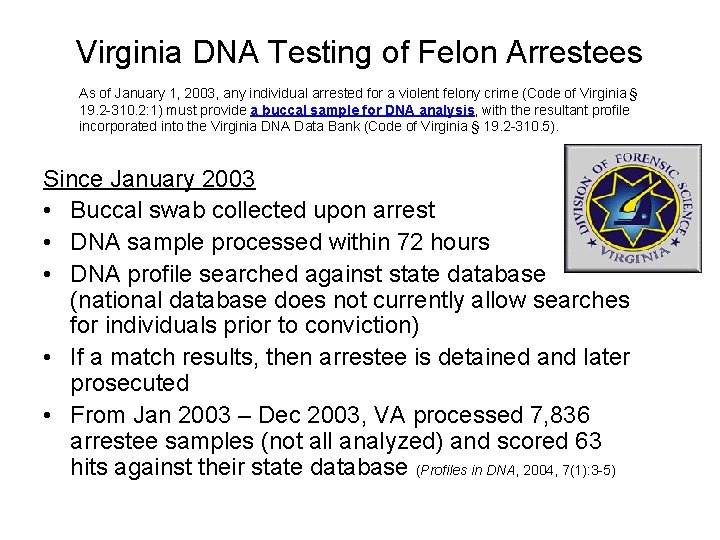
Virginia DNA Testing of Felon Arrestees As of January 1, 2003, any individual arrested for a violent felony crime (Code of Virginia § 19. 2 -310. 2: 1) must provide a buccal sample for DNA analysis, with the resultant profile incorporated into the Virginia DNA Data Bank (Code of Virginia § 19. 2 -310. 5). Since January 2003 • Buccal swab collected upon arrest • DNA sample processed within 72 hours • DNA profile searched against state database (national database does not currently allow searches for individuals prior to conviction) • If a match results, then arrestee is detained and later prosecuted • From Jan 2003 – Dec 2003, VA processed 7, 836 arrestee samples (not all analyzed) and scored 63 hits against their state database (Profiles in DNA, 2004, 7(1): 3 -5)
If you want to know more… • Forensic DNA Typing: Biology and Technology behind STR Markers • NIST website: http: //www. cstl. nist. gov/biotech/strbase • John Butler email: john. butler@nist. gov STRBase
Thank you for your attention… NIST Project Team: John Butler (leader) Margaret Kline Jan Redman Pete Vallone Dave Duewer Jill Appleby Amy Decker Mike Coble National Institute of Justice Funding through NIST Office of Law Enforcement Standards
- Slides: 57