
Forensic Botany Stephanie Nunez Libie Motchan Karim Moftah
Forensic Botany Stephanie Nunez Libie Motchan Karim Moftah
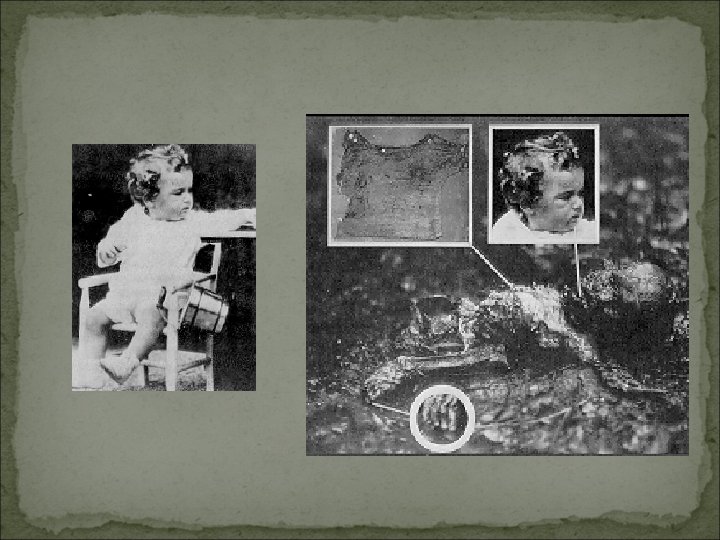
History The first botanical testimony was used in 1935. The son of world famous aviator Charles Lindbergh was kidnapped in 1932 and Bruno Richard Hauptmann was being tried for the kidnapping and death of one and a half year old Charles Lindbergh Jr. in a New Jersey Courthouse in 1935. During this trial the judge allowed Arthur Koehler, an expert on wood to testify against Bruno Hauptmann
History continued At first the judge and the jury were reluctant to let Dr. Koehler testify but then the judge granted him permission. Dr. Koehler matched the ladder used at the crime scene with a block of wood that was sawn away from Hauptmann's attic. After this trial, forensic botany became really widespread and accepted in courts. It has helped solve many crimes. This evidence was the most crucial and decisive and ultimately led to the electrocution of Bruno Hauptmann
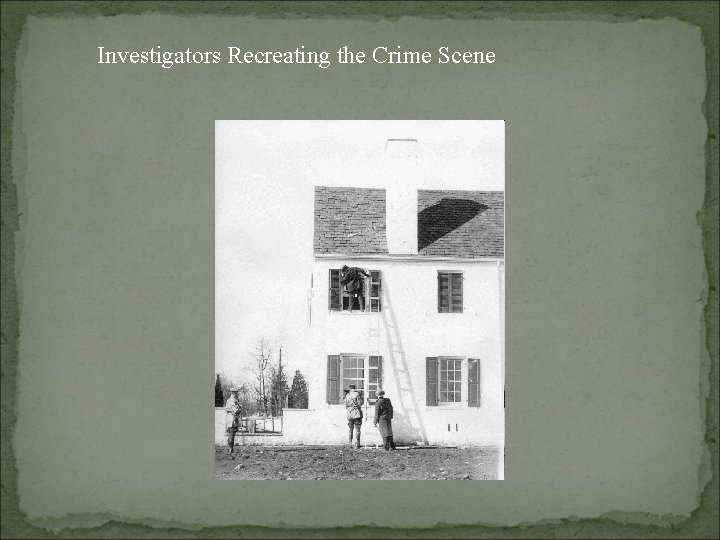
Investigators Recreating the Crime Scene
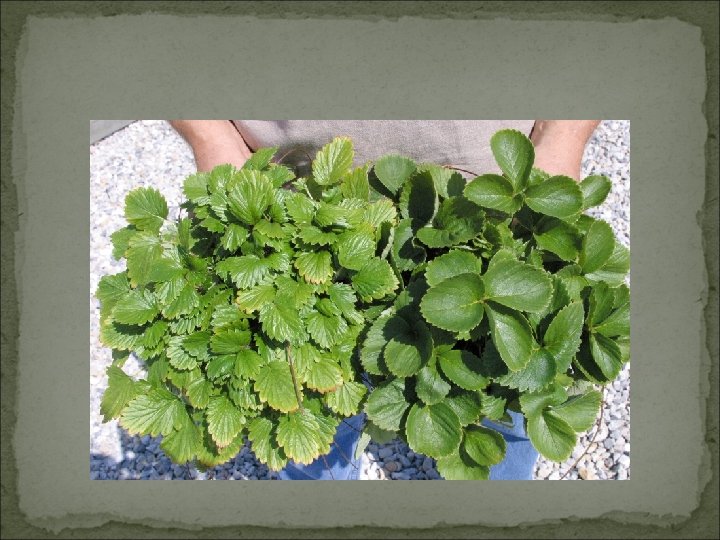
What is forensic botany? Forensic Botany is the use of plants or plant matter to assist investigators with solving a crime Trace botanical evidence can help a forensic investigator link objects or suspects to a crime scene. Plant remains can be found almost anywhere and they offer a variety of evidence.

Forensic Botany Cont. Examples of plantlife or plant remains that can be used as evidence are pieces of wood, seeds, fruits, leaves, twigs, plant hairs, pollen, spores and even algae cells. Plants allow forensic botanists to identify things such as what season the crime took place or geographical location, whether or not a body has been moved following a murder, and how long a body has been buried if it was buried. These forms of physical evidence can be sometimes traced to an individual suspect
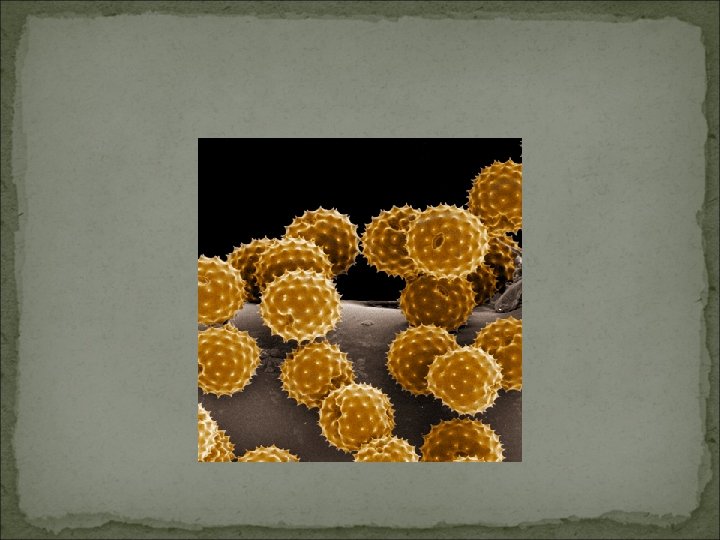
The use of pollen in forensic botany Scientists started using pollen in forensic botany when evidence provided by entomology was not sufficient. Scientists realized that pollen is present everywhere and could serve as a valuable tool in forensic investigation. Pollen is not only present in the air but on our clothes and in our lungs. Study of pollen called “palynology” Palynology also includes the analysis of microscopic organisms such as dinoflagellates and chitinozoans.
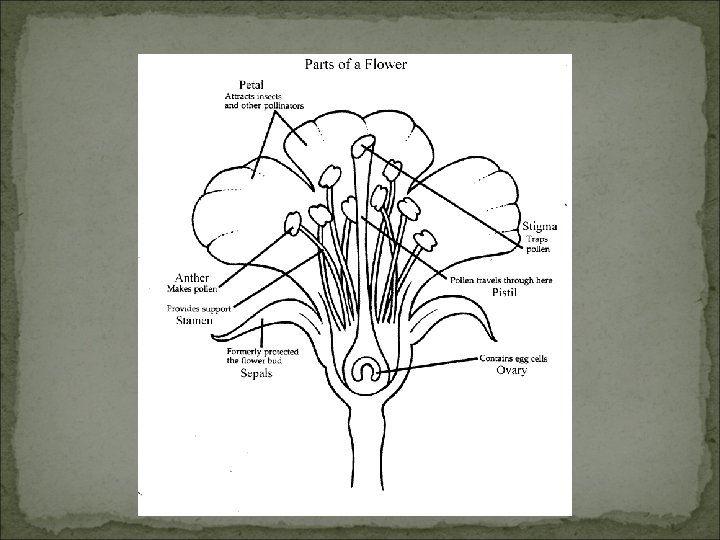
Science of pollen Pollen is fine powder made up of micro gametophytes of seed plants The hard coats on pollen grains protect the sperm cells in the process of transitioning from the sperm cells to the pistils of plants. When pollen lands on compatible plants it germinates
How scientists tested their work Scientists analyze pollen in cases where the time and location had already been determined. Based on this they were able to determine the accuracy of using pollen as a tool for determining the location and time of a crime.

Advantages to using pollen at the crime scene There is some level of pollen at virtually every crime scene, which can greatly help develop the case. Pollen can not be used to not only determine the location of a crime, but also the time. Scientists have information on the dates certain flowers are expected to pollinate and can use this information to solve crimes.
Advantages continued Pollen and spore exines are very diverse, sometimes even to the species level. This is advantageous because it can not only narrow down a specific location but also a specific season. The diversity among pollen morphology in the related family are widely published
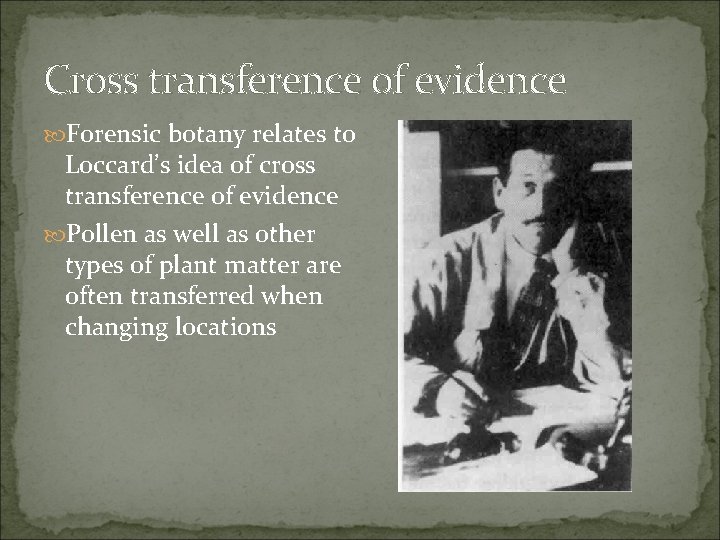
Cross transference of evidence Forensic botany relates to Loccard’s idea of cross transference of evidence Pollen as well as other types of plant matter are often transferred when changing locations
Disadvantages of using pollen analysis in the crime lab Pollen is often difficult to analyze and therefore requires advanced tools and microscopes. Additionally, pollen is often impossible to detect on clothes because it is microscopic. There is generally not a lot of pollen at a specific crime scene, which prevent scientists from being able to experiment on the pollen they collect. There are not many palynologists available to study and test pollen samples.
Advantages and disadvantages of different types of pollination Zoogamous plants, the largest category are ideal. They are dependant upon insects for the transfer of pollen. Their pollen production is low, but not too low that it can not be detected. Additionally, their pollen exines are the most durable, meaning that they will stay in the environment for the longest Anemophilous plants are wind pollinated. The abundance of pollen that they produce can be a disadvantage because it is everywhere Autogamous plants do not produce pollen in the atmosphere and create minimal amounts of pollen
New Zealand case In a recent case a woman was pulled into an alley way and raped. The suspect has dirt on his clothes that he claimed came from working on his car. Investigators were able to analyze the pollen found in the shrubbery of the alleyway. It was determined to be Artemisia, a rare type of pollen They compare the dirt on the suspect’s clothes and found him guilty
Advantages to using pollen in the court room Palynology is becoming further accepted in the legal world. Forensic botany has the potential to be very influential in the courtroom Botanical evidence can be found at almost any crime scene Like DNA botanical evidence has individual characteristics
Disadvantages of using pollen in the court room Because pollen is in the air, oftentimes, many people in a city or neighborhood will have the same strain of pollen in their lungs and on their clothes pollen will not always have individual characteristics, but rather group characteristics It often can not convict a suspect, but rather point an investigator in a certain direction Pollen is still not accepted or recognized in most court systems.
Forensic botany in the court room continued Forensic botany has the potential to be very influential in the courtroom Forensic botany has the ability to decide whether the victim’s body was moved after the murder, if a body is buried, how long it has been buried, and whether a suspect was present at the crime scene.
The future of forensic botany Forensic botanists are currently searching for different techniques to determine whether plants of the same species have different and individual fingerprints Such a discovery would give investigators an unparalleled tool in solving crimes
Questions raised by this technique How rare is each strain of pollen? What is the most effective way to detect and collect pollen? To what materials does pollen attach to?
Questions raised by forensic botany Can forensic botany potentially be used in the place of the very costly and time consuming DNA testing? How can forensic botany be used in collaboration with other pieces of physical evidence to solve a crime? Is forensic botany reliable enough to greatly influence a jury or judge?
Next steps Study the individual strains of pollen and plants Try and introduce pollen into more courtroom investigations and spread its use among forensic investigations Study the accuracy of forensic botany in past cases.
Bibliography Slide 2 Castillo, Fabiola "Forensic Botany Analyzing Plants and Seeds. " Forensic Botany Analyzing Plants and Seeds. 15 Apr. 2008 Ezine. Articles. com. 6 Nov. 2009 <http: //ezinearticles. com/? Forensic Botany Analyzing Plants and Seeds&id=1113205>. Slide 3 Castillo, Fabiola "Forensic Botany Analyzing Plants and Seeds. " Forensic Botany Analyzing Plants and Seeds. 15 Apr. 2008 Ezine. Articles. com. 6 Nov. 2009 <http: //ezinearticles. com/? Forensic Botany Analyzing Plants and Seeds&id=1113205>.
Bibliography Cont. Slide 4 Trenchard, T. W. State of New Jersey vs. Bruno Richard Hauptmann, Trial transcript, 1935: 3805. Slide 5 Trenchard, T. W. State of New Jersey vs. Bruno Richard Hauptmann, Trial transcript, 1935: 3805.
Bibliography Cont. Slide 6 Topham, John. "Forensic Botany. " Forensic Botany Information. 17 06 2005. Halifax, Web. 8 Nov 2009. Slide 7 Topham, John. "Forensic Botany. " Forensic Botany Information. 17 06 2005. Halifax, Web. 8 Nov 2009. Slide 8 Topham, John. "Forensic Botany. " Forensic Botany Information. 17 06 2005. Halifax, Web. 8 Nov 2009. Slide 9 Topham, John. "Forensic Botany. " Forensic Botany Information. 17 06 2005. Halifax, Web. 8 Nov 2009.
Bibliography slide 10: "The Beauty of Botany". Journey North. 11/16/09 <http: //www. learner. org/jnorth/tm/tulips/Botany. Bea uty. html>. ] slide 11 Miller Coyle, Heather. "Forensic Botany: Using Plant Evidence to Aid in Forensic Death Investigation. " Croatian Medical Journal. 46. 4 (2005): 606 612. Print. slide 12 Miller Coyle, Heather. "Forensic Botany: Using Plant Evidence to Aid in Forensic Death Investigation. " Croatian Medical Journal. 46. 4 (2005): 606 612. Print.
Bibliography Cont. slide 13 Štambuk, . "Forensic Botany: Potential Usefulness of Microsatellite based Genotyping of Croatian Olive (Olea europaea L. ) in Forensic Casework. " Croatian Medical Journal. 48. 4 (2007): 556 562. Print. slide 14 Tenenbaum, Sara. "Achoo". Special Comment. 11/16/09 <http: //specialcomment. wordpress. com/2007/04/25/ achoo/>.
Bibliography Cont. slide 15 Miller Coyle, Heather. "Forensic Botany: Using Plant Evidence to Aid in Forensic Death Investigation. " Croatian Medical Journal. 46. 4 (2005): 606 612. Print. Templeman, Henry. "Fingerprint Identification". 11/16/09 <http: //www. henrytempleman. com/pre determined_minimum_to_individualize>. slide 16 Miller Coyle, Heather. "Forensic Botany: Using Plant Evidence to Aid in Forensic Death Investigation. " Croatian Medical Journal. 46. 4 (2005): 606 612. Print.
Bibliography Cont. slide 17 M. Bryant, Vaugn. "Forensic Palynology: A New Way to Catch Crooks. " 20 Sep. 2009: n. pag. Web. 9 Nov 2009. slide 18 Miller Coyle, Heather. "Forensic Botany: Using Plant Evidence to Aid in Forensic Death Investigation. " Croatian Medical Journal. 46. 4 (2005): 606 612. Print.
Bibliography Continue Slide 19 Castillo, Fabiola "Forensic Botany Analyzing Plants and Seeds. " Forensic Botany Analyzing Plants and Seeds. 15 Apr. 2008 Ezine. Articles. com. 6 Nov. 2009 <http: //ezinearticles. com/? Forensic Botany Analyzing Plants and Seeds&id=1113205>. Slide 20 Castillo, Fabiola "Forensic Botany Analyzing Plants and Seeds. " Forensic Botany Analyzing Plants and Seeds. 15 Apr. 2008 Ezine. Articles. com. 6 Nov. 2009 <http: //ezinearticles. com/? Forensic Botany Analyzing Plants and Seeds&id=1113205>.
Bibliography Cont. Slide 21 Castillo, Fabiola "Forensic Botany Analyzing Plants and Seeds. " Forensic Botany Analyzing Plants and Seeds. 15 Apr. 2008 Ezine. Articles. com. 6 Nov. 2009 <http: //ezinearticles. com/? Forensic Botany Analyzing Plants and Seeds&id=1113205>. Slide 22 Topham, John. "Forensic Botany. " Forensic Botany Information. 17 06 2005. Halifax, Web. 8 Nov 2009.
Bibliography Cont. Slide 23 Topham, John. "Forensic Botany. " Forensic Botany Information. 17 06 2005. Halifax, Web. 8 Nov 2009. Slide 24 Topham, John. "Forensic Botany. " Forensic Botany Information. 17 06 2005. Halifax, Web. 8 Nov 2009. Slide 25 Miller Coyle, Heather. "Forensic Botany: Using Plant Evidence to Aid in Forensic Death Investigation. " Croatian Medical Journal. 46. 4 (2005): 606 612. Print.
Bibliography Cont. Slide 26 Miller Coyle, Heather. "Forensic Botany: Using Plant Evidence to Aid in Forensic Death Investigation. " Croatian Medical Journal. 46. 4 (2005): 606 612. Print.
- Slides: 37