
Foreign Policy Goals Types People involved Foreign Policy
- Slides: 17
Foreign Policy Goals Types People involved
Foreign Policy Goals 1. Maintaining National Security - to protect the rights, freedoms, and property of the United States and its people 2. Supporting Democracy - aid democratic nations as well as move them toward democracy
Foreign Policy Goals 3. Promoting World Peace - the more nations at peace, the less likely the U. S. will be drawn into an existing conflict 4. Providing Aid to People in Need - assume the responsibility of providing humanitarian and other relief to foreign countries
Foreign Policy Goals 5. Establishing Free and Open Trade - increases the size of the market to which domestic businesses can sell their goods - gives U. S. consumers a chance to buy goods from around the world
Types of Foreign Policy 1. Isolationism – A view that a nation should tend to its domestic affairs rather than to international affairs 2. Realism - - Believe an internationalist approach – taking an active role in international affairs to promote U. S. interests Military intervention when necessary
Types of Foreign Policy 3. Neoisolationism - foreign involvement should be kept to a minimum - not only for the good of the United States but also because such involvement is likely to be bad for nations in whose affairs the U. S. would intervene
Types of Foreign Policy 4. Idealism - want an internationalist foreign policy - are motivated by what is good for other countries as well as the U. S. - support democratic values everywhere
Role of the President • Influence through general acceptance: – Congress and the American people give the president the authority to make policy decisions as needed • Influence as commander in chief: – Used to order short-term military strikes – commit forces to serve in what have been called undeclared wars • Influence through executive agreements: – Formal understandings with foreign governments
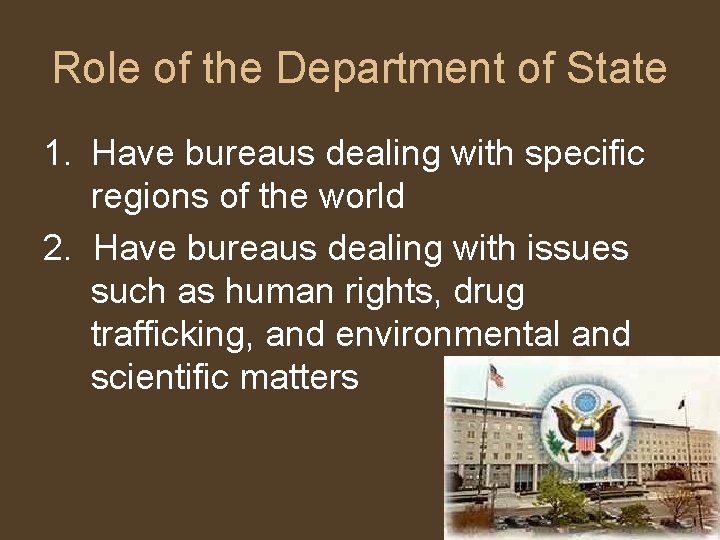
Role of the Department of State 1. Have bureaus dealing with specific regions of the world 2. Have bureaus dealing with issues such as human rights, drug trafficking, and environmental and scientific matters
Role of the Department of State 3. Maintain embassies and consulates a. Embassy: diplomatic center b. Ambassador: the chief diplomatic official at each embassy - a personal representative of the president - receive the post as a reward for supporting the president or his party
Role of the Department of State 3. Maintain embassies and consulates c. Consulate: deal with U. S. commercial interests d. Consul: head of a consulate - appointed by the president - confirmed by the Senate e. Foreign Service: members of the State Department who serve abroad
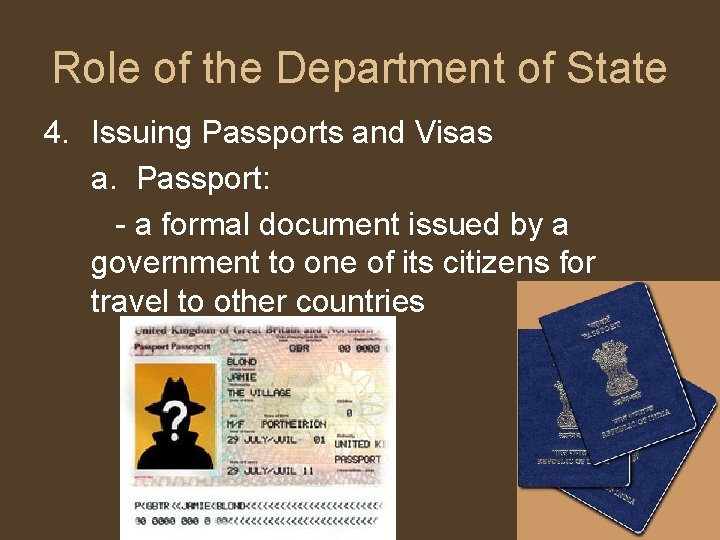
Role of the Department of State 4. Issuing Passports and Visas a. Passport: - a formal document issued by a government to one of its citizens for travel to other countries
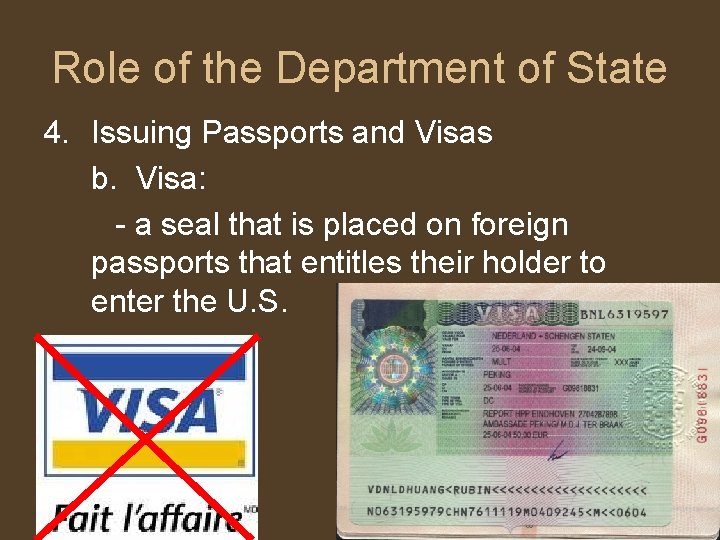
Role of the Department of State 4. Issuing Passports and Visas b. Visa: - a seal that is placed on foreign passports that entitles their holder to enter the U. S.
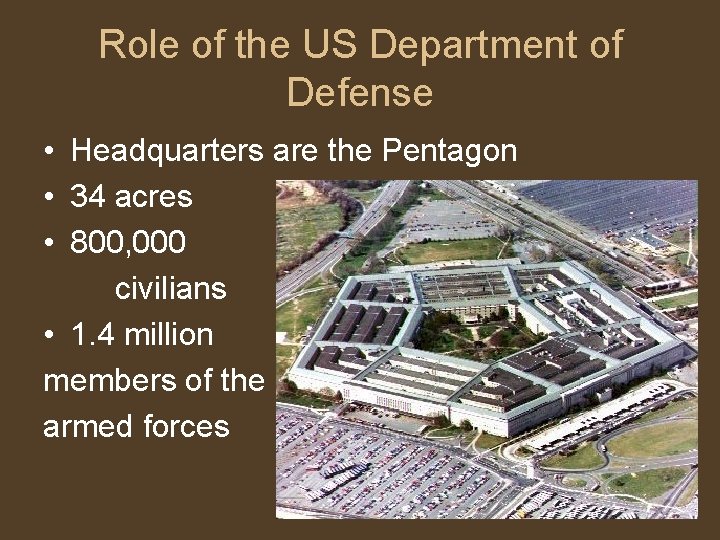
Role of the US Department of Defense • Headquarters are the Pentagon • 34 acres • 800, 000 civilians • 1. 4 million members of the armed forces
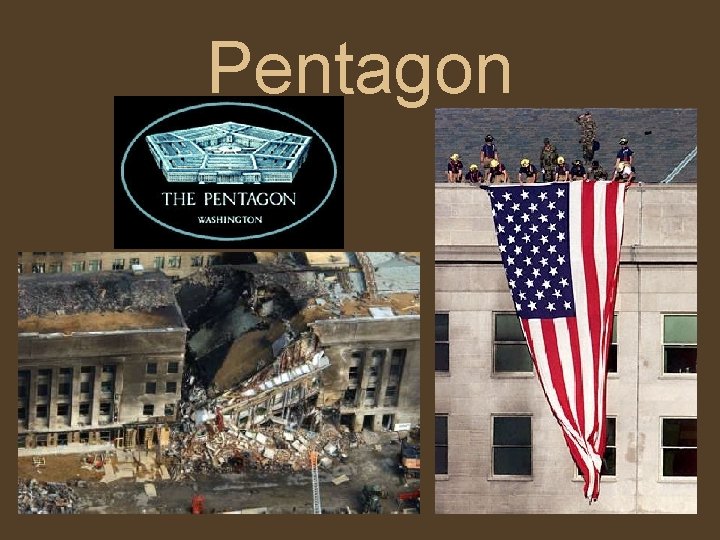
Pentagon
Role of the US Department of Defense • Joint Chiefs of Staff – Most influential military advisors • chair (selected by the president) • Army chief of staff • Chief of naval operations • Air Force chief of staff • Marine Corps commandant
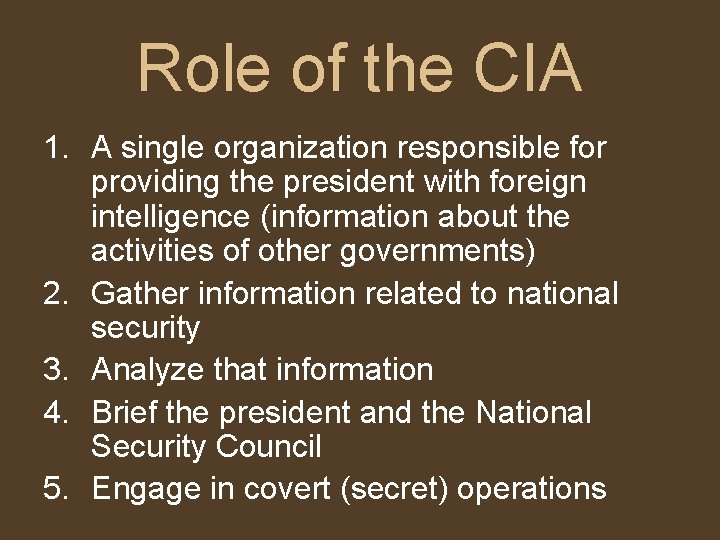
Role of the CIA 1. A single organization responsible for providing the president with foreign intelligence (information about the activities of other governments) 2. Gather information related to national security 3. Analyze that information 4. Brief the president and the National Security Council 5. Engage in covert (secret) operations