
Forefoot Fractures Marie Bamer What is a Forefoot
Forefoot Fractures Marie Bamer
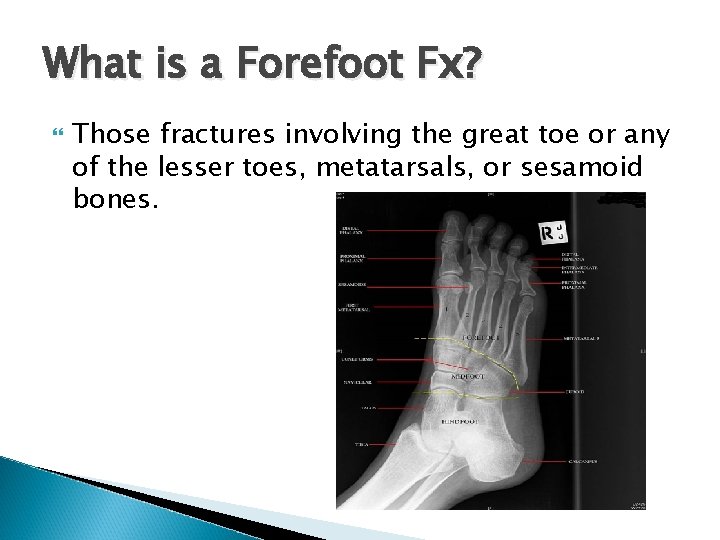
What is a Forefoot Fx? Those fractures involving the great toe or any of the lesser toes, metatarsals, or sesamoid bones.
3 Types of Forefoot Fractures Phalangeal Metatarsal Sesamoid
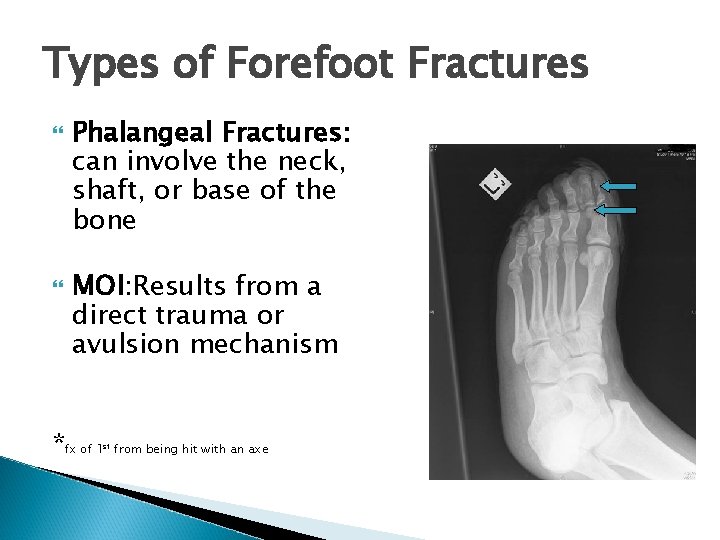
Types of Forefoot Fractures Phalangeal Fractures: can involve the neck, shaft, or base of the bone MOI: Results from a direct trauma or avulsion mechanism *fx of 1 st from being hit with an axe
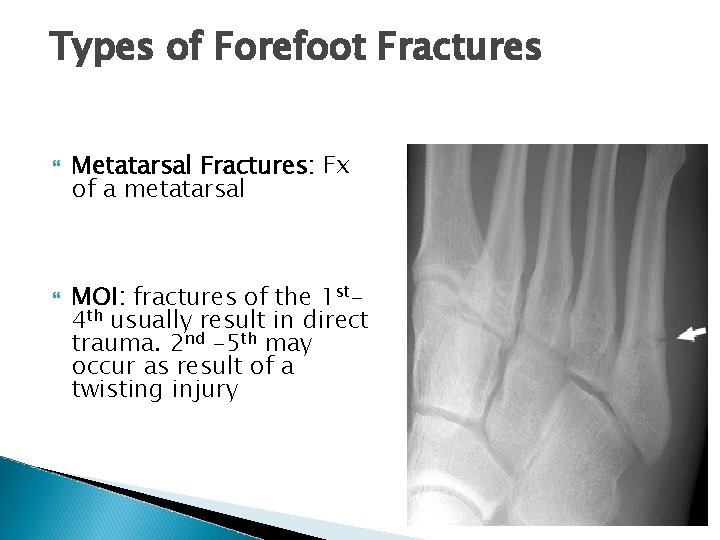
Types of Forefoot Fractures Metatarsal Fractures: Fx of a metatarsal MOI: fractures of the 1 st 4 th usually result in direct trauma. 2 nd -5 th may occur as result of a twisting injury
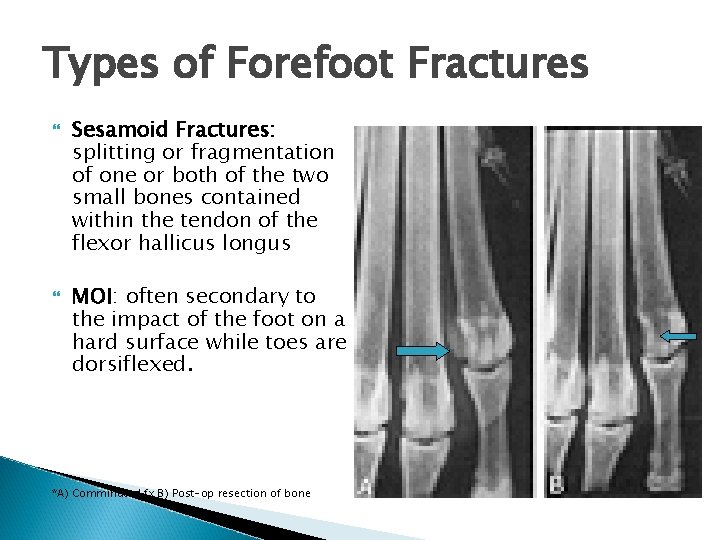
Types of Forefoot Fractures Sesamoid Fractures: splitting or fragmentation of one or both of the two small bones contained within the tendon of the flexor hallicus longus MOI: often secondary to the impact of the foot on a hard surface while toes are dorsiflexed. *A) Comminuted fx B) Post-op resection of bone
Treatment Goals Orthopaedic Objectives Anatomical alignment of the great toe, phalanx, metatarsal and sesamoid is essential in weight bearing and load distribution on the foot. Alignment of the 2 nd- 5 th metatarsals is important to minimize problematic gait and painful fitting of shoes Forefoot stability is important to maintain stable and pain-free gait
Treatment Goals Rehabilitation Objectives Range of Motion-restore and maintain all ROM Muscle Strength- improve and restore strength of extensors, flexors, invertors, and evertors in foot Functional Goals- normalize gait to pre-injury pattern
Expected time of bone healing Lesser Phalanx Fx: 4 to 6 weeks 2 nd, 3 rd and 4 th Metatarsal Fx: 4 to 6 weeks 5 th Metatarsal Fx ( Jones Fx): 6 to 8 weeks Great Toe Phalanx Fx: 4 to 6 weeks 1 st Metatarsal Fx: 6 to 8 weeks Sesamoid Fx: 4 to 8 weeks
Expected Time of Rehabilitation Lesser Phalanx Fx: 2 to 6 weeks 2 nd, 3 rd and 4 th Metatarsal Fx: 4 to 6 weeks 5 th Metatarsal Fx (Jones): 4 to 6 weeks (acute), 6 to 10 for delayed union, nonunion, or stress fx Great Toe Phalanx Fx: 4 to 6 weeks 1 st Metatarsal Fx: 4 to 6 weeks Sesamoid Fx: 8 to 12 weeks, possibly longer after sesamoidectomy
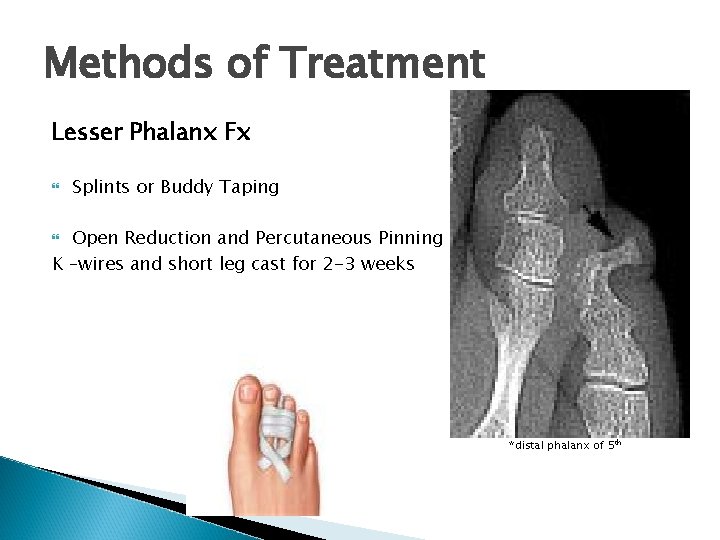
Methods of Treatment Lesser Phalanx Fx Splints or Buddy Taping Open Reduction and Percutaneous Pinning K –wires and short leg cast for 2 -3 weeks *distal phalanx of 5 th
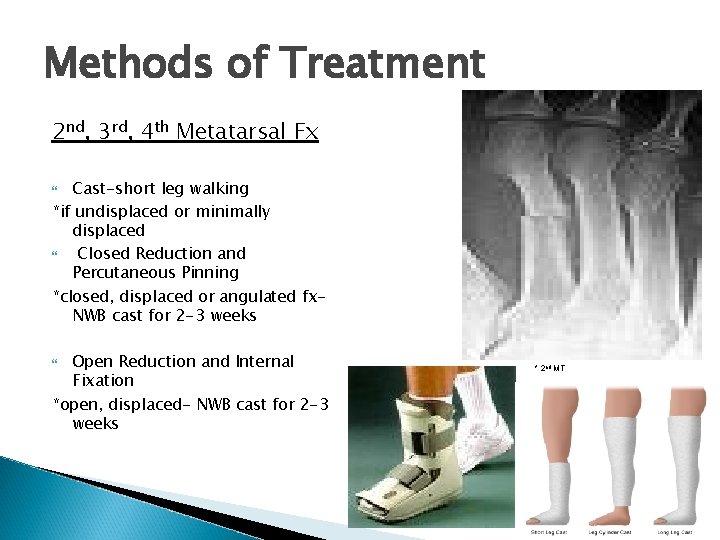
Methods of Treatment 2 nd, 3 rd, 4 th Metatarsal Fx Cast-short leg walking *if undisplaced or minimally displaced Closed Reduction and Percutaneous Pinning *closed, displaced or angulated fx. NWB cast for 2 -3 weeks Open Reduction and Internal Fixation *open, displaced- NWB cast for 2 -3 weeks * 2 nd MT
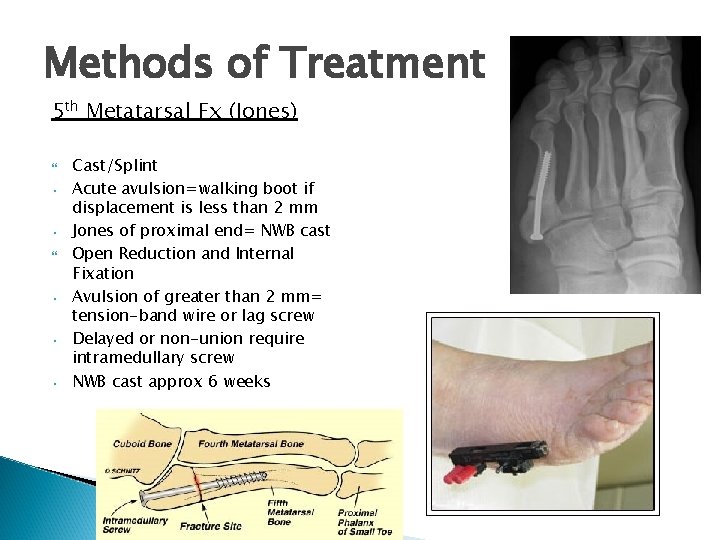
Methods of Treatment 5 th Metatarsal Fx (Jones) • • • Cast/Splint Acute avulsion=walking boot if displacement is less than 2 mm Jones of proximal end= NWB cast Open Reduction and Internal Fixation Avulsion of greater than 2 mm= tension-band wire or lag screw Delayed or non-union require intramedullary screw NWB cast approx 6 weeks
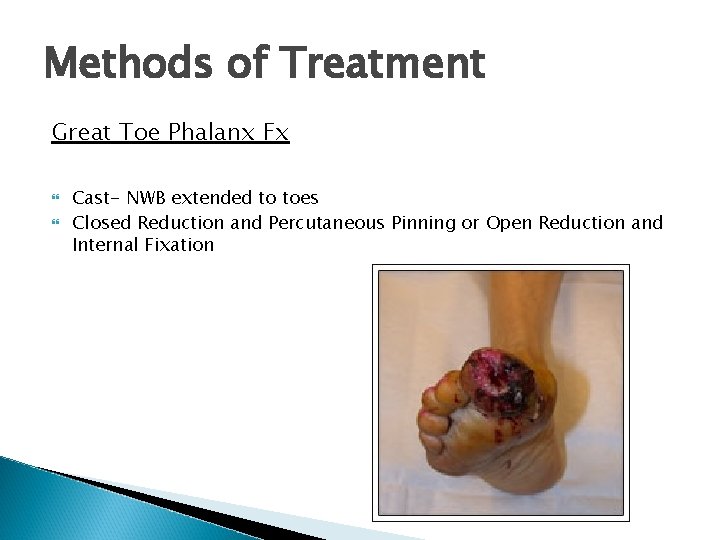
Methods of Treatment Great Toe Phalanx Fx Cast- NWB extended to toes Closed Reduction and Percutaneous Pinning or Open Reduction and Internal Fixation
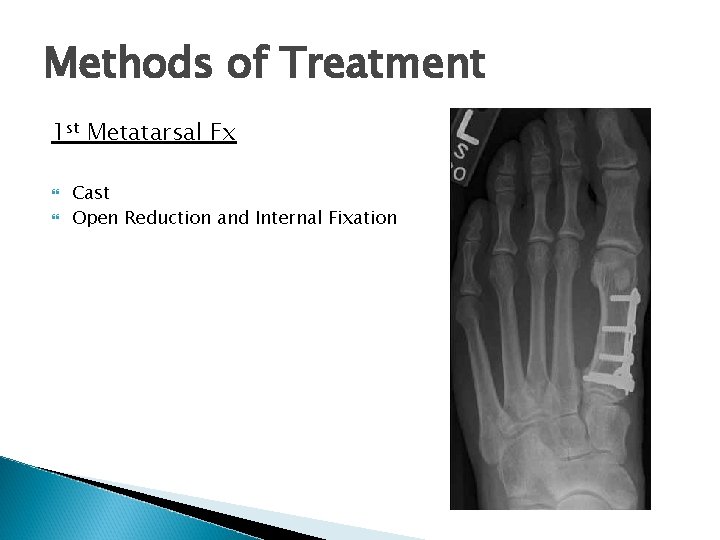
Methods of Treatment 1 st Metatarsal Fx Cast Open Reduction and Internal Fixation
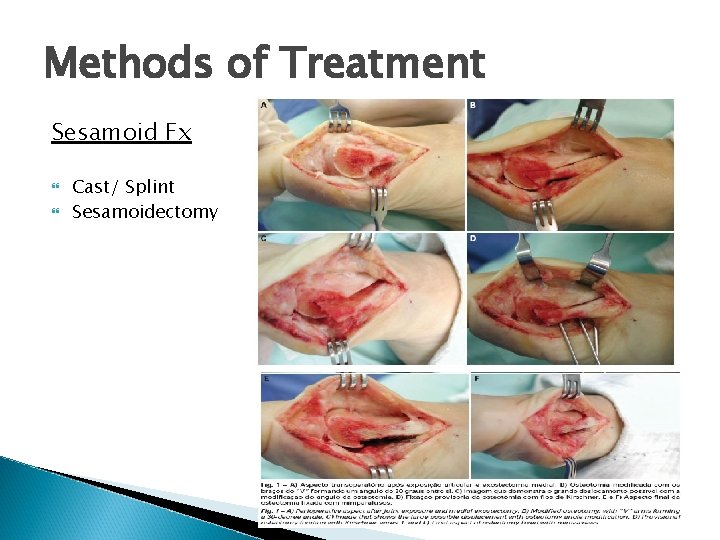
Methods of Treatment Sesamoid Fx Cast/ Splint Sesamoidectomy
Phase of Bone Healing Day of injury to 1 week Stability of fx site: None Stage of Bone Healing: Inflammatory phase Radiograph: No callus * NWB, check cap refill, no deformities, radiograph,
Phase of Bone Healing Two Weeks Stability of fx site: None to minimal Stage of bone healing: Begins reparative phase Radiograph: No change or early callus
Phase of Bone Healing Four to Six Weeks Stability of fx site: Bridging callus and fx usually stable (acute fx) Stage of bone healing: reparative phase Radiograph: Bridging callus visible
Phase of Bone Healing Six to Eight Weeks Stability of fx site: Fx stable with bridging callus Stage of bone healing: reparative phase Radiograph: Bridging callus visible w/ increased ridgidity. Fx line less distinct
Phase of Bone Healing Eight to Twelve Weeks Stability of fx site: Stable Stage of bone healing: Remodeling Phase Radiograph: abundant callus
Special Considerations of the Fracture Age – elderly at higher risks for joint stiffness Articular Involvement- any fx in forefoot requires anatomic reduction Location Open Fractures- all must be treated aggressively with irrigation, debridement, and intravenous antibiotics
- Slides: 22