
Forecast Sensitivity Observation Impact FSOI Intercomparison Experiment Tom
Forecast Sensitivity - Observation Impact (FSOI) Inter-comparison Experiment Tom Auligné, Joint Center for Satellite Data Assimilation (JCSDA) Ron Gelaro, NASA, Global Modeling and Assimilation Office (GMAO) Rahul Mahajan, David Groff, NOAA, National Weather Service (NWS) Rolf Langland, Naval Research Laboratory (NRL) Jianjun Liu, NOAA’s Satellite and Information Service ( NESDIS) James Cotton, Larry Morgan, UK Met Office Yoichiro Ota, Japan Meterological Agency (JMA) 1
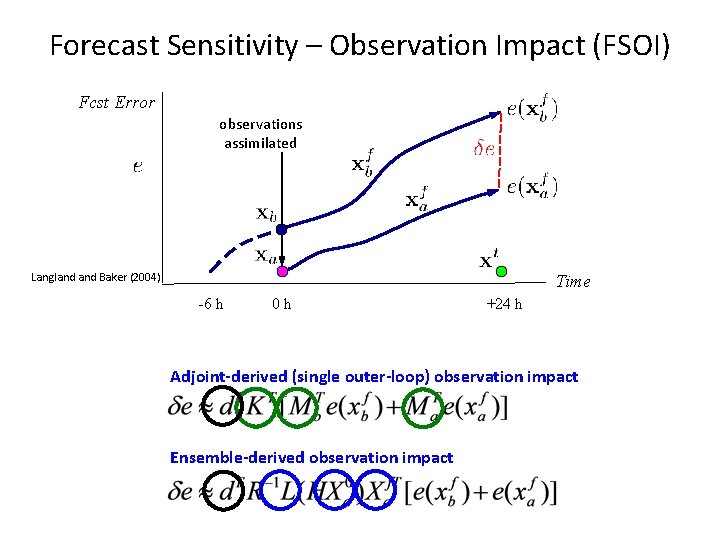
Forecast Sensitivity – Observation Impact (FSOI) Fcst Error observations assimilated Langland Baker (2004) Time -6 h 0 h +24 h Adjoint-derived (single outer-loop) observation impact Ensemble-derived observation impact
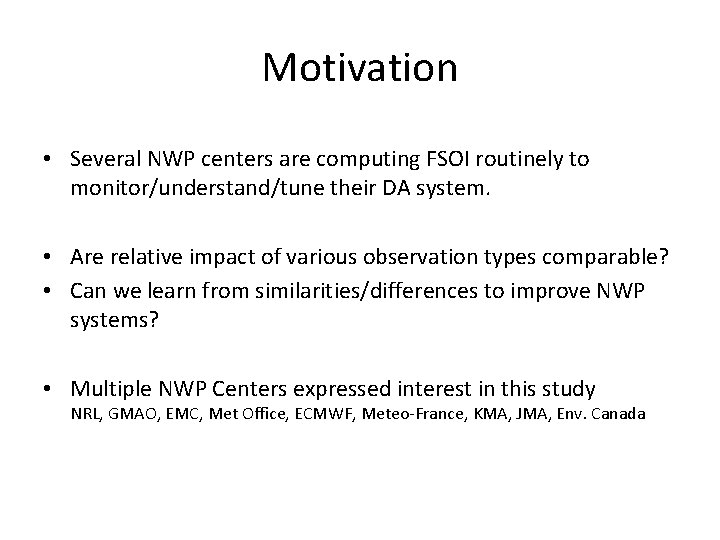
Motivation • Several NWP centers are computing FSOI routinely to monitor/understand/tune their DA system. • Are relative impact of various observation types comparable? • Can we learn from similarities/differences to improve NWP systems? • Multiple NWP Centers expressed interest in this study NRL, GMAO, EMC, Met Office, ECMWF, Meteo-France, KMA, JMA, Env. Canada
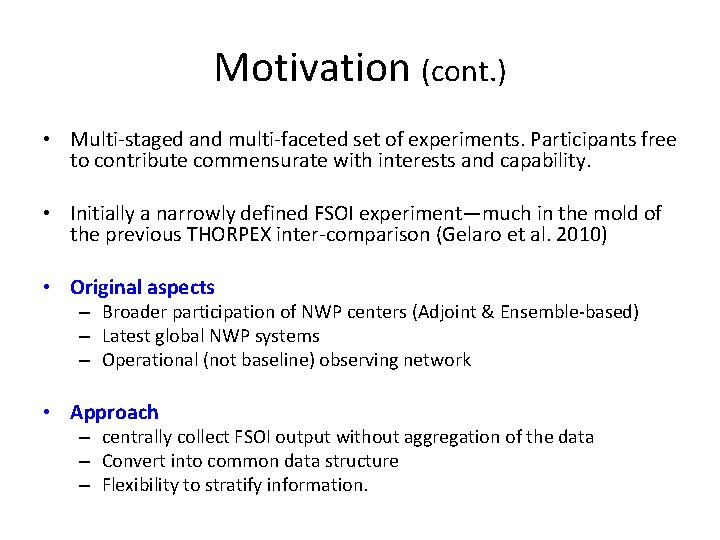
Motivation (cont. ) • Multi-staged and multi-faceted set of experiments. Participants free to contribute commensurate with interests and capability. • Initially a narrowly defined FSOI experiment—much in the mold of the previous THORPEX inter-comparison (Gelaro et al. 2010) • Original aspects – Broader participation of NWP centers (Adjoint & Ensemble-based) – Latest global NWP systems – Operational (not baseline) observing network • Approach – centrally collect FSOI output without aggregation of the data – Convert into common data structure – Flexibility to stratify information.
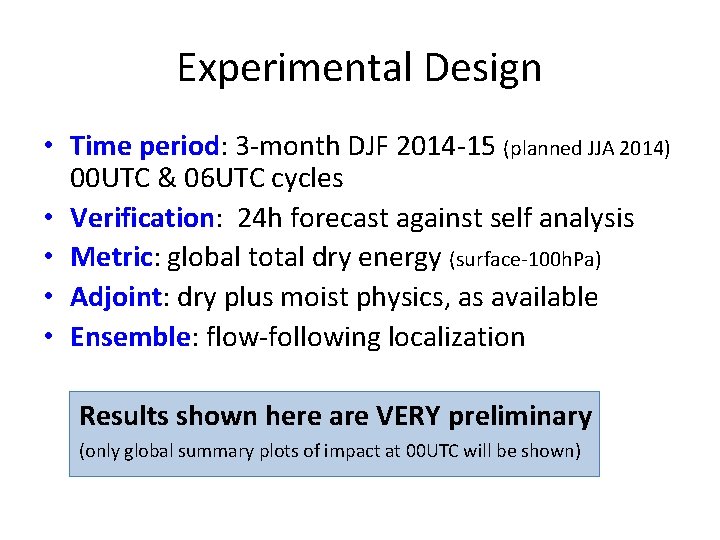
Experimental Design • Time period: 3 -month DJF 2014 -15 (planned JJA 2014) 00 UTC & 06 UTC cycles • Verification: 24 h forecast against self analysis • Metric: global total dry energy (surface-100 h. Pa) • Adjoint: dry plus moist physics, as available • Ensemble: flow-following localization Results shown here are VERY preliminary (only global summary plots of impact at 00 UTC will be shown)
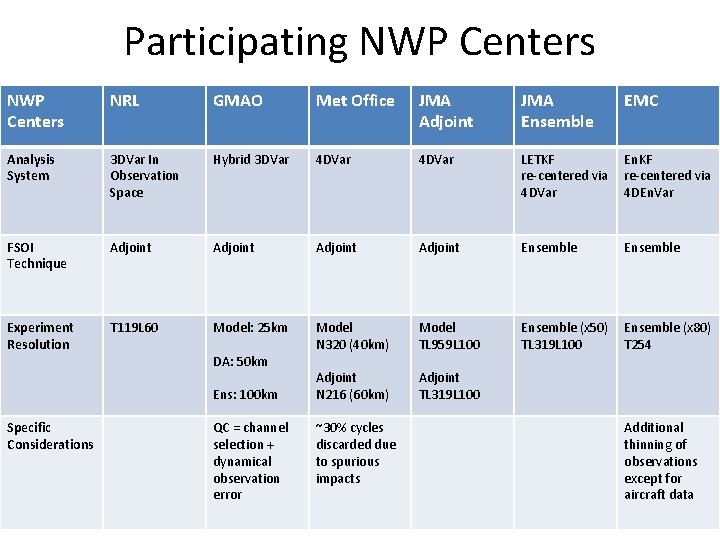
Participating NWP Centers NRL GMAO Met Office JMA Adjoint JMA Ensemble Analysis System 3 DVar In Observation Space Hybrid 3 DVar 4 DVar LETKF En. KF re-centered via 4 DVar 4 DEn. Var FSOI Technique Adjoint Ensemble Experiment Resolution T 119 L 60 Model: 25 km Model N 320 (40 km) Model TL 959 L 100 Ensemble (x 50) Ensemble (x 80) TL 319 L 100 T 254 Adjoint N 216 (60 km) Adjoint TL 319 L 100 DA: 50 km Ens: 100 km Specific Considerations QC = channel selection + dynamical observation error ~30% cycles discarded due to spurious impacts EMC Ensemble Additional thinning of observations except for aircraft data
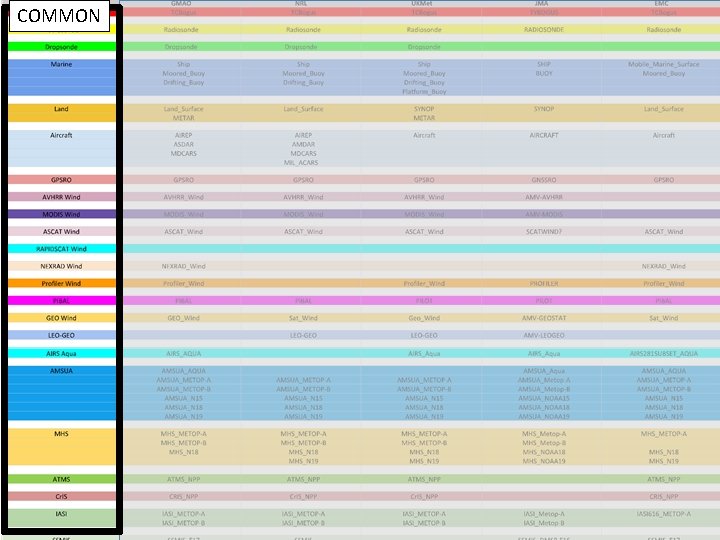
COMMON
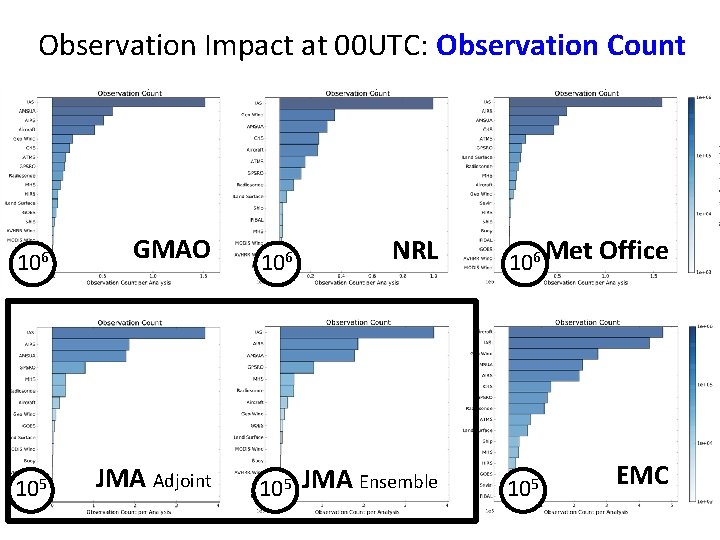
Observation Impact at 00 UTC: Observation Count 106 GMAO 105 JMA Adjoint 106 NRL 105 JMA Ensemble 106`Met Office 105 EMC

Observation Impact at 00 UTC: Observation Count
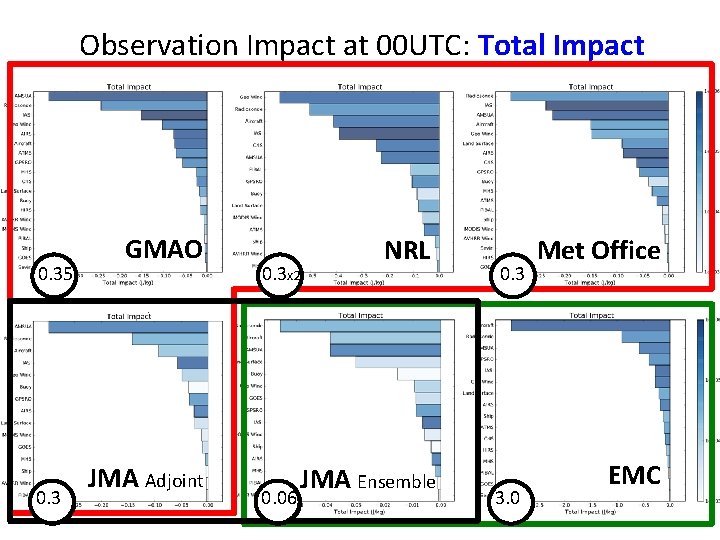
Observation Impact at 00 UTC: Total Impact 0. 35 0. 3 GMAO JMA Adjoint 0. 3 x 2 0. 06 NRL JMA Ensemble 0. 3 3. 0 Met Office EMC
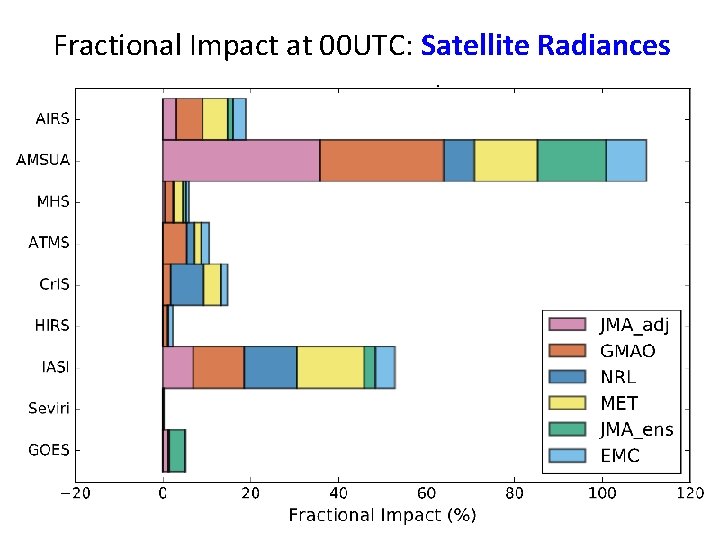
Fractional Impact at 00 UTC: Satellite Radiances
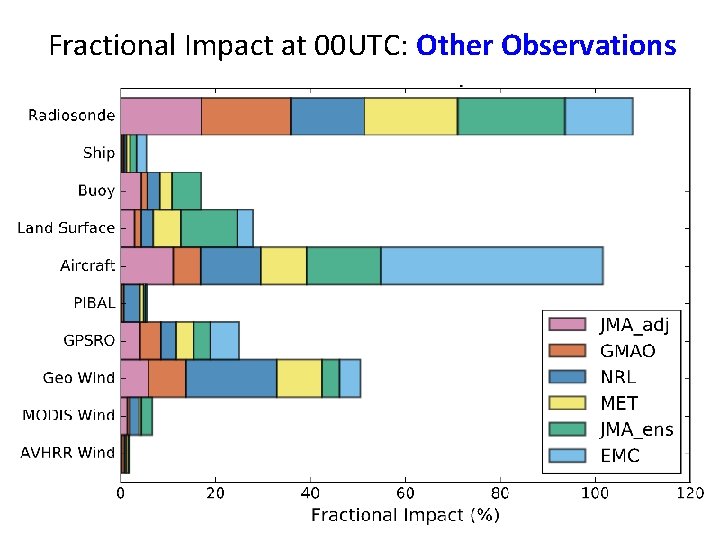
Fractional Impact at 00 UTC: Other Observations

Observation Impact at 00 UTC: Fraction of Beneficial Observations Impact < 0 Beneficial Impact > 0 Detrimental ε=10 -10 Impact < -ε Beneficial Impact > ε Detrimental -ε < Impact < ε Neutral
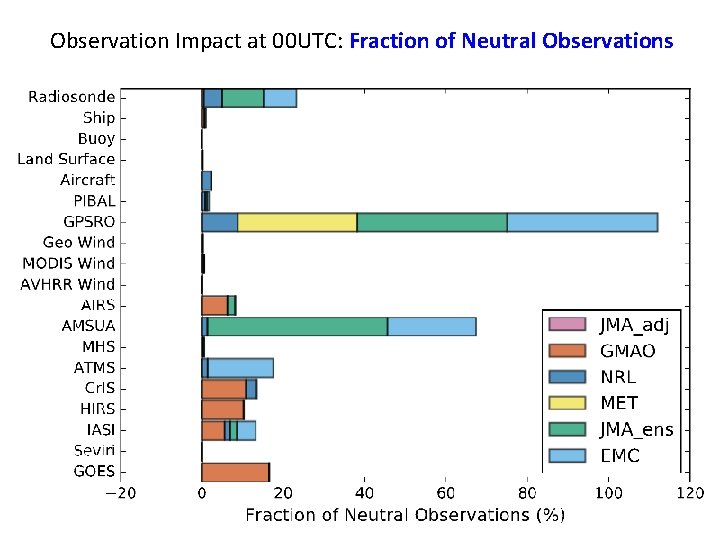
Observation Impact at 00 UTC: Fraction of Neutral Observations
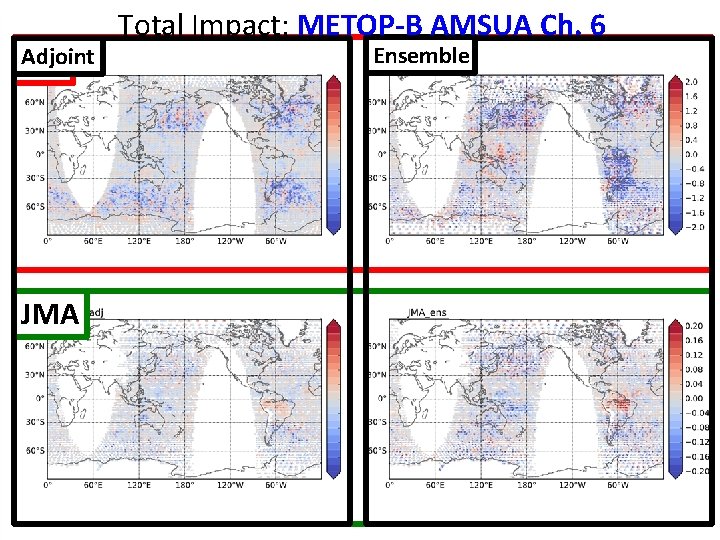
Adjoint GSI JMA Total Impact: METOP-B AMSUA Ch. 6 Ensemble
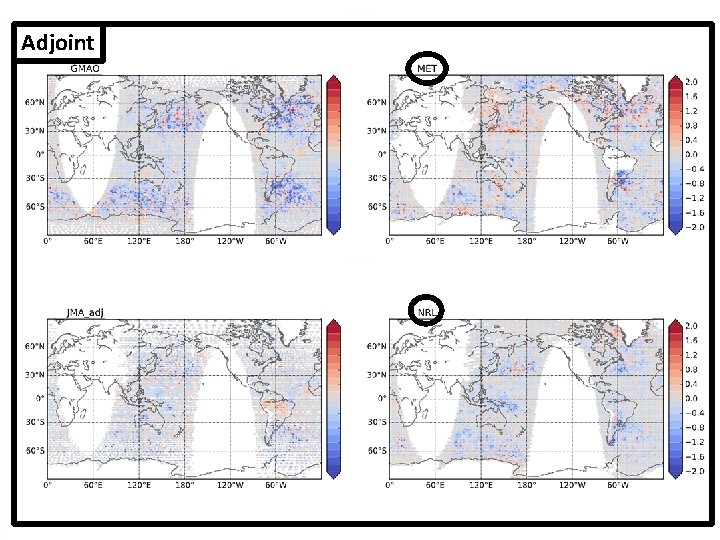
Adjoint
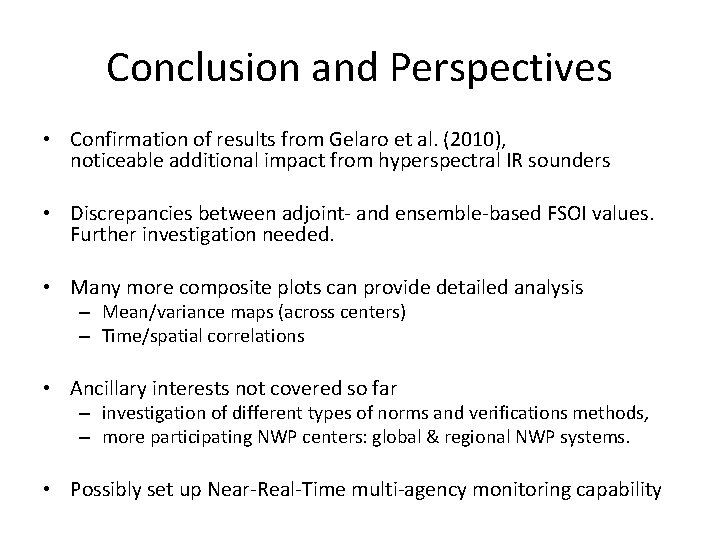
Conclusion and Perspectives • Confirmation of results from Gelaro et al. (2010), noticeable additional impact from hyperspectral IR sounders • Discrepancies between adjoint- and ensemble-based FSOI values. Further investigation needed. • Many more composite plots can provide detailed analysis – Mean/variance maps (across centers) – Time/spatial correlations • Ancillary interests not covered so far – investigation of different types of norms and verifications methods, – more participating NWP centers: global & regional NWP systems. • Possibly set up Near-Real-Time multi-agency monitoring capability
Questions? 18
- Slides: 18