
FORCES Vectors have magnitude and direction Scalar quantities
- Slides: 24
FORCES
Vectors have magnitude and direction. Scalar quantities have magnitude only. A force is an action that causes a change Forces are measured in units known as Newtons (N).
Contact and Non-contact Forces These two force types exist in nature and affect the way that humans move. The most important non-contact force is gravity. Others include magnetic and electrical. Examples of Contact Forces: Ground Reaction Force Joint Reaction Friction Fluid resistance Muscle Force Elastic Force
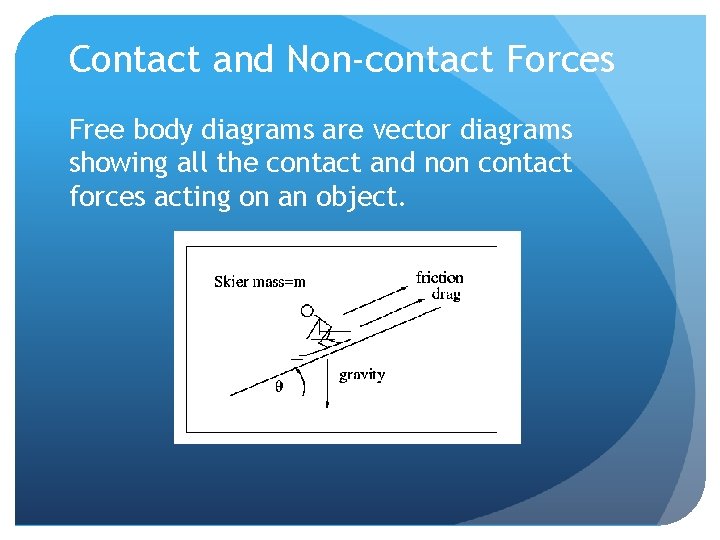
Contact and Non-contact Forces Free body diagrams are vector diagrams showing all the contact and non contact forces acting on an object.
Contact and Non-contact Forces Draw and label a free body diagram for: a. ) person running b. ) high jumper c. ) cyclist d. ) a discus that is in flight
Newton’s Laws of Motion
Isaac Newton was a mid 1600 American scientist. As a scientist he was responsible for many advances including the reflecting telescope, the calculus branch of mathematics and most importantly for us the effect of gravity and the law’s of motion. The unit of force is named after him.
First Law of Motion Often referred to as the Law of Inertia. The law states that ‘objects will continue to either stay at rest or move with the same speed and direction unless another force acts upon the object’. In other words objects will tend to keep doing what they were already doing.
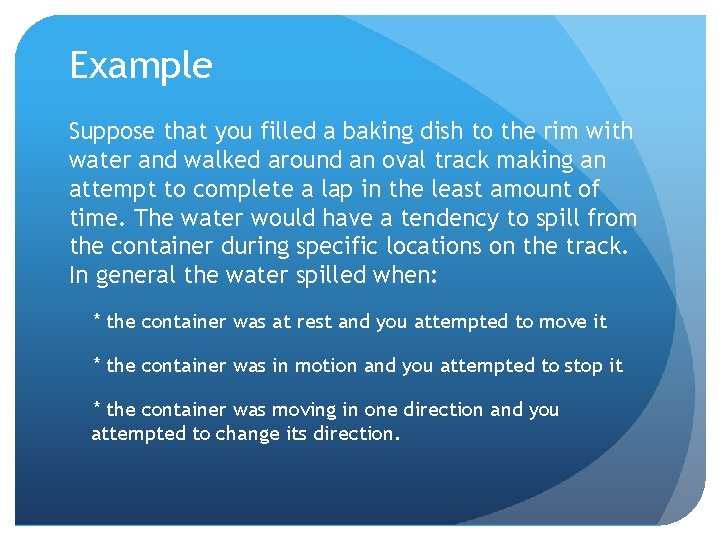
Example Suppose that you filled a baking dish to the rim with water and walked around an oval track making an attempt to complete a lap in the least amount of time. The water would have a tendency to spill from the container during specific locations on the track. In general the water spilled when: * the container was at rest and you attempted to move it * the container was in motion and you attempted to stop it * the container was moving in one direction and you attempted to change its direction.
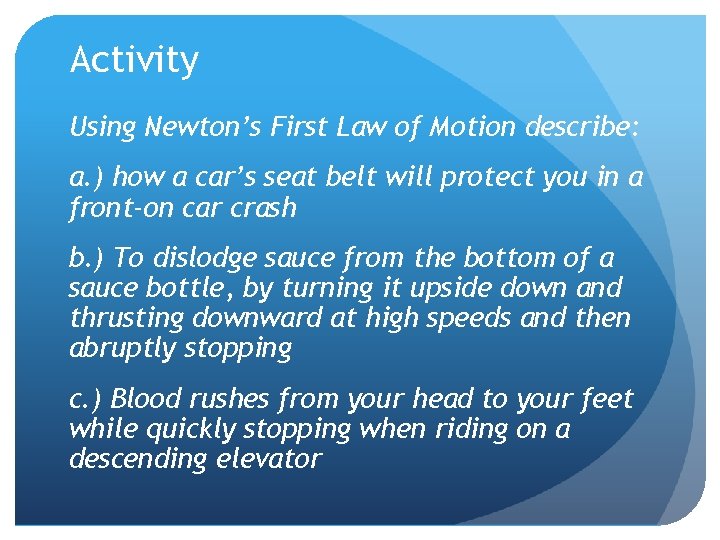
Activity Using Newton’s First Law of Motion describe: a. ) how a car’s seat belt will protect you in a front-on car crash b. ) To dislodge sauce from the bottom of a sauce bottle, by turning it upside down and thrusting downward at high speeds and then abruptly stopping c. ) Blood rushes from your head to your feet while quickly stopping when riding on a descending elevator
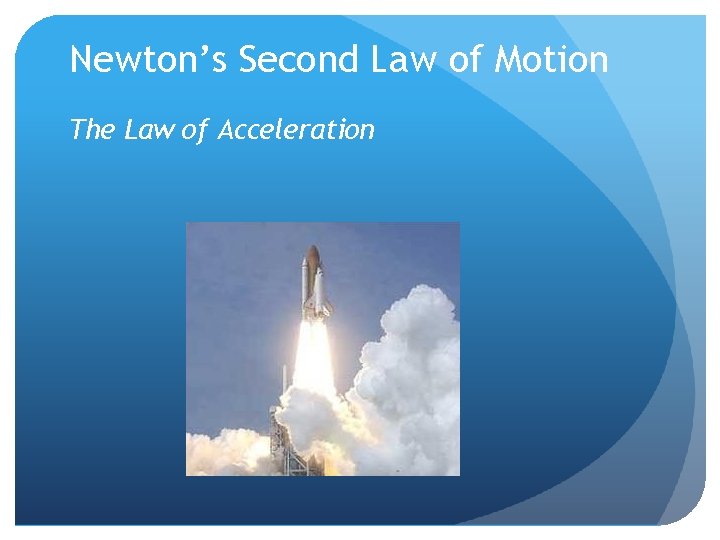
Newton’s Second Law of Motion The Law of Acceleration
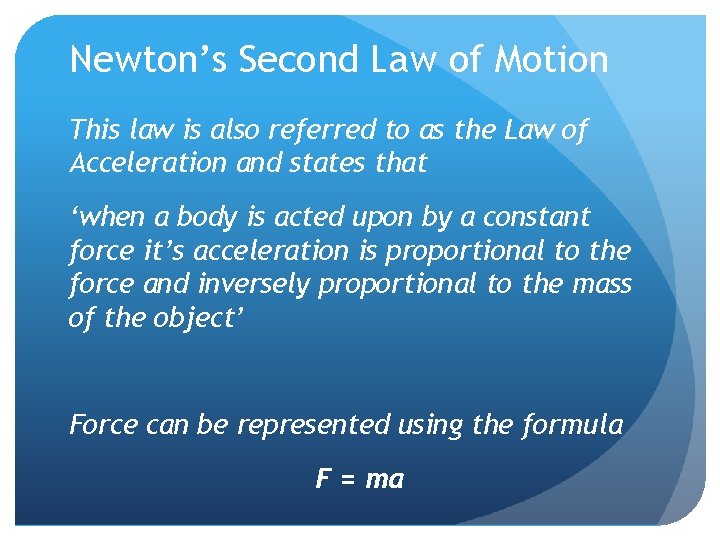
Newton’s Second Law of Motion This law is also referred to as the Law of Acceleration and states that ‘when a body is acted upon by a constant force it’s acceleration is proportional to the force and inversely proportional to the mass of the object’ Force can be represented using the formula F = ma
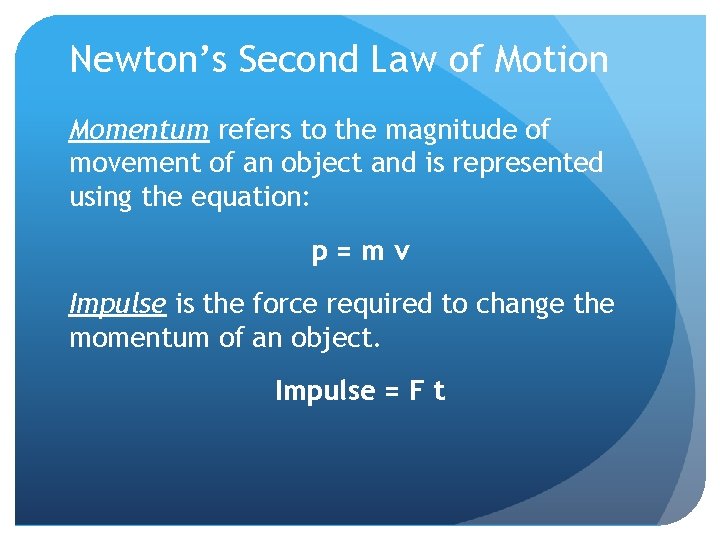
Newton’s Second Law of Motion Momentum refers to the magnitude of movement of an object and is represented using the equation: p=mv Impulse is the force required to change the momentum of an object. Impulse = F t
Newton’s Second Law of Motion Activity Complete the worksheet looking at Newton’s Second Law of Motion.
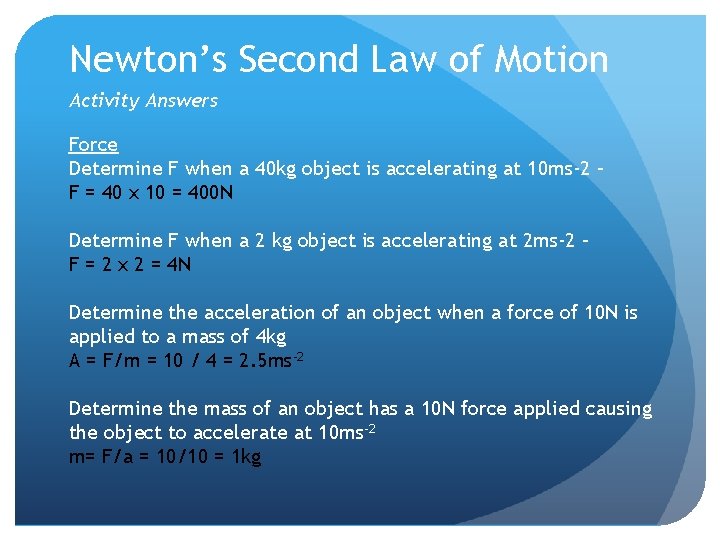
Newton’s Second Law of Motion Activity Answers Force Determine F when a 40 kg object is accelerating at 10 ms-2 – F = 40 x 10 = 400 N Determine F when a 2 kg object is accelerating at 2 ms-2 – F = 2 x 2 = 4 N Determine the acceleration of an object when a force of 10 N is applied to a mass of 4 kg A = F/m = 10 / 4 = 2. 5 ms-2 Determine the mass of an object has a 10 N force applied causing the object to accelerate at 10 ms-2 m= F/a = 10/10 = 1 kg
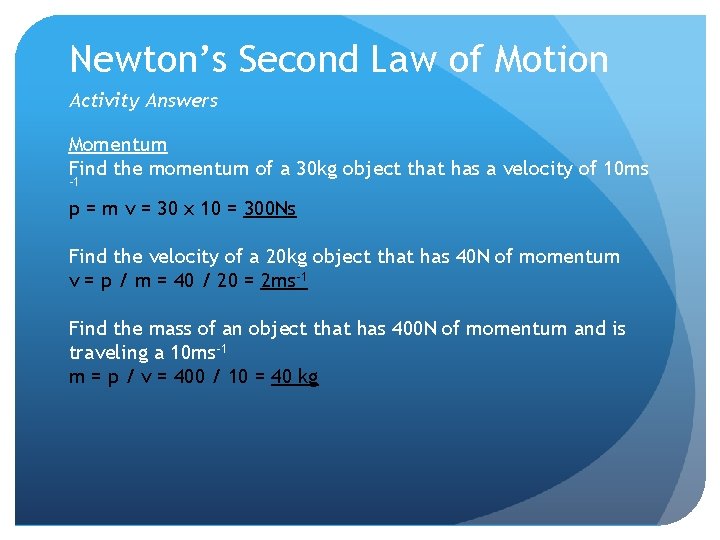
Newton’s Second Law of Motion Activity Answers Momentum Find the momentum of a 30 kg object that has a velocity of 10 ms -1 p = m v = 30 x 10 = 300 Ns Find the velocity of a 20 kg object that has 40 N of momentum v = p / m = 40 / 20 = 2 ms-1 Find the mass of an object that has 400 N of momentum and is traveling a 10 ms-1 m = p / v = 400 / 10 = 40 kg
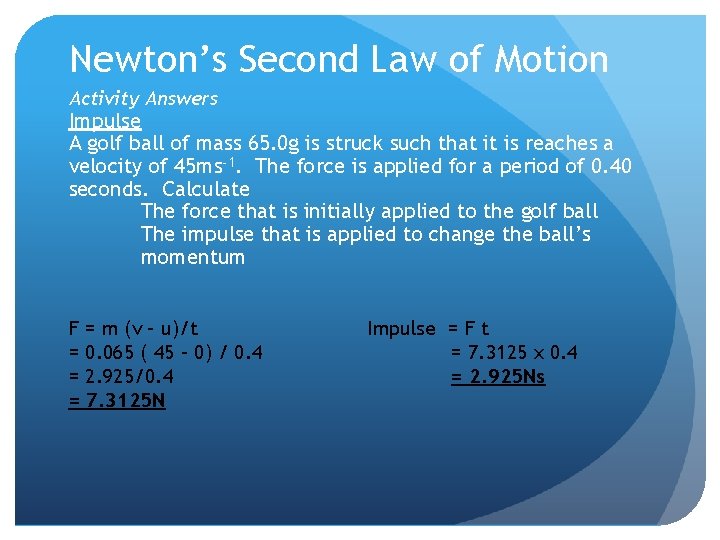
Newton’s Second Law of Motion Activity Answers Impulse A golf ball of mass 65. 0 g is struck such that it is reaches a velocity of 45 ms-1. The force is applied for a period of 0. 40 seconds. Calculate The force that is initially applied to the golf ball The impulse that is applied to change the ball’s momentum F = m (v – u)/t = 0. 065 ( 45 – 0) / 0. 4 = 2. 925/0. 4 = 7. 3125 N Impulse = F t = 7. 3125 x 0. 4 = 2. 925 Ns
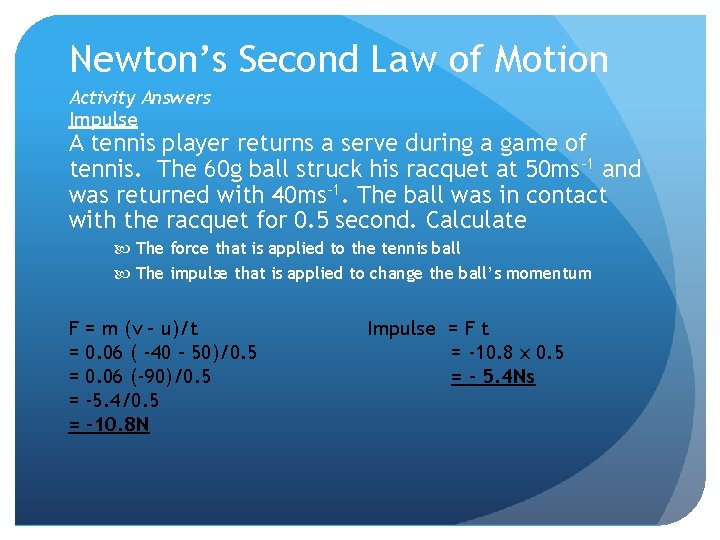
Newton’s Second Law of Motion Activity Answers Impulse A tennis player returns a serve during a game of tennis. The 60 g ball struck his racquet at 50 ms-1 and was returned with 40 ms-1. The ball was in contact with the racquet for 0. 5 second. Calculate The force that is applied to the tennis ball The impulse that is applied to change the ball’s momentum F = m (v – u)/t = 0. 06 ( -40 – 50)/0. 5 = 0. 06 (-90)/0. 5 = -5. 4/0. 5 = -10. 8 N Impulse = F t = -10. 8 x 0. 5 = - 5. 4 Ns
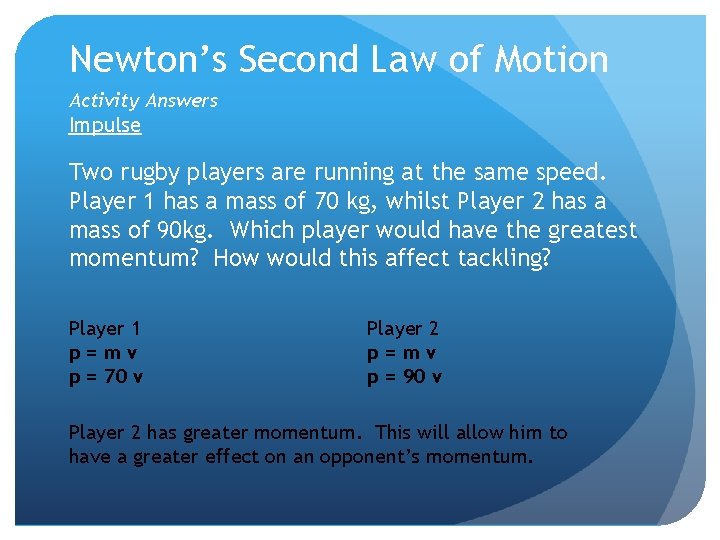
Newton’s Second Law of Motion Activity Answers Impulse Two rugby players are running at the same speed. Player 1 has a mass of 70 kg, whilst Player 2 has a mass of 90 kg. Which player would have the greatest momentum? How would this affect tackling? Player 1 p=mv p = 70 v Player 2 p=mv p = 90 v Player 2 has greater momentum. This will allow him to have a greater effect on an opponent’s momentum.
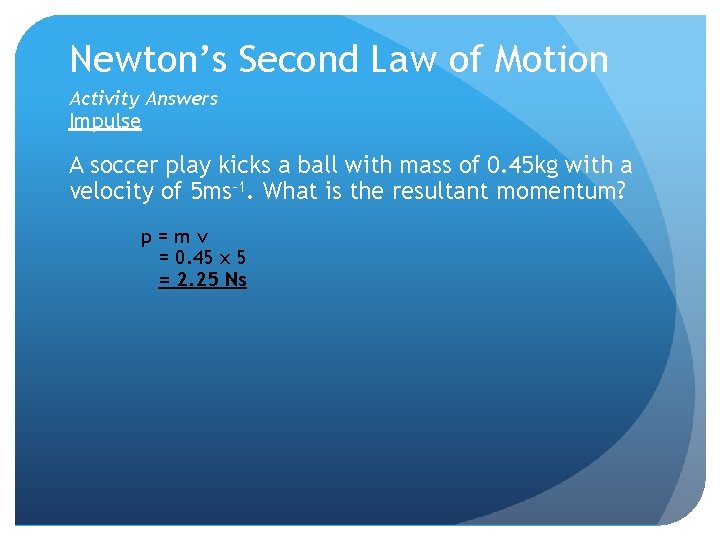
Newton’s Second Law of Motion Activity Answers Impulse A soccer play kicks a ball with mass of 0. 45 kg with a velocity of 5 ms-1. What is the resultant momentum? p=mv = 0. 45 x 5 = 2. 25 Ns
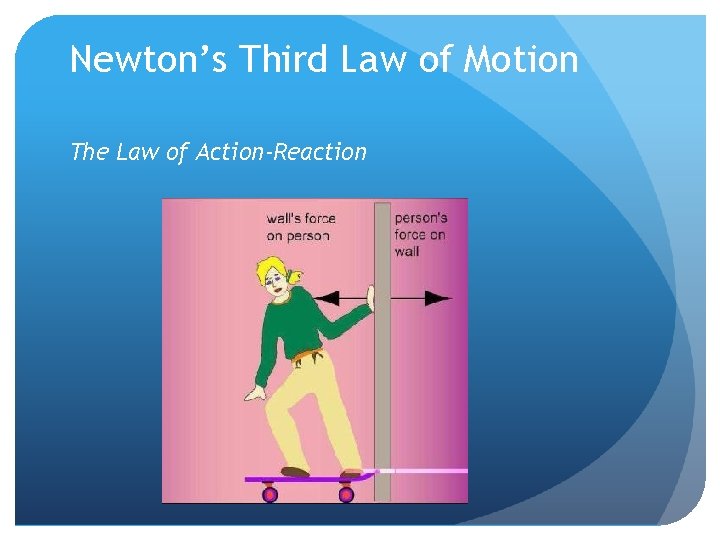
Newton’s Third Law of Motion The Law of Action-Reaction
Newton’s Third Law of Motion The third law of motion is often referred to as the law of action-reaction. It states: ‘To every action there is an equal or opposite reaction’ In simple terms this means that forces cannot act in isolation. When a long jumper lands not only is he applying a force to the ground on impact but the earth exerts an equal and opposite force.
Newton’s Third Law of Motion Try these questions to test your understanding of the Third Law of Motion. While driving down the road, a firefly strikes the windshield of a bus and makes a quite obvious mess in front of the face of the driver. The firefly hit the bus and the bus hits the firefly. Which of the two forces is greater: the force on the firefly or the force on the bus? Trick Question! Each force is the same size. For every action, there is an equal. . .
Newton’s Third Law of Motion Many people are familiar with the fact that a rifle recoils when fired. This recoil is the result of action-reaction force pairs. A gunpowder explosion creates hot gases which expand outward allowing the rifle to push forward on the bullet. Consistent with Newton's third law of motion, the bullet pushes backwards upon the rifle. The acceleration of the recoiling rifle is. . . a. greater than the acceleration of the bullet. b. smaller than the acceleration of the bullet. c. the same size as the acceleration of the bullet. The force on the rifle equals the force on the bullet. Yet, acceleration depends on both force and mass. The bullet has a greater acceleration due to the fact that it has a smaller mass.