
FORCES NEWTONS LAWS Chapter 12 Objectives Students will
FORCES & NEWTON’S LAWS Chapter 12
Objectives: Students will be able to… q. Define force q. Describe net force and its effects
Observe q. Observe the textbook on the table q. Describe its motion relative to the room; does it change? q. Observe the rolling ball q. How does its motion change? q. Observe the dropped ball q. How does its motion change?
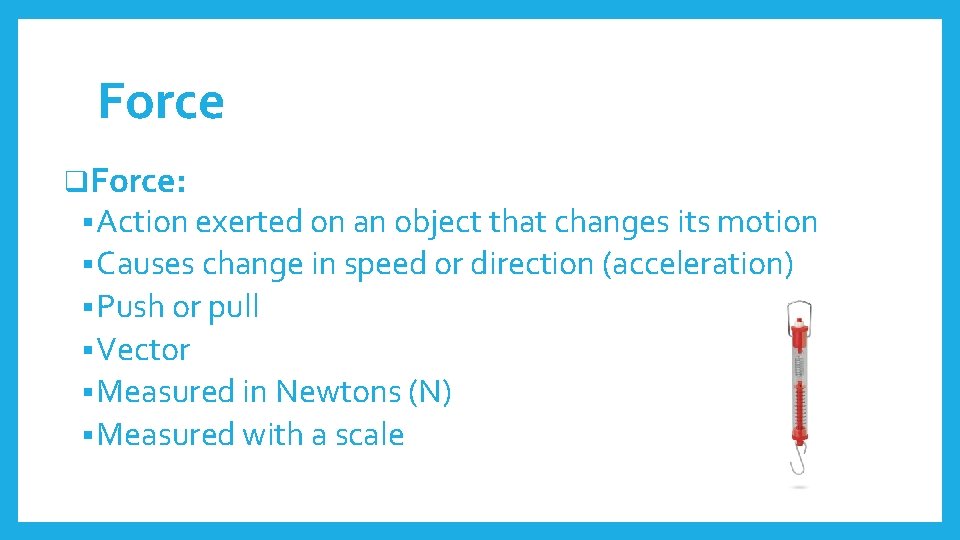
Force q. Force: § Action exerted on an object that changes its motion § Causes change in speed or direction (acceleration) § Push or pull § Vector § Measured in Newtons (N) § Measured with a scale
Fundamental forces q. There are four fundamental forces in the universe § Strong nuclear § Weak nuclear § Gravity § Electromagnetic
Contact vs Field q. Contact forces act on objects they touch § Pushing a chair, friction q. Field forces act on objects over a distance without making contact § Gravity, magnetic attraction/repulsion
Net force q. Net force: combination of all forces on an object § Vector § Same direction add forces § Opposite direction subtract forces
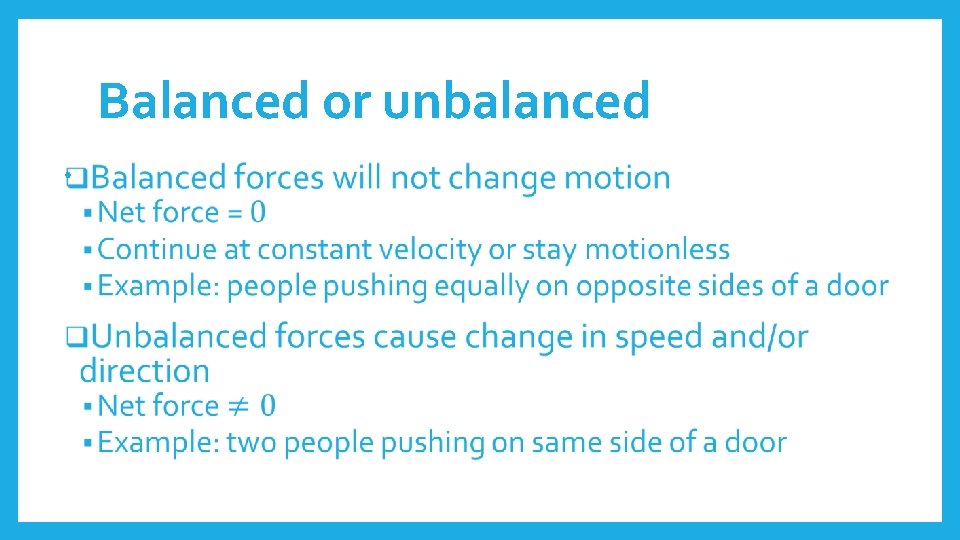
Balanced or unbalanced •
Balanced or unbalanced q. Consider the following examples. What forces are involved? Is the net force balanced or unbalanced? What is your evidence? § Ball in hand § Dropped ball
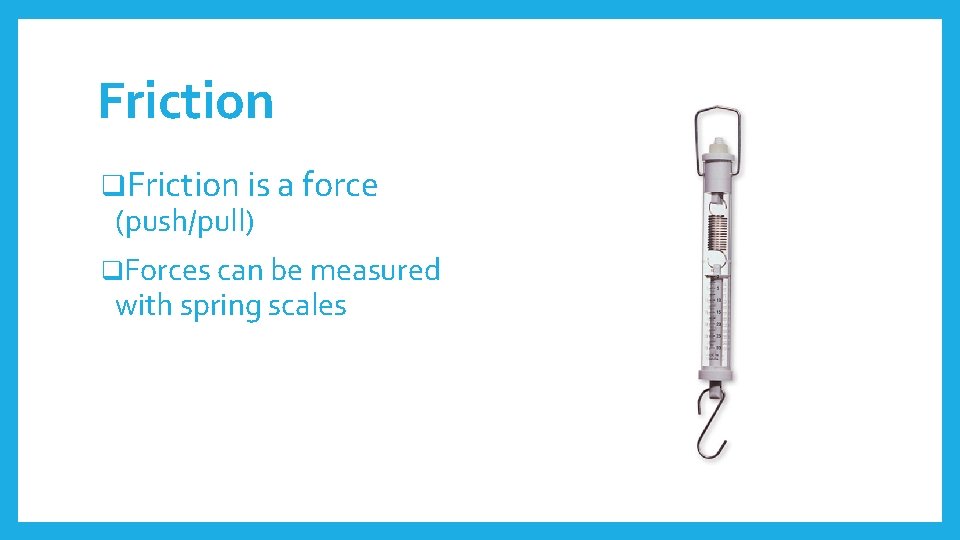
Friction q. Friction is a force (push/pull) q. Forces can be measured with spring scales
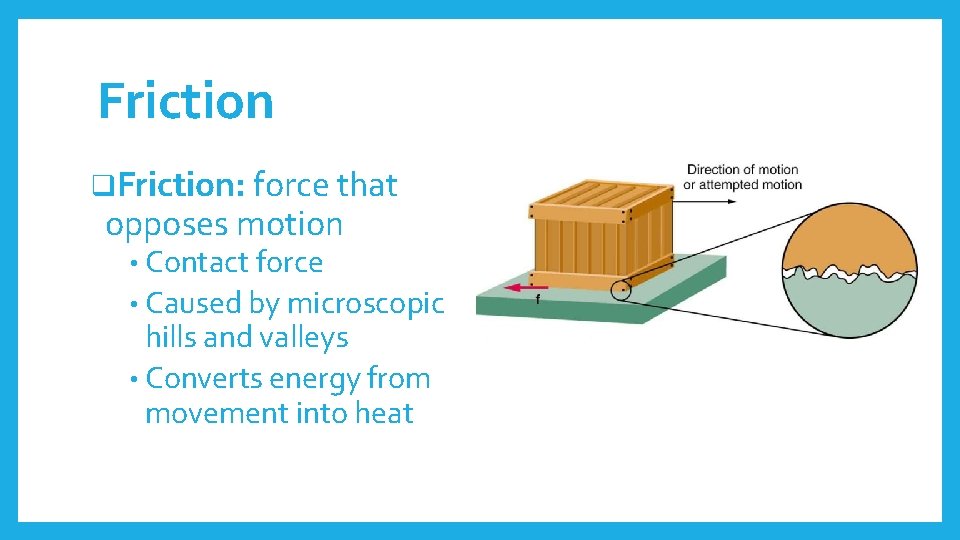
Friction q. Friction: force that opposes motion • Contact force • Caused by microscopic hills and valleys • Converts energy from movement into heat
Types of friction q. Static friction: between two non-moving objects q. Kinetic friction: between moving object and a surface • Sliding – object is sliding (example: pushing box across floor) • Rolling – object is rolling (examples: tires, wheels, rollers)
Friction problems q. Friction converts energy from movement into heat q. Machine parts can wear down and/or overheat q. Adding lubricants (oil, graphite, etc. ) help to reduce friction
Friction lab discussion q. The spring scale actually measures the force of your pull, so how can it be used to measure the friction? q. The objects are either not moving (static friction) or moving at constant speed (sliding & rolling friction) § Objects have constant motion if forces are balanced § Your pull in one direction = friction’s pull in opposite direction
Schedule – Tuesday, Oct. q. Discuss friction labs q. Newton’s 1 st law demos q. Newton’s 1 st law notes th 10
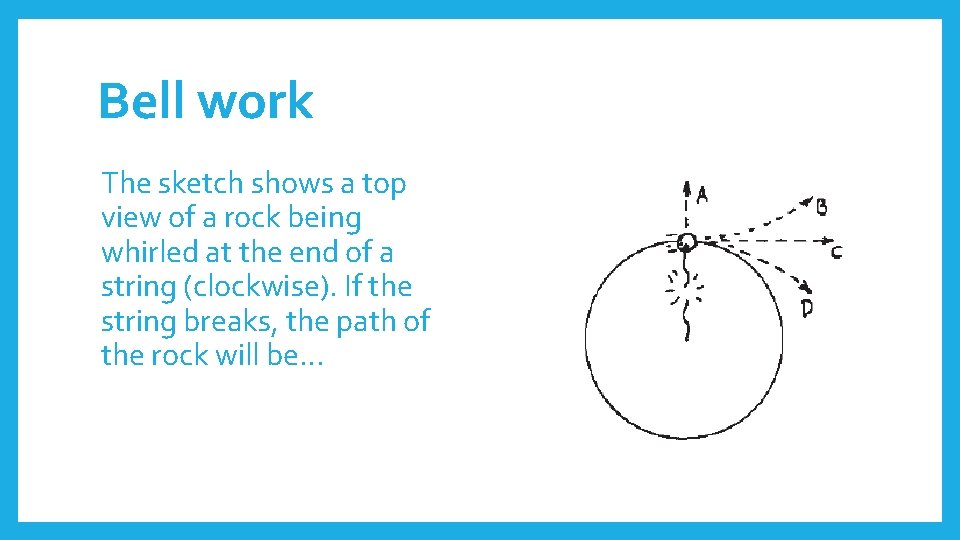
Bell work The sketch shows a top view of a rock being whirled at the end of a string (clockwise). If the string breaks, the path of the rock will be…
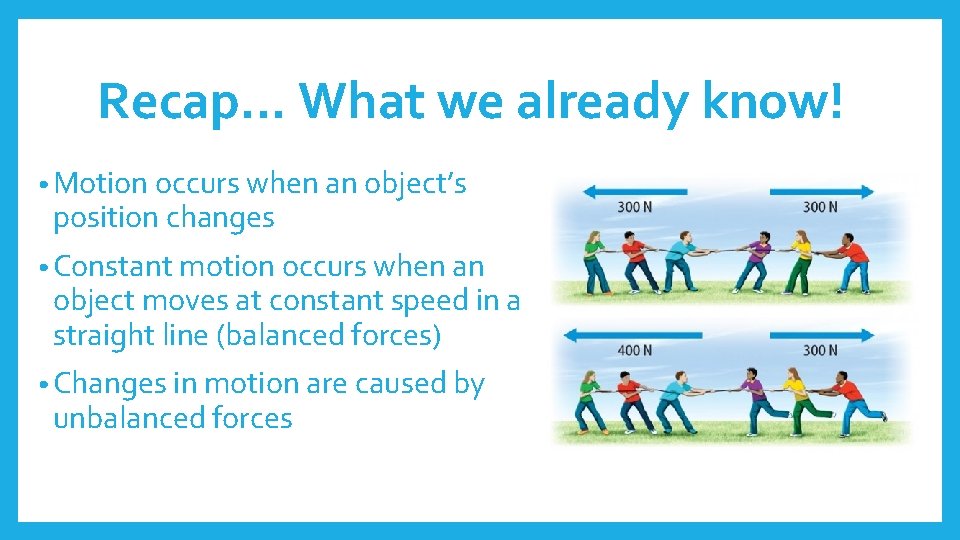
Recap. . . What we already know! • Motion occurs when an object’s position changes • Constant motion occurs when an object moves at constant speed in a straight line (balanced forces) • Changes in motion are caused by unbalanced forces
Friction lab discussion q. What factors affected the magnitude of friction? § Mass of object? Textbook vs planner § Type of friction? Static vs sliding vs rolling § Roughness of surface? Table vs sand paper
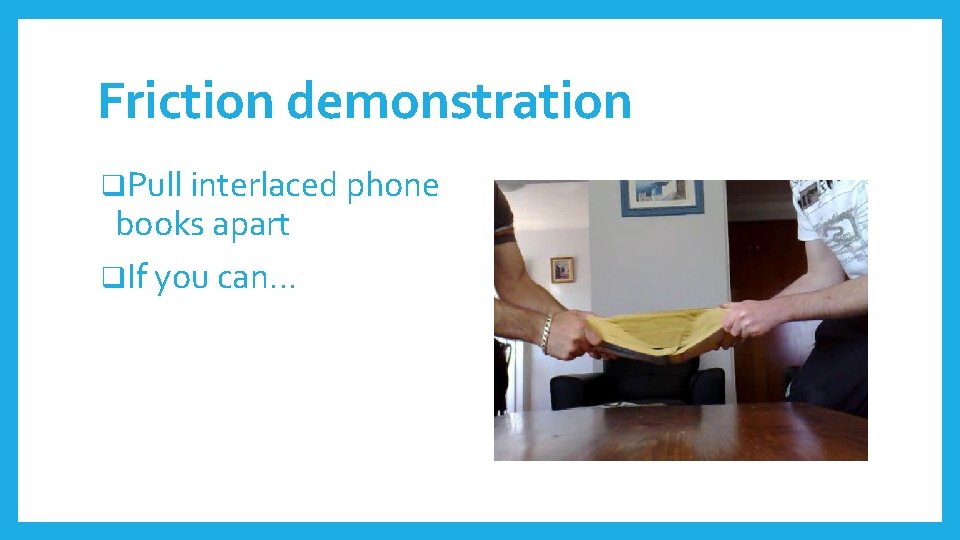
Friction demonstration q. Pull interlaced phone books apart q. If you can…

st 1 law demonstration q. Table Cloth q. Egg challenge q. Penny Stack q. Quarter challenge q. Marker in flask q. Egg in water
Newton’s First Law of Motion • An object at rest will remain at rest unless acted on by an unbalanced force • An object in motion will remain in constant motion unless acted on by an unbalanced force • Also known as the law of inertia
Inertia • Inertia: tendency of an object to resist changes in motion • Greater mass = greater inertia • Which would be easier to move: napping elephant or napping cat? • Which would be easier to stop: stampeding elephant or stampeding cat?
Egg challenge • Hard-boiled egg • Before: Inside and shell spin together until stopped • After: Both are motionless so will not start spinning • Raw egg • Before: Shell starts spinning and so does the inside (yolk, etc) • After: Shell stops because of force, insides keep spinning
Penny challenge • Stack of pennies is motionless • Will stay motionless unless there is an unbalanced force • By applying unbalanced force to bottom penny, it changes motion (accelerates) • Remaining pennies then have unbalanced force (gravity), so they fall
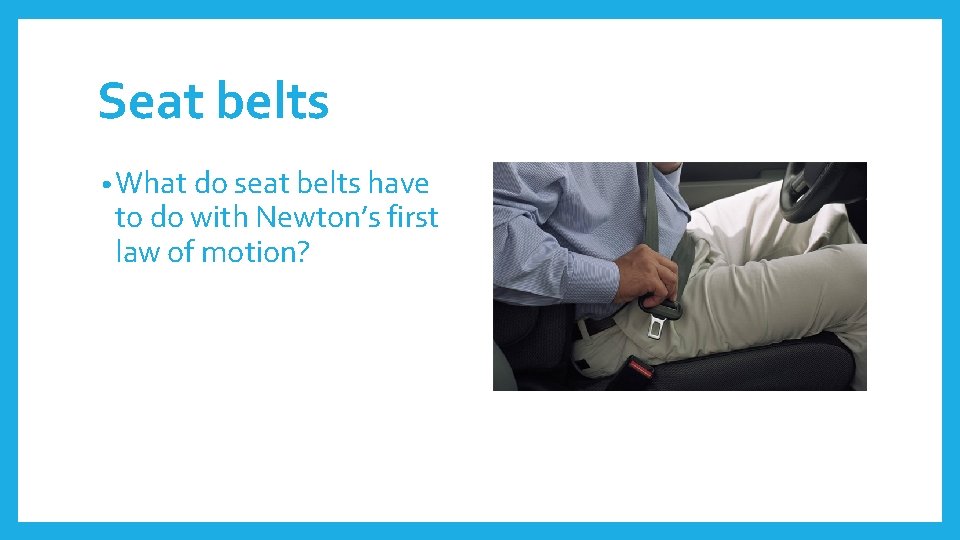
Seat belts • What do seat belts have to do with Newton’s first law of motion?
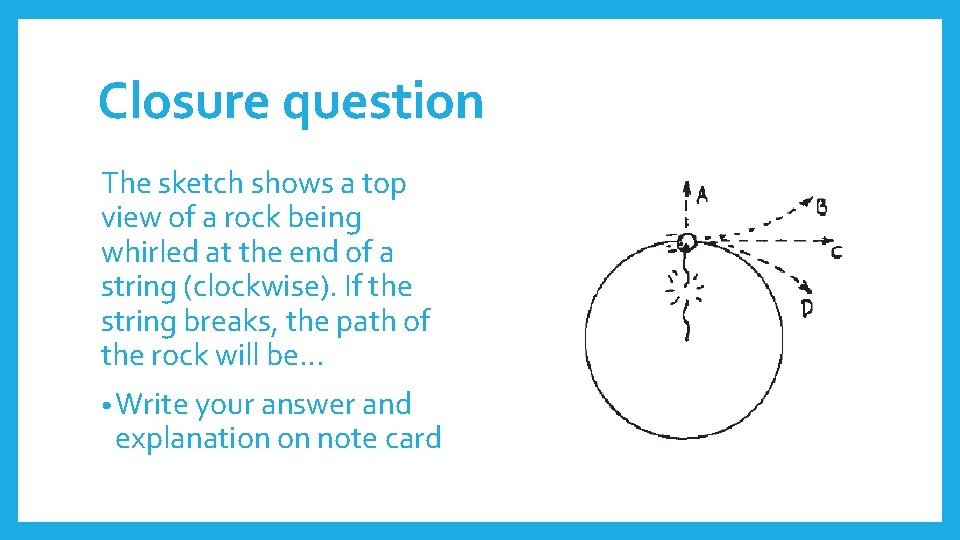
Closure question The sketch shows a top view of a rock being whirled at the end of a string (clockwise). If the string breaks, the path of the rock will be… • Write your answer and explanation on note card
Bell work § What does Newton’s 1 st law tell us about motion? § How are mass and inertia related?
Newton’s st 1 law q. An object at rest will _____ unless acted on by a(n) _______ force. q. An object in motion will _____ unless acted on by a(n) ______ force. q. Which object in each pair will have more inertia? • 3 -kg cat at rest or 40 -kg dog at rest • 3 -kg cat running 10 m/s or 40 -kg dog running 10 m/s • 3 -kg cat at rest or 3 -kg cat running 10 m/s
Newton’s st 1 law q. What are 3 ways an object’s motion can change? • Speed up, slow down, change direction q. What kind of forces can produce these changes: balanced or unbalanced? • Unbalanced
Newton’s st 1 law q. Mike pushes a box across the floor by applying a force of 200 N. If the box moves with constant speed, how much sliding friction is there? q. Mike pushes a box across the floor by applying a force of 200 N east. Describe the motion of the box if the magnitude of sliding friction is 50 N.
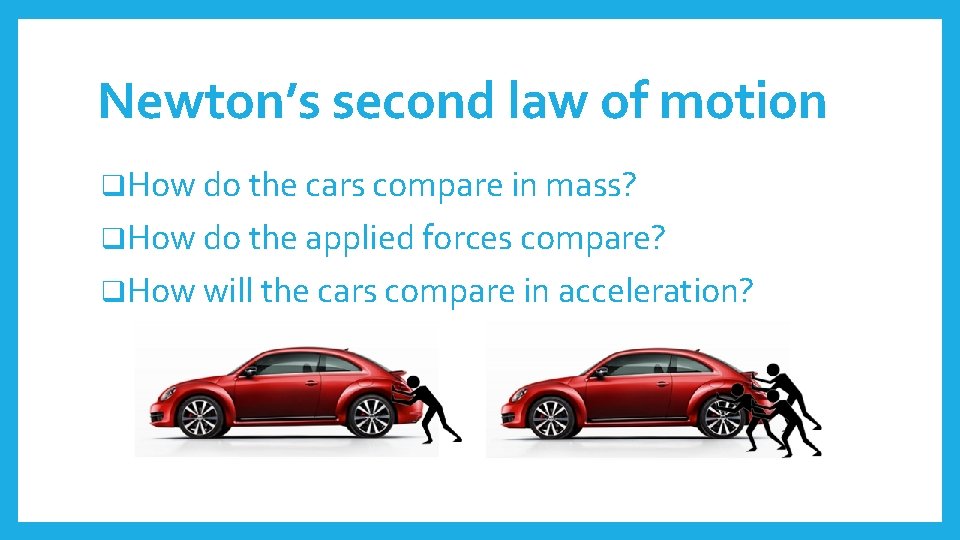
Newton’s second law of motion q. How do the cars compare in mass? q. How do the applied forces compare? q. How will the cars compare in acceleration?
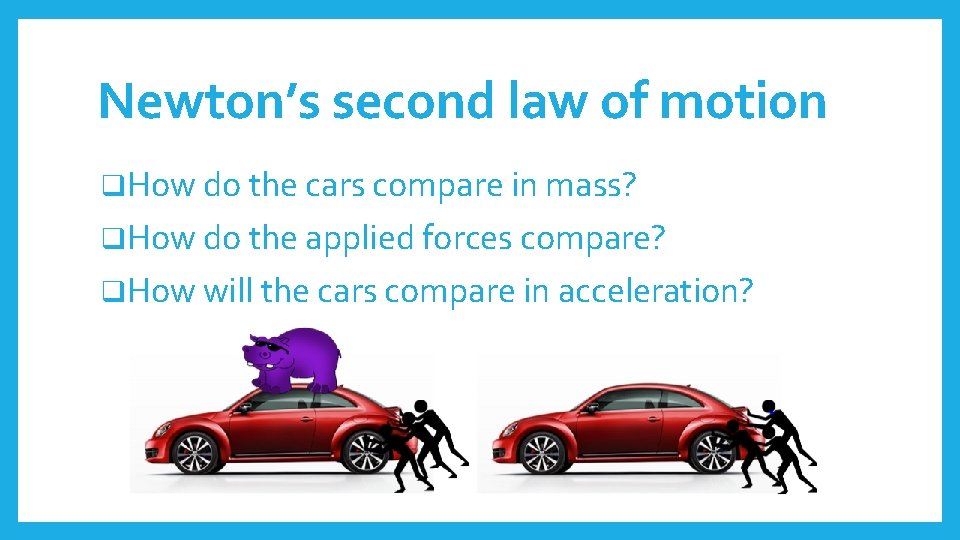
Newton’s second law of motion q. How do the cars compare in mass? q. How do the applied forces compare? q. How will the cars compare in acceleration?
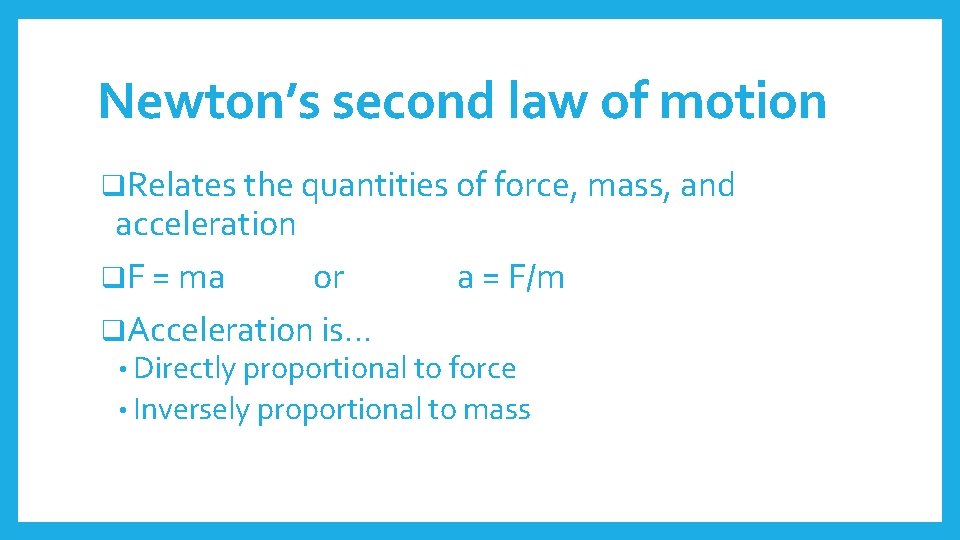
Newton’s second law of motion q. Relates the quantities of force, mass, and acceleration q. F = ma or q. Acceleration is… a = F/m • Directly proportional to force • Inversely proportional to mass
Newton’s second law q. Which will accelerate more if they are both pushed with the same amount of force, a basketball or a bowling ball? Why? q. Which will accelerate more, a football kicked with 200 N of force or the same football kicked with 300 N of force? Why?
Newton’s second law of motion q. So if F = ma… q 1 Newton = 1 kg*m/s 2 q. When calculating 2 nd law problems… q. Force in newtons (N) q. Mass in kilograms (kg) q. Acceleration in m/s 2
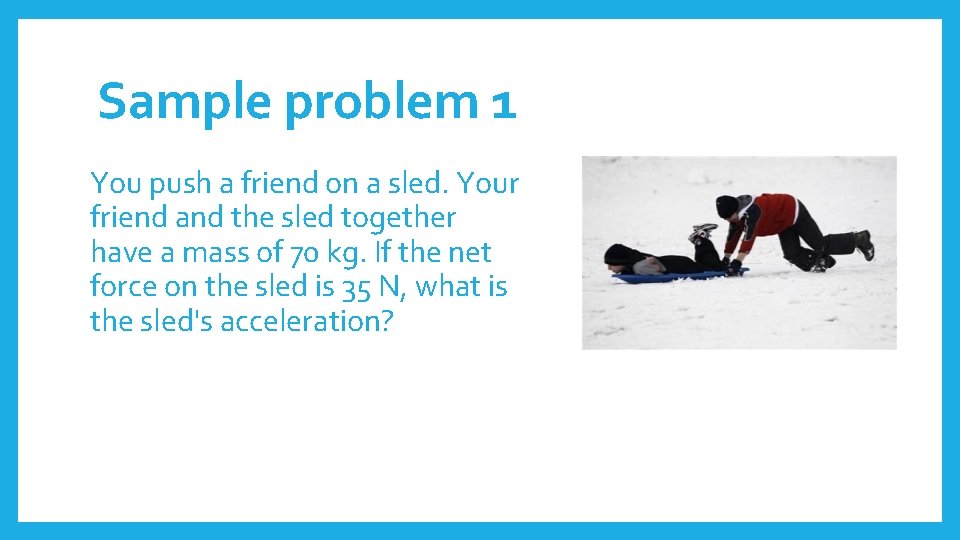
Sample problem 1 You push a friend on a sled. Your friend and the sled together have a mass of 70 kg. If the net force on the sled is 35 N, what is the sled's acceleration?
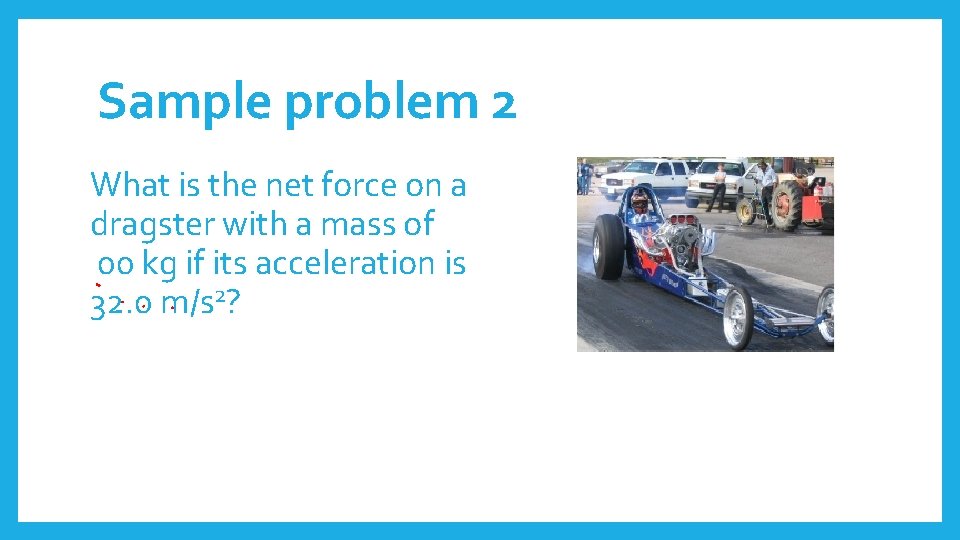
Sample problem 2 What is the net force on a dragster with a mass of 00 kg if its acceleration is 32. 0 m/s 2?
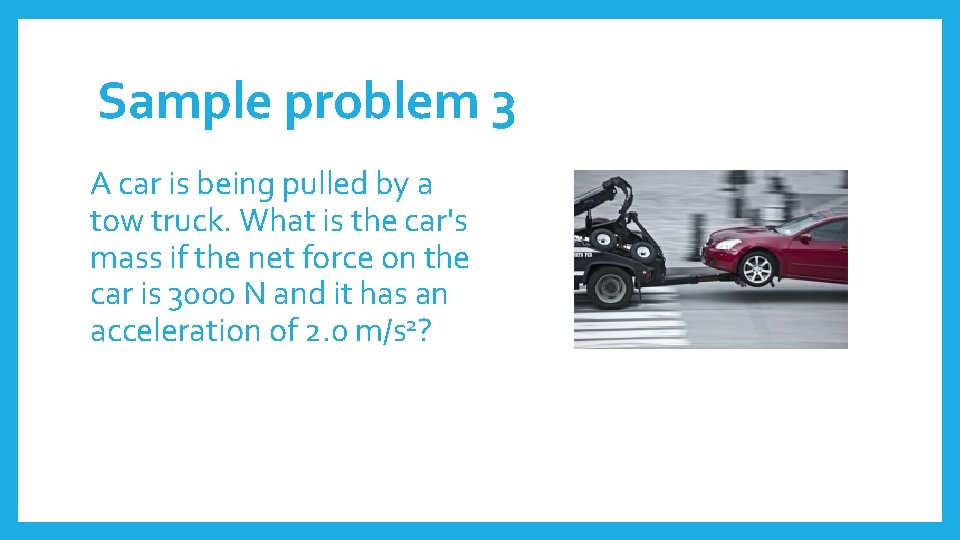
Sample problem 3 A car is being pulled by a tow truck. What is the car's mass if the net force on the car is 3000 N and it has an acceleration of 2. 0 m/s 2?
Sample problem 4 Curly and Moe are pushing on opposite sides of a 75 -kg box. Curly pushes with a force of 120 N, and Moe pushes with a force of 150 N. What is the acceleration of the box?
Sage & Scribe #1 Sally has a car that accelerates at 5 m/s 2. If the car has a mass of 500 kg, what is the force on the car?
Sage & Scribe #2 • What net force is required to accelerate a car at a rate of 4 m/s 2 if the car has a mass of 3, 000 kg?
Sage & Scribe #3 • What is the acceleration of a 0. 5 -kg softball if it hits the catcher's glove with a force of 50 N?
Sage & Scribe #4 • What is the mass of a truck if it produces a force of 15, 000 N while accelerating at a rate of 7. 5 m/s 2?
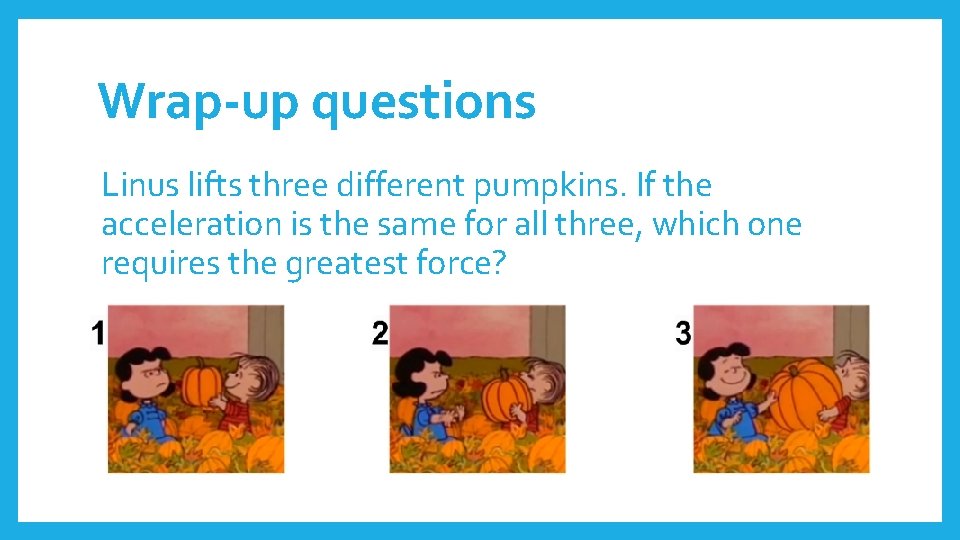
Wrap-up questions Linus lifts three different pumpkins. If the acceleration is the same for all three, which one requires the greatest force?
Forces & free body diagrams q. Weight: force of gravity on a mass; pulls down towards center of object q. Normal: aka support; pushes object off surface at 90° angle q. Tension: stretching force; occurs in strings, ropes, chains, etc.
Forces & free body diagrams q. Buoyant: exerted up on object immersed in fluid q. Drag: resists motion of object through fluid q. Lift: force that fluid exerts as it flows around an object; usually perpendicular to the flow q. Thrust: force exerted by an expelled fluid; directed opposite of the fluid
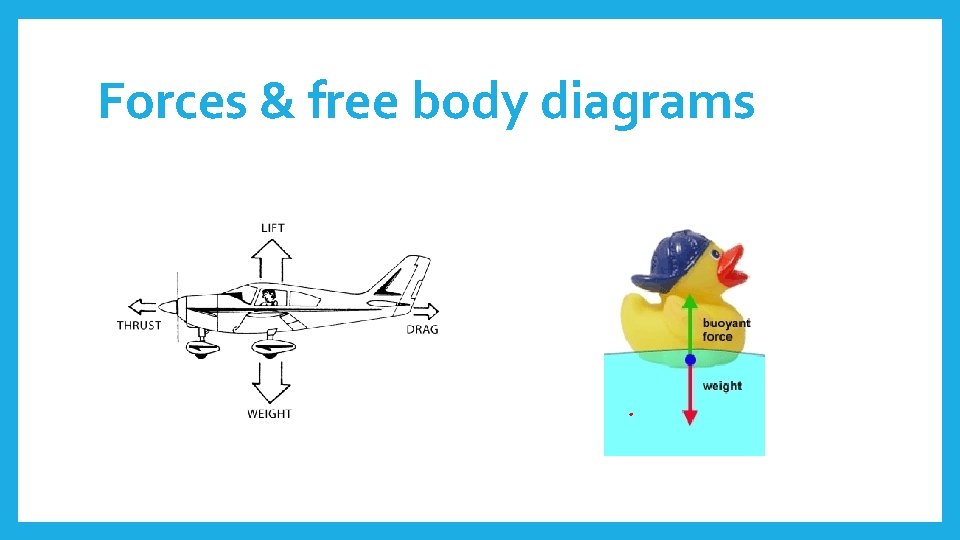
Forces & free body diagrams
Forces & free body diagrams q. Free body diagram: drawing used to represent an object and the forces acting on it § Object shown as a dot § Forces shown as arrows (vectors) § Length of vector represents its magnitude
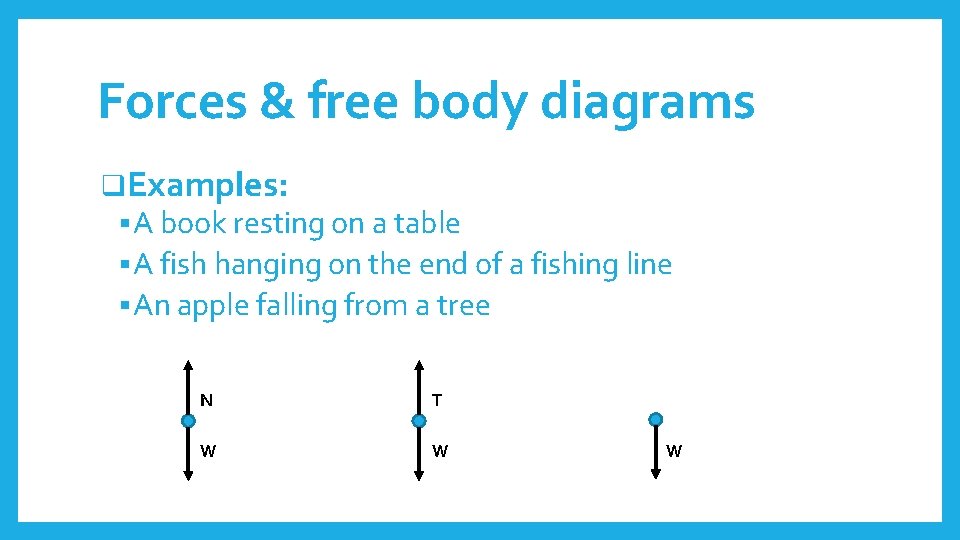
Forces & free body diagrams q. Examples: § A book resting on a table § A fish hanging on the end of a fishing line § An apple falling from a tree N T W W W
Bell work q. Draw a free-body diagram to show a 100 -N monkey hanging onto a single rope q. How would the diagram change if it were hanging from two ropes (one in each hand)?
Mass vs Weight q. Mass: amount of matter in an object; resistance to acceleration; measured with a balance q. Weight: gravitational force exerted on an object; measured with a scale q. If you were to go to the moon… • Would your mass change? • Would your weight change?
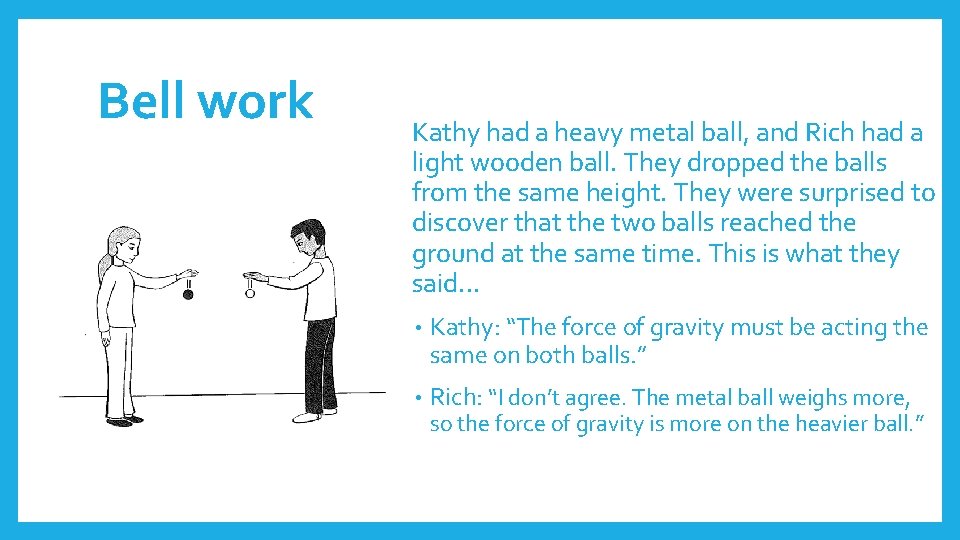
Bell work Kathy had a heavy metal ball, and Rich had a light wooden ball. They dropped the balls from the same height. They were surprised to discover that the two balls reached the ground at the same time. This is what they said. . . • Kathy: “The force of gravity must be acting the same on both balls. ” • Rich: “I don’t agree. The metal ball weighs more, so the force of gravity is more on the heavier ball. ”
Objectives: be able to… q. Summarize how mass and distance affect gravity q. Use forces to explain terminal velocity
Force of gravity q. Force of gravity is an attractive force between any two masses q. Directly proportional to the product of the masses q. Inversely proportional to the square of the distance between masses
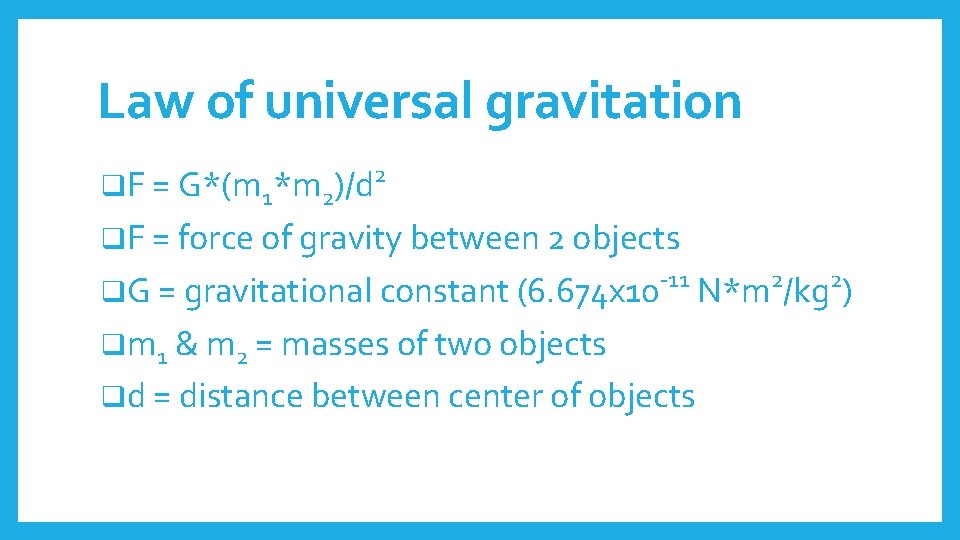
Law of universal gravitation q. F = G*(m 1*m 2)/d 2 q. F = force of gravity between 2 objects q. G = gravitational constant (6. 674 x 10 -11 qm 1 & m 2 = masses of two objects qd = distance between center of objects 2 2 N*m /kg )
Law of universal gravitation q. F = G*(m 1*m 2)/d 2 q. What happens to the gravitational force as the masses of the objects increase? q. What happens to the gravitational force as the distance increases? q. What happens if the distance doubles? Triples? Quadruples?
Gravity on Earth q. As an objects mass increases, force of gravity also increases q. Because mass and force both increase, acceleration remains constant q. On earth all objects fall with an acceleration of 2 9. 8 m/s
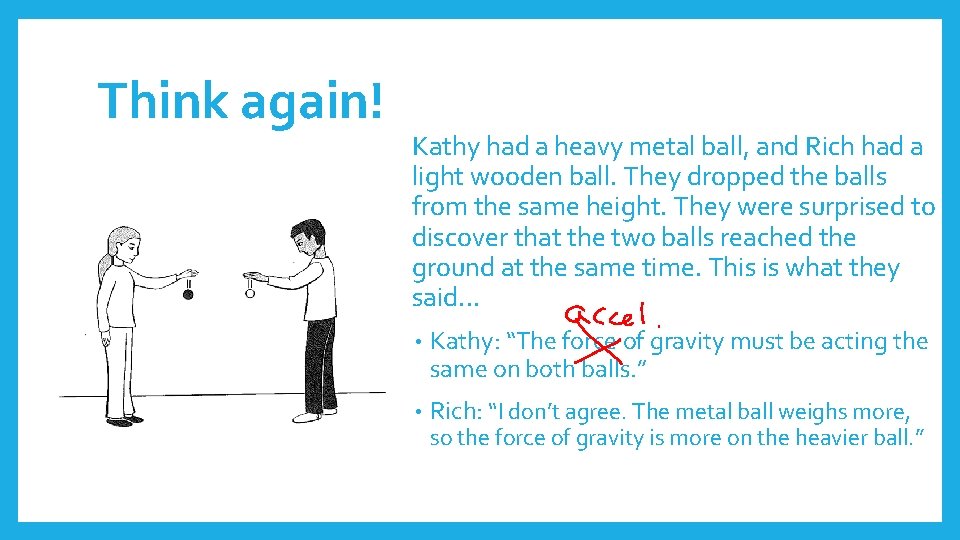
Think again! Kathy had a heavy metal ball, and Rich had a light wooden ball. They dropped the balls from the same height. They were surprised to discover that the two balls reached the ground at the same time. This is what they said. . . • Kathy: “The force of gravity must be acting the same on both balls. ” • Rich: “I don’t agree. The metal ball weighs more, so the force of gravity is more on the heavier ball. ”
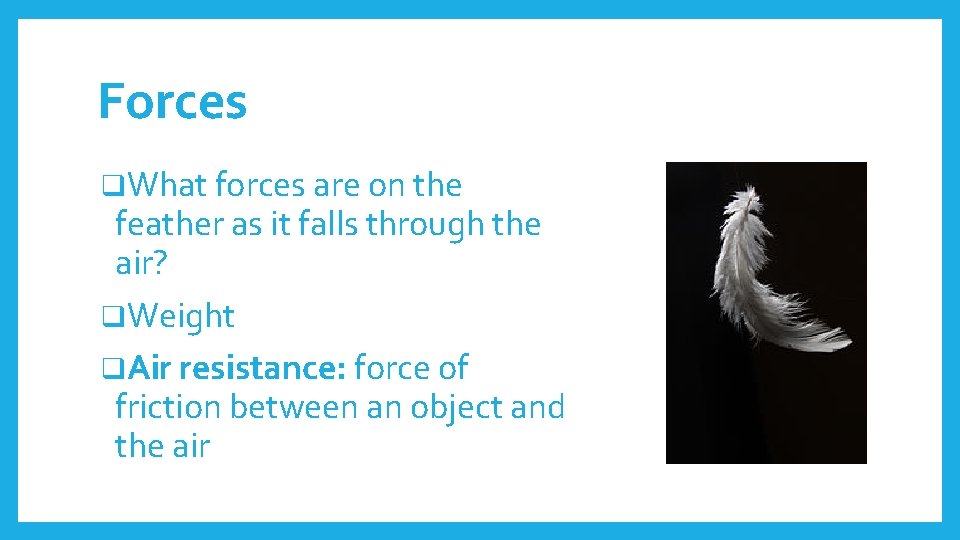
Forces q. What forces are on the feather as it falls through the air? q. Weight q. Air resistance: force of friction between an object and the air
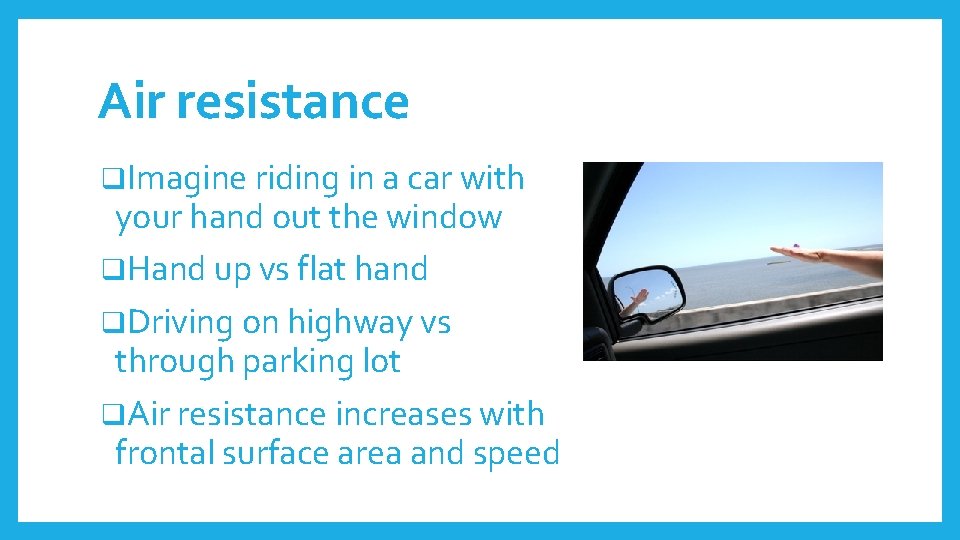
Air resistance q. Imagine riding in a car with your hand out the window q. Hand up vs flat hand q. Driving on highway vs through parking lot q. Air resistance increases with frontal surface area and speed
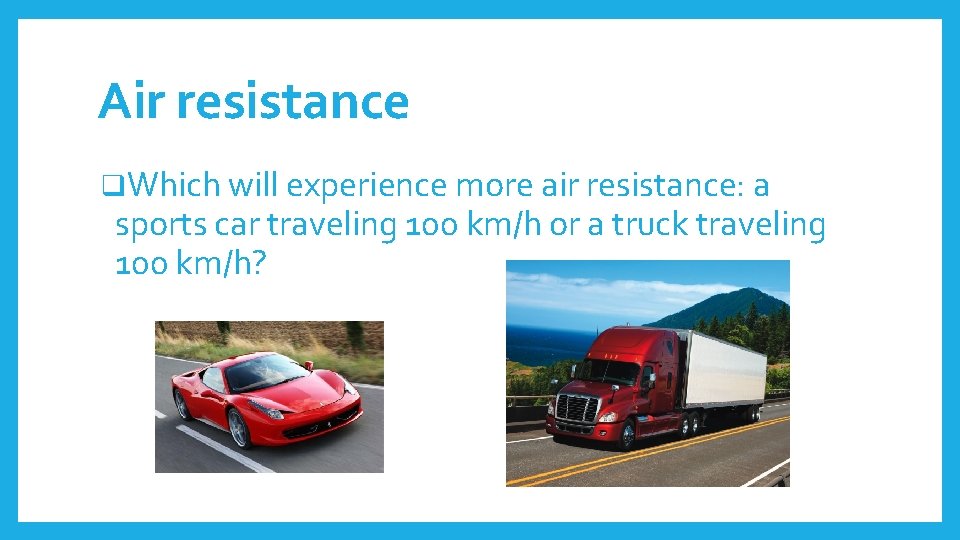
Air resistance q. Which will experience more air resistance: a sports car traveling 100 km/h or a truck traveling 100 km/h?
Air resistance q. Which will experience more air resistance: a truck traveling 60 km/h or a truck traveling 90 km/h?
Terminal velocity q. As an object falls, force of gravity (weight) speeds it up q. As speed increases, so does air resistance q. Once air resistance and weight are balanced, object will move at constant speed q. Terminal velocity: fastest speed at which an object can fall
Projectile motion q. Free fall: occurs when an object is only under the influence of gravity q. Projectile: object moving through the air with horizontal and vertical motion • Horizontal motion is constant • Vertical motion accelerates at 9. 8 m/s 2
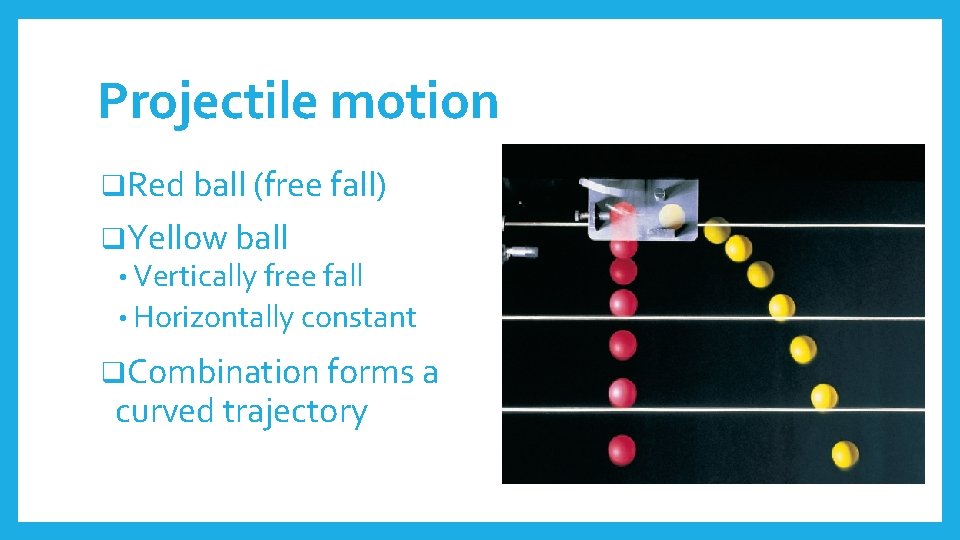
Projectile motion q. Red ball (free fall) q. Yellow ball • Vertically free fall • Horizontally constant q. Combination forms a curved trajectory
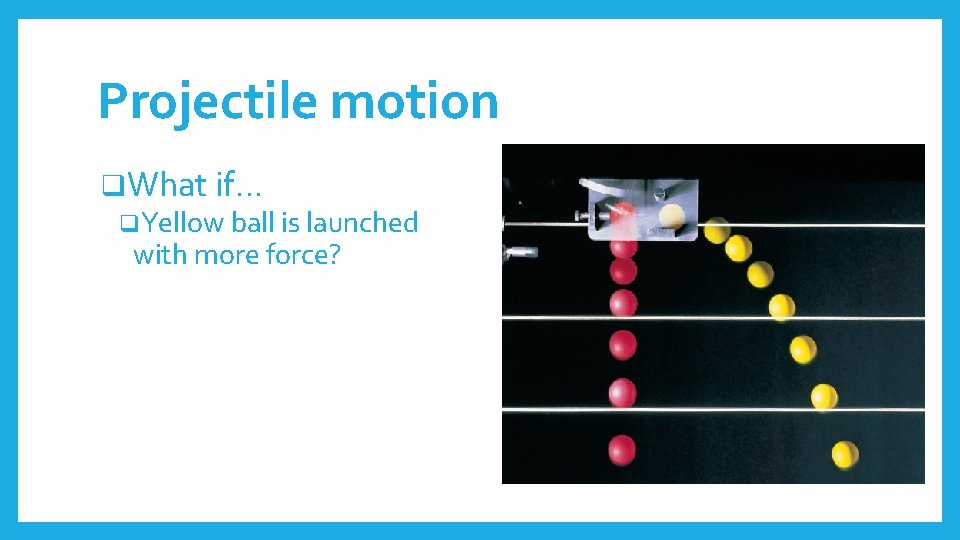
Projectile motion q. What if… q. Yellow ball is launched with more force?
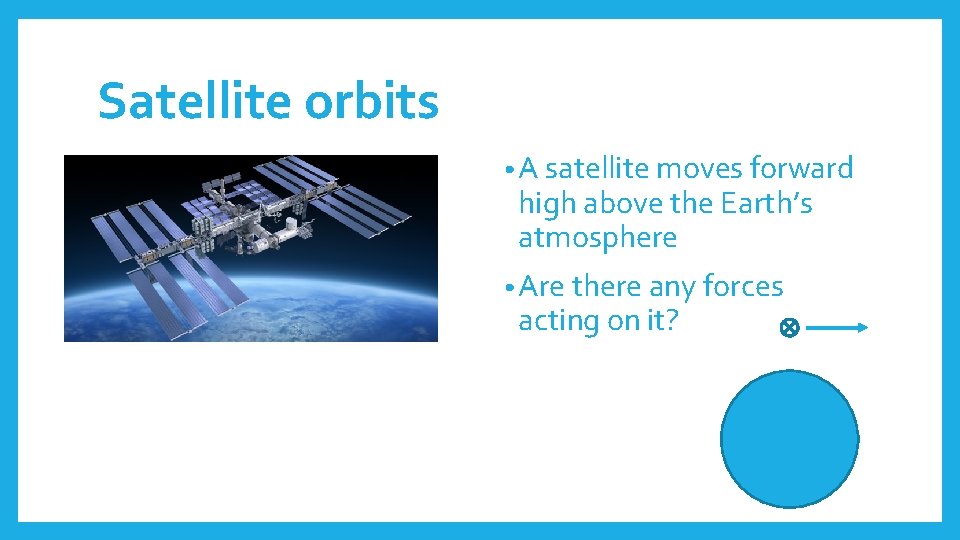
Satellite orbits • A satellite moves forward high above the Earth’s atmosphere • Are there any forces acting on it?
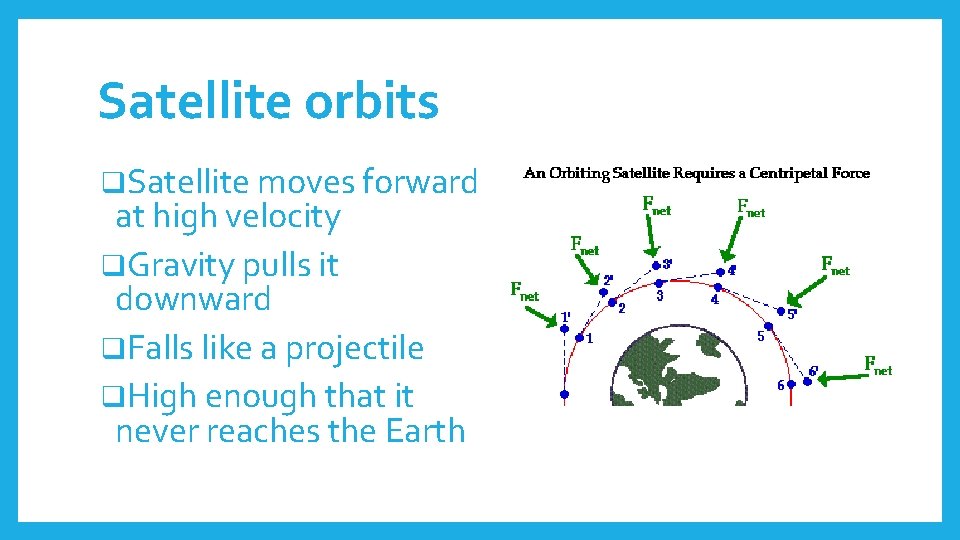
Satellite orbits q. Satellite moves forward at high velocity q. Gravity pulls it downward q. Falls like a projectile q. High enough that it never reaches the Earth
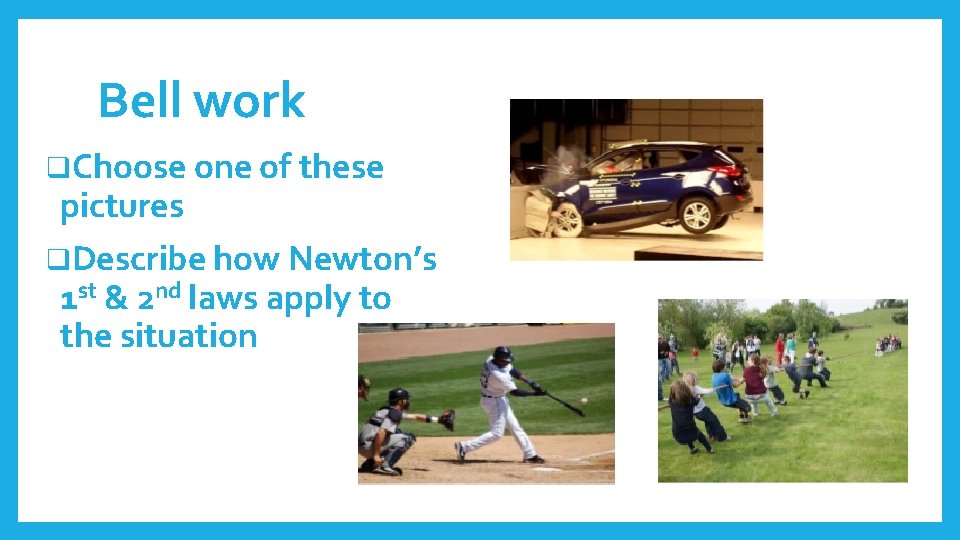
Bell work q. Choose one of these pictures q. Describe how Newton’s 1 st & 2 nd laws apply to the situation
Schedule – Thursday, October q. Review Newton’s 1 st & 2 nd laws q. Newton’s laws video q. Newton’s 3 rd law • Demonstrations • Golf video th 19
Newton’s rd 3 law of motion q. For every action force, there is an equal and opposite reaction force • Forces occur in pairs; acting on different objects • Equal in magnitude • Opposite in direction
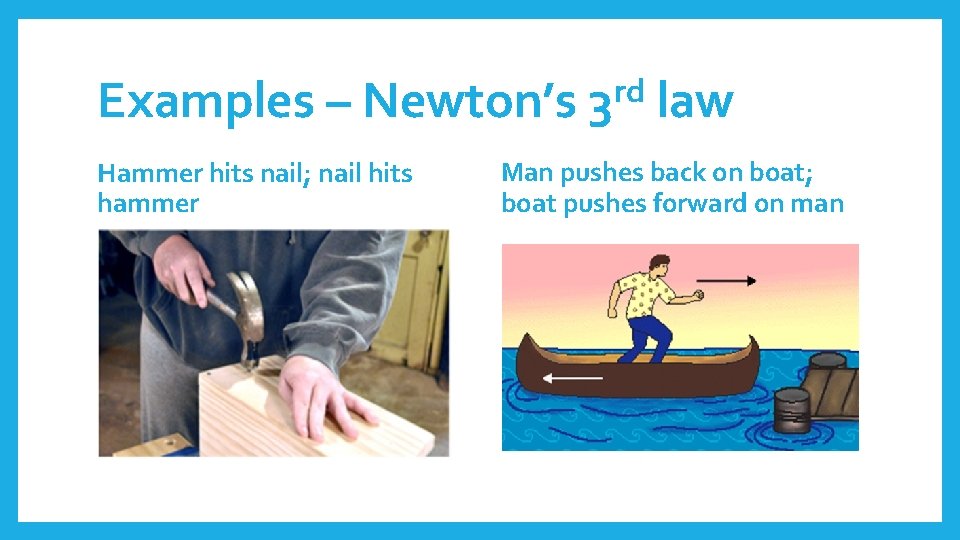
Examples – Newton’s Hammer hits nail; nail hits hammer rd 3 law Man pushes back on boat; boat pushes forward on man
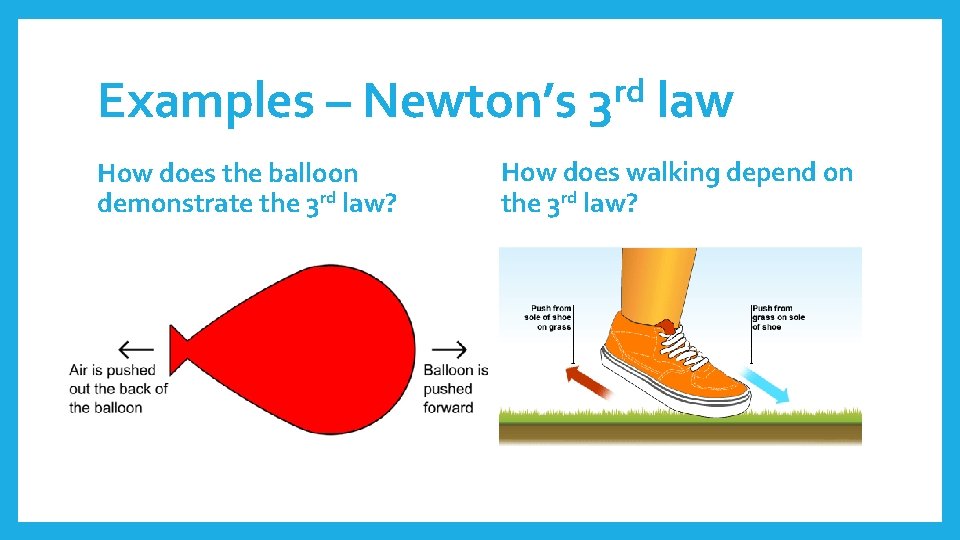
Examples – Newton’s How does the balloon demonstrate the 3 rd law? rd 3 law How does walking depend on the 3 rd law?
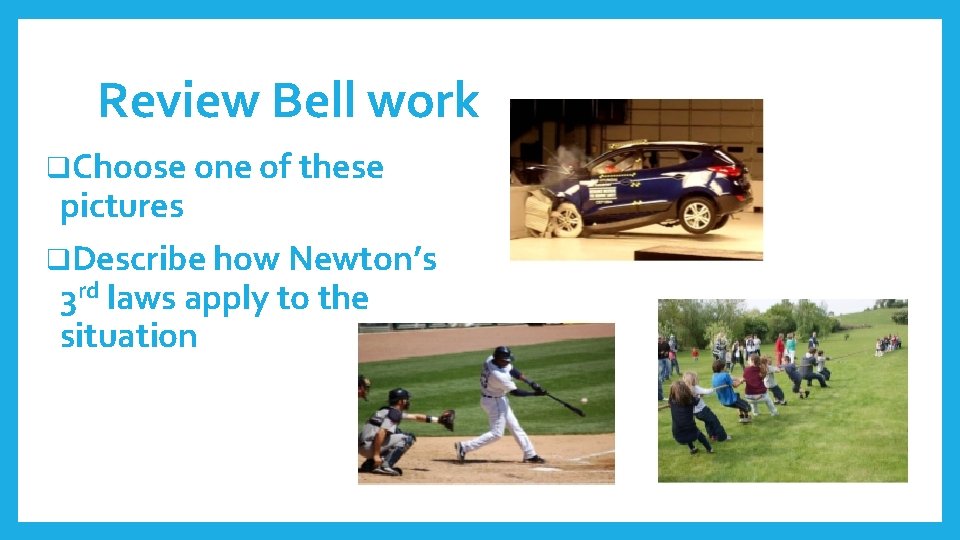
Review Bell work q. Choose one of these pictures q. Describe how Newton’s 3 rd laws apply to the situation
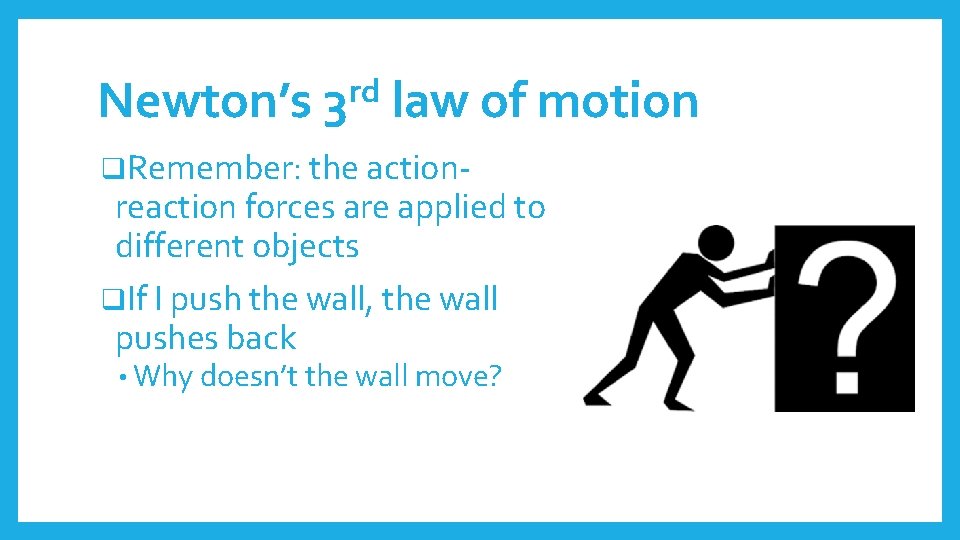
Newton’s rd 3 law of motion q. Remember: the action- reaction forces are applied to different objects q. If I push the wall, the wall pushes back • Why doesn’t the wall move?
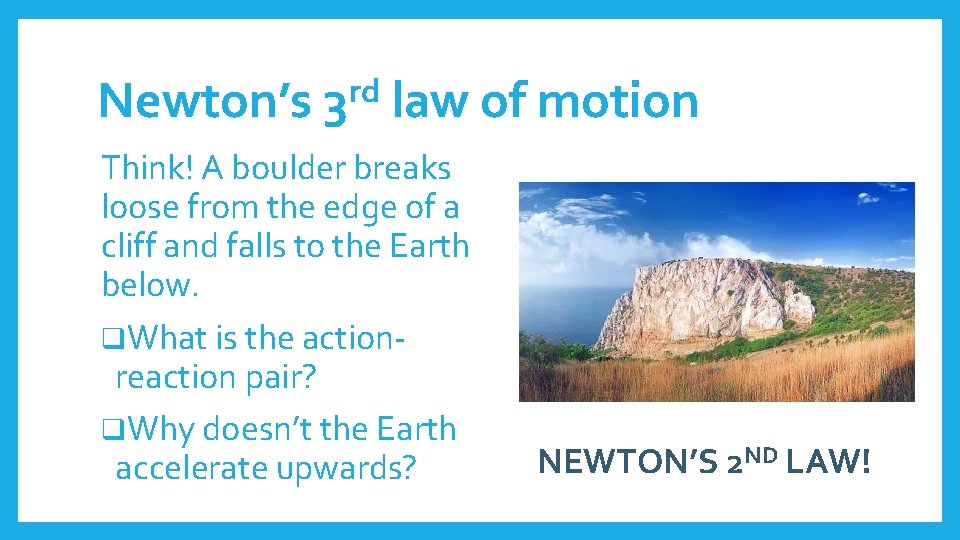
Newton’s rd 3 law of motion Think! A boulder breaks loose from the edge of a cliff and falls to the Earth below. q. What is the actionreaction pair? q. Why doesn’t the Earth accelerate upwards? m a a=m NEWTON’S 2 ND LAW!
Newton’s 1 st Law 2 nd Law 3 rd Law rd 3 law of motion
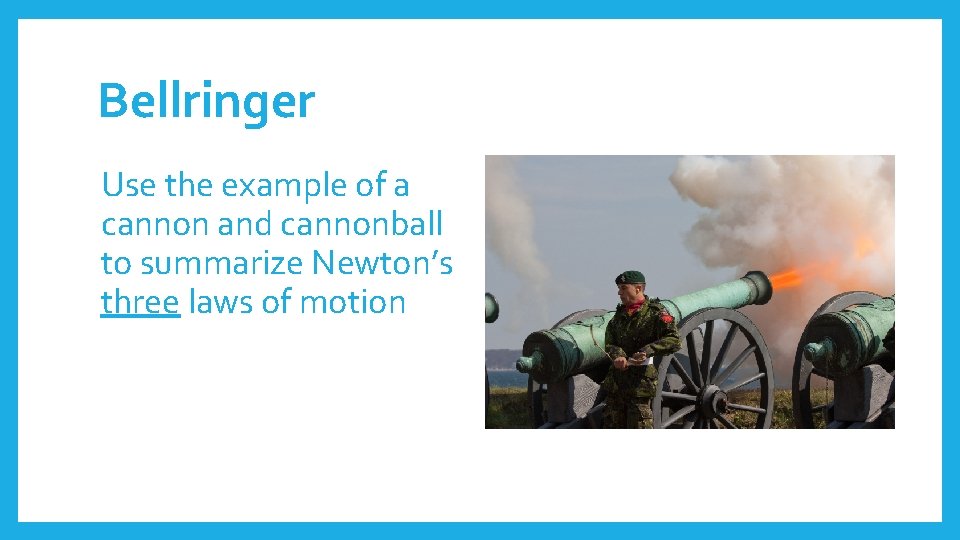
Bellringer Use the example of a cannon and cannonball to summarize Newton’s three laws of motion
Objectives: be able to… q. Perform calculations with momentum q. Summarize conservation of momentum
Momentum q. Momentum: the product of an object’s mass and velocity q. Momentum = mass x velocity qp = mv q. Vector quantity q. Measured in kg*m/s • (kilogram-meters per second)
Momentum q. Momentum increases with both mass and velocity q. Which will have more momentum? • Large truck going 50 km/h or same truck going 90 km/h • Large truck going 50 km/h or small car going 50 km/h
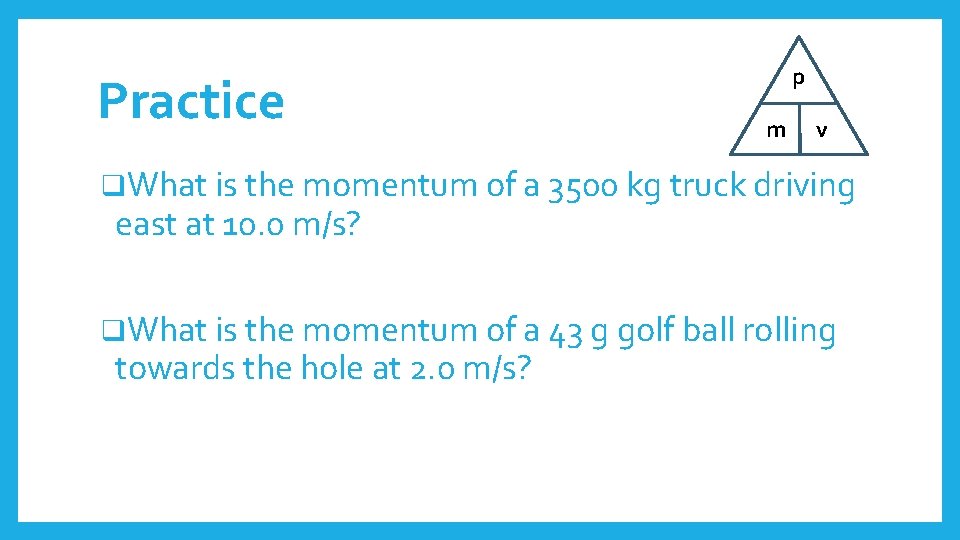
Practice p m v q. What is the momentum of a 3500 kg truck driving east at 10. 0 m/s? q. What is the momentum of a 43 g golf ball rolling towards the hole at 2. 0 m/s?
Momentum q. What is the velocity of a 750 -kg car that has a momentum of 18, 750 kg*m/s? q. A bowling ball rolls down the lane with a velocity of 2. 8 m/s and has 20. 2 kg*m/s of momentum. What is the bowling ball’s mass?
Sage & scribe q. What is the velocity of a 0. 148 -kg baseball that has a momentum of 5. 96 kg*m/s? q. How large is a ping pong ball that moves at 3. 4 m/s and has momentum of 0. 0092 kg*m/s?
Conservation of momentum q. Law of conservation of momentum: • The total momentum in a system is conserved • Momentum cannot be created or destroyed • It can be transferred from one object to another • Total momentum before = total momentum after
Collisions q. Elastic collisions: objects bounce off of each other after the collision q. Inelastic collisions: objects stick together after collision
Collisions & momentum conservation Tim has a mass of 70. 0 kg and is zooming along in a 100. 0 -kg bumper car at 12 m/s. He bumps into Melinda’s car, which is sitting still. Melinda has a mass of 25. 0 kg. After the elastic collision, Tim continues ahead with a speed of 4. 12 m/s. How fast is Melinda’s car bumped across the floor?
Collisions & momentum conservation Sometimes the curiosity factor at the scene of a car accident is so great that it actually produces secondary accidents. If an 800. -kg sports car slows to 13. 0 m/s to check out an accident scene and the 1200. -kg pick-up behind him continues traveling at 25. 0 m/s, with what velocity will the two move if they lock bumpers after a read end collision?
Collisions & momentum conservation Charlotte, a 60. 0 -kg skin diver, shoots a 2. 0 -kg spear with a speed of 15 m/s at a fish who darts quickly away without getting hit. How fast does Charlotte move backwards?
- Slides: 89