
Forces Lesson 3 Gravity Mass and Weight Learning
- Slides: 20
Forces Lesson 3: Gravity, Mass and Weight
Learning Objective To investigate what happens to mass and weight on different planets. Success Criteria • To accurately measure weight using a newton meter. • To calculate weight and gravitational field strength. • To explain the difference between mass and weight.
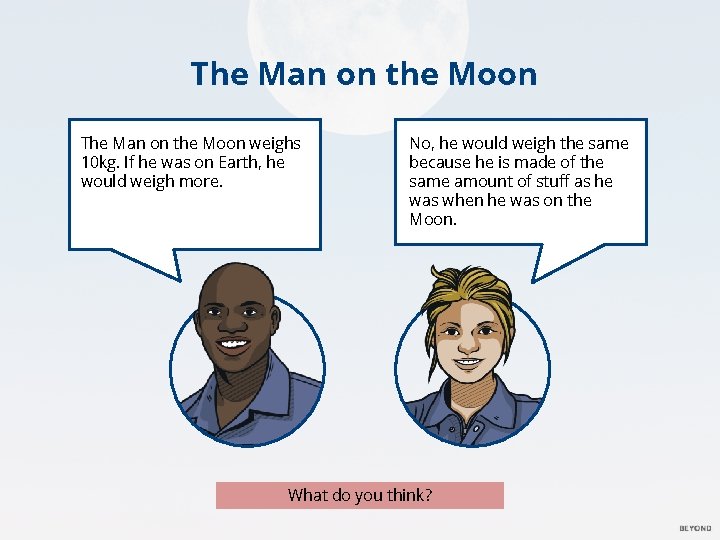
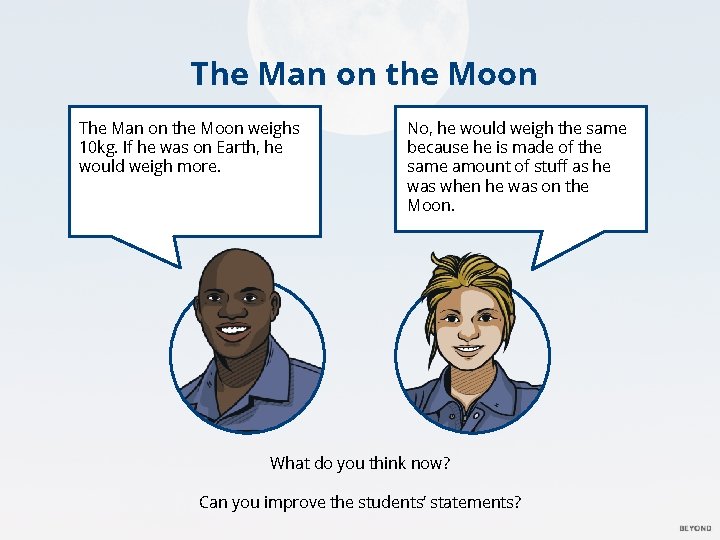
The Man on the Moon weighs 10 kg. If he was on Earth, he would weigh more. No, he would weigh the same because he is made of the same amount of stuff as he was when he was on the Moon. What do you think?
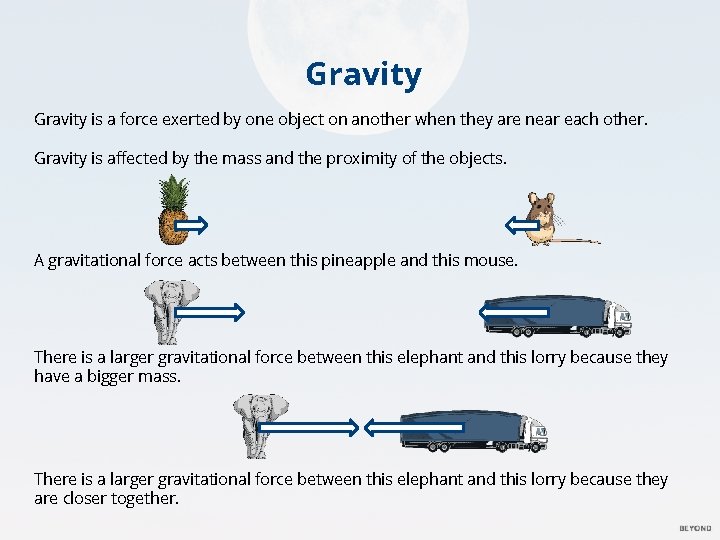
Gravity is a force exerted by one object on another when they are near each other. Gravity is affected by the mass and the proximity of the objects. A gravitational force acts between this pineapple and this mouse. There is a larger gravitational force between this elephant and this lorry because they have a bigger mass. There is a larger gravitational force between this elephant and this lorry because they are closer together.
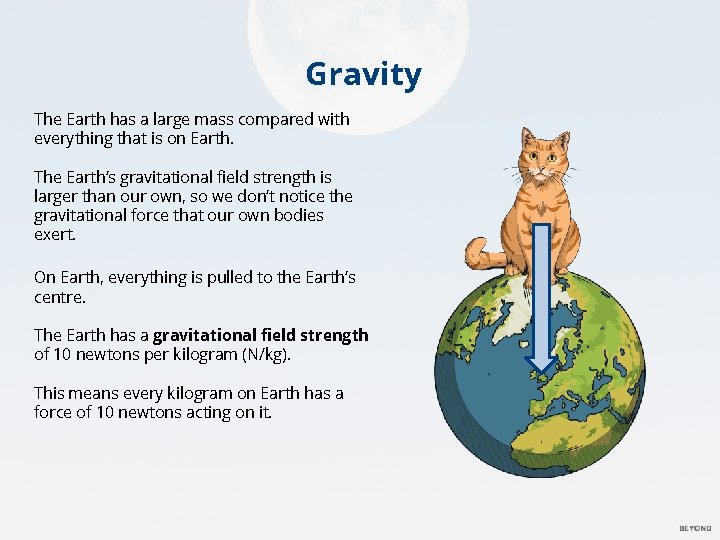
Gravity The Earth has a large mass compared with everything that is on Earth. The Earth’s gravitational field strength is larger than our own, so we don’t notice the gravitational force that our own bodies exert. On Earth, everything is pulled to the Earth’s centre. The Earth has a gravitational field strength of 10 newtons per kilogram (N/kg). This means every kilogram on Earth has a force of 10 newtons acting on it.
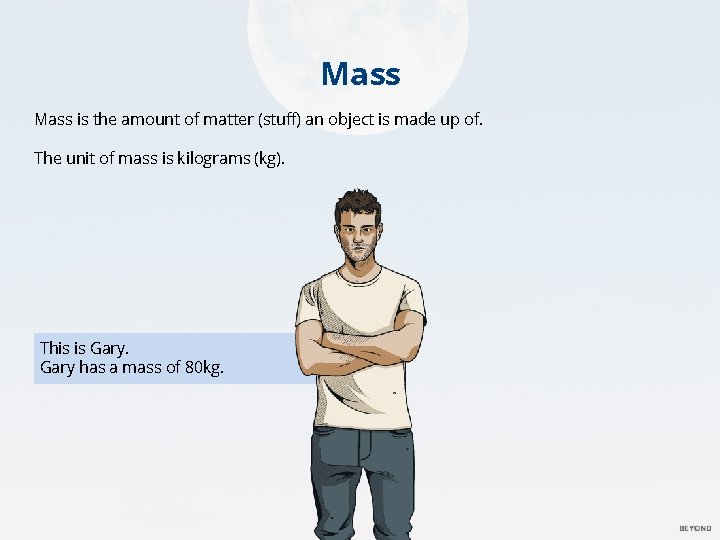
Mass is the amount of matter (stuff) an object is made up of. The unit of mass is kilograms (kg). This is Gary has a mass of 80 kg.
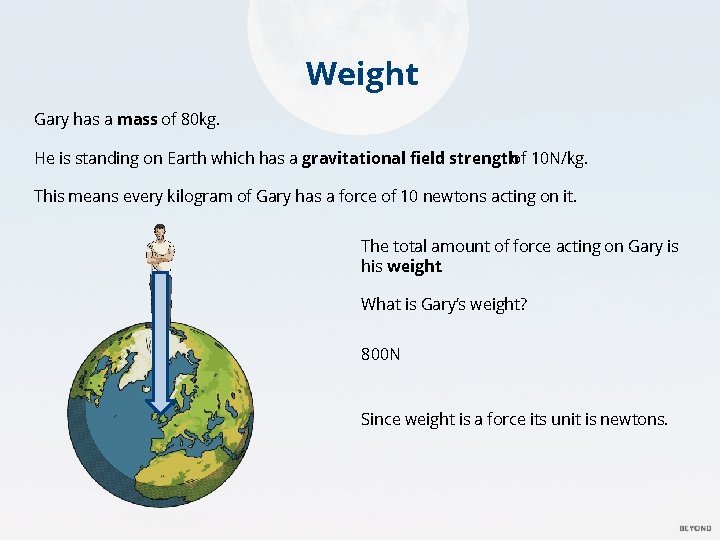
Weight Gary has a mass of 80 kg. He is standing on Earth which has a gravitational field strengthof 10 N/kg. This means every kilogram of Gary has a force of 10 newtons acting on it. The total amount of force acting on Gary is his weight. What is Gary’s weight? 800 N Since weight is a force its unit is newtons.
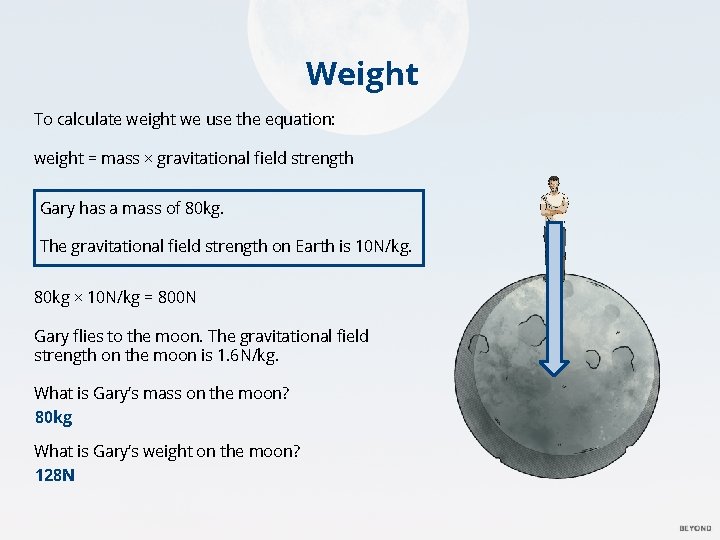
Weight To calculate weight we use the equation: weight = mass × gravitational field strength Gary has a mass of 80 kg. The gravitational field strength on Earth is 10 N/kg. 80 kg × 10 N/kg = 800 N Gary flies to the moon. The gravitational field strength on the moon is 1. 6 N/kg. What is Gary’s mass on the moon? 80 kg What is Gary’s weight on the moon? 128 N
The Man on the Moon weighs 10 kg. If he was on Earth, he would weigh more. No, he would weigh the same because he is made of the same amount of stuff as he was when he was on the Moon. What do you think now? Can you improve the students’ statements?
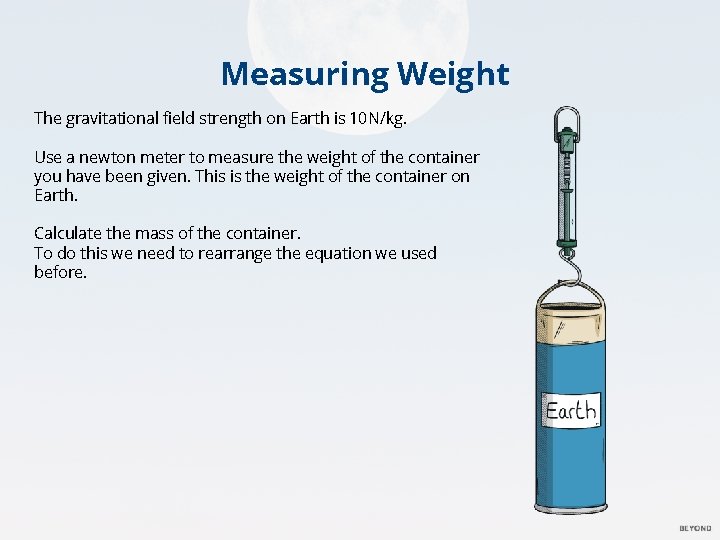
Measuring Weight The gravitational field strength on Earth is 10 N/kg. Use a newton meter to measure the weight of the container you have been given. This is the weight of the container on Earth. Calculate the mass of the container. To do this we need to rearrange the equation we used before.
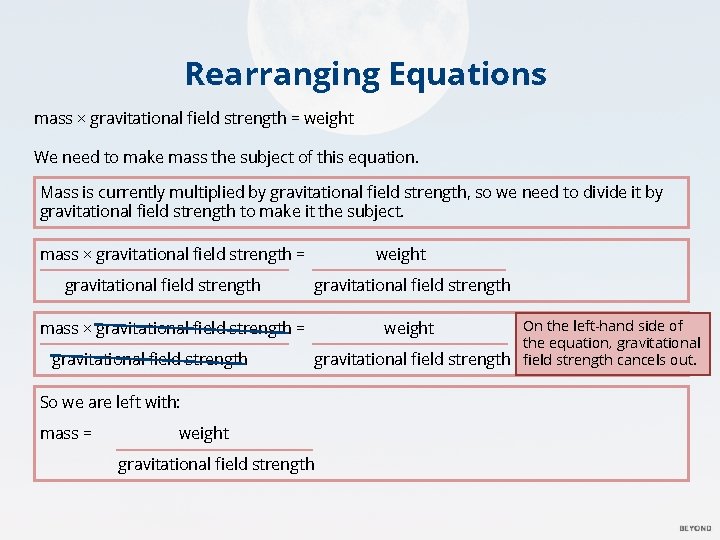
Rearranging Equations mass × gravitational field strength = weight We need to make mass the subject of this equation. Mass is currently multiplied by gravitational field strength, so we need to divide it by gravitational field strength to make it the subject. mass × gravitational field strength = gravitational field strength So we are left with: mass = weight gravitational field strength On the left-hand side of the equation, gravitational field strength cancels out. weight
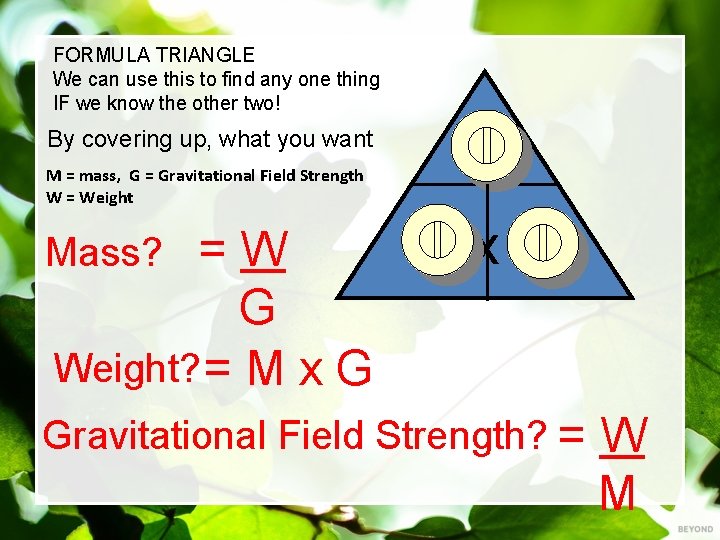
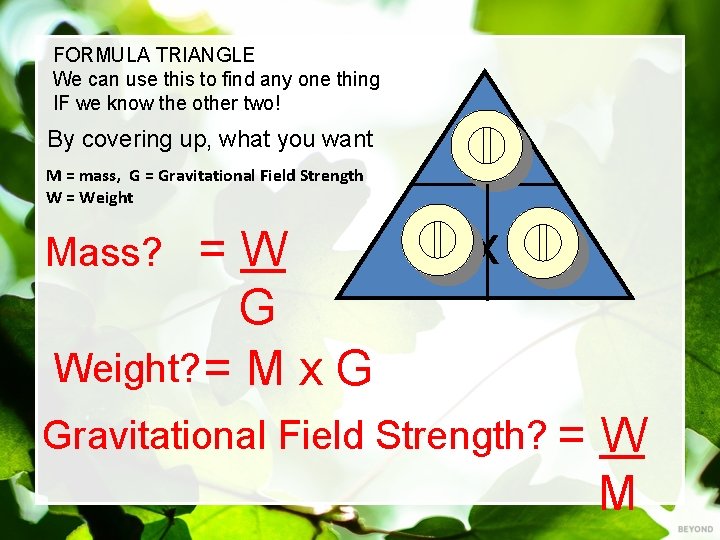
FORMULA TRIANGLE We can use this to find any one thing IF we know the other two! By covering up, what you want M = mass, G = Gravitational Field Strength W = Weight =W G Weight? = M x G Mass? W Mx G Gravitational Field Strength? = W M
FORMULA TRIANGLE We can use this to find any one thing IF we know the other two! By covering up, what you want M = mass, G = Gravitational Field Strength W = Weight =W G Weight? = M x G Mass? W Mx G Gravitational Field Strength? = W M
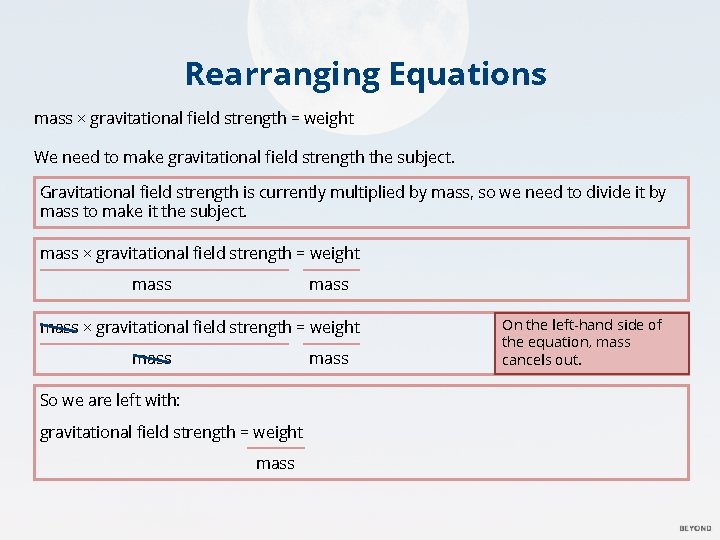
Rearranging Equations mass × gravitational field strength = weight We need to make gravitational field strength the subject. Gravitational field strength is currently multiplied by mass, so we need to divide it by mass to make it the subject. mass × gravitational field strength = weight mass So we are left with: gravitational field strength = weight mass On the left-hand side of the equation, mass cancels out.
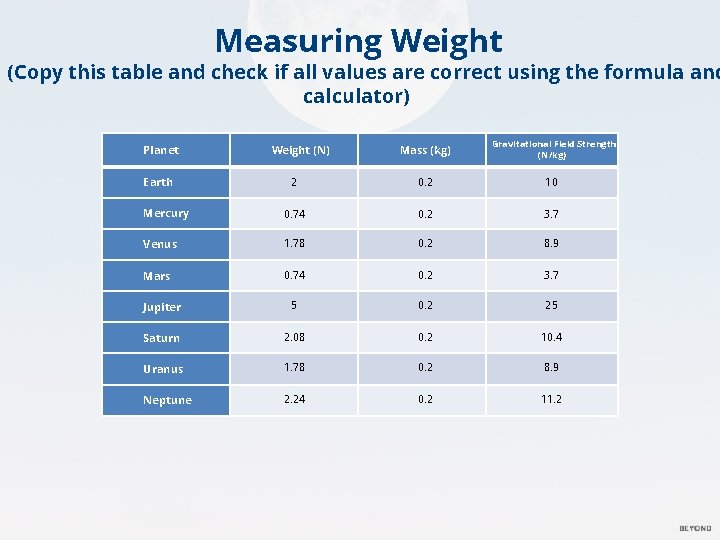
Measuring Weight (Copy this table and check if all values are correct using the formula and calculator) Mass (kg) Gravitational Field Strength (N/kg) 2 0. 2 10 Mercury 0. 74 0. 2 3. 7 Venus 1. 78 0. 2 8. 9 Mars 0. 74 0. 2 3. 7 Jupiter 5 0. 2 25 Saturn 2. 08 0. 2 10. 4 Uranus 1. 78 0. 2 8. 9 Neptune 2. 24 0. 2 11. 2 Planet Earth Weight (N)
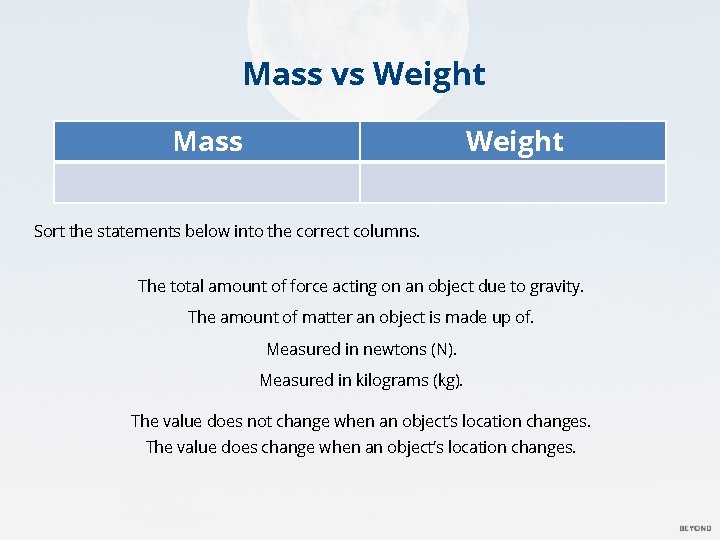
Mass vs Weight Mass Weight Sort the statements below into the correct columns. The total amount of force acting on an object due to gravity. The amount of matter an object is made up of. Measured in newtons (N). Measured in kilograms (kg). The value does not change when an object’s location changes. The value does change when an object’s location changes.
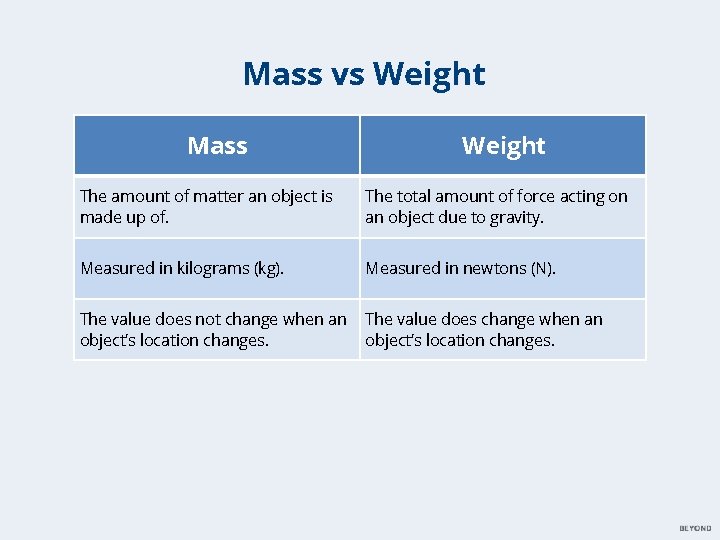
Mass vs Weight Mass Weight The amount of matter an object is made up of. The total amount of force acting on an object due to gravity. Measured in kilograms (kg). Measured in newtons (N). The value does not change when an object’s location changes. The value does change when an object’s location changes.
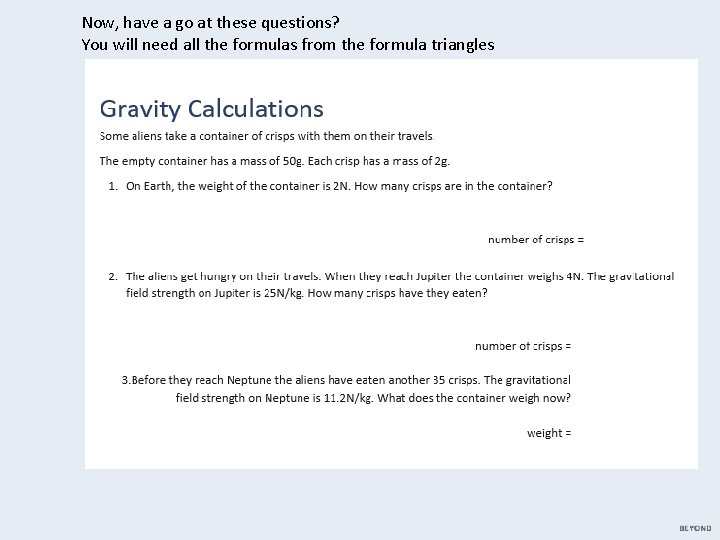
Now, have a go at these questions? You will need all the formulas from the formula triangles
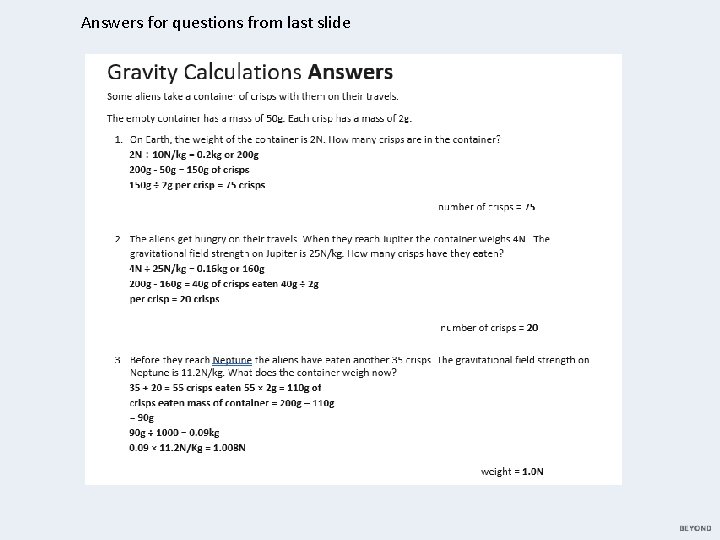
Answers for questions from last slide