
Forces Learning objectives 1 To know the units
Forces Learning objectives: 1. To know the units forces are measured in. 2. To know what equipment is used to measure a force. 3. To be able to measure the force of objects in the classroom and record the data in a results table.
What is a force? Here are some ways of describing forces: l. A push l A pull l A stretch l A squeeze l A catch l A twist We can’t see forces but we can see the effects of a force.
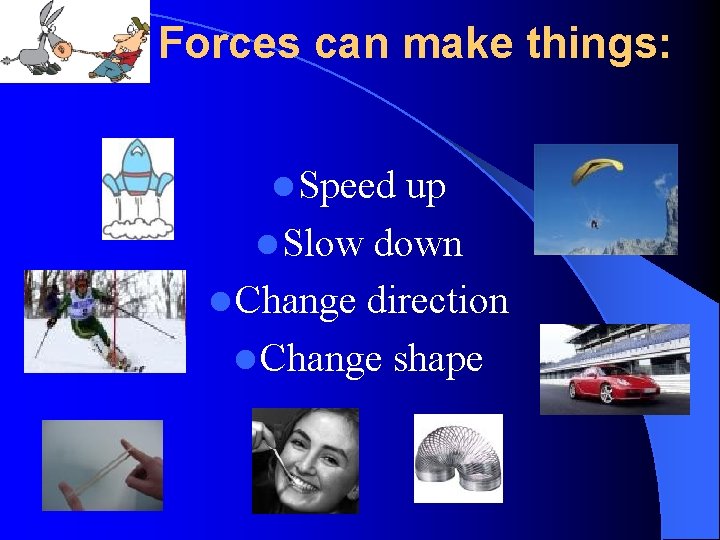
Forces can make things: l Speed up l Slow down l Change direction l Change shape
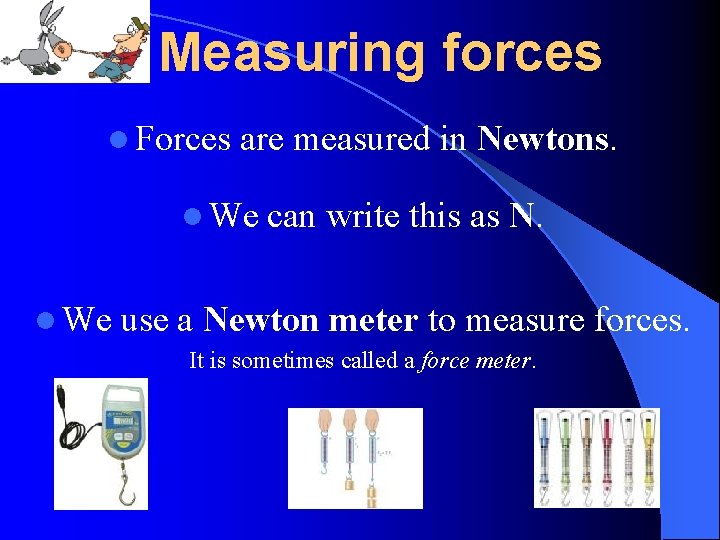
Measuring forces l Forces are measured in Newtons. l We can write this as N. use a Newton meter to measure forces. It is sometimes called a force meter.
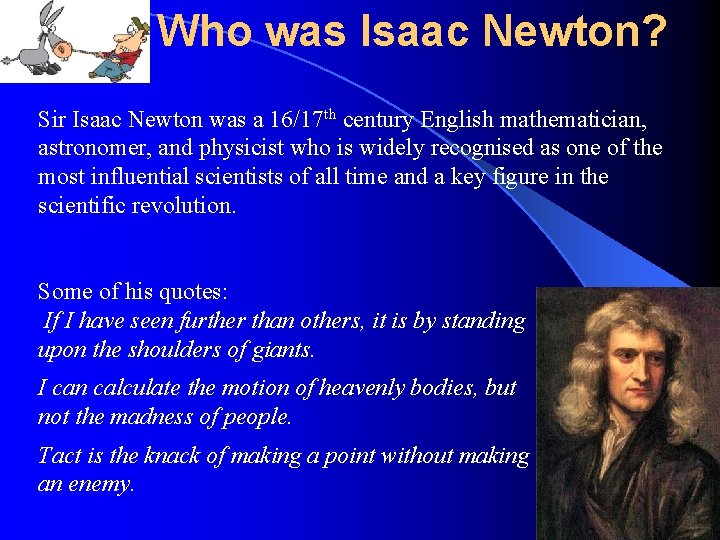
Who was Isaac Newton? Sir Isaac Newton was a 16/17 th century English mathematician, astronomer, and physicist who is widely recognised as one of the most influential scientists of all time and a key figure in the scientific revolution. Some of his quotes: If I have seen further than others, it is by standing upon the shoulders of giants. I can calculate the motion of heavenly bodies, but not the madness of people. Tact is the knack of making a point without making an enemy.
Newton’s 3 Laws of Motion The first law, known as the “law of inertia”, states that: “An object at rest will remain at rest unless acted on by an unbalanced force. An object in motion continues in motion with the same speed and in the same direction unless acted upon by an unbalanced force. ” The second law states that acceleration is produced when a force acts on a mass – ergo, the greater the mass of the object, the greater the force required to accelerate it. The third law states that “for every action, there is an equal but opposite reaction”.
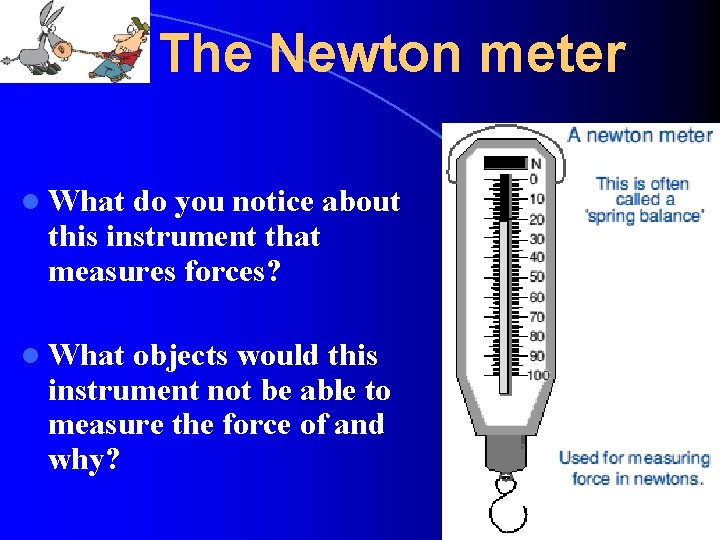
The Newton meter l What do you notice about this instrument that measures forces? l What objects would this instrument not be able to measure the force of and why?
Assignment l You are going to complete the Worksheet. l You will work in small groups and measure the force of different objects in the classroom using a Newton meter. You will record your findings in a table. We will then discuss our findings.
What did we find out? l What object had the biggest force? l What object had the smallest force? l Challenge: can you find an object that has a force of exactly 3 N? l Which object has a force greater than 5 N?
Quick quiz! l 1. What is a force? l 2. Can you see forces? l 3. Can you name any effects that forces have? l 4. What units do we measure forces in? l 5. What instrument do we use to measure force? l 6. What is this instrument also known as? How did you score? ? !
- Slides: 10