
Forces in Two Dimensions Example Three kids are
- Slides: 9
Forces in Two Dimensions
Example Three kids are fighting over the same toy. One pulls the toy with a force of 20 N (E), another pulls with a force of 15 N (15°N of W), and the third pull with 22 N (S). a) Find the total force on the toy. b) What is the toy’s acceleration?
Example A child pulls on a wooden toy attached to a string. The toy has a mass of 5 kg and the child pull on the string with a force of 25 N at an angle of 50° with the horizontal. Assuming no friction. a) Draw the free body diagram. b) Calculate the normal force. c) Determine the acceleration of the toy.
Example Working in his yard, a man pushes on a 50 kg lawnmower. He exerts a force of 200 N on the handle that makes and angle of 60° with the horizontal. Assume no friction. a) Draw the free body diagram. b) Determine the Normal force. c) Find the acceleration of the mower.
Example A 10 kg box is placed at the top of a frictionless ramp with an angle of 30 o with the horizontal. Calculate the acceleration of the box down the ramp.
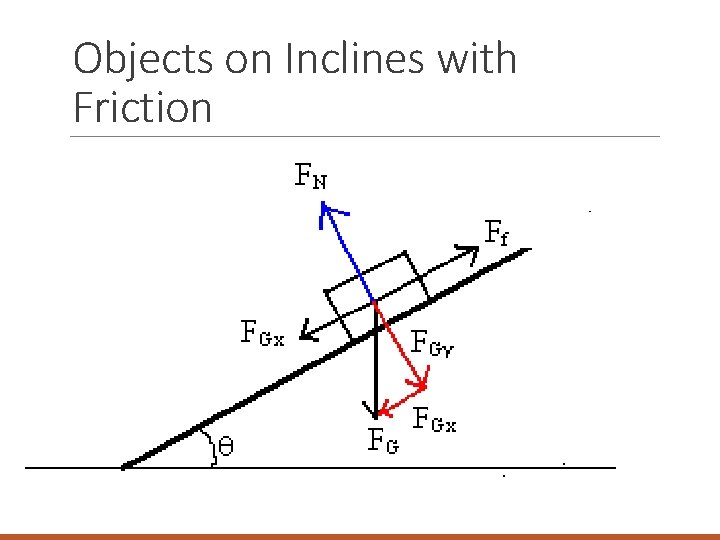
Objects on Inclines with Friction
When will a block slide down an incline? If the portion of its weight parallel to the incline is greater than the friction between the surfaces (FGx > Ff) If FGx is less than friction, the block will not move
Ex A 51. 0 kg skier is descending down a 30° slope. If the coefficient of friction is. 10 a) draw the free body diagram b) find her acceleration c) find her speed after 4. 0 sec
Ex Suppose that the skier in the previous problem encounters slushy snow and then moves down the slope at a constant speed. What is the new coefficient of friction?