
Forces in Fluids Table of Contents Pressure Floating
Forces in Fluids Table of Contents Pressure Floating and Sinking Pascal’s Principle Bernoulli’s Principle
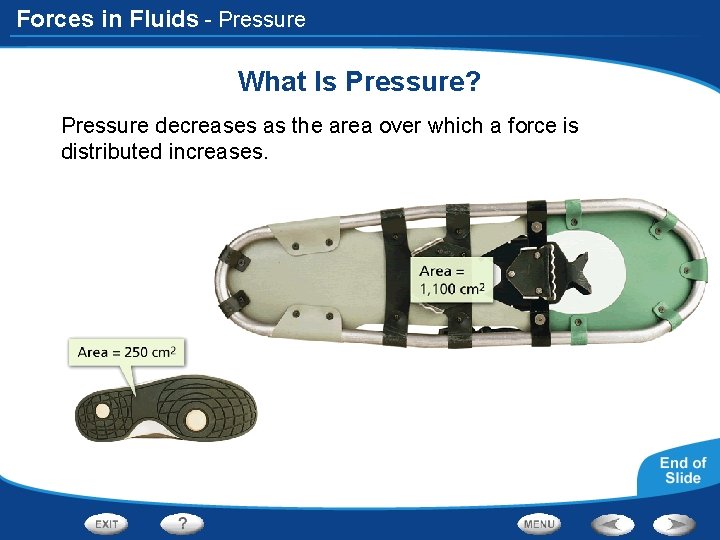
Forces in Fluids - Pressure What Is Pressure? Pressure decreases as the area over which a force is distributed increases.
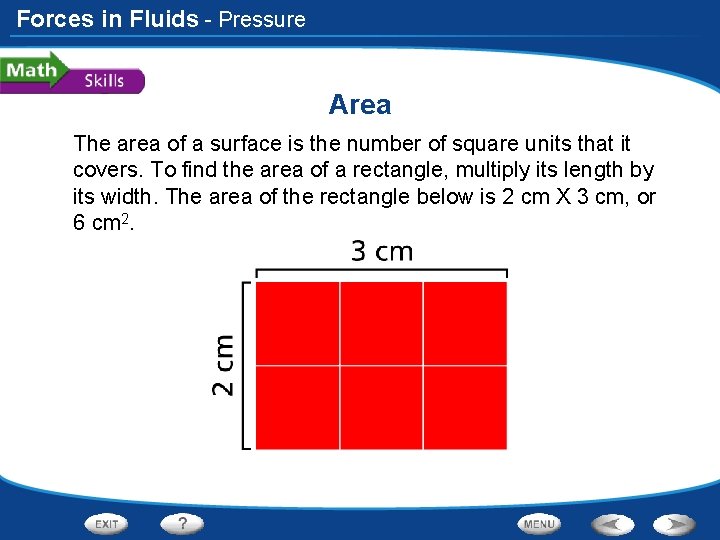
Forces in Fluids - Pressure Area The area of a surface is the number of square units that it covers. To find the area of a rectangle, multiply its length by its width. The area of the rectangle below is 2 cm X 3 cm, or 6 cm 2.
Forces in Fluids - Pressure Area Practice Problem Which has a greater area: a rectangle that is 5 cm X 20 cm or a square that is 10 cm X 10 cm? Both have the same area, 100 cm 2. 5 cm X 20 cm = 100 cm 2 10 cm X 10 cm = 100 cm 2
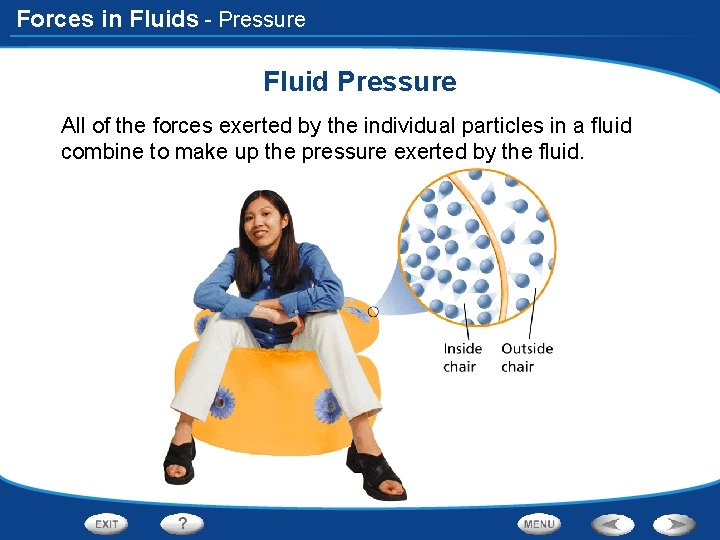
Forces in Fluids - Pressure Fluid Pressure All of the forces exerted by the individual particles in a fluid combine to make up the pressure exerted by the fluid.
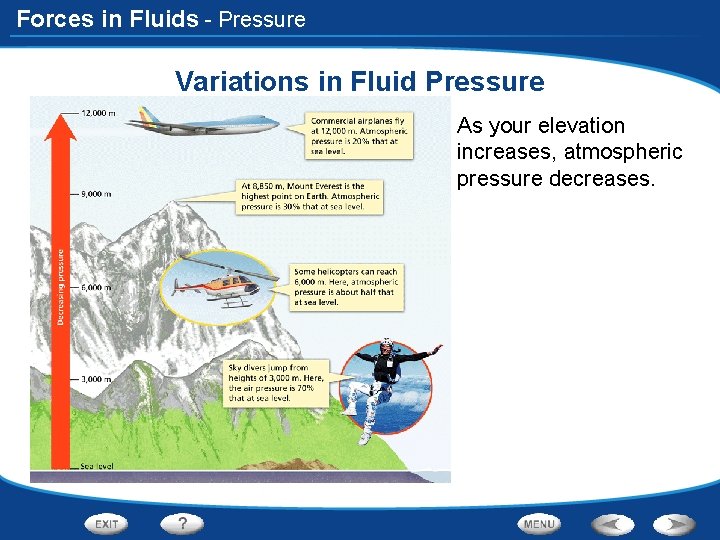
Forces in Fluids - Pressure Variations in Fluid Pressure As your elevation increases, atmospheric pressure decreases.
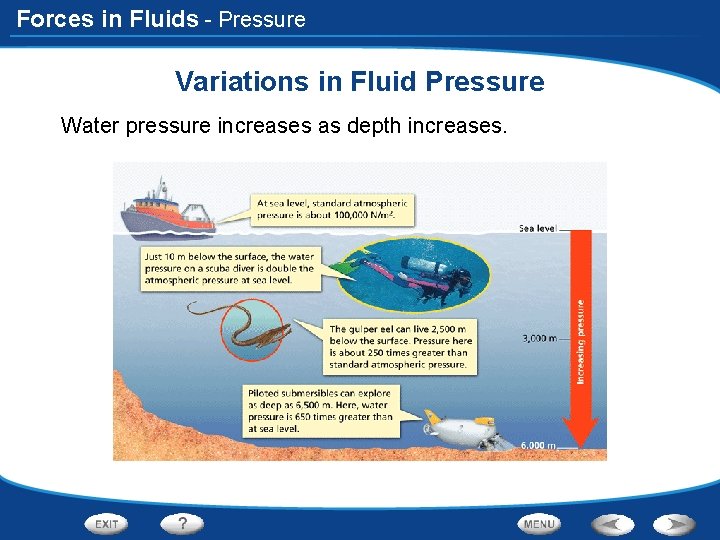
Forces in Fluids - Pressure Variations in Fluid Pressure Water pressure increases as depth increases.
Forces in Fluids - Pressure Previewing Visuals Before you read, preview Figure 5. Then write two questions that you have about the diagram in a graphic organizer like the one below. As you read, answer your questions. Pressure Variations Q. Why does the pressure change with elevation and depth? A. Air and water exert pressure, so pressure varies depending on how much air or water is above you. Q. How much greater is water pressure at a depth of 6, 500 m than it is at sea level? A. It is about 650 times greater.
Forces in Fluids - Pressure Links on Fluids and Pressure Click the Sci. Links button for links on fluids and pressure.
Forces in Fluids End of Section: Pressure
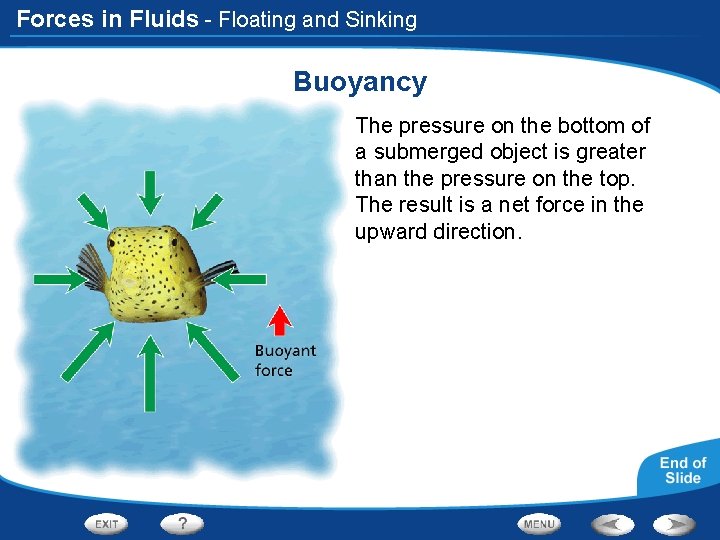
Forces in Fluids - Floating and Sinking Buoyancy The pressure on the bottom of a submerged object is greater than the pressure on the top. The result is a net force in the upward direction.
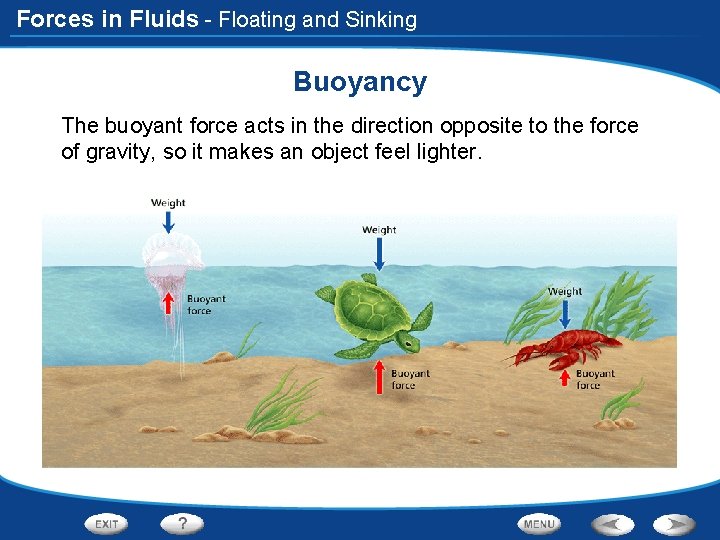
Forces in Fluids - Floating and Sinking Buoyancy The buoyant force acts in the direction opposite to the force of gravity, so it makes an object feel lighter.
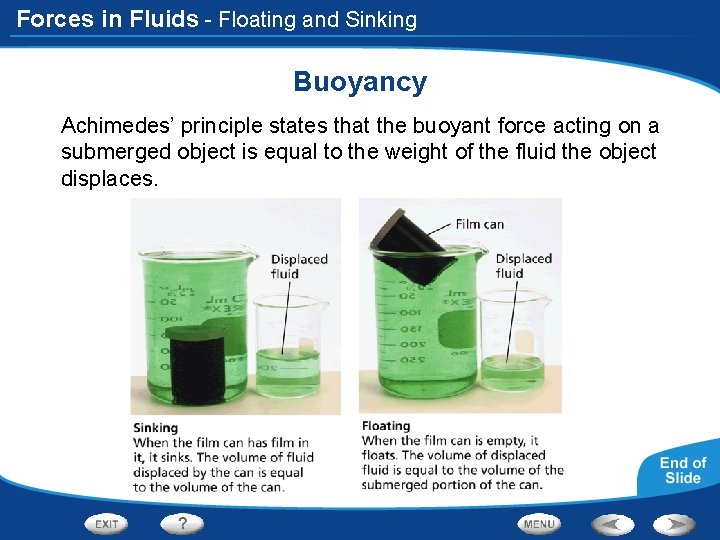
Forces in Fluids - Floating and Sinking Buoyancy Achimedes’ principle states that the buoyant force acting on a submerged object is equal to the weight of the fluid the object displaces.
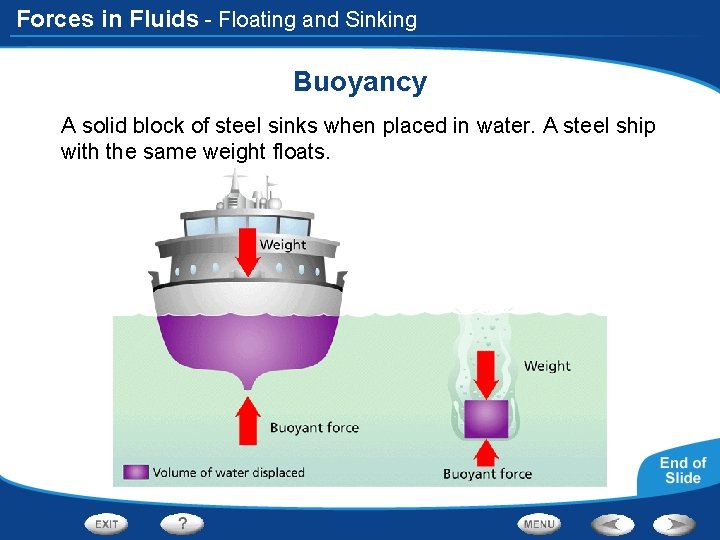
Forces in Fluids - Floating and Sinking Buoyancy A solid block of steel sinks when placed in water. A steel ship with the same weight floats.
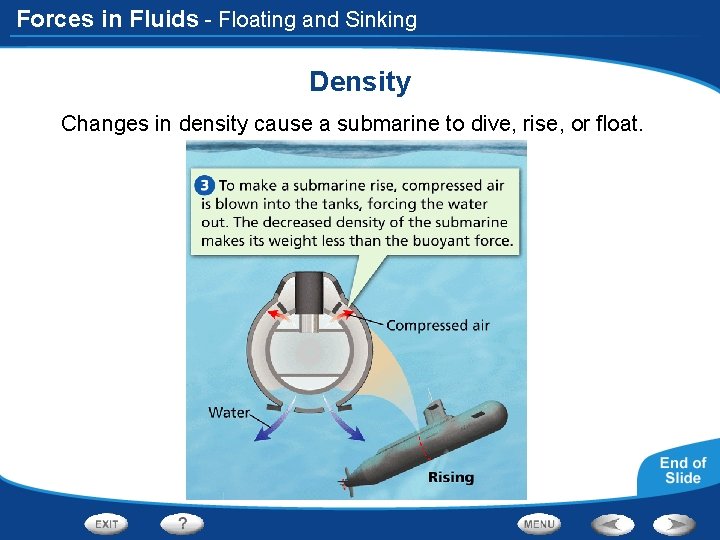
Forces in Fluids - Floating and Sinking Density Changes in density cause a submarine to dive, rise, or float.
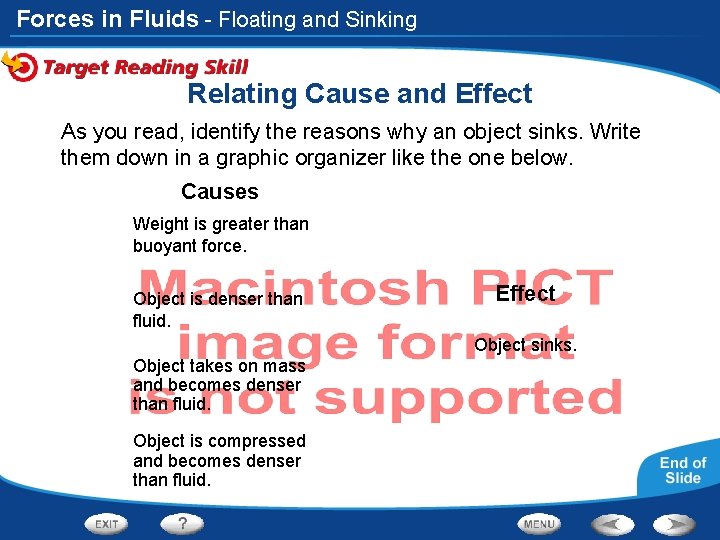
Forces in Fluids - Floating and Sinking Relating Cause and Effect As you read, identify the reasons why an object sinks. Write them down in a graphic organizer like the one below. Causes Weight is greater than buoyant force. Object is denser than fluid. Effect Object sinks. Object takes on mass and becomes denser than fluid. Object is compressed and becomes denser than fluid.
Forces in Fluids - Floating and Sinking Density Click the Video button to watch a movie about density.
Forces in Fluids End of Section: Floating and Sinking
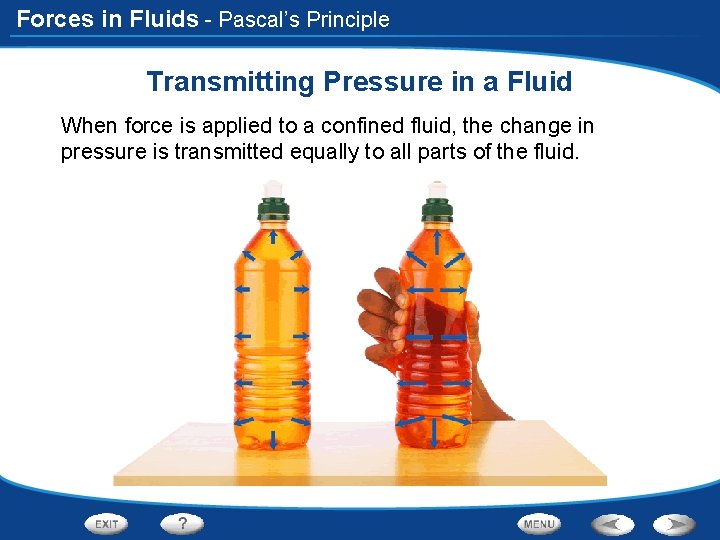
Forces in Fluids - Pascal’s Principle Transmitting Pressure in a Fluid When force is applied to a confined fluid, the change in pressure is transmitted equally to all parts of the fluid.
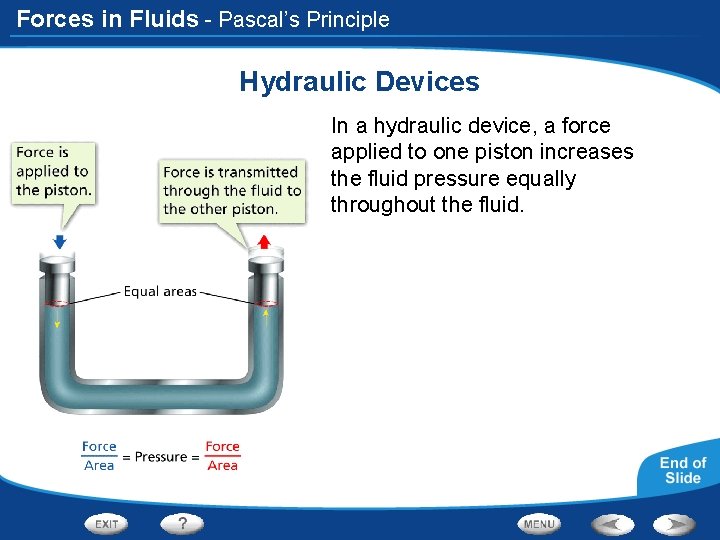
Forces in Fluids - Pascal’s Principle Hydraulic Devices In a hydraulic device, a force applied to one piston increases the fluid pressure equally throughout the fluid.
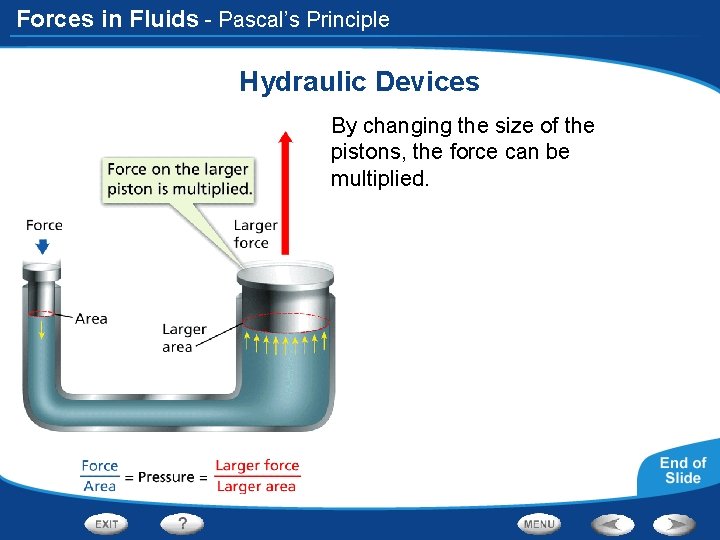
Forces in Fluids - Pascal’s Principle Hydraulic Devices By changing the size of the pistons, the force can be multiplied.
Forces in Fluids - Pascal’s Principle Hydraulic Systems Activity Click the Active Art button to open a browser window and access Active Art about hydraulic systems.
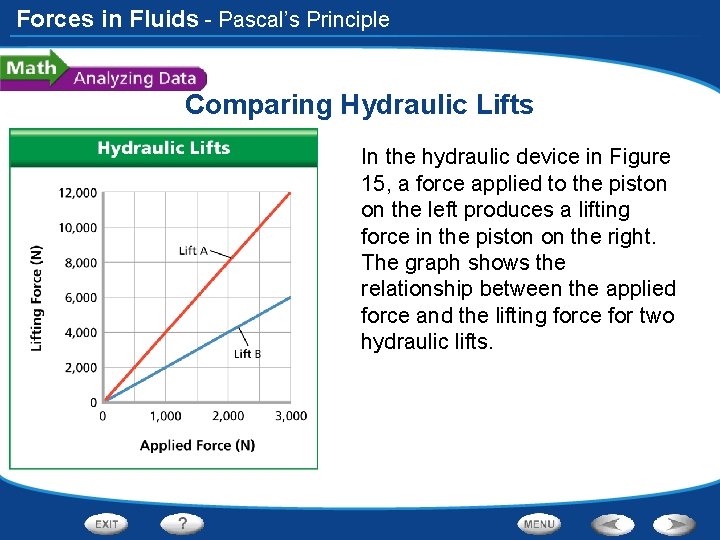
Forces in Fluids - Pascal’s Principle Comparing Hydraulic Lifts In the hydraulic device in Figure 15, a force applied to the piston on the left produces a lifting force in the piston on the right. The graph shows the relationship between the applied force and the lifting force for two hydraulic lifts.
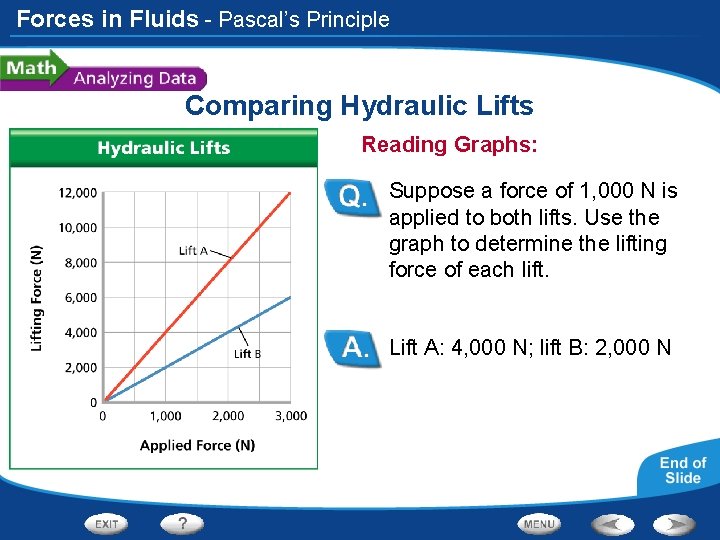
Forces in Fluids - Pascal’s Principle Comparing Hydraulic Lifts Reading Graphs: Suppose a force of 1, 000 N is applied to both lifts. Use the graph to determine the lifting force of each lift. Lift A: 4, 000 N; lift B: 2, 000 N
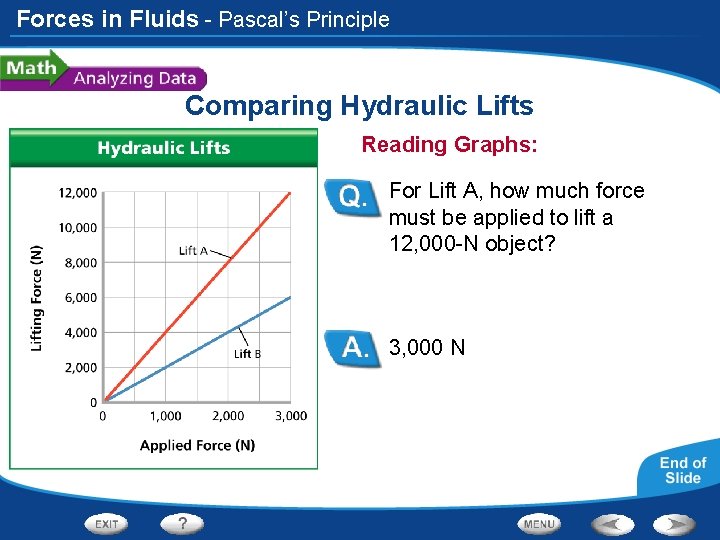
Forces in Fluids - Pascal’s Principle Comparing Hydraulic Lifts Reading Graphs: For Lift A, how much force must be applied to lift a 12, 000 -N object? 3, 000 N
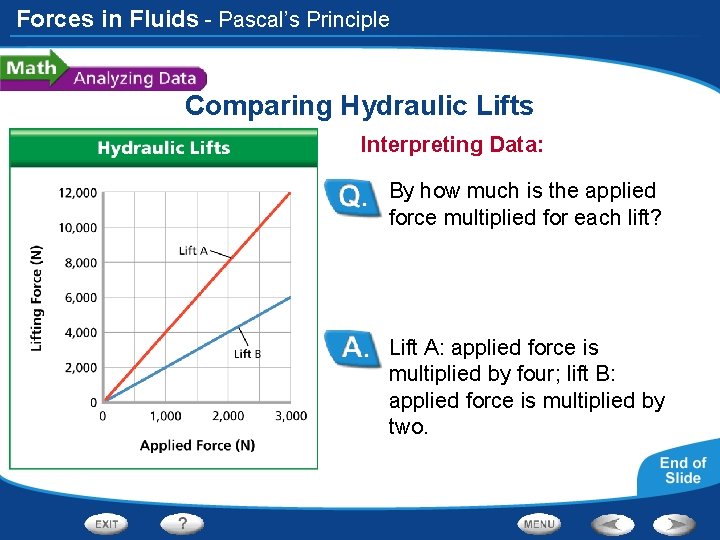
Forces in Fluids - Pascal’s Principle Comparing Hydraulic Lifts Interpreting Data: By how much is the applied force multiplied for each lift? Lift A: applied force is multiplied by four; lift B: applied force is multiplied by two.
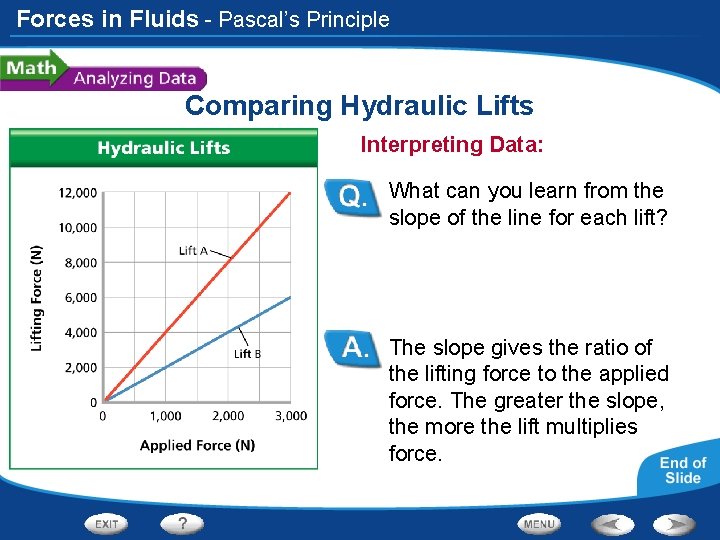
Forces in Fluids - Pascal’s Principle Comparing Hydraulic Lifts Interpreting Data: What can you learn from the slope of the line for each lift? The slope gives the ratio of the lifting force to the applied force. The greater the slope, the more the lift multiplies force.
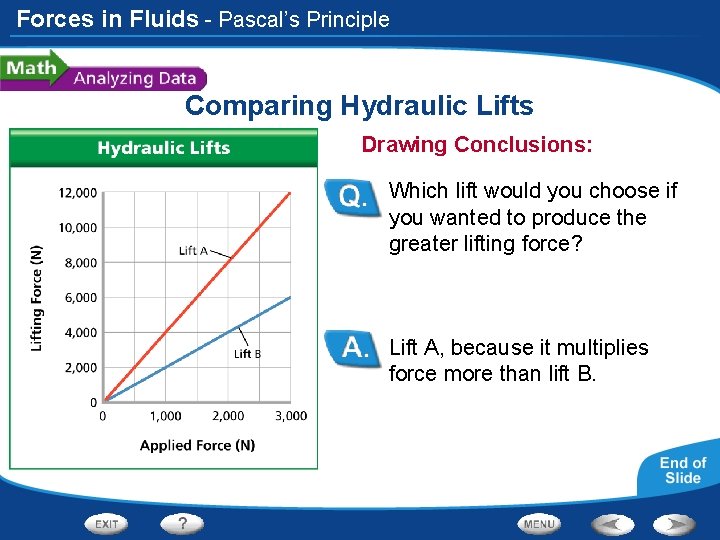
Forces in Fluids - Pascal’s Principle Comparing Hydraulic Lifts Drawing Conclusions: Which lift would you choose if you wanted to produce the greater lifting force? Lift A, because it multiplies force more than lift B.
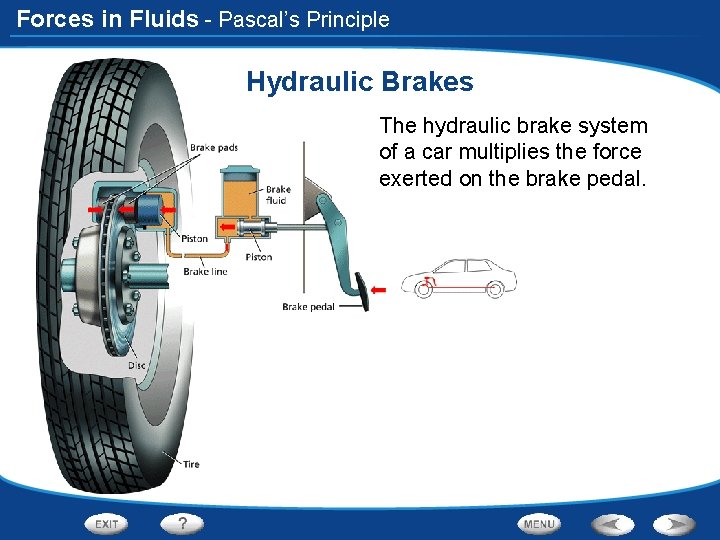
Forces in Fluids - Pascal’s Principle Hydraulic Brakes The hydraulic brake system of a car multiplies the force exerted on the brake pedal.
Forces in Fluids - Pascal’s Principle Asking Questions Before you read, preview the red headings. In a graphic organizer like the one below, ask a what or how question for each heading. As you read, write answers to your questions. Question How is pressure transmitted in a fluid? What is a hydraulic system? Answer Pressure is transmitted equally to all parts of the fluid. A hydraulic system uses a confined fluid to transmit pressure.
Forces in Fluids End of Section: Pascal’s Principle
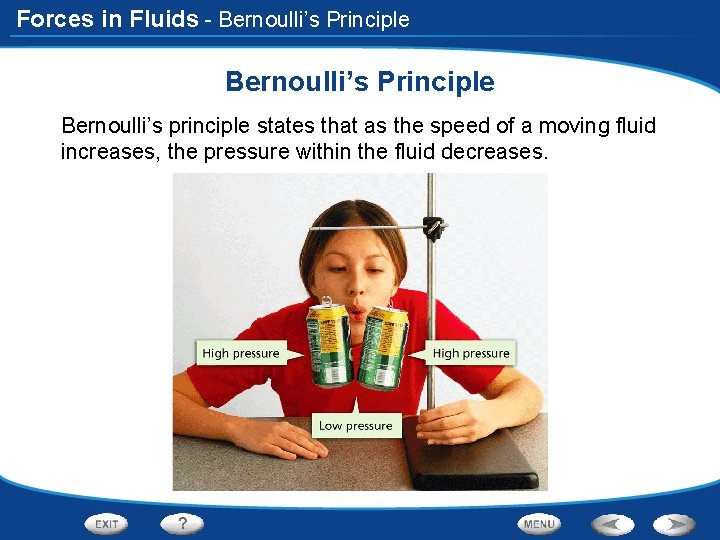
Forces in Fluids - Bernoulli’s Principle Bernoulli’s principle states that as the speed of a moving fluid increases, the pressure within the fluid decreases.
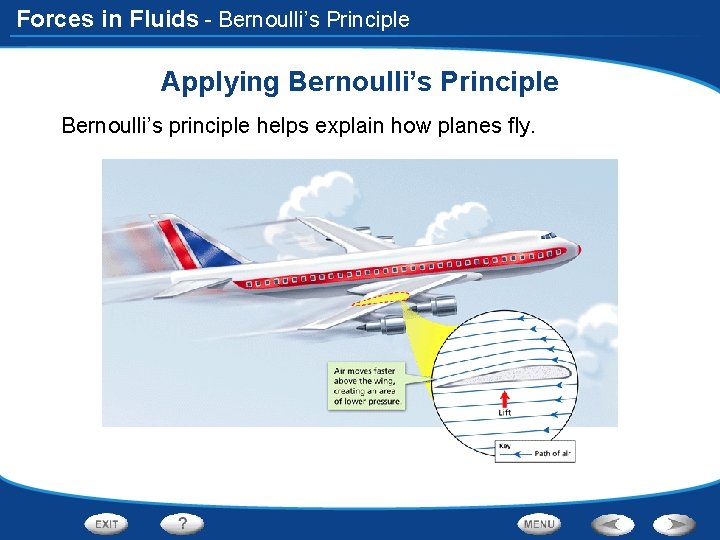
Forces in Fluids - Bernoulli’s Principle Applying Bernoulli’s Principle Bernoulli’s principle helps explain how planes fly.
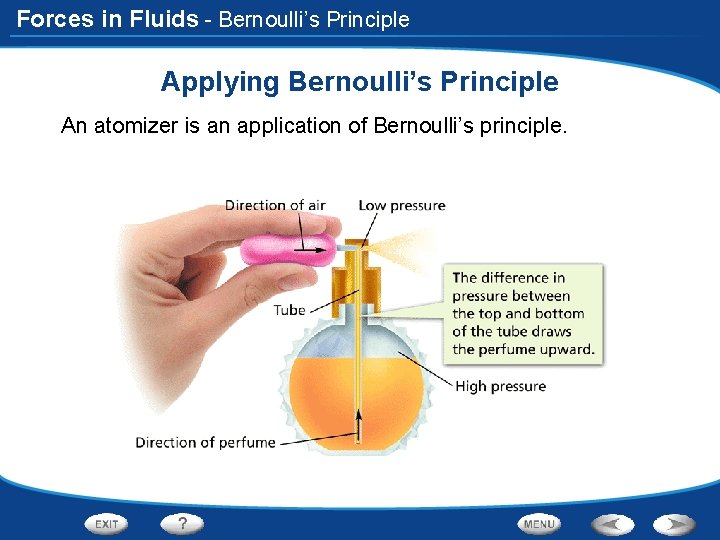
Forces in Fluids - Bernoulli’s Principle Applying Bernoulli’s Principle An atomizer is an application of Bernoulli’s principle.
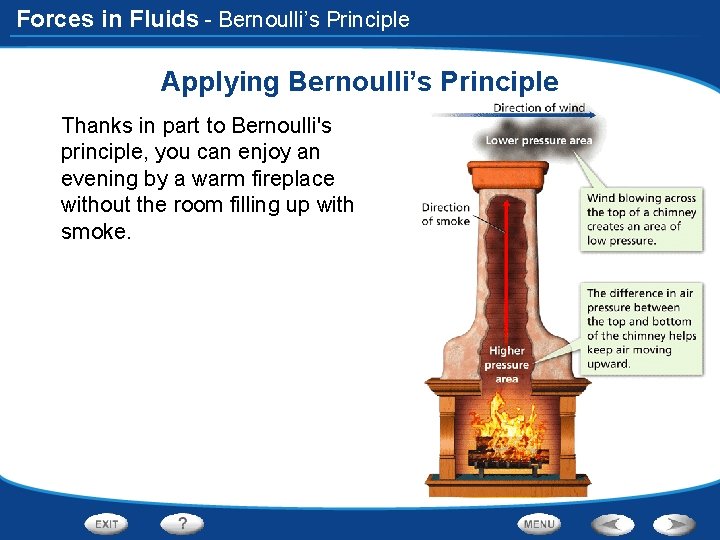
Forces in Fluids - Bernoulli’s Principle Applying Bernoulli’s Principle Thanks in part to Bernoulli's principle, you can enjoy an evening by a warm fireplace without the room filling up with smoke.
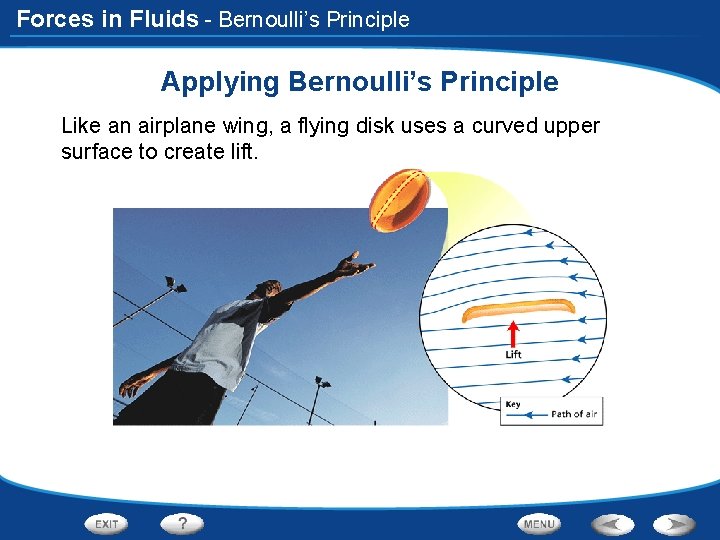
Forces in Fluids - Bernoulli’s Principle Applying Bernoulli’s Principle Like an airplane wing, a flying disk uses a curved upper surface to create lift.

Forces in Fluids - Bernoulli’s Principle Identifying Main Ideas As you read the section “Applying Bernoulli’s Principle, ” write the main idea in a graphic organizer like the one below. Then write three supporting details that further explain the main idea. Main Idea Bernoulli’s principle is a factor that helps explain… Detail how airplanes fly Detail why smoke rises up a chimney Detail how an atomizer works

Forces in Fluids - Bernoulli’s Principle Links on Bernoulli’s Principle Click the Sci. Links button for links on Bernoulli’s principle.

Forces in Fluids End of Section: Bernoulli’s Principle
Forces in Fluids Graphic Organizer How a Hydraulic Device Works Force is applied to a small piston. Pressure in a confined fluid is increased. The pressure is transmitted equally throughout the fluid. The confined fluid presses on a piston with a larger surface area. The original force is multiplied.
Forces in Fluids End of Section: Graphic Organizer
- Slides: 41