
Forces Forces A FORCE is a push or

- Slides: 23
Forces
Forces A FORCE is a push or a pull exerted on an object n Forces cause objects to speed up, slow down, or change direction. n Force is measured in Newtons n
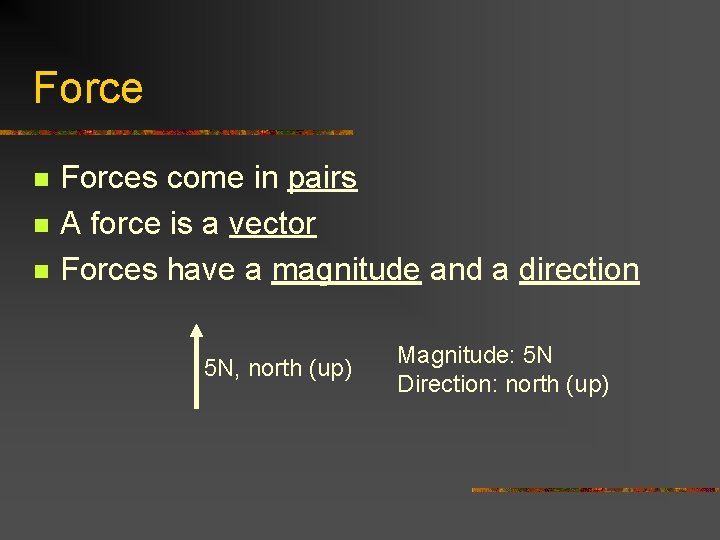
Force n n n Forces come in pairs A force is a vector Forces have a magnitude and a direction 5 N, north (up) Magnitude: 5 N Direction: north (up)
Types of Forces n There are two types of forces 1. Contact forces 2. Forces at a distance (long range forces)
Contact Forces n Types of forces that result when the two interacting objects are perceived to be physically contacting each other
Examples of Contact forces 1. 2. 3. 4. 5. 6. Applied force Friction force Tension force Normal force Air resistance Spring force
Applied Force n n n Identified as Fa Applied to an object by a person or another object Acts in the horizontal direction, parallel to the surface
Friction Force n n n Identified as Ff Acts opposite sliding motion between surfaces Acts in the horizontal direction, parallel to the surface and opposite the direction of sliding
Tension Force n n n Identified as FT Pull exerted by a rope, string, or cable attached to a body and pulled tight Acts away from the object and parallel to the string, rope, or cable
Normal Force n n Identified as FN Exerted by a surface on an object (presses two surfaces together) Acts in an upward, vertical direction, perpendicular to the surface Sometimes referred to as the support force
Air Resistance Force n n n Identified as Fair Type of frictional force that acts upon objects as they travel through the air Acts opposite motion
Long Range Forces n Long Range Forces- types of forces that result even when the two interacting objects are not in physical contact with each other, yet are able to exert a push or pull despite their physical separation
Examples of Long Range forces 1. 2. 3. Gravitational force Electrical force Magnetic force
Gravitational Force n n All objects on Earth experience a force of gravity that is directed downward towards the center of the earth. Identified as FW or Fg Referred to as the force of weight Acts in the vertical direction
Balanced and Unbalanced Forces n Forces occur in pairs and they can be either balanced or unbalanced
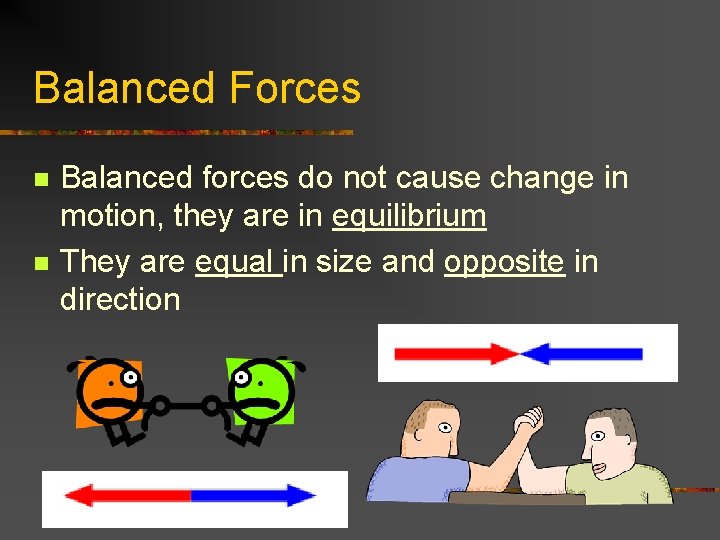
Balanced Forces n n Balanced forces do not cause change in motion, they are in equilibrium They are equal in size and opposite in direction
Unbalanced Forces n n An unbalanced force always causes a change in motion Forces are not in equilibrium When unbalanced forces act in opposite directions you can find the net force The net force is the sum of all the forces acting on an object
Net Force n n n A net force shows magnitude and direction The magnitude is the difference between forces acting on an object The resulting motion of an object is in the direction of the largest force
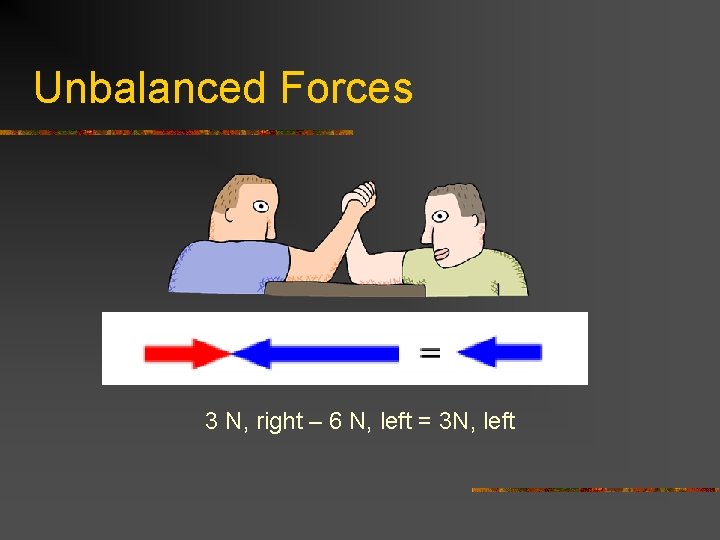
Unbalanced Forces 3 N, right – 6 N, left = 3 N, left
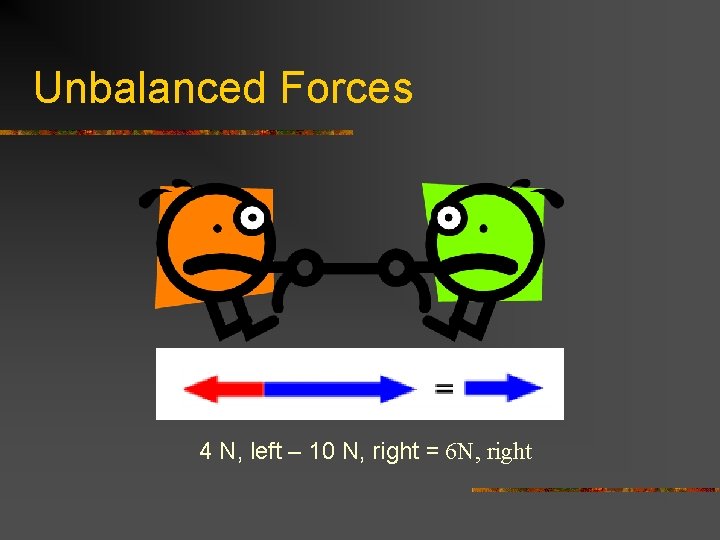
Unbalanced Forces 4 N, left – 10 N, right = 6 N, right
Force Body Diagrams n n n Used to show all the forces acting on an object (can be 1, 2, 3, or 4 forces) Can help you understand the motion of an object Force vectors are represented by arrows
How to Draw a Force Body Diagram n n n The length of the arrow reflects the magnitude of the force The direction of the arrow shows the direction that the force is acting Represent the object as a box
How to Draw a Force Body Diagram n n n Draw the force arrow from the center of the box outward in the direction that the force is acting Label each force arrow as to what type of force is present Calculate the sum of the forces