
Forces Chapter 3 Section 1 Newtons Second Law
- Slides: 58
Forces Chapter 3
Section 1: Newton’s Second Law 1. 2. 3. 4. What you will learn: Define Newton’s second law of motion. Apply Newton’s second law of motion. Describe three different types of friction. Observe the effects of air resistance on falling objects.
Force, Mass, and Acceleration p Review: n p Newton’s FIRST law of motion: the motion of an object changes only if an unbalanced force acts on the object. New: n Newton’s SECOND law of motion: describes how the forces exerted on an object, its mass, and its acceleration are related.
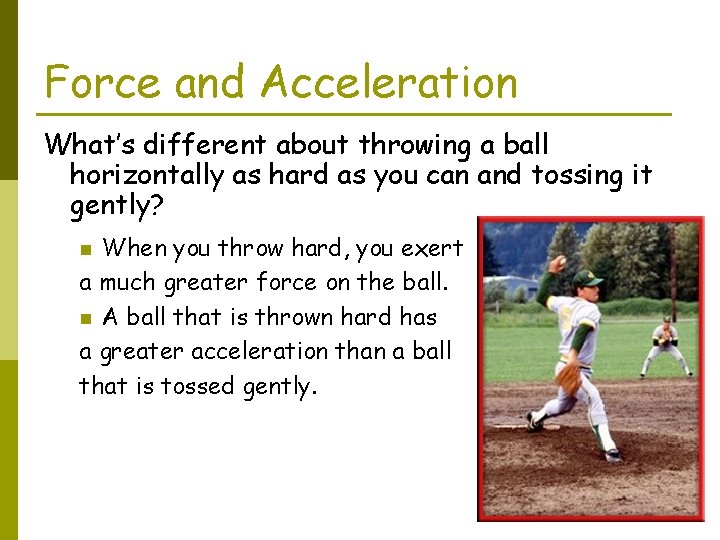
Force and Acceleration What’s different about throwing a ball horizontally as hard as you can and tossing it gently? When you throw hard, you exert a much greater force on the ball. n A ball that is thrown hard has a greater acceleration than a ball that is tossed gently. n
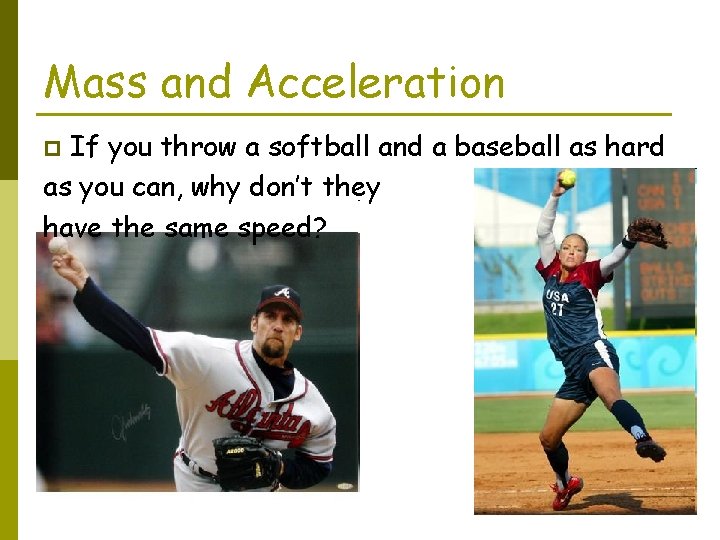
Mass and Acceleration If you throw a softball and a baseball as hard as you can, why don’t they have the same speed? p
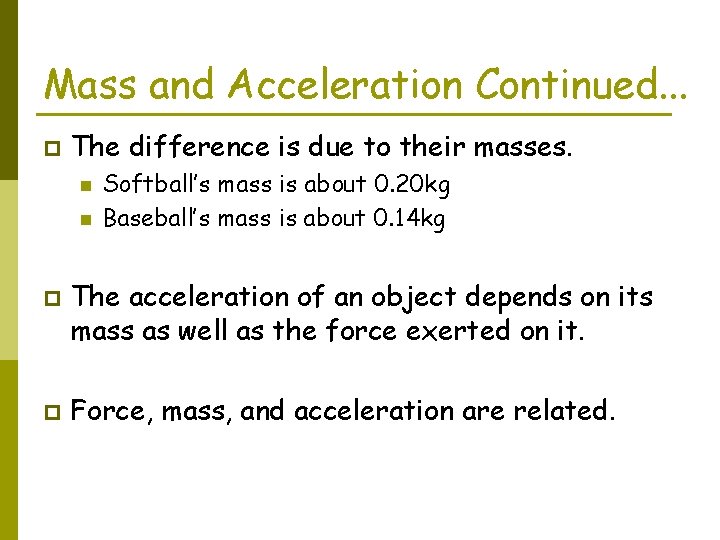
Mass and Acceleration Continued. . . p The difference is due to their masses. n n p p Softball’s mass is about 0. 20 kg Baseball’s mass is about 0. 14 kg The acceleration of an object depends on its mass as well as the force exerted on it. Force, mass, and acceleration are related.
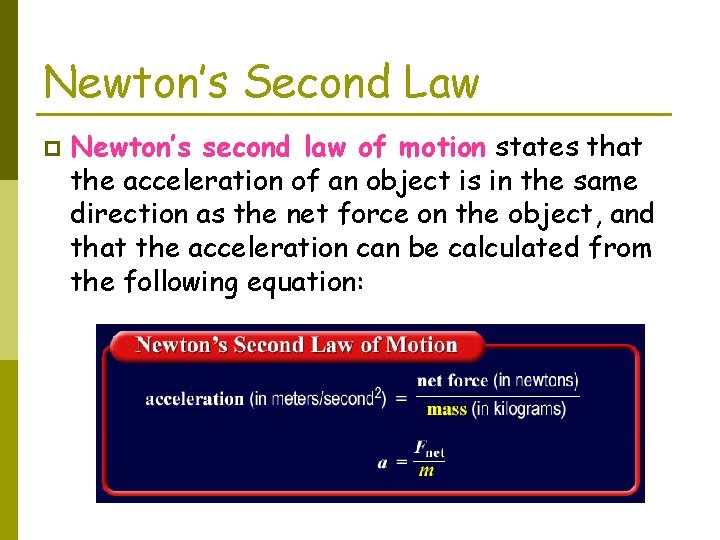
Newton’s Second Law p Newton’s second law of motion states that the acceleration of an object is in the same direction as the net force on the object, and that the acceleration can be calculated from the following equation:
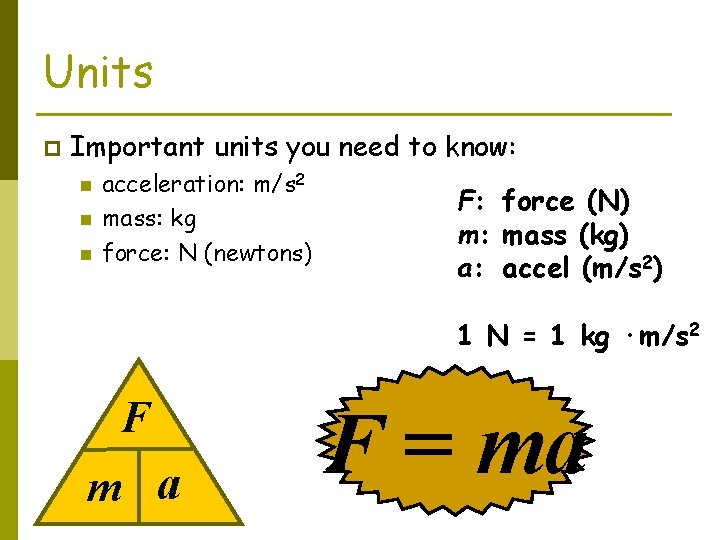
Units p Important units you need to know: n n n acceleration: m/s 2 mass: kg force: N (newtons) F: force (N) m: mass (kg) a: accel (m/s 2) 1 N = 1 kg ·m/s 2 F m a F = ma
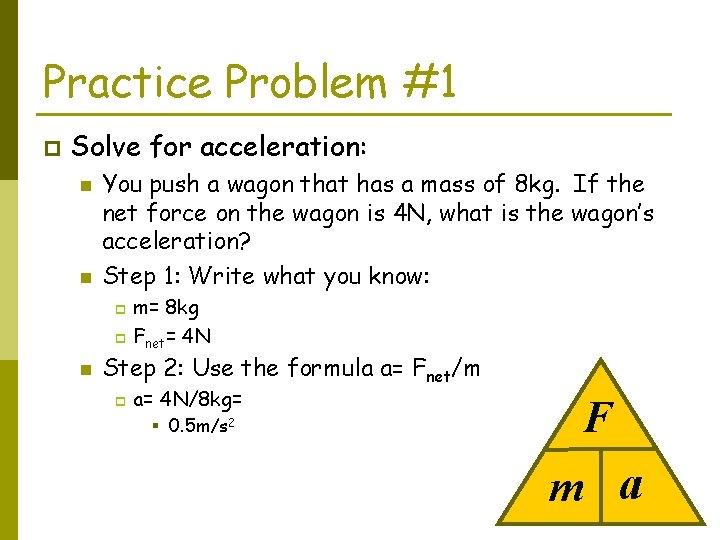
Practice Problem #1 p Solve for acceleration: n n You push a wagon that has a mass of 8 kg. If the net force on the wagon is 4 N, what is the wagon’s acceleration? Step 1: Write what you know: m= 8 kg p Fnet= 4 N p n Step 2: Use the formula a= Fnet/m p a= 4 N/8 kg= § 0. 5 m/s 2 F m a
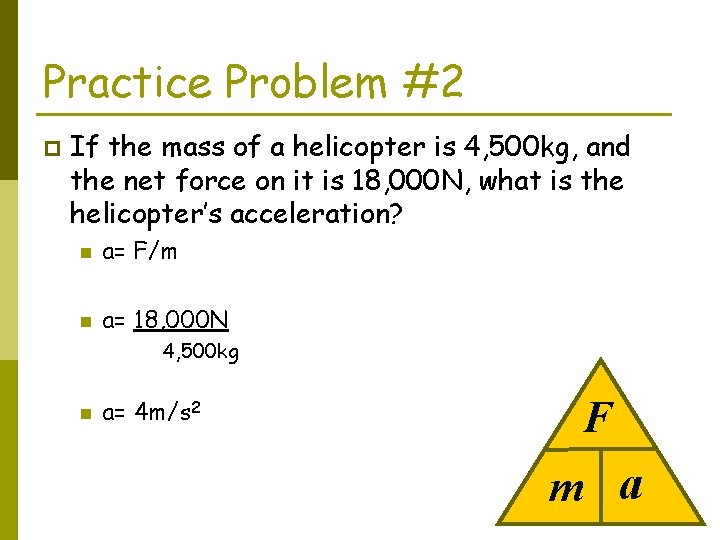
Practice Problem #2 p If the mass of a helicopter is 4, 500 kg, and the net force on it is 18, 000 N, what is the helicopter’s acceleration? n a= F/m n a= 18, 000 N 4, 500 kg n a= 4 m/s 2 F m a
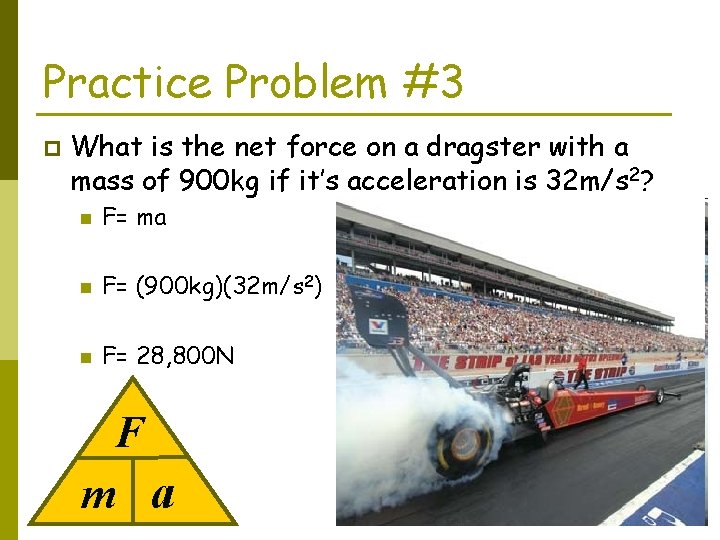
Practice Problem #3 p What is the net force on a dragster with a mass of 900 kg if it’s acceleration is 32 m/s 2? n F= ma n F= (900 kg)(32 m/s 2) n F= 28, 800 N F m a
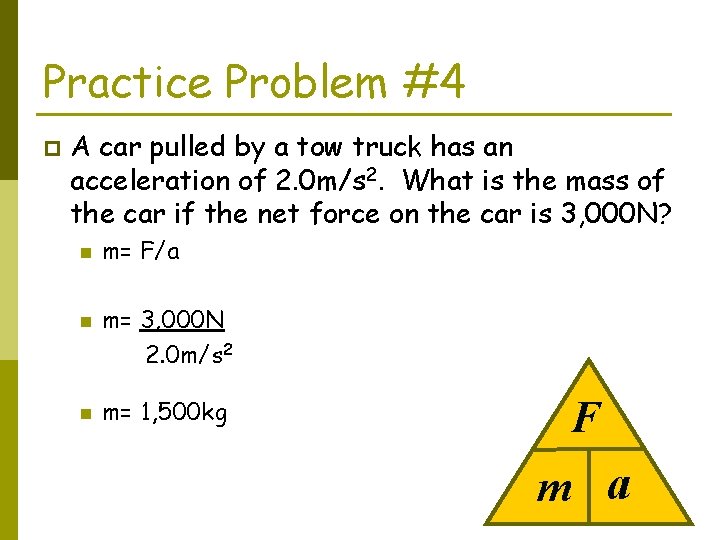
Practice Problem #4 p A car pulled by a tow truck has an acceleration of 2. 0 m/s 2. What is the mass of the car if the net force on the car is 3, 000 N? n n n m= F/a m= 3, 000 N 2. 0 m/s 2 m= 1, 500 kg F m a
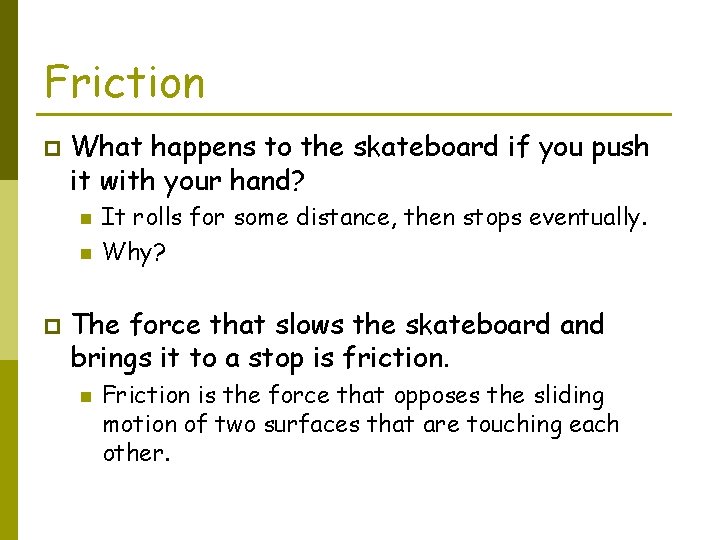
Friction p What happens to the skateboard if you push it with your hand? n n p It rolls for some distance, then stops eventually. Why? The force that slows the skateboard and brings it to a stop is friction. n Friction is the force that opposes the sliding motion of two surfaces that are touching each other.
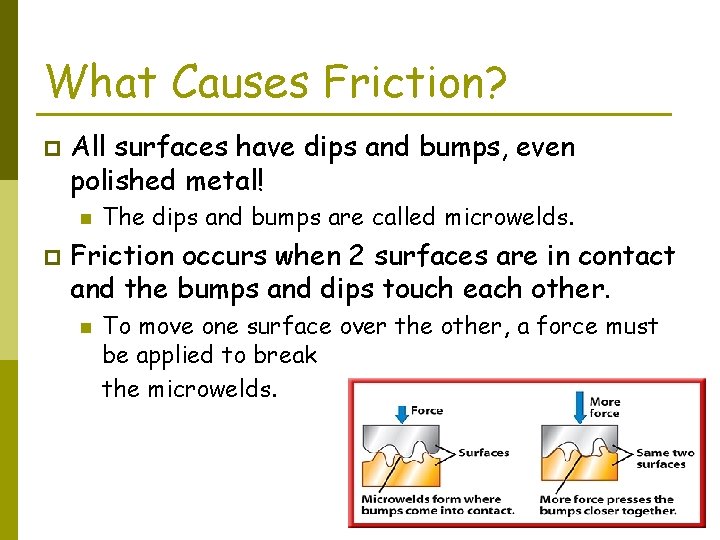
What Causes Friction? p All surfaces have dips and bumps, even polished metal! n p The dips and bumps are called microwelds. Friction occurs when 2 surfaces are in contact and the bumps and dips touch each other. n To move one surface over the other, a force must be applied to break the microwelds.
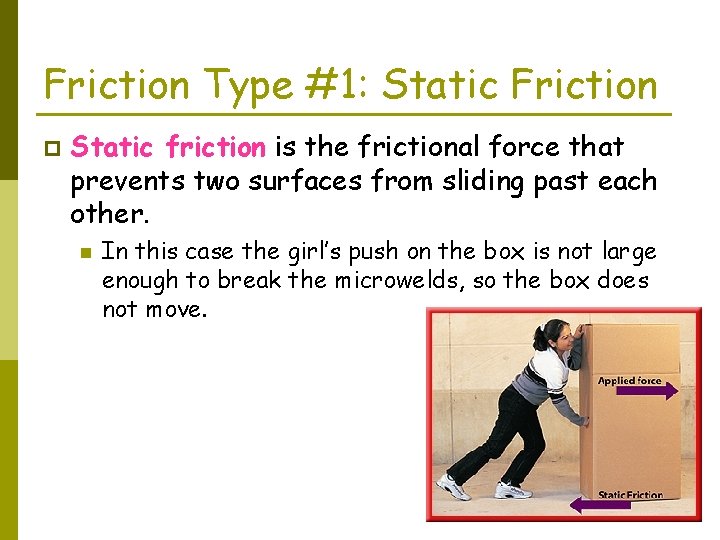
Friction Type #1: Static Friction p Static friction is the frictional force that prevents two surfaces from sliding past each other. n In this case the girl’s push on the box is not large enough to break the microwelds, so the box does not move.
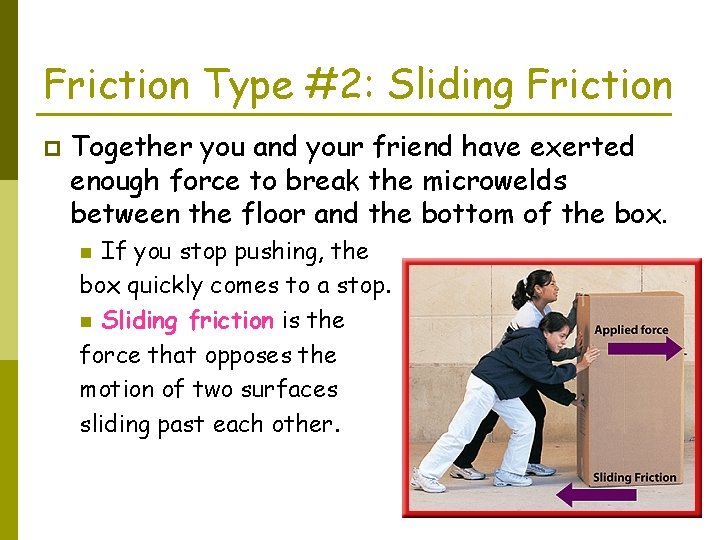
Friction Type #2: Sliding Friction p Together you and your friend have exerted enough force to break the microwelds between the floor and the bottom of the box. If you stop pushing, the box quickly comes to a stop. n Sliding friction is the force that opposes the motion of two surfaces sliding past each other. n
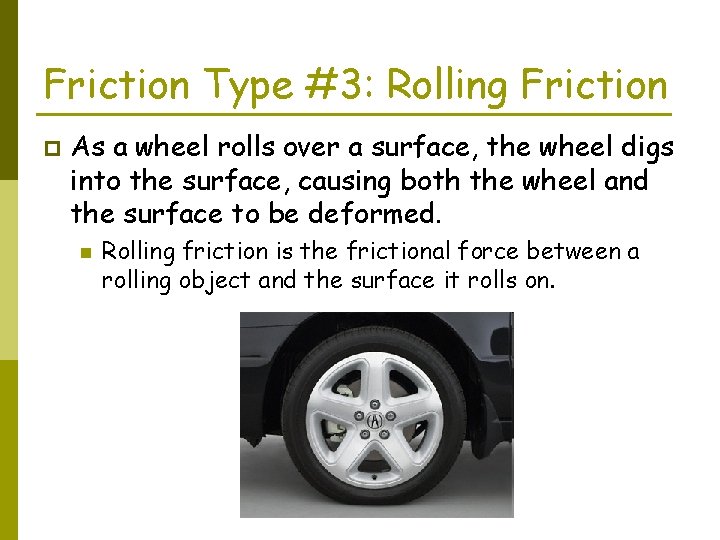
Friction Type #3: Rolling Friction p As a wheel rolls over a surface, the wheel digs into the surface, causing both the wheel and the surface to be deformed. n Rolling friction is the frictional force between a rolling object and the surface it rolls on.
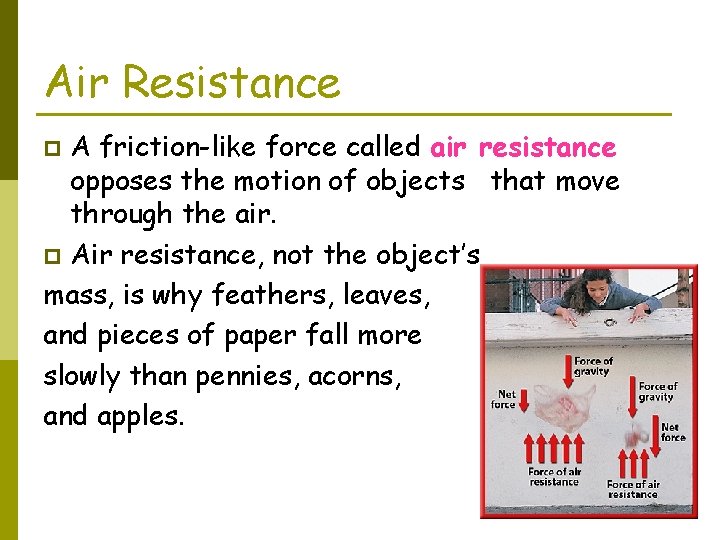
Air Resistance A friction-like force called air resistance opposes the motion of objects that move through the air. p Air resistance, not the object’s mass, is why feathers, leaves, and pieces of paper fall more slowly than pennies, acorns, and apples. p
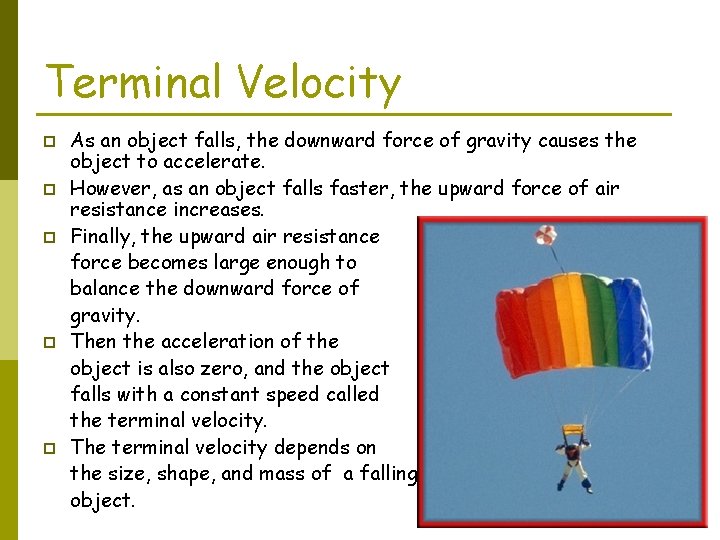
Terminal Velocity p p p As an object falls, the downward force of gravity causes the object to accelerate. However, as an object falls faster, the upward force of air resistance increases. Finally, the upward air resistance force becomes large enough to balance the downward force of gravity. Then the acceleration of the object is also zero, and the object falls with a constant speed called the terminal velocity. The terminal velocity depends on the size, shape, and mass of a falling object.
Did We Reach Our Learning Goals For Section 1? 1. Define Newton’s second law of motion. n 2. Apply Newton’s second law of motion. n 3. F= ma Describe three different types of friction. n 4. Acceleration is produced when a force acts on a mass. The greater the mass (of the object being accelerated) the greater the amount of force needed (to accelerate the object). Static friction (friction to begin moving), sliding friction (friction to keep moving), rolling friction (friction between a rolling object and the surface it rolls on) Observe the effects of air resistance on falling objects. n Air resistance is a force that acts on objects that move through the air.
Section 2: Gravity 1. 2. 3. 4. What you will learn: Describe the gravitational force. Distinguish between mass and weight. Explain why objects that are thrown will follow a curved path. Compare circular motion with motion in a straight line.
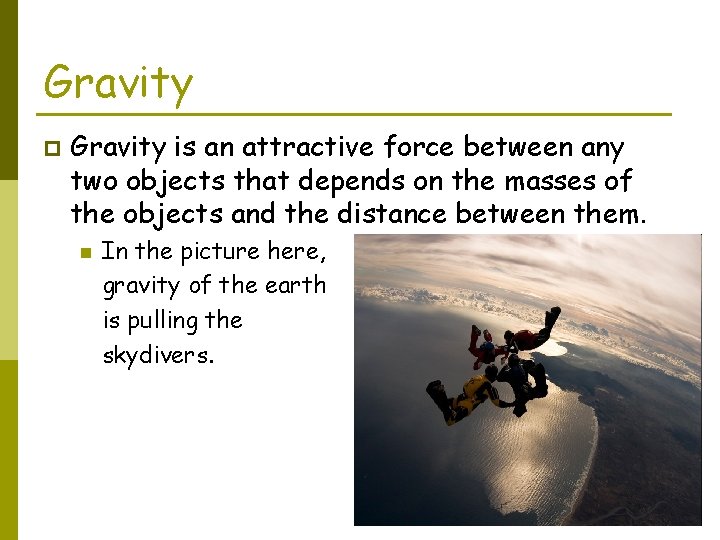
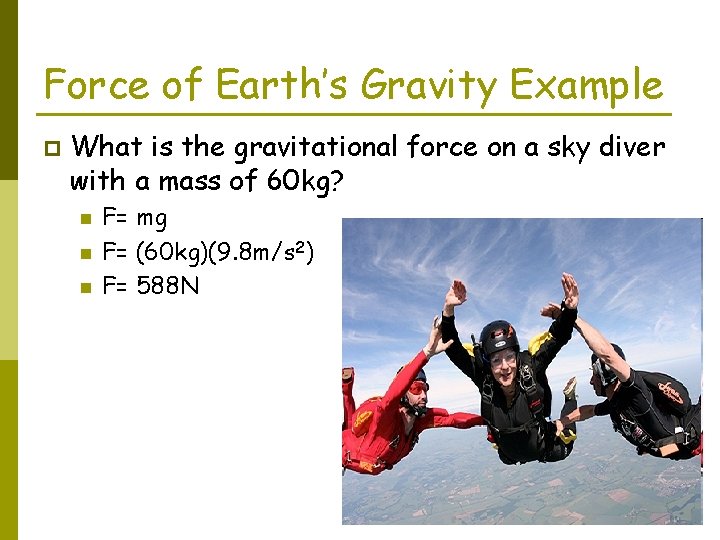
Gravity p Gravity is an attractive force between any two objects that depends on the masses of the objects and the distance between them. n In the picture here, gravity of the earth is pulling the skydivers.
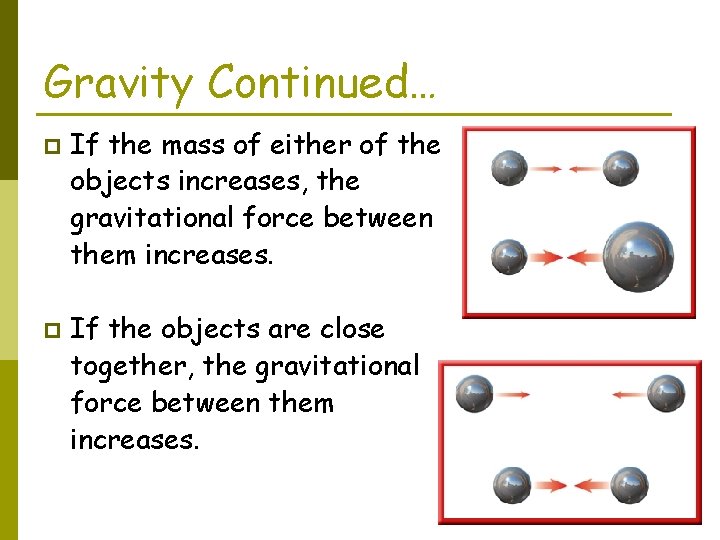
Gravity Continued… p p If the mass of either of the objects increases, the gravitational force between them increases. If the objects are close together, the gravitational force between them increases.
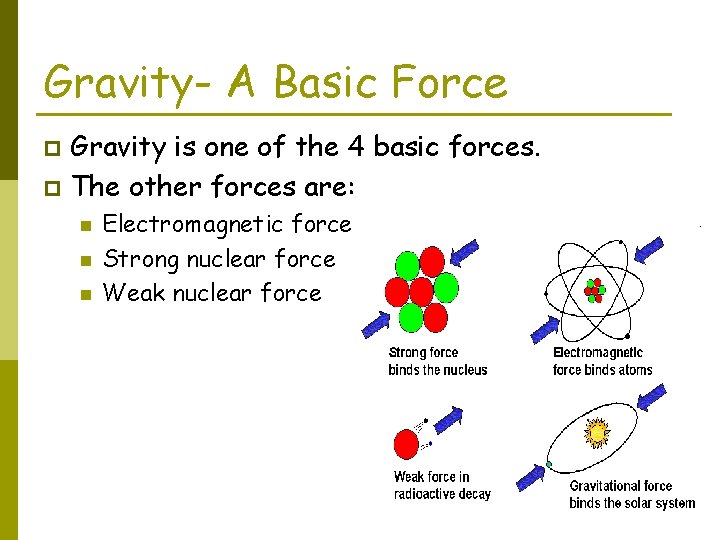
Gravity- A Basic Force Gravity is one of the 4 basic forces. p The other forces are: p n n n Electromagnetic force Strong nuclear force Weak nuclear force
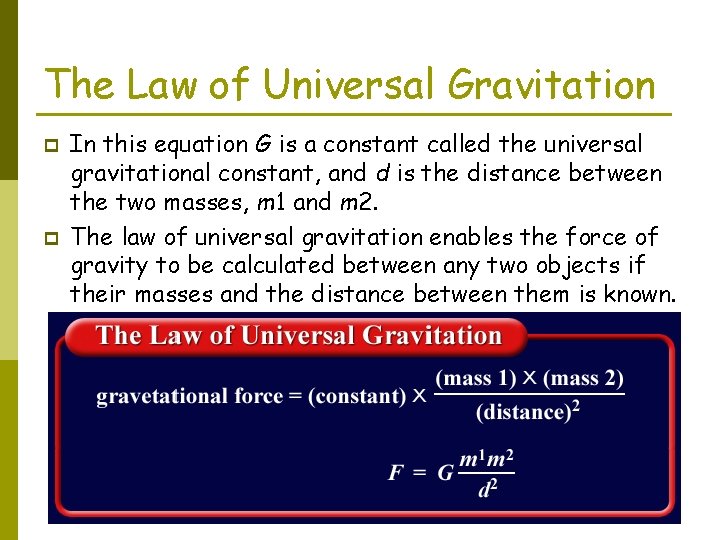
The Law of Universal Gravitation p p In this equation G is a constant called the universal gravitational constant, and d is the distance between the two masses, m 1 and m 2. The law of universal gravitation enables the force of gravity to be calculated between any two objects if their masses and the distance between them is known.
The Range of Gravity According to the law of universal gravitation, the gravitational force between two masses decreases rapidly as the distance between the masses increases. p No matter how far apart two objects are, the gravitational force between them never completely goes to zero. p Because the gravitational force between two objects never disappears, gravity is called a long-range force. p
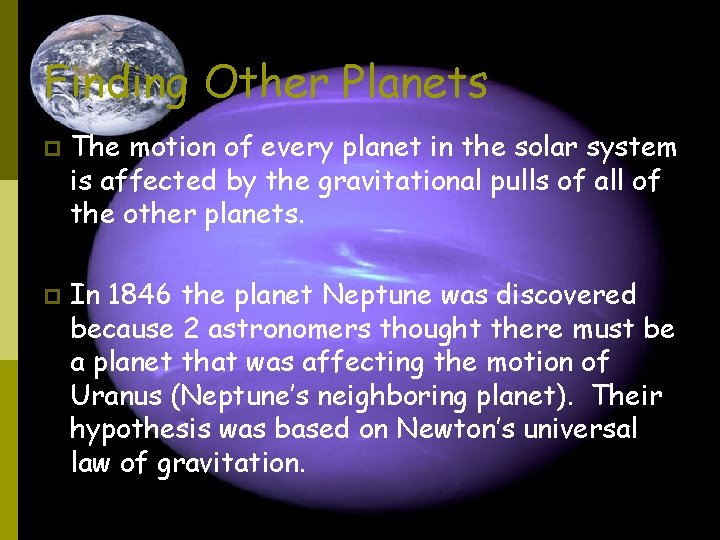
Finding Other Planets p p The motion of every planet in the solar system is affected by the gravitational pulls of all of the other planets. In 1846 the planet Neptune was discovered because 2 astronomers thought there must be a planet that was affecting the motion of Uranus (Neptune’s neighboring planet). Their hypothesis was based on Newton’s universal law of gravitation.
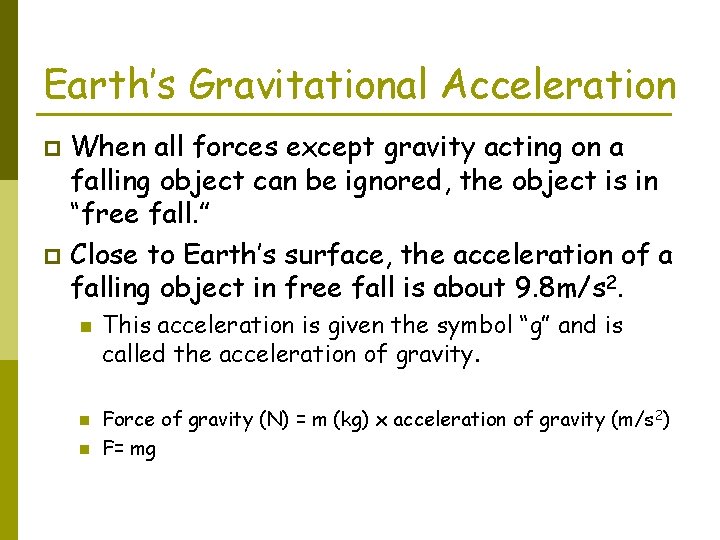
Earth’s Gravitational Acceleration When all forces except gravity acting on a falling object can be ignored, the object is in “free fall. ” p Close to Earth’s surface, the acceleration of a falling object in free fall is about 9. 8 m/s 2. p n n n This acceleration is given the symbol “g” and is called the acceleration of gravity. Force of gravity (N) = m (kg) x acceleration of gravity (m/s 2) F= mg
Force of Earth’s Gravity Example p What is the gravitational force on a sky diver with a mass of 60 kg? n n n F= mg F= (60 kg)(9. 8 m/s 2) F= 588 N
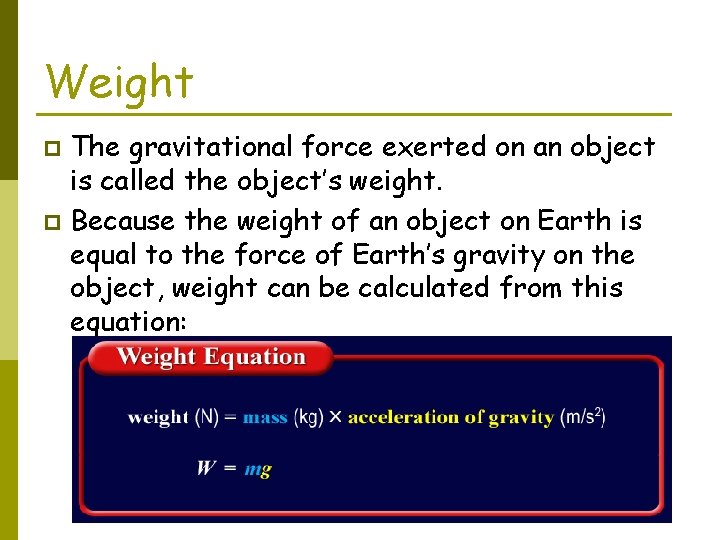
Weight The gravitational force exerted on an object is called the object’s weight. p Because the weight of an object on Earth is equal to the force of Earth’s gravity on the object, weight can be calculated from this equation: p
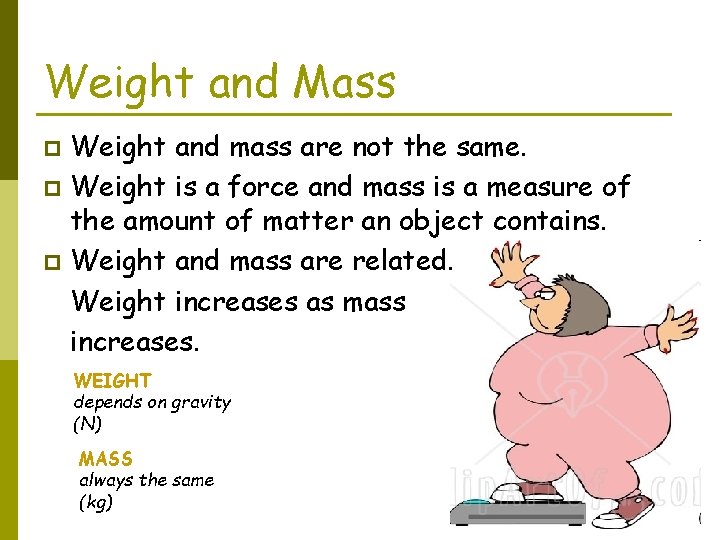
Weight and Mass Weight and mass are not the same. p Weight is a force and mass is a measure of the amount of matter an object contains. p Weight and mass are related. Weight increases as mass increases. p WEIGHT depends on gravity (N) MASS always the same (kg)
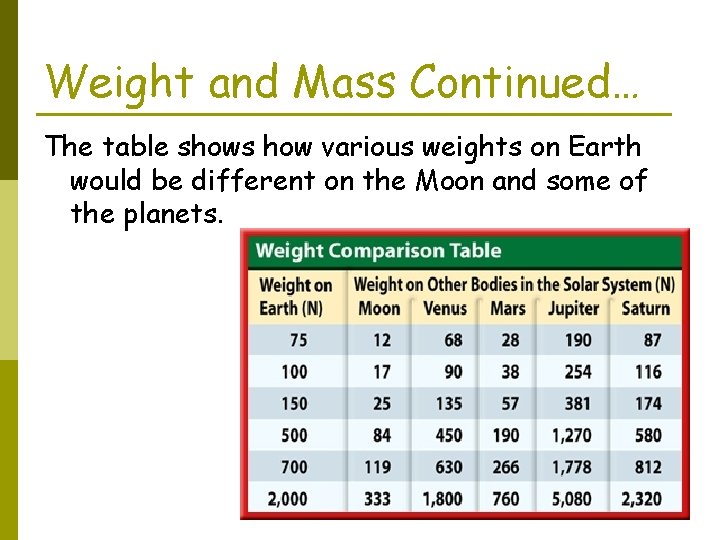
Weight and Mass Continued… The table shows how various weights on Earth would be different on the Moon and some of the planets.
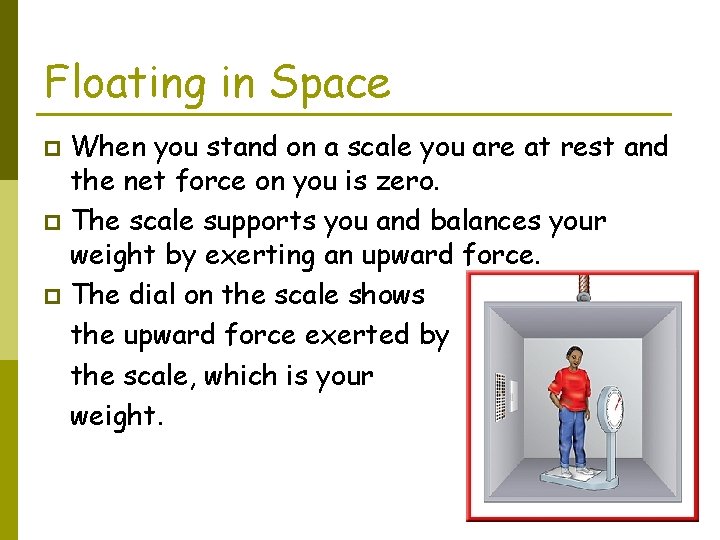
Floating in Space When you stand on a scale you are at rest and the net force on you is zero. p The scale supports you and balances your weight by exerting an upward force. p The dial on the scale shows the upward force exerted by the scale, which is your weight. p
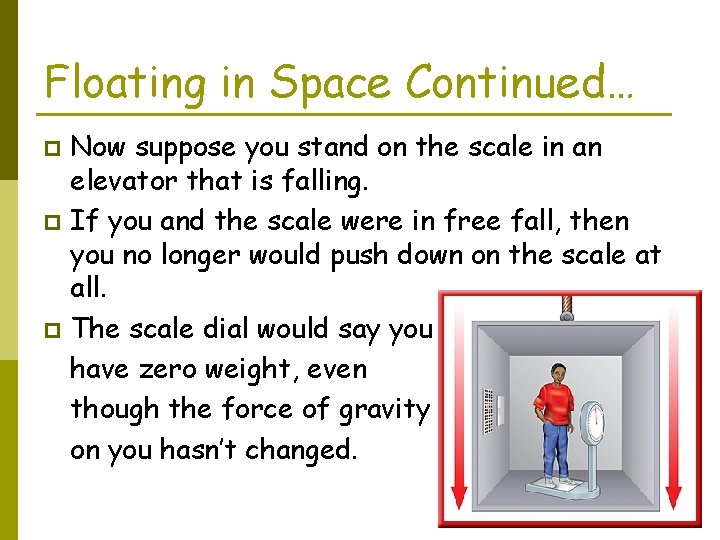
Floating in Space Continued… Now suppose you stand on the scale in an elevator that is falling. p If you and the scale were in free fall, then you no longer would push down on the scale at all. p The scale dial would say you have zero weight, even though the force of gravity on you hasn’t changed. p
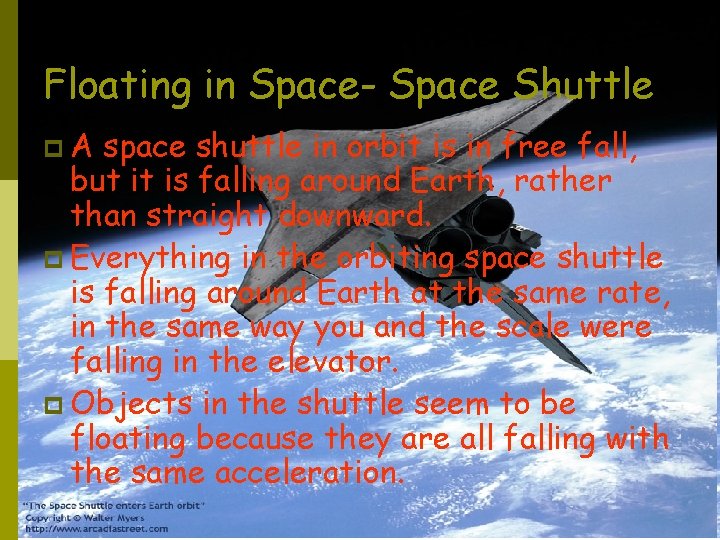
Floating in Space- Space Shuttle p. A space shuttle in orbit is in free fall, but it is falling around Earth, rather than straight downward. p Everything in the orbiting space shuttle is falling around Earth at the same rate, in the same way you and the scale were falling in the elevator. p Objects in the shuttle seem to be floating because they are all falling with the same acceleration.
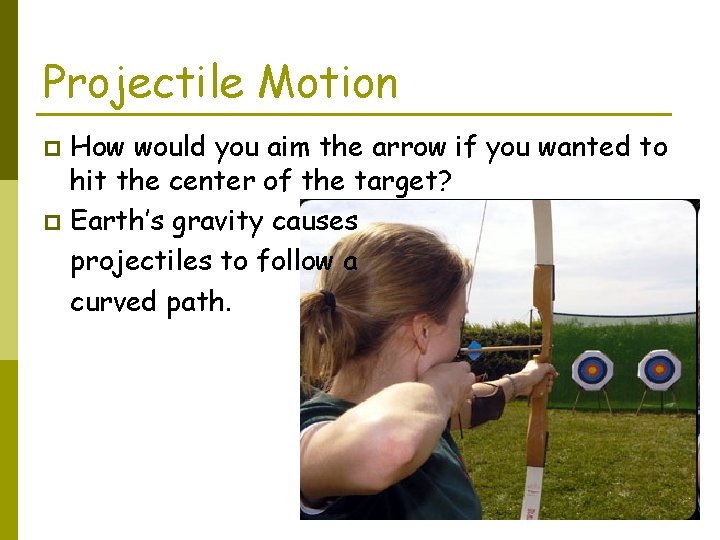
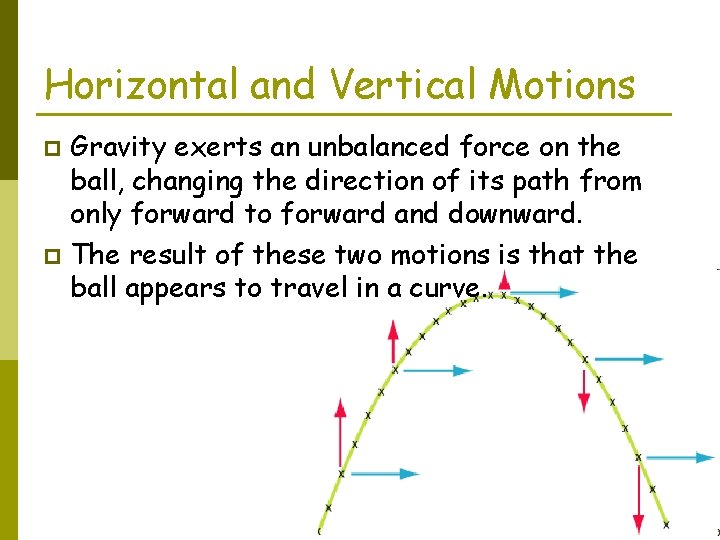
Projectile Motion How would you aim the arrow if you wanted to hit the center of the target? p Earth’s gravity causes projectiles to follow a curved path. p
Horizontal and Vertical Motions Gravity exerts an unbalanced force on the ball, changing the direction of its path from only forward to forward and downward. p The result of these two motions is that the ball appears to travel in a curve. p
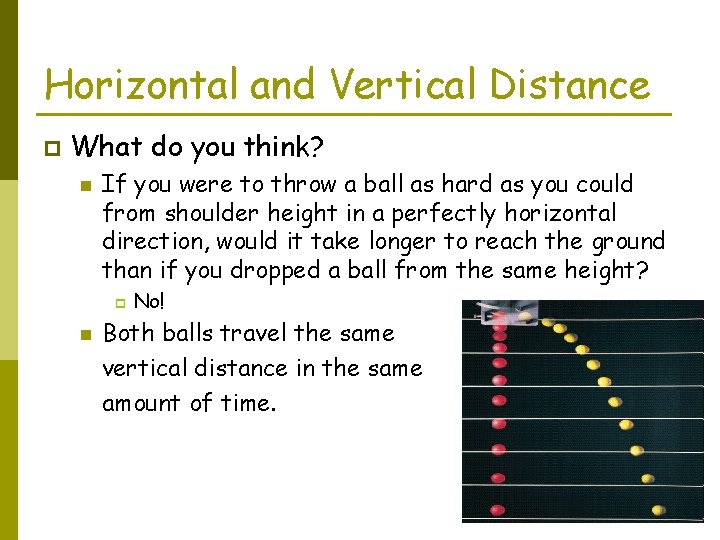
Horizontal and Vertical Distance p What do you think? n If you were to throw a ball as hard as you could from shoulder height in a perfectly horizontal direction, would it take longer to reach the ground than if you dropped a ball from the same height? p n No! Both balls travel the same vertical distance in the same amount of time.
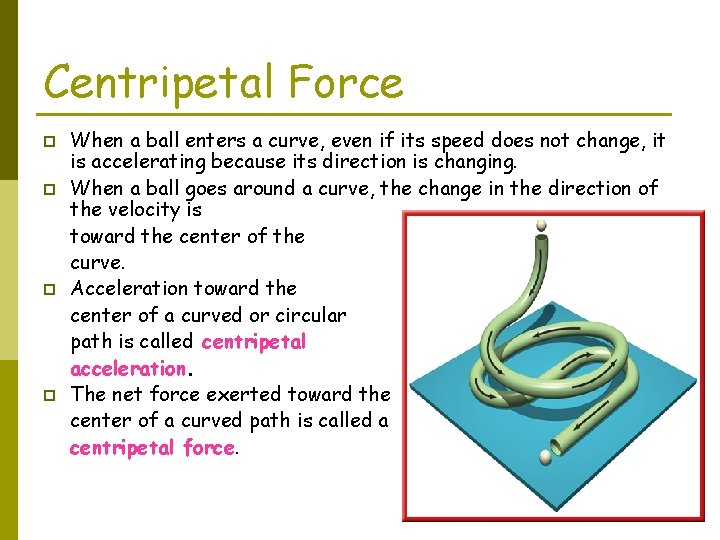
Centripetal Force p p When a ball enters a curve, even if its speed does not change, it is accelerating because its direction is changing. When a ball goes around a curve, the change in the direction of the velocity is toward the center of the curve. Acceleration toward the center of a curved or circular path is called centripetal acceleration. The net force exerted toward the center of a curved path is called a centripetal force.
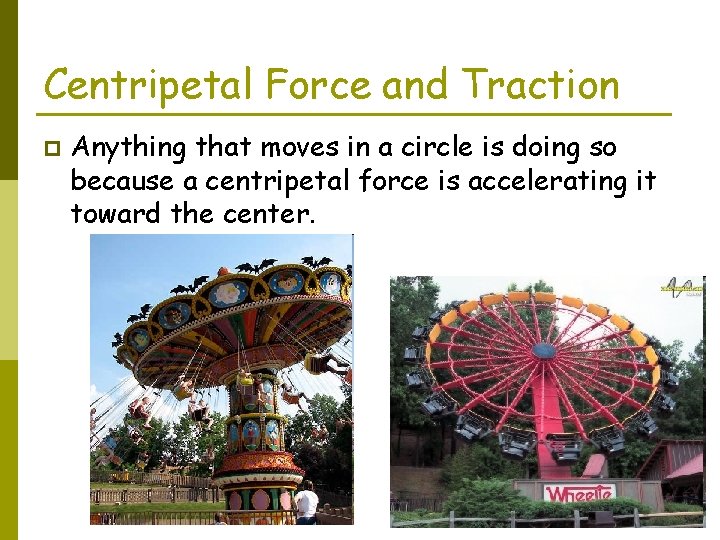
Centripetal Force and Traction p Anything that moves in a circle is doing so because a centripetal force is accelerating it toward the center.
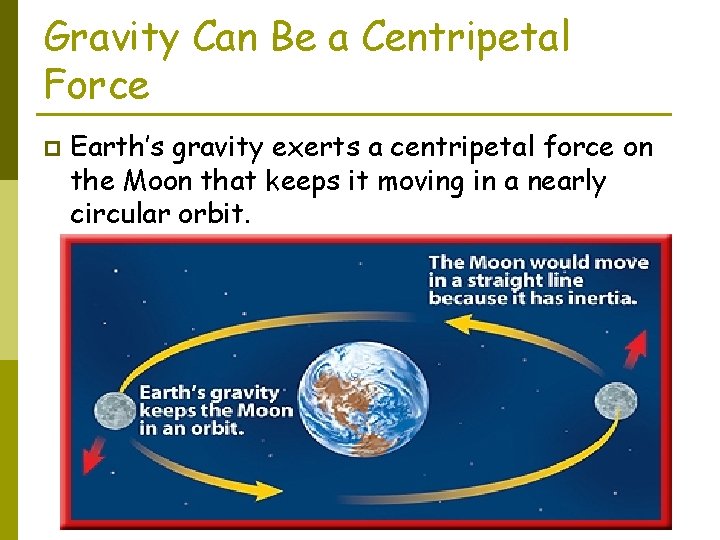
Gravity Can Be a Centripetal Force p Earth’s gravity exerts a centripetal force on the Moon that keeps it moving in a nearly circular orbit.
Did We Reach Our Learning Goals For Section 2? 1. Describe the gravitational force. n 2. Distinguish between mass and weight. n 3. The weight of an object is related to its mass according to the following equation: W=mg Explain why objects that are thrown will follow a curved path. n 4. The gravitational force between 2 objects depends on the masses of the objects and the distance between them. Projectiles follow a curved path because their horizontal motion is constant, but gravity causes their vertical motion to change. Compare circular motion with motion in a straight line. n The net force on an object moving in a circular path is the centripetal force.
Section 3: The Third Law of Motion 1. 2. 3. 4. What you will learn: State Newton’s third law of motion. Identify action and reaction forces. Calculate momentum. Recognize when momentum is conserved.
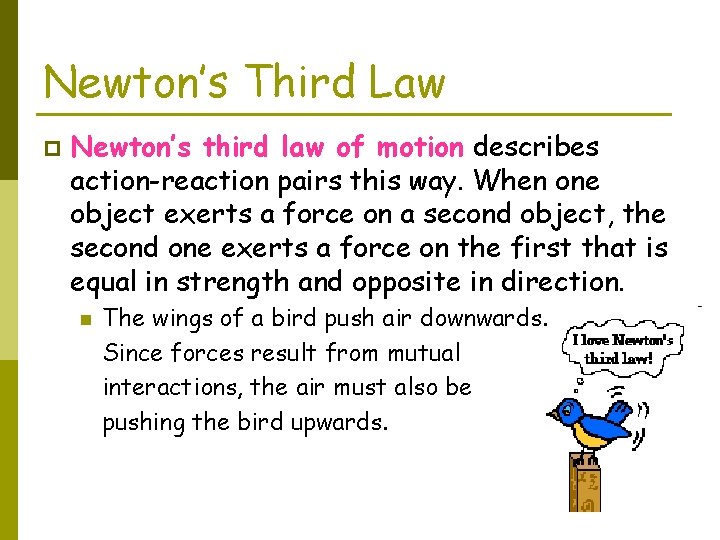
Newton’s Third Law p Newton’s third law of motion describes action-reaction pairs this way. When one object exerts a force on a second object, the second one exerts a force on the first that is equal in strength and opposite in direction. n The wings of a bird push air downwards. Since forces result from mutual interactions, the air must also be pushing the bird upwards.
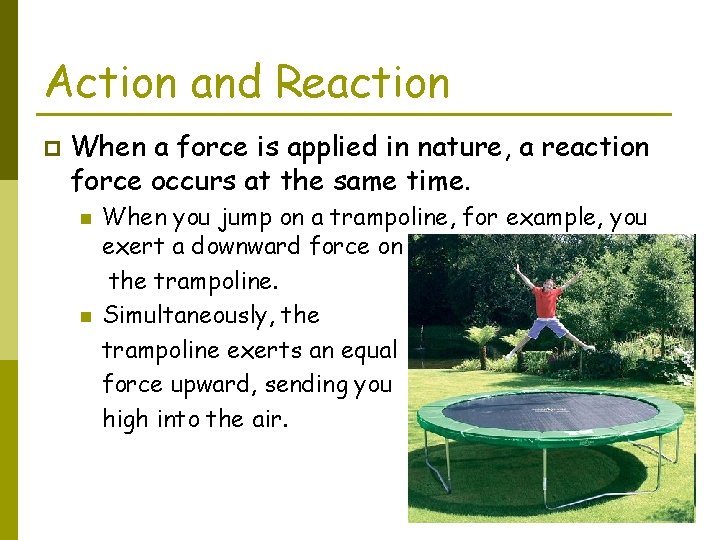
Action and Reaction p When a force is applied in nature, a reaction force occurs at the same time. n n When you jump on a trampoline, for example, you exert a downward force on the trampoline. Simultaneously, the trampoline exerts an equal force upward, sending you high into the air.
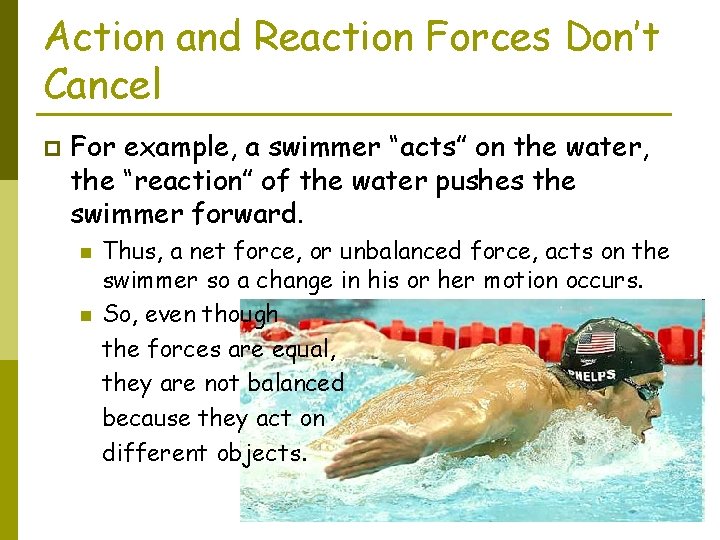
Action and Reaction Forces Don’t Cancel p For example, a swimmer “acts” on the water, the “reaction” of the water pushes the swimmer forward. n n Thus, a net force, or unbalanced force, acts on the swimmer so a change in his or her motion occurs. So, even though the forces are equal, they are not balanced because they act on different objects.
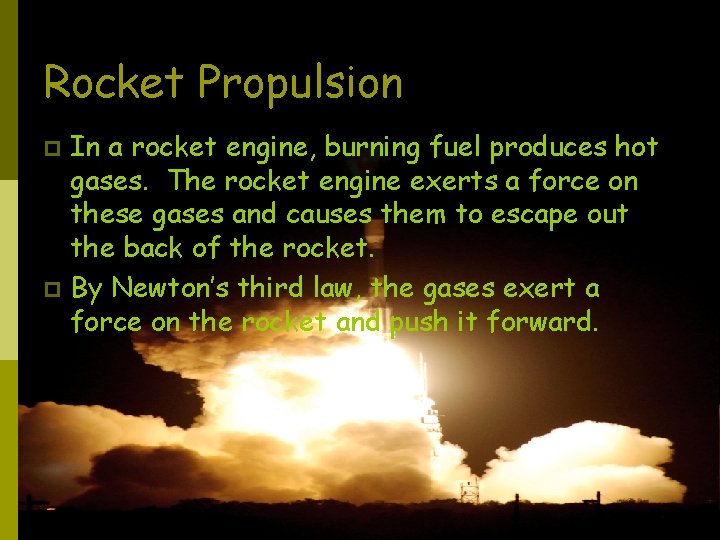
Rocket Propulsion In a rocket engine, burning fuel produces hot gases. The rocket engine exerts a force on these gases and causes them to escape out the back of the rocket. p By Newton’s third law, the gases exert a force on the rocket and push it forward. p
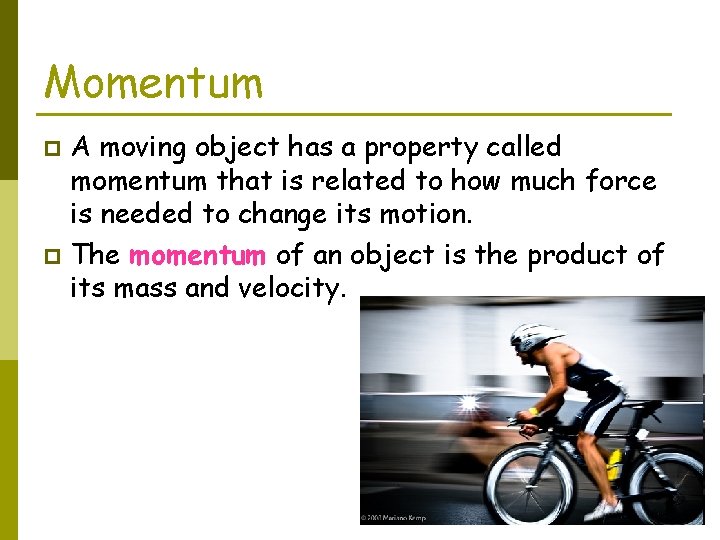
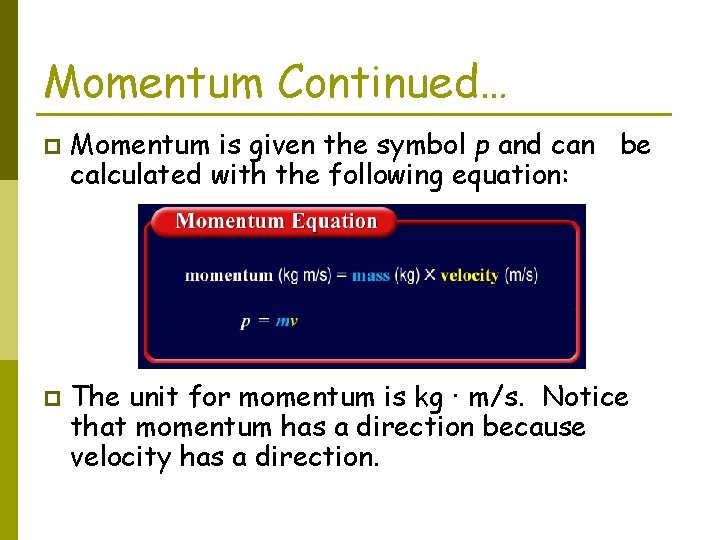
Momentum A moving object has a property called momentum that is related to how much force is needed to change its motion. p The momentum of an object is the product of its mass and velocity. p
Momentum Continued… p p Momentum is given the symbol p and can be calculated with the following equation: The unit for momentum is kg · m/s. Notice that momentum has a direction because velocity has a direction.
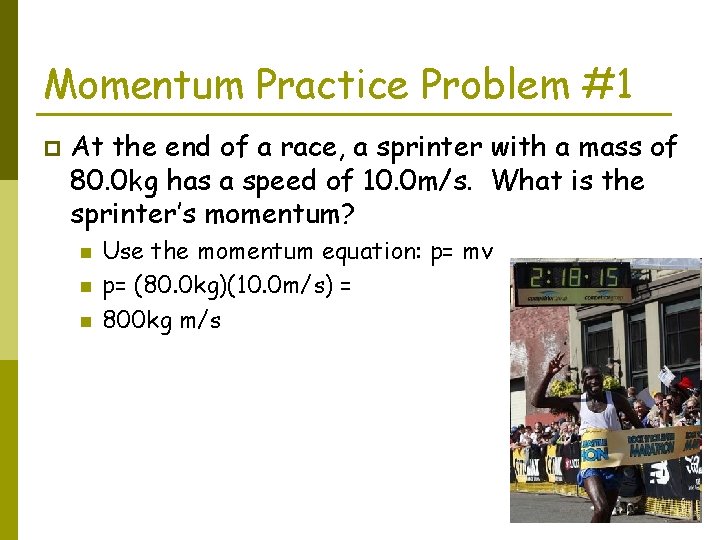
Momentum Practice Problem #1 p At the end of a race, a sprinter with a mass of 80. 0 kg has a speed of 10. 0 m/s. What is the sprinter’s momentum? n n n Use the momentum equation: p= mv p= (80. 0 kg)(10. 0 m/s) = 800 kg m/s
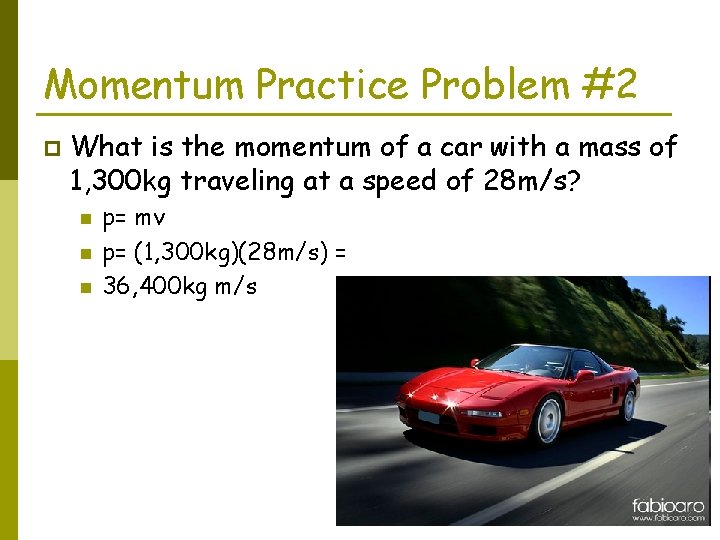
Momentum Practice Problem #2 p What is the momentum of a car with a mass of 1, 300 kg traveling at a speed of 28 m/s? n n n p= mv p= (1, 300 kg)(28 m/s) = 36, 400 kg m/s
Momentum Practice Problem #3 p A baseball has a momentum of 6. 0 kg x m/s. If the mass of the baseball is 0. 15 kg, what is the baseballs speed? p= mv n v= p m v= (6. 0 kg x m/s) = 40 m/s 0. 15 kg n
Momentum Practice Problem #4 p What is the mass of a person walking at a speed of 0. 8 m/s if the person’s momentum is 52. 0 kg x m/s? n n n p= mv m= p v m= (52. 0 kg x m/s) = 65 kg 0. 8 m/s
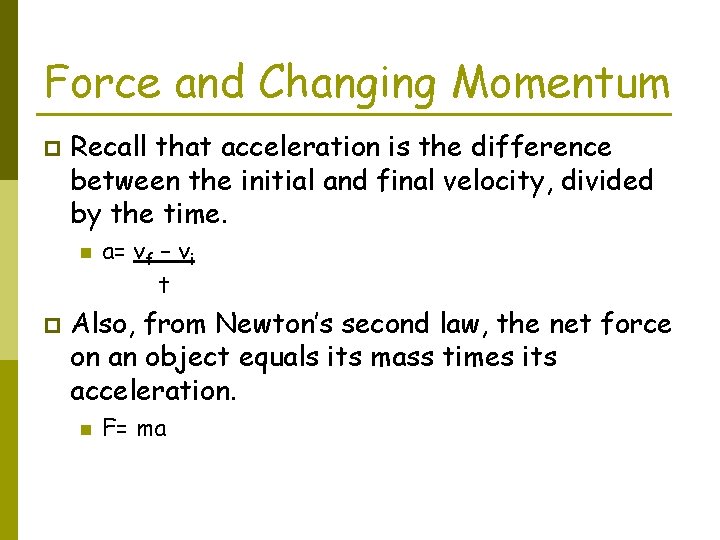
Force and Changing Momentum p Recall that acceleration is the difference between the initial and final velocity, divided by the time. n p a= vf – vi t Also, from Newton’s second law, the net force on an object equals its mass times its acceleration. n F= ma
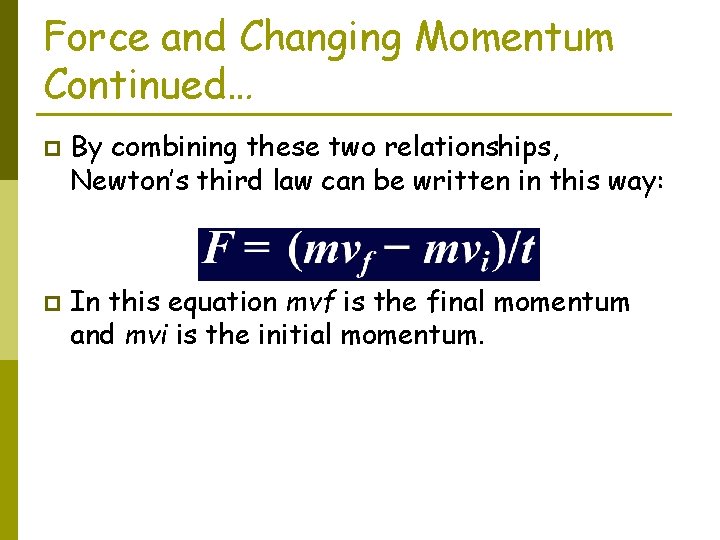
Force and Changing Momentum Continued… p p By combining these two relationships, Newton’s third law can be written in this way: In this equation mvf is the final momentum and mvi is the initial momentum.
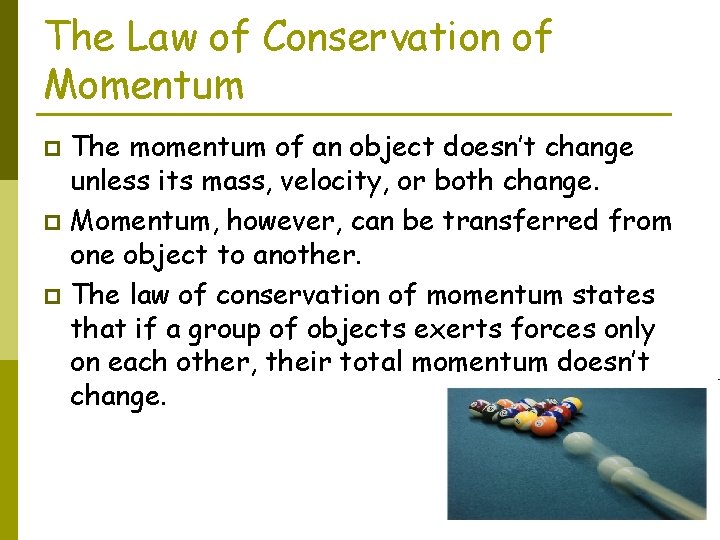
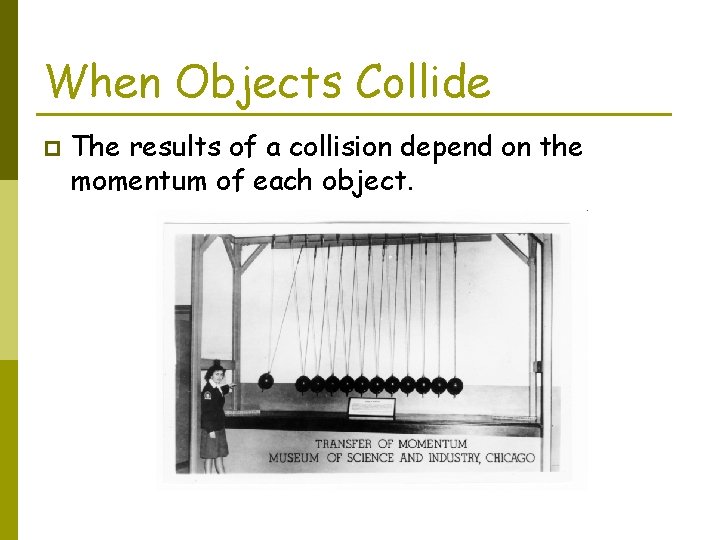
The Law of Conservation of Momentum The momentum of an object doesn’t change unless its mass, velocity, or both change. p Momentum, however, can be transferred from one object to another. p The law of conservation of momentum states that if a group of objects exerts forces only on each other, their total momentum doesn’t change. p
When Objects Collide p The results of a collision depend on the momentum of each object.
Did We Reach Our Learning Goals For Section 3? 1. State Newton’s third law of motion. n 2. Identify action and reaction forces. n 3. Action and reaction forces act on different objects. Calculate momentum. n 4. For every action force, there is an equal and opposite reaction force. p= mv Recognize when momentum is conserved. n If objects exert forces only on each other, their total momentum is conserved. In a collision, momentum is transferred from one object to another.