
Forces Change in motion What causes an object
Forces

Change in motion? �What causes an object to start moving, stop moving, or change direction? UNBANLANCED FORCE
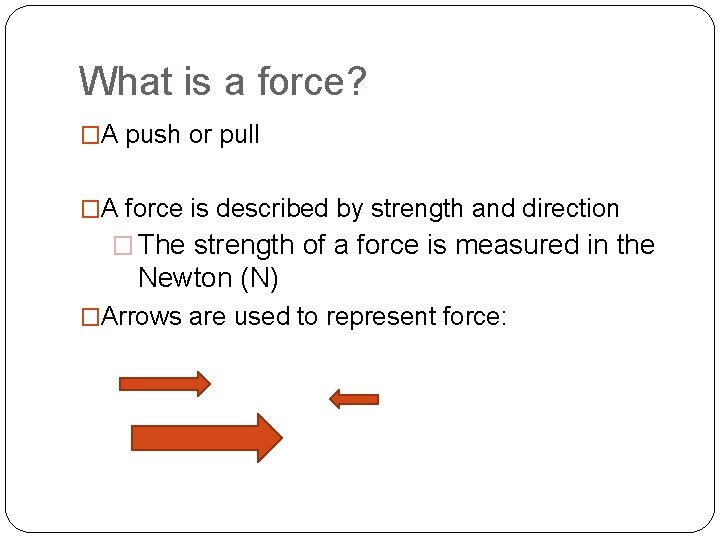
What is a force? �A push or pull �A force is described by strength and direction � The strength of a force is measured in the Newton (N) �Arrows are used to represent force:
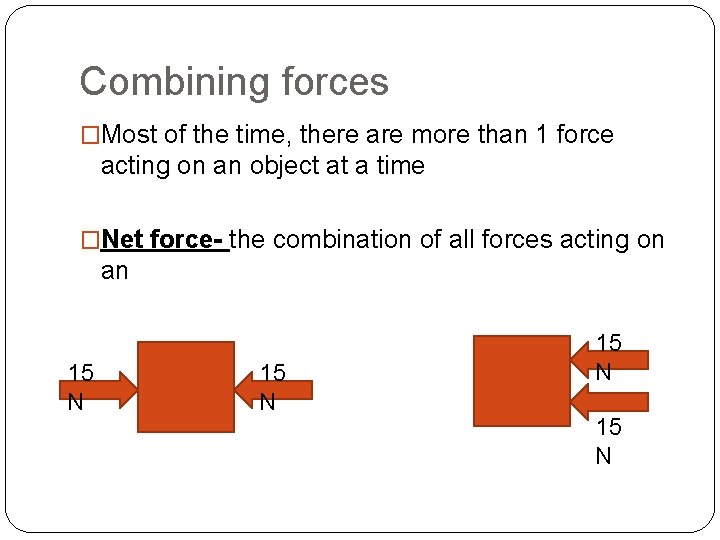
Combining forces �Most of the time, there are more than 1 force acting on an object at a time �Net force- the combination of all forces acting on an 15 N
Unbalanced vs. Balanced Forces Unbalanced Forces �Result in a net force �Can cause a change in the object’s motion Balanced Forces �Equal forces acting in opposite direction �Do not cause a change in the object’s motion �They cancel each other out
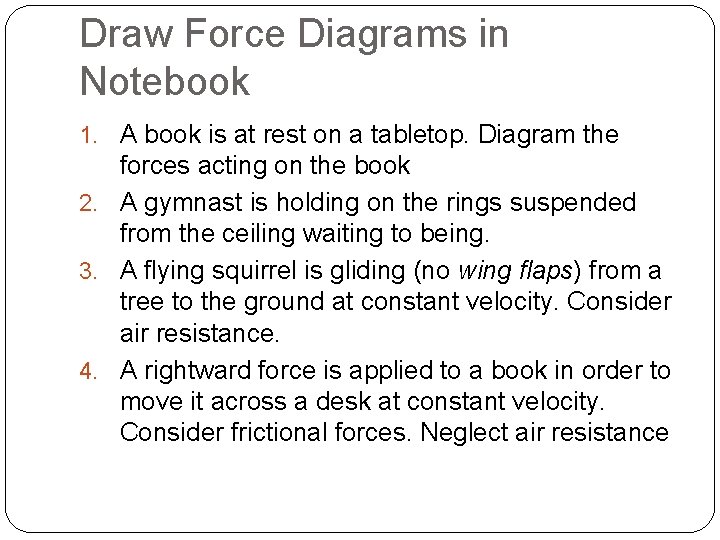
Draw Force Diagrams in Notebook 1. A book is at rest on a tabletop. Diagram the forces acting on the book 2. A gymnast is holding on the rings suspended from the ceiling waiting to being. 3. A flying squirrel is gliding (no wing flaps) from a tree to the ground at constant velocity. Consider air resistance. 4. A rightward force is applied to a book in order to move it across a desk at constant velocity. Consider frictional forces. Neglect air resistance
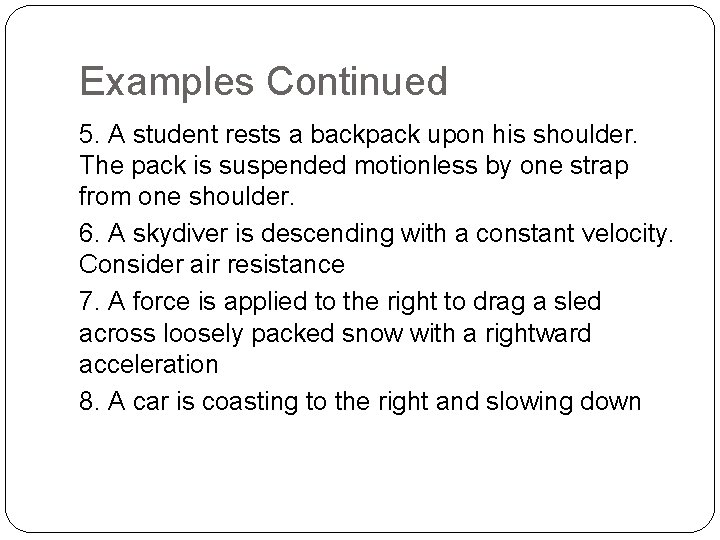
Examples Continued 5. A student rests a backpack upon his shoulder. The pack is suspended motionless by one strap from one shoulder. 6. A skydiver is descending with a constant velocity. Consider air resistance 7. A force is applied to the right to drag a sled across loosely packed snow with a rightward acceleration 8. A car is coasting to the right and slowing down
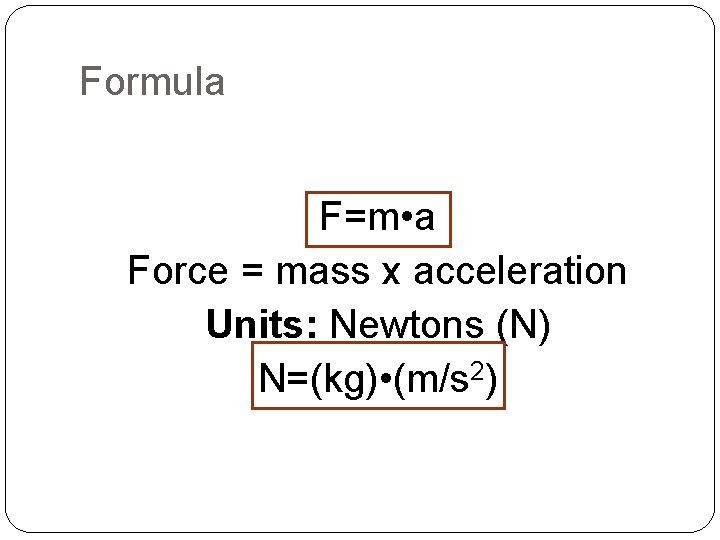
Formula F=m • a Force = mass x acceleration Units: Newtons (N) N=(kg) • (m/s 2)
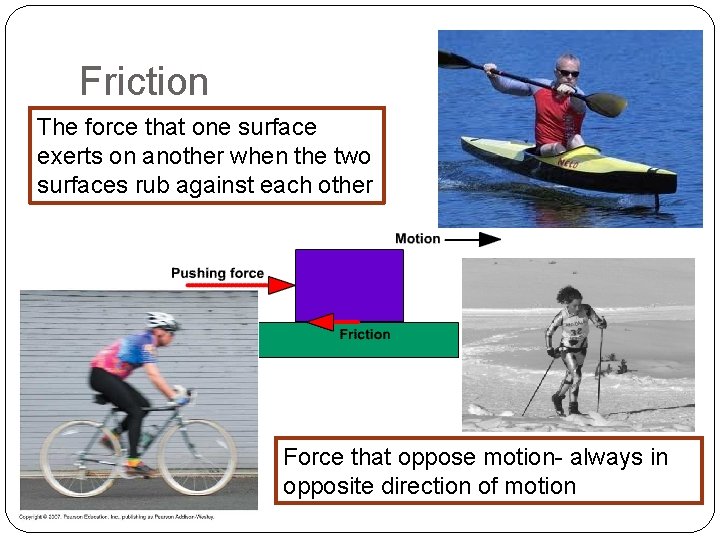
Friction The force that one surface exerts on another when the two surfaces rub against each other Force that oppose motion- always in opposite direction of motion
Friction… �Friction produces heat! – how have you seen this? �The amount of friction depends on: �How hard the surfaces push together (force) �Types of surfaces involved SURFACE AREA DOES NOT AFFECT THE AMOUNT OF FRICTION
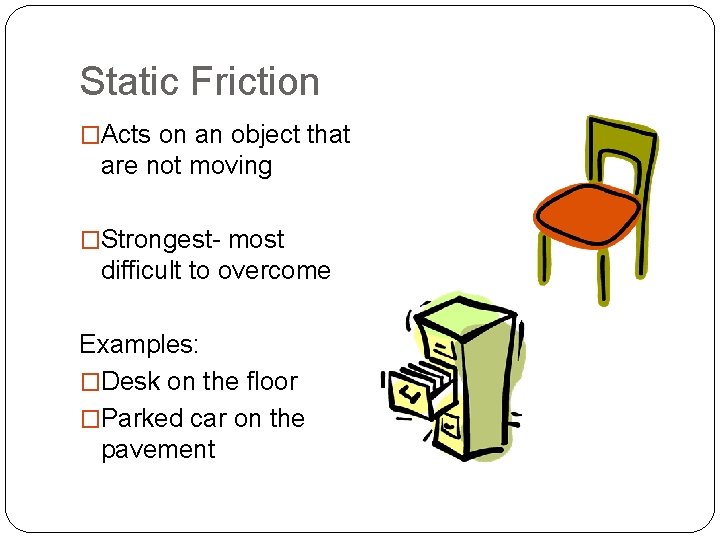
Static Friction �Acts on an object that are not moving �Strongest- most difficult to overcome Examples: �Desk on the floor �Parked car on the pavement
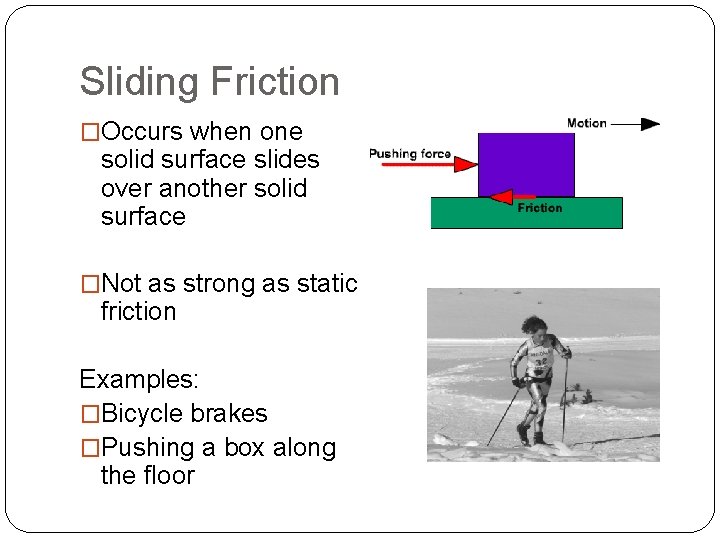
Sliding Friction �Occurs when one solid surface slides over another solid surface �Not as strong as static friction Examples: �Bicycle brakes �Pushing a box along the floor
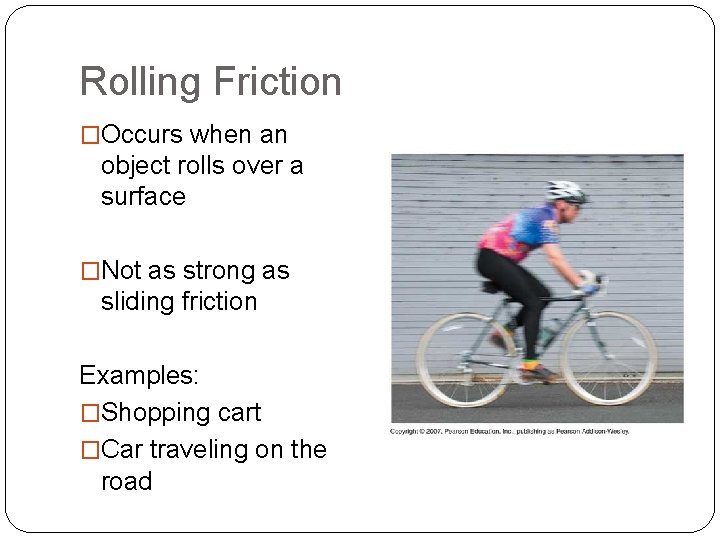
Rolling Friction �Occurs when an object rolls over a surface �Not as strong as sliding friction Examples: �Shopping cart �Car traveling on the road
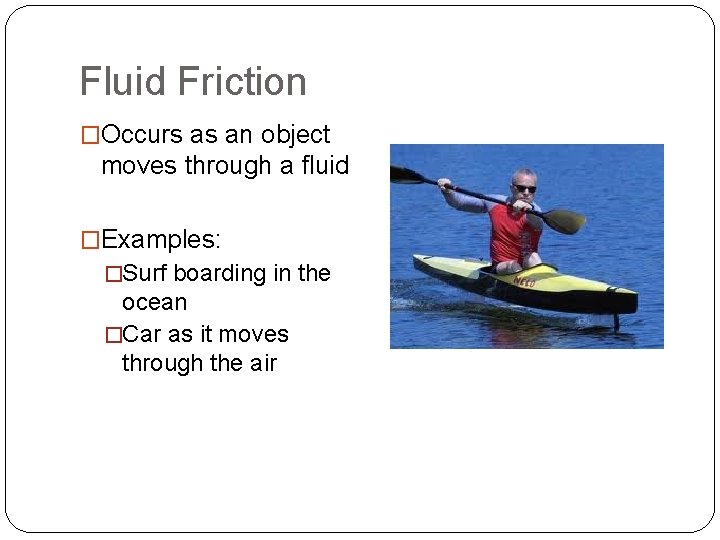
Fluid Friction �Occurs as an object moves through a fluid �Examples: �Surf boarding in the ocean �Car as it moves through the air
Gravity �Is the force that pulls objects toward each other �The law of Universal Gravitation- the force of gravity acts between all objects in the universe! �That means: any two masses exert an attractive force on each other
Factors affecting gravity �Mass- a measure of the amount of matter in an object �The more mass an object has, the greater its gravitational force on other objects is �Distance �The farther apart objects are, the lesser the gravitational force between them �The sun has a gravitational force on you. . why don’t you feel it? �The pencil in front of you has a gravitational force on you…why don’t you feel it?
Gravitational Acceleration �The gravitational attraction of Earth causes all falling objects to have an acceleration of 9. 8 m/s 2 �Which direction is Earth’s gravitational force?
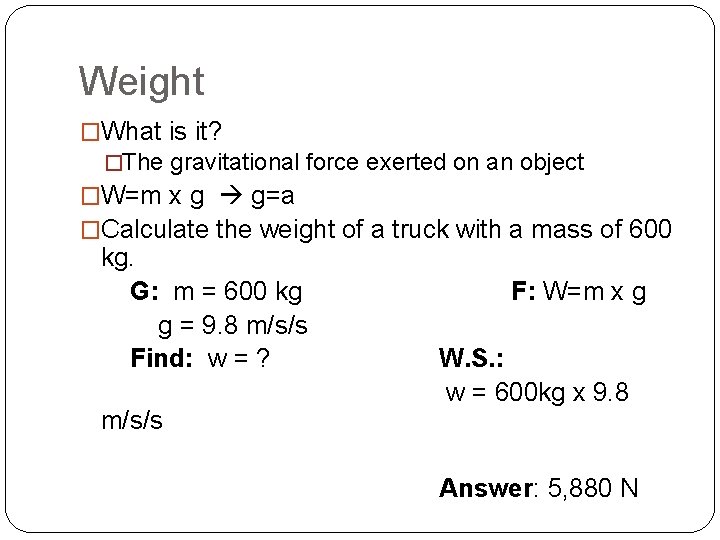
Weight �What is it? �The gravitational force exerted on an object �W=m x g g=a �Calculate the weight of a truck with a mass of 600 kg. G: m = 600 kg g = 9. 8 m/s/s Find: w = ? m/s/s F: W=m x g W. S. : w = 600 kg x 9. 8 Answer: 5, 880 N
Mass vs. Weight �Mass is _____ �Weight is a FORCE �the more mass an object has, the stronger the gravitational force between the object and Earth. So, the more mass an object has, the more it weighs �Weight can be different if the gravitational force is different
Weightlessness �When an object is influences only by the force of gravity, it is said to be in free fall.
Air resistance �Air resistance acts in the opposite direct of an object’s motion �The force it opposes is GRAVITY �The amount of air resistance depends on: �Speed �Size �Shape �Terminal velocity- when the force of air resistance = weight of object no more acceleration
What happens if you drop 2 objects? �What would happen if there was no air resistance? REMEMBER: �ALL OBJECTS IN FREE FALL ACCELERATE AT THE SAME RATE, REGARDLESS OF MASS!!
Projectile Motion �A projectile is an object that has been projected through the air �A projectile has horizontal and vertical motion �Neglecting air resistance, all falling objects accelerate at the same rate �No matter how fast and object is moving horizontally, the force of gravity acts the same as if it was falling straight down
- Slides: 23