
Forces CH 12 What Is a Force n
- Slides: 12
Forces CH 12
What Is a Force? n. A force is a push or a pull that acts on an object n. A force can cause a resting object to move, or it can accelerate a moving object by changing the object’s speed or direction.
Units of Force n You is measured in newtons (N). can use an arrow to represent the direction and strength of a force.
Combining Forces n You can combine force arrows to show the result of how forces combine. n Forces in the same direction add, and forces in opposite directions subtract. n The net force is the overall force acting on an object after ALL the forces are combined.
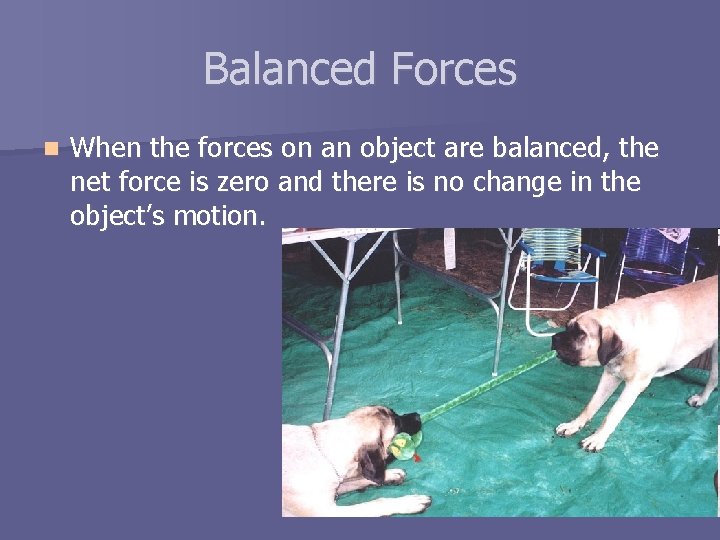
Balanced Forces n When the forces on an object are balanced, the net force is zero and there is no change in the object’s motion.
Unbalanced Forces n Often, the forces on an object are unbalanced. n When an unbalanced force acts on an object, the object accelerates.
Friction moving objects are subject to friction, a force that opposes the motion of objects that touch as they move past each other. n All n There are four main types of friction: –Static friction –Sliding friction –Rolling friction –Fluid friction
Static Friction/Sliding Friction Static friction is the friction force that acts on objects that are NOT moving. – Always acts in the direction opposite to that of the applied force n Sliding friction is a force that opposes the direction of motion of an object as it slides over a surface – Sliding friction is less than static friction
Rolling Friction/Fluid Friction n Rolling friction is the friction force that acts on rolling objects. n The force of fluid friction opposes the motion of an object through a fluid. n Fluid friction acting on an object moving through the air is known as air resistance.
Gravity n Gravity is a force that acts between any two masses. n Gravity is an attractive force, it pulls objects together. n Earth’s gravity acts downward toward the center of Earth.
Gravity n Gravity causes objects to accelerate downward, whereas air resistance acts in the direction opposite to the motion and reduces acceleration. n Terminal velocity is the constant velocity of a falling object when the force of air resistance equals the force of gravity.
Projectile Motion n Projectile motion is the motion of a falling object (projectile) after it is given an initial forward velocity. n Air resistance and gravity are the only forces acting on a projectile. n The combination of an initial forward velocity and the downward vertical force of gravity causes the ball to follow a curved path.