
Forces and the Laws of Motion Noncontact forces

- Slides: 15
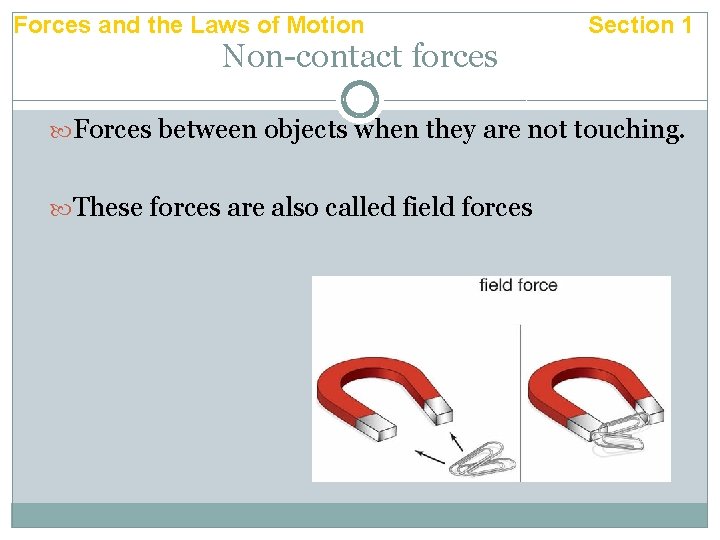
Forces and the Laws of Motion Non-contact forces Section 1 Forces between objects when they are not touching. These forces are also called field forces
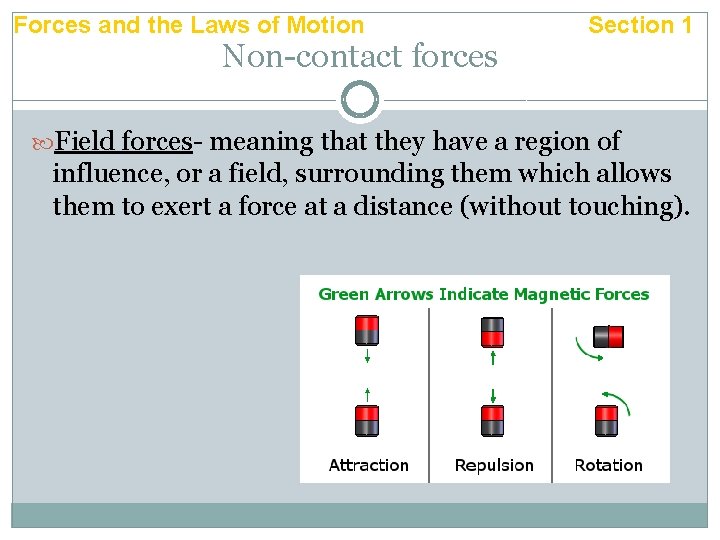
Forces and the Laws of Motion Non-contact forces Section 1 Field forces- meaning that they have a region of influence, or a field, surrounding them which allows them to exert a force at a distance (without touching).
Forces and the Laws of Motion Non-contact forces Examples of non-contact forces Gravitational Magnetic Electrical forces can act at a distance. Section 1
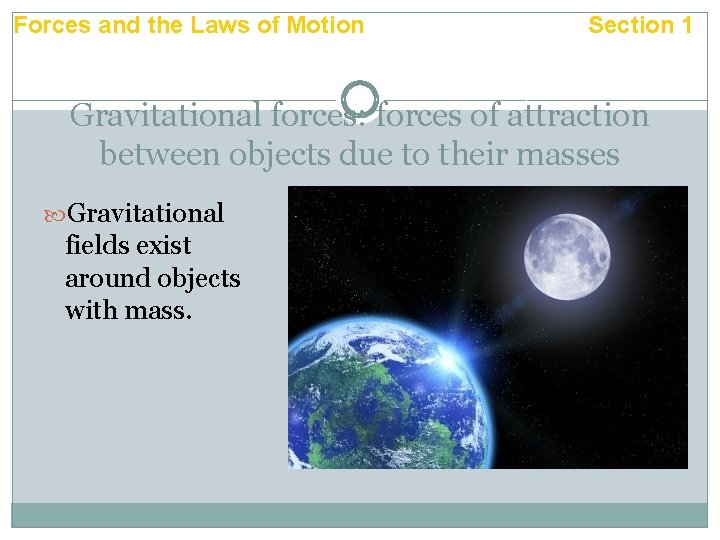
Forces and the Laws of Motion Section 1 Gravitational forces: forces of attraction between objects due to their masses Gravitational fields exist around objects with mass.
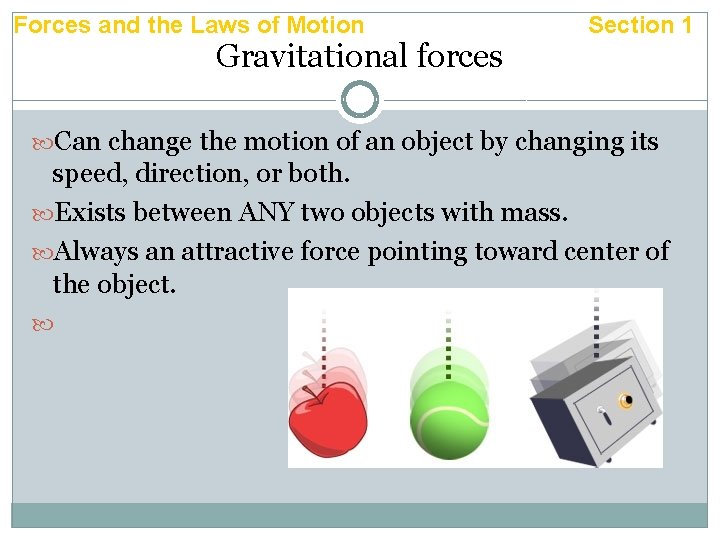
Forces and the Laws of Motion Gravitational forces Section 1 Can change the motion of an object by changing its speed, direction, or both. Exists between ANY two objects with mass. Always an attractive force pointing toward center of the object.
Forces and the Laws of Motion Section 1 Gravitational forces depend on: Mass of objects: As mass of the objects increases, the gravitational force increases. Distance between objects: As distance between the objects increases, the gravitational force decreases.
Forces and the Laws of Motion Section 1 If any two objects have gravitational force, why don’t we notice it more? Only noticeable if one of the objects has a very large mass. Examples: Earth - objects are pulled (fall) toward the center of the Earth Sun - Earth and other planets stay in orbit around the sun
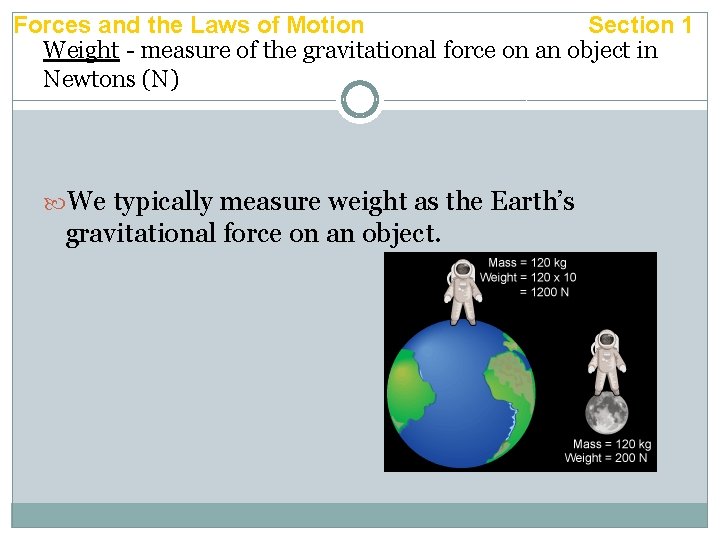
Forces and the Laws of Motion Section 1 Weight - measure of the gravitational force on an object in Newtons (N) We typically measure weight as the Earth’s gravitational force on an object.
Forces and the Laws of Motion Section 1 Reminder: Mass - the amount of matter in an object; measured in grams or kilograms
Forces and the Laws of Motion Section 1 Weight and mass are NOT the same thing! Weight can change if gravitational force changes (i. e. if we are measuring the gravitational force from something other than Earth). Mass does NOT change.
Forces and the Laws of Motion Section 1 So the difference between mass and weight? Acceleration due to gravity
Forces and the Laws of Motion Section 1 Acceleration What is acceleration? ? ? A increase or decrease in speed…. speeding up or slowing down Defined as a change in speed in a given amount of time Acceleration = the change in speed / time
Forces and the Laws of Motion Section 1 Calculating speed and acceleration If you ran 200 meters in 120 seconds. What is your speed? What is your velocity?
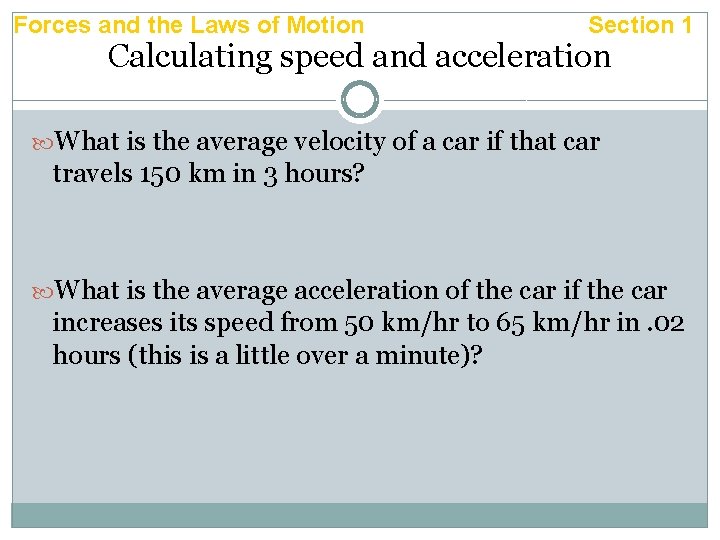
Forces and the Laws of Motion Section 1 Calculating speed and acceleration What is the average velocity of a car if that car travels 150 km in 3 hours? What is the average acceleration of the car increases its speed from 50 km/hr to 65 km/hr in. 02 hours (this is a little over a minute)?
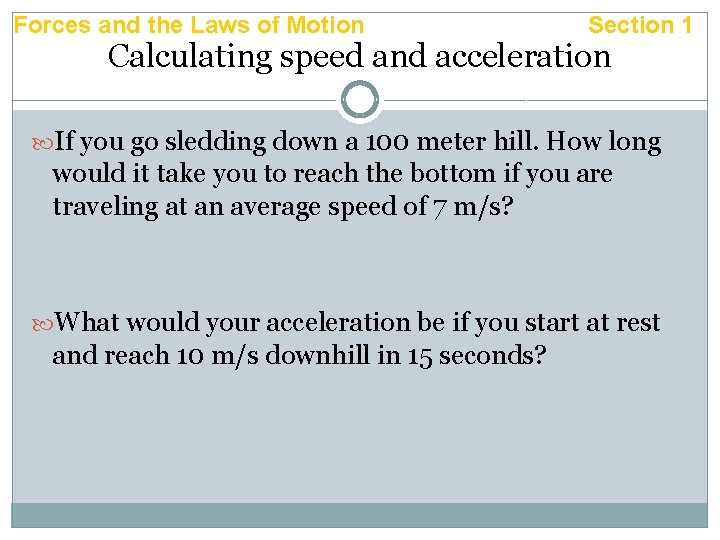
Forces and the Laws of Motion Section 1 Calculating speed and acceleration If you go sledding down a 100 meter hill. How long would it take you to reach the bottom if you are traveling at an average speed of 7 m/s? What would your acceleration be if you start at rest and reach 10 m/s downhill in 15 seconds?