
Forces and the Laws of Motion Everyday Forces
- Slides: 21
Forces and the Laws of Motion Everyday Forces Chapter 4: Section 4
Learning Targets • Explain the difference between mass and weight • Find the direction and magnitude of normal forces • Describe air resistance as a form of friction • Use coefficients of friction to calculate frictional forces P 3. 1 d, P 3. 2 A, P 3. 2 C, P 3. 2 d, P 3. 4 e, P 3. 6 C
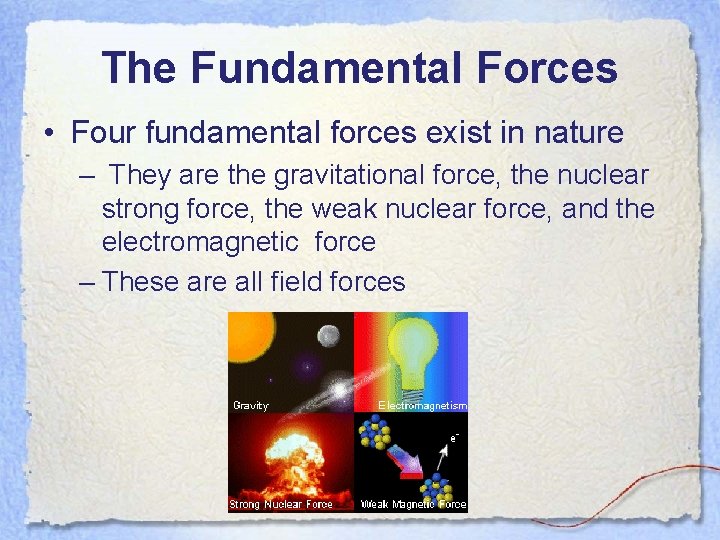
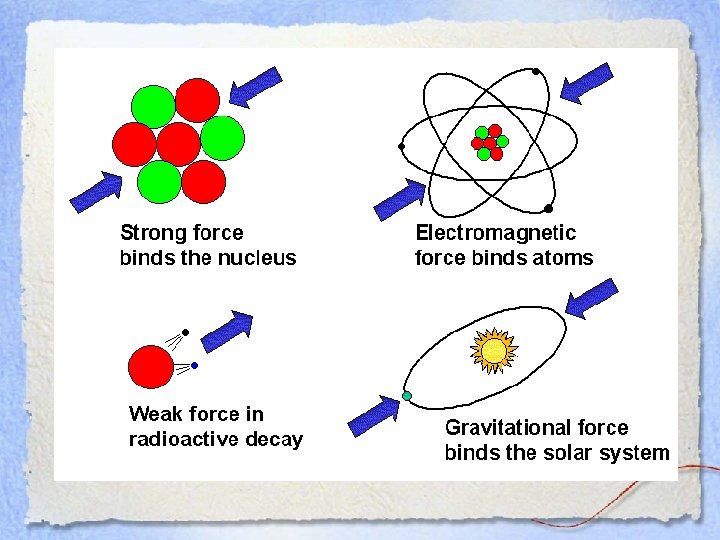
The Fundamental Forces • Four fundamental forces exist in nature – They are the gravitational force, the nuclear strong force, the weak nuclear force, and the electromagnetic force – These are all field forces
Force Characteristics • Strong and weak force have very small ranges, so their effects are not directly observable • Electromagnetic and gravitational forces act over long ranges • Strong force is the strongest while gravity is the weakest
Weight • Weight is the measure of the gravitational force exerted on objects – The more mass an object has, the more strongly it is pulled by the gravitational force – The gravitational force exerted on an object by Earth, Fg, is a vector quantity – The magnitude of this force is a scalar quantity called weight Fg = mag where g = 9. 81 m/s 2
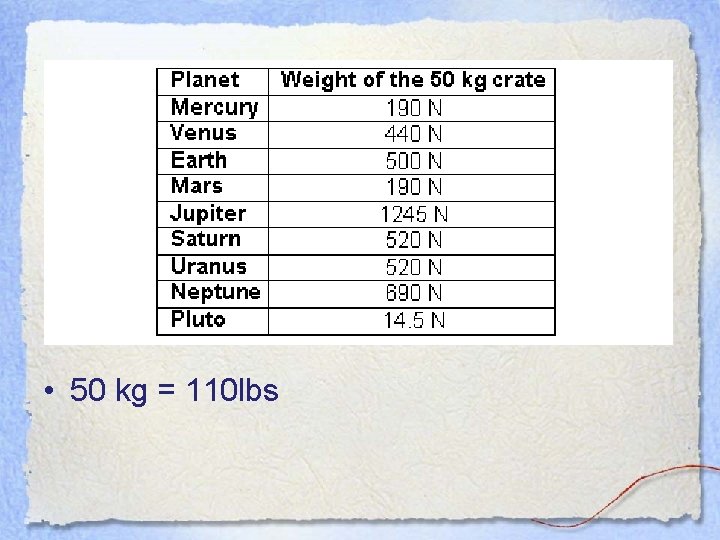
• Weight depends on location – The values of gravity on other planets depend on the planet’s mass and radius – Objects also weigh less at higher altitudes than at sea level because the value of gravity decreases as distance from the surface of the Earth increases
• 50 kg = 110 lbs
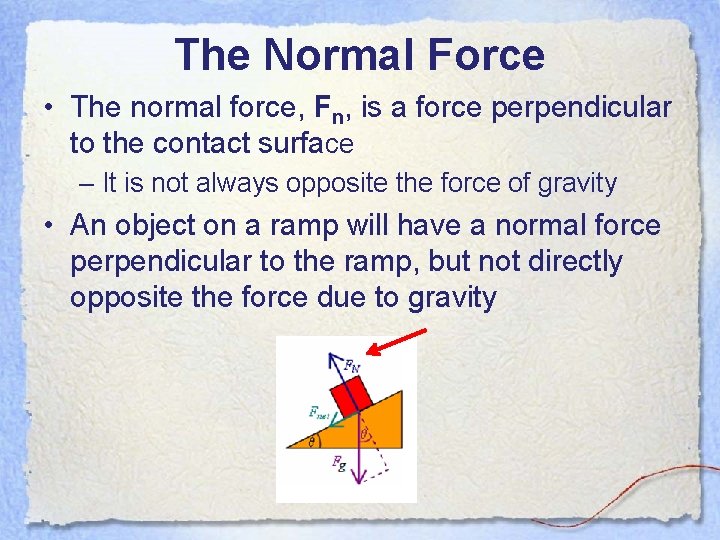
The Normal Force • The normal force, Fn, is a force perpendicular to the contact surface – It is not always opposite the force of gravity • An object on a ramp will have a normal force perpendicular to the ramp, but not directly opposite the force due to gravity
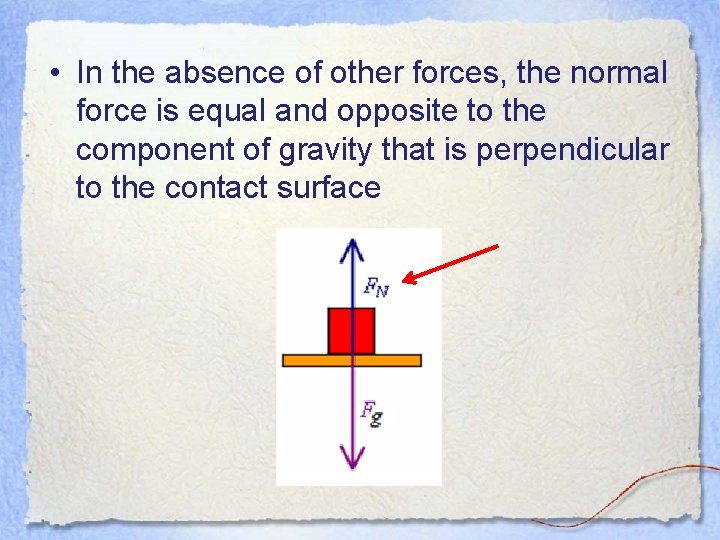
• In the absence of other forces, the normal force is equal and opposite to the component of gravity that is perpendicular to the contact surface
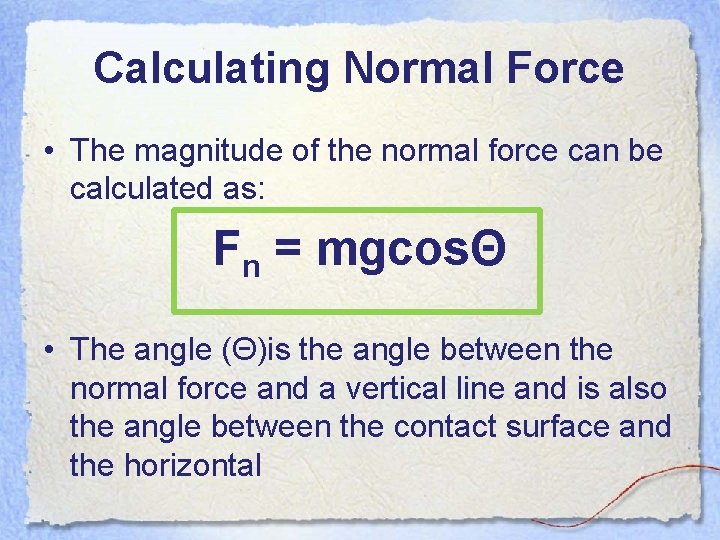
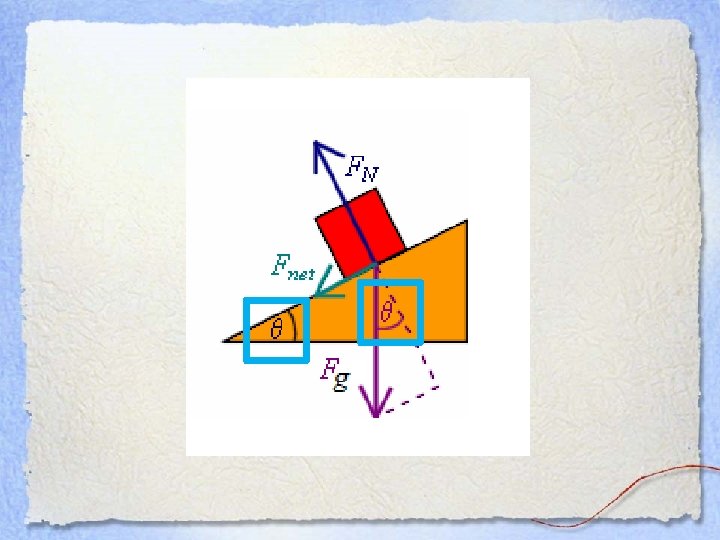
Calculating Normal Force • The magnitude of the normal force can be calculated as: Fn = mgcosΘ • The angle (Θ)is the angle between the normal force and a vertical line and is also the angle between the contact surface and the horizontal
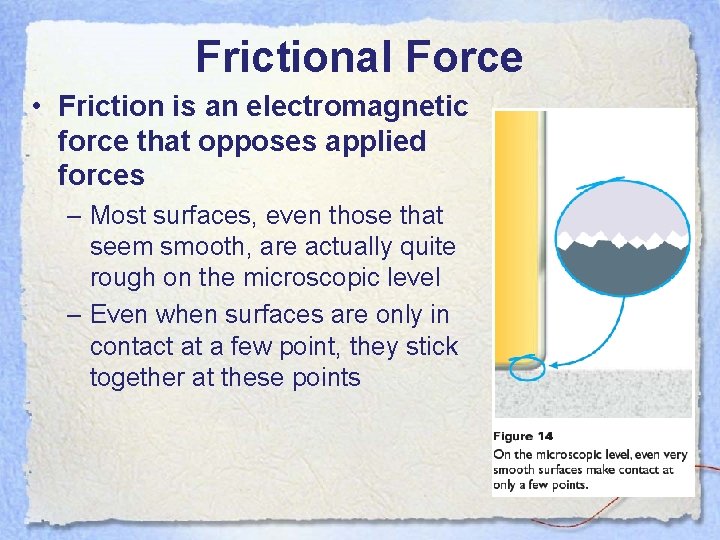
Frictional Force • Friction is an electromagnetic force that opposes applied forces – Most surfaces, even those that seem smooth, are actually quite rough on the microscopic level – Even when surfaces are only in contact at a few point, they stick together at these points
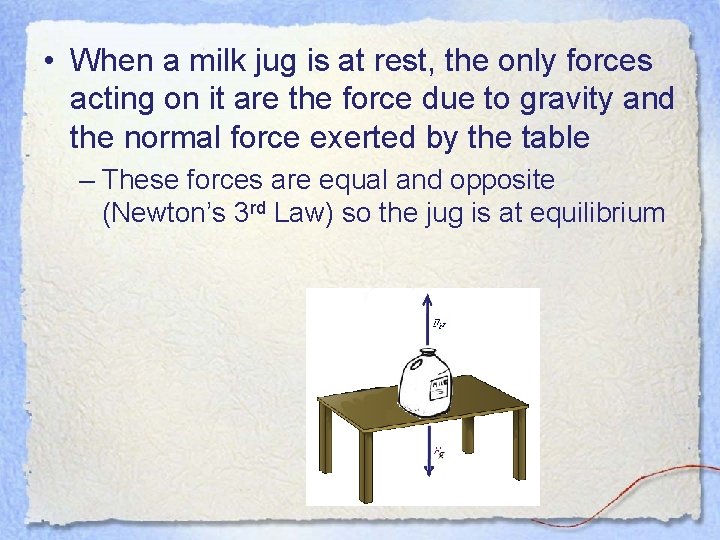
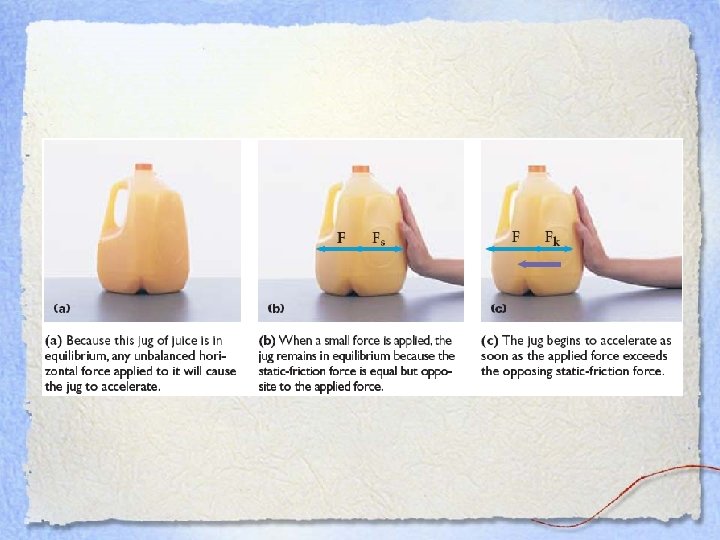
• When a milk jug is at rest, the only forces acting on it are the force due to gravity and the normal force exerted by the table – These forces are equal and opposite (Newton’s 3 rd Law) so the jug is at equilibrium
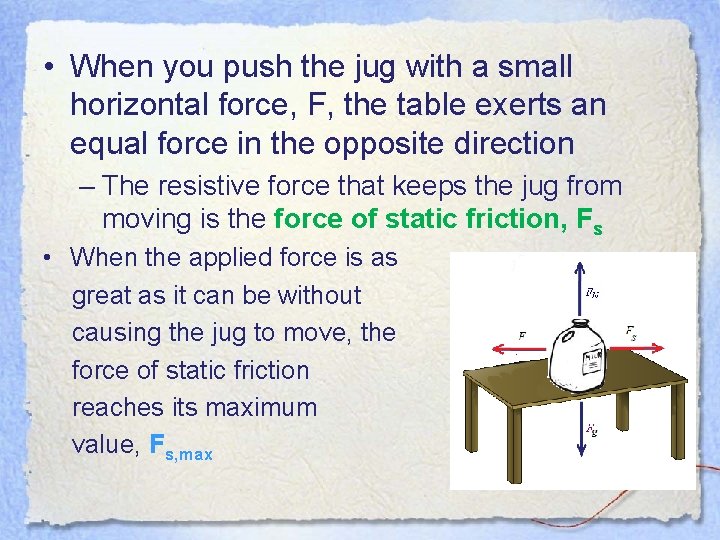
• When you push the jug with a small horizontal force, F, the table exerts an equal force in the opposite direction – The resistive force that keeps the jug from moving is the force of static friction, Fs • When the applied force is as great as it can be without causing the jug to move, the force of static friction reaches its maximum value, Fs, max
Kinetic Friction • When the applied force exceeds the maximum static friction (Fs, max), the jug begins to move with an acceleration – A frictional force is still acting on the jug as the jug moves, but the force is less than maximum (Fs, max) • The frictional force on an object in motion is called the force of kinetic friction, Fk
Friction and the Normal Force • The magnitude of the force of friction is approximately proportional to the magnitude of the normal force that the surface exerts on an object • A heavier object would experience a greater normal force and therefore greater friction
Calculating Friction • The force of friction depends on the mass of the object as well as the composition of the surfaces in contact • The quantity that expresses the dependence of frictional forces on the particular surfaces in contact is called the coefficient of friction – Represented by the Greek letter mu (μ)
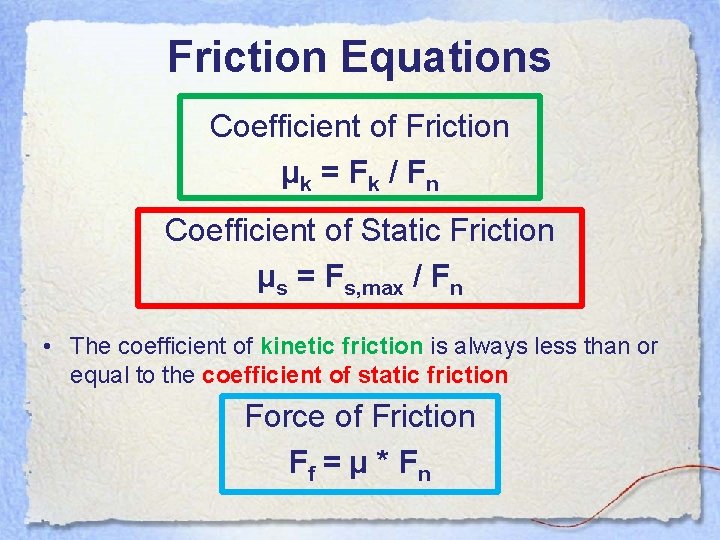
Friction Equations Coefficient of Friction μk = F k / F n Coefficient of Static Friction μs = Fs, max / Fn • The coefficient of kinetic friction is always less than or equal to the coefficient of static friction Force of Friction Ff = μ * F n
Air Resistance • Air resistance (FR)is a form of friction – At low speeds FR is roughly proportional to an object’s speed – At higher speed FR is roughly proportional to the square of the object’s speed • When the upward force of air resistance balances the downward gravitational force, the net force is zero – The object continues to move with a constant maximum speed known as terminal velocity