
Forces and Stresses Forces and stresses are part
- Slides: 9
Forces and Stresses Forces and stresses are part of our everyday lives Products are designed to cope with these forces Some products can use these forces and stresses to their advantage
Forces and Stresses • Forces can act on objects in different ways • They can cause products and materials to break or change shape • A material is said to be Strong if it is good at withstanding a force without breaking • Force is measured in Newtons (N) • Stress is Force per unit area, measured in N/m 2
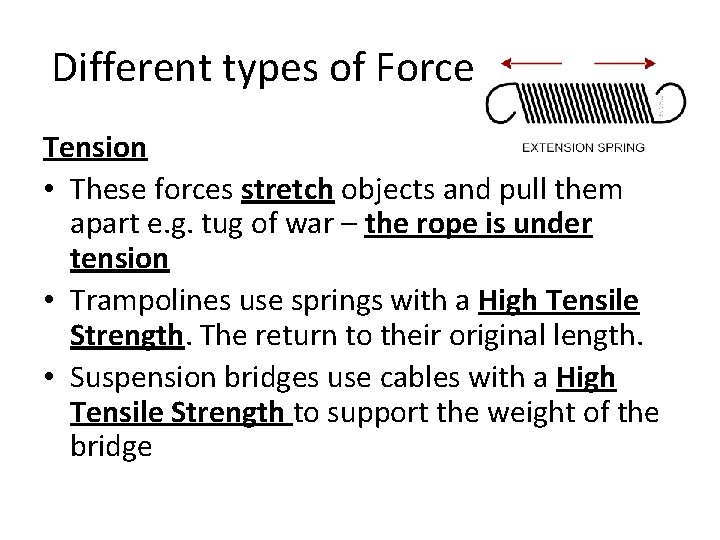
Different types of Force Tension • These forces stretch objects and pull them apart e. g. tug of war – the rope is under tension • Trampolines use springs with a High Tensile Strength. The return to their original length. • Suspension bridges use cables with a High Tensile Strength to support the weight of the bridge
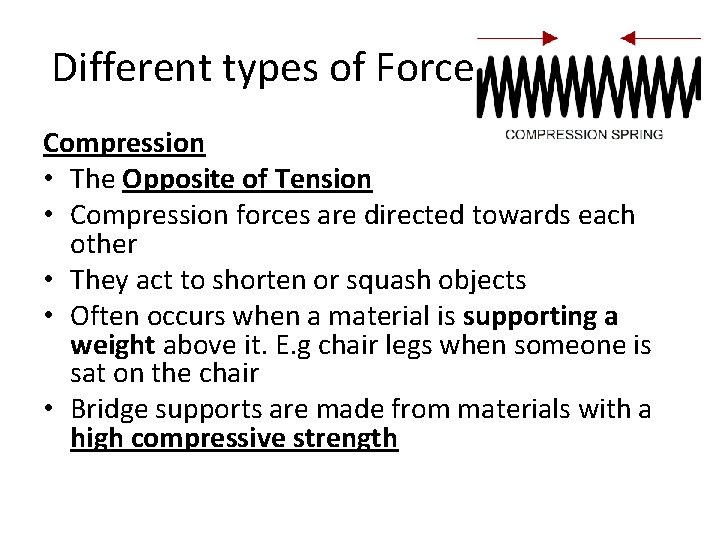
Different types of Force Compression • The Opposite of Tension • Compression forces are directed towards each other • They act to shorten or squash objects • Often occurs when a material is supporting a weight above it. E. g chair legs when someone is sat on the chair • Bridge supports are made from materials with a high compressive strength
Tension and Compression in a Suspension Bridge
Different types of Force Shear • Often act in opposite directions but unlike compressive forces they aren’t aligned • Scissors use shear forces to cut (shear) materials • Industrial cutting machines such as guillotines and die cutters use shear forces to cut materials
Different types of Force Bending • A bending force is a type of shear force • Occurs when a load is applied to a part of a material • A bench has to resist bending when someone sits in the middle of it
Different types of Force Torsion • Torsion acts to twist objects and materials • Forces act to rotate different parts of an object in opposite directions • Propeller shafts and drive shafts have to be able to resist torsion to allow them to transfer rotary motion without breaking
Task and Testing our understanding • Read P 37 in your blue book • Complete the questions on P 34 and 35 in your white question book.